What Is Human-Centered Design? HCD Process, Real Examples & Why Most Teams Get It Wrong
Vincent読了 11 分 ·
Human-centered design (HCD) is a problem-solving approach that starts with real human needs, behaviors, constraints, and context—not with a predetermined solution. Teams use research to understand the problem, then prototype, test, measure, and iterate before making expensive product or design decisions.
The problem is that many teams claim to be human-centered while still relying on assumptions, stakeholder opinions, late-stage research, or solutions chosen before the real problem is clear. AI increases that risk: teams can create more concepts faster with AI design tools, but producing the wrong solution faster is still solving the wrong problem.
Virse supports a more human-centered AI design workflow by keeping exploration, context, iteration, and creative judgment connected. Its infinite canvas, shared project context, multiple collaborating Agents, long-term memory, and style continuity help professional designers explore more possibilities without reducing design to one-prompt generation—so AI accelerates execution while humans remain responsible for defining the problem and deciding what should be built.
What Is Human-Centered Design and What Makes Design Human-Centered?
A design becomes human-centered when the people affected by it influence both how the problem is understood and how the solution evolves.
ISO 9241-210 defines human-centred design as an approach applied throughout the lifecycle of interactive systems. NIST similarly emphasizes understanding users, tasks, and environments; involving people throughout design and development; evaluating solutions with users; iterating; considering the whole experience; and bringing together multidisciplinary perspectives.
HCD Starts With Evidence, Not Assumptions
A conventional product workflow often looks like this:
Idea → requirements → development → launch → feedback → rework
HCD changes the order:
Research → problem definition → concepts → prototypes → testing → delivery → measurement
That change matters because research can reveal that the original problem statement is wrong before expensive engineering and operational decisions accumulate.
Across practitioner discussions and recurring product questions, one failure pattern appears repeatedly: teams talk extensively about customers without regularly interacting with them. Personas, journey maps, workshops, and stakeholder meetings can support HCD, but they do not replace evidence about real behavior.
HCD Goes Beyond Interface Design
HCD can improve an interface, but it can also address the environment, service, workflow, organization, or system around it.
A hospital experience may involve physical spaces, caregivers, appointment systems, communication, anxiety, and digital tools. An AI design workflow may involve references, creative direction, generation, revision, collaboration, brand consistency, and approvals.
The unit of design is the human experience, not necessarily the screen.
How Does the Human-Centered Design Process Work?
Different organizations use different HCD frameworks. HBS uses Clarify, Ideate, Develop, Implement. UNDP uses Empathize, Define, Ideate, Prototype, Test. Digital.gov organizes HCD around Discovery, Design, Delivery, Measurement.
The terminology varies, but the underlying design workflow is similar
Understand People and Context
Start by investigating what people actually do.
Methods can include interviews, observation, usability testing, support analysis, behavioral data, diary studies, and field research. The goal is not simply to collect feature requests. Teams look for tasks, motivations, workarounds, frustrations, environmental constraints, and differences between what people say and what they do.
Define the Real Problem
Research should improve the question.
"We need an AI Agent" is a solution statement.
"Design teams lose time maintaining style consistency and coordinating revisions across fragmented tools" describes a problem that could support many possible solutions.
Good HCD separates the human problem from the first proposed implementation.
Explore Multiple Solutions
Teams then generate several possible approaches rather than polishing the first idea too early.
HBS frames strong innovation around three questions: Is it desirable for people? Is it feasible to build? Is it viable as a business?
A successful product needs all three.
Prototype Before Expensive Development
A prototype is primarily a learning tool.
It can be a sketch, storyboard, interactive prototype, simulated service, AI-generated concept, manual workflow, or physical model.
The objective is to make assumptions testable while they are still inexpensive to change.
Test, Measure, and Iterate
Testing should help a team learn, not prove that an existing decision is correct.
Observe where people hesitate, misunderstand, abandon tasks, create workarounds, or behave differently from expectations. After launch, continue measuring whether the solution actually improves the original problem.
HCD is therefore a continuous learning cycle, not a phase that ends when a product ships.
What Are the Core Human-Centered Design Principles?
HCD depends on team behavior as much as methodology.
Understand Users, Tasks, and Environments
People cannot be separated from the context in which they use a product.
A workflow that succeeds at a desk may fail in a hospital, factory, warehouse, or high-pressure service environment. Context changes attention, available time, physical interaction, risk, accessibility, and decision-making.
Involve People Throughout the Process
Human involvement should not be limited to a final usability test.
Research can change problem framing. Prototypes can expose false assumptions. Post-launch evidence can uncover adoption barriers that were invisible before release.
Teams should also include diverse perspectives and people with different abilities, environments, and constraints when those differences affect the experience.
Treat Designs as Hypotheses
One useful HCD principle is simple:
The current design is a hypothesis, not a conclusion.
This is especially important in AI-assisted design. Generative systems can produce polished concepts quickly, but visual quality is not evidence that the underlying solution is correct.
Human-Centered Design Examples and Case Studies
The strongest HCD cases show how human insight changed a decision.
Oral-B: Observation Revealed an Unspoken Need
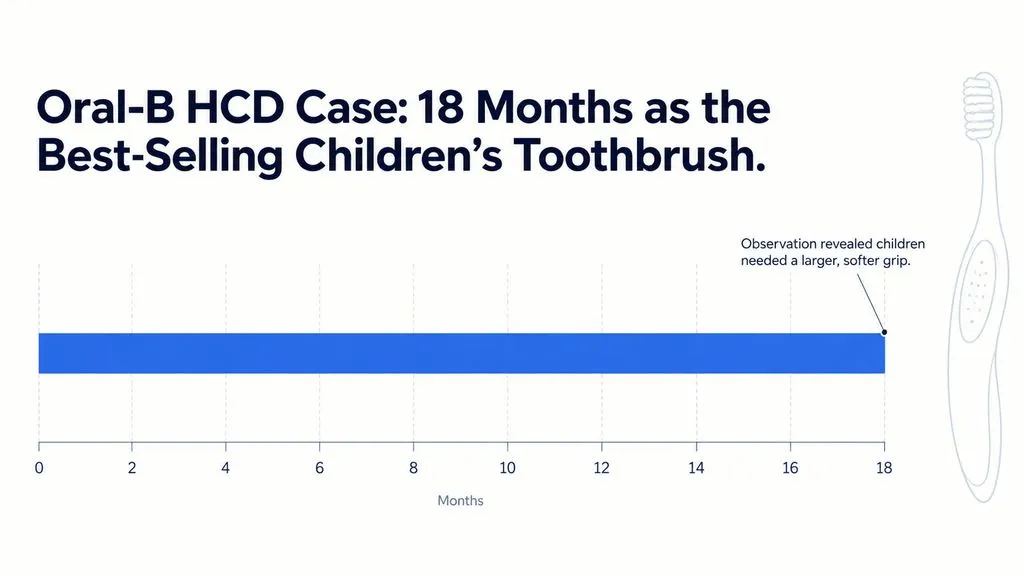
When Oral-B asked IDEO to design a children's toothbrush, the obvious solution was a smaller adult toothbrush.
Instead, designers observed children brushing their teeth and found that they lacked the dexterity required to comfortably grip thin handles. The resulting design used a larger, softer grip.
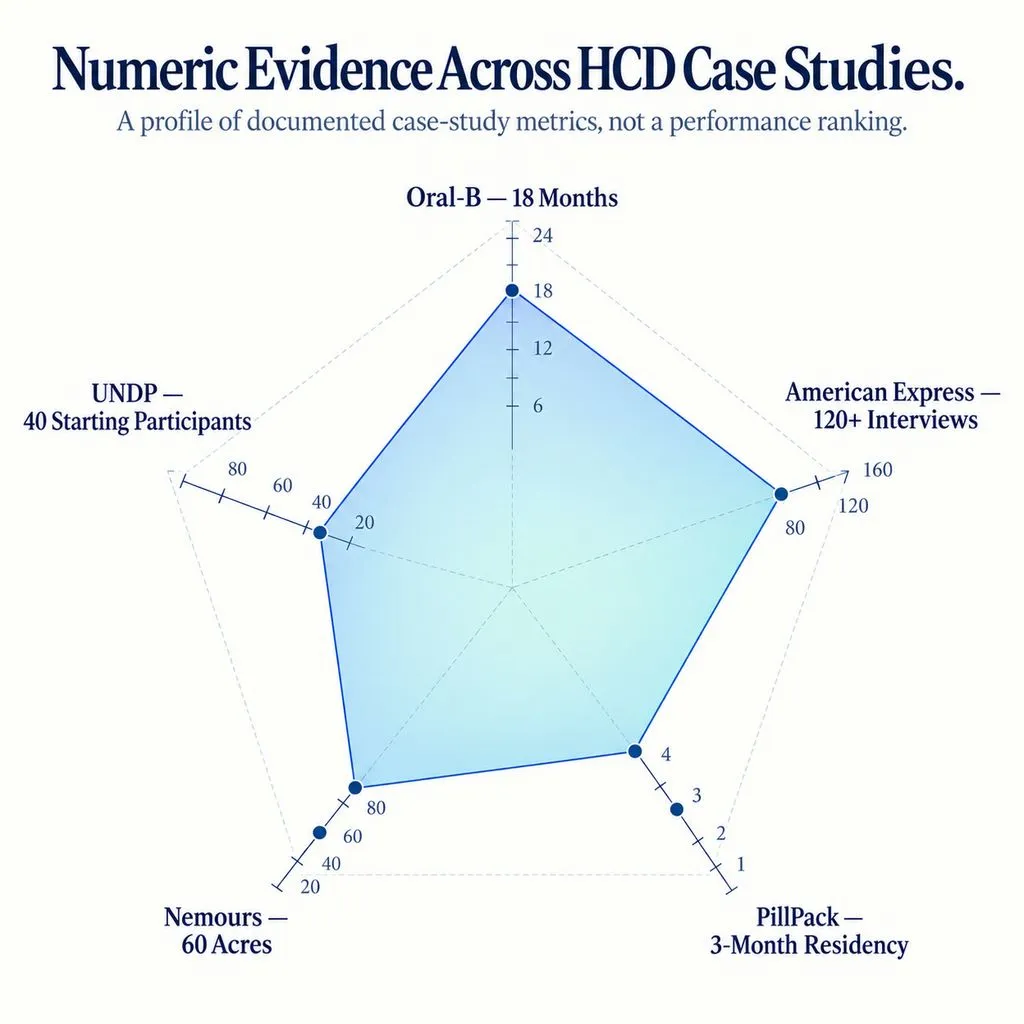
According to the HBS case, Oral-B reported that the design became the world's best-selling children's toothbrush for 18 months.
The lesson is clear: behavioral observation can reveal needs people may never express as product requirements.
American Express: 120+ Interviews Led to Nearly $4 Billion in Purchases
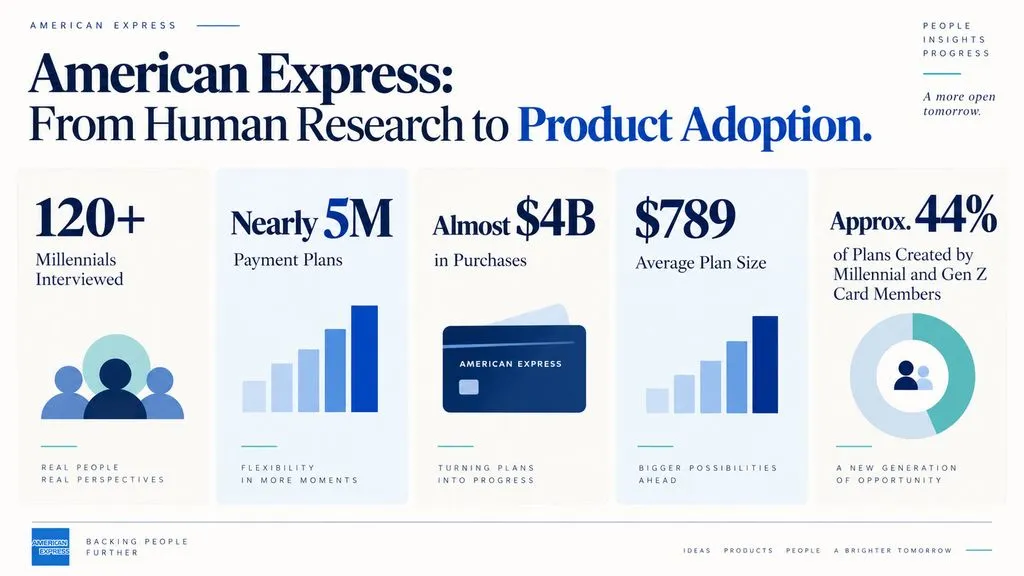
American Express and IDEO interviewed more than 120 millennials about credit, spending, borrowing, and payment behavior.
Research uncovered anxiety around large monthly bills and a desire for greater transparency and control. These insights helped shape Pay It Plan It.
After launch, customers created nearly 5 million payment plans totaling almost $4 billion in purchases, with an average plan size of $789. Millennial and Gen Z Card Members accounted for approximately 44% of those plans.
The important point is that research did not simply improve an interface. It changed the value proposition around the human problem customers were trying to manage.
PillPack: Design the Entire Task, Not One Screen
PillPack approached medication management as an end-to-end experience rather than only a pharmacy website.
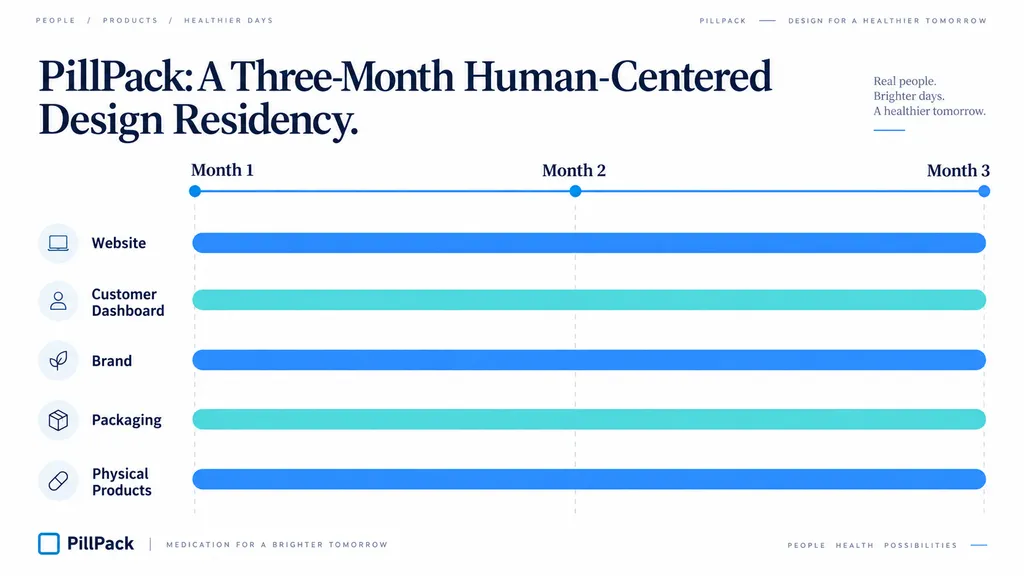
Medications were organized into personalized packets labeled by date and time, supported by physical packaging, digital tools, delivery, and pharmacist access. During a three-month IDEO residency, the team worked across the website, dashboard, brand, packaging, and physical products.
The HCD lesson is to design around the complete human task when the problem crosses digital and physical touchpoints.
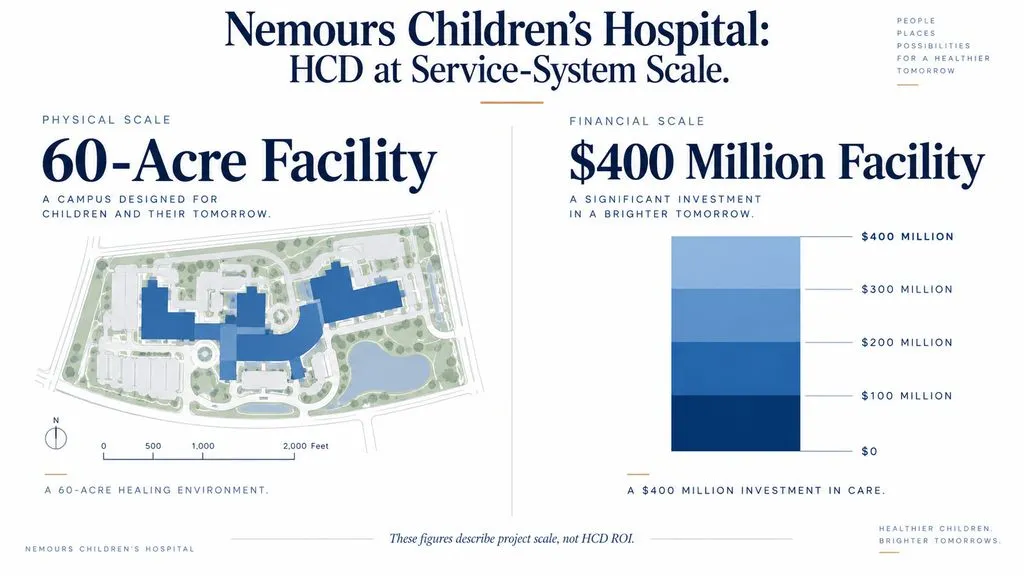
Nemours Children's Hospital: HCD at Service-System Scale
Nemours applied patient- and family-centered thinking while developing its children's hospital in Orlando.
The project involved key touchpoints across the healthcare journey and resulted in a 60-acre, $400 million facility.
The size of the investment is not evidence that HCD caused the outcome. What the case demonstrates is that human-centered thinking can shape services, environments, processes, and infrastructure—not only interfaces.
UNDP: HCD Beyond Commercial Products
UNDP has applied HCD to social innovation involving communities, institutions, and multiple stakeholders.
Its Youth Leadership Programme began with 40 participants from 18 Arab countries in 2015 and grew across subsequent cycles. By the end of 2019, UNDP reported more than 20,000 youth participants across five cycles.
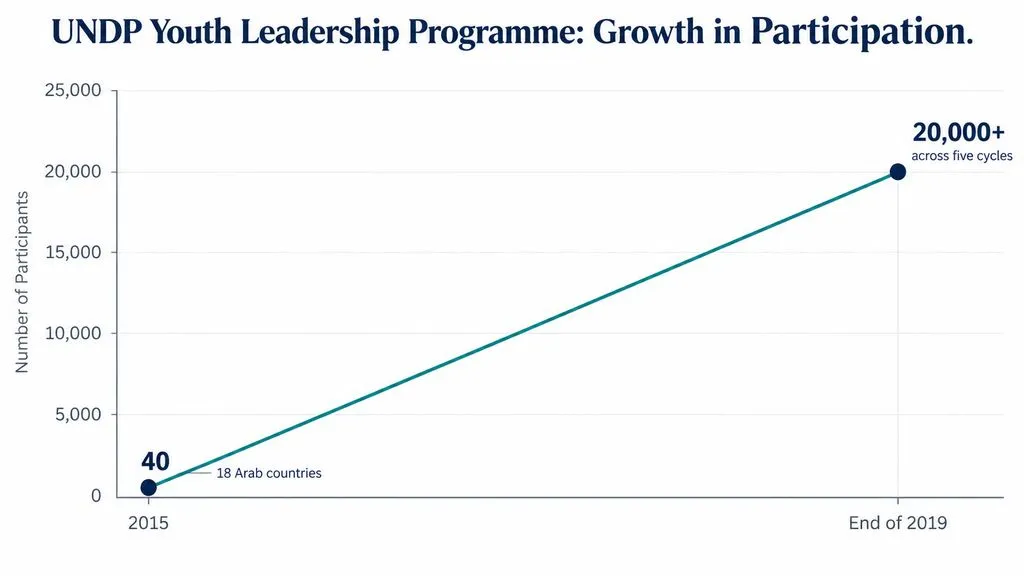
This broader application shows that HCD can operate at the level of products, services, communities, organizations, and systems.
HCD vs DT vs UCD vs UX: What Is the Difference?
These concepts overlap, but they emphasize different aspects of design practice.
HCD vs DT
HCD is the broader human-centered orientation, while DT is commonly used as a structured approach for exploring problems and testing solutions.
DT methods such as empathy research, ideation, prototyping, and testing can operate within an HCD approach.
HCD vs UCD
UCD usually focuses more specifically on defined users and their interaction with a product or system. HCD can use a wider lens, including employees, service providers, communities, physical environments, and indirect stakeholders.
HCD vs UX
UX focuses on the experience people have with a product or service. HCD can include UX but extends further into problem definition, research, implementation, organizational processes, and system-level effects.
The practical issue is less about choosing the perfect label and more about whether real human evidence can change decisions.
Why Does Human-Centered Design Fail in Product Teams?
HCD often fails because of organizational behavior rather than a missing technique.
Teams Replace User Research With Internal Knowledge
Founders, product managers, sales teams, and domain experts may know a market extremely well, but internal expertise is still different from observing real behavior.
A team can become highly sophisticated at discussing customers while reinforcing assumptions that have never been tested.
Research Happens Too Late
If meaningful research starts when development is nearly complete, teams can change interface details but may struggle to change the underlying strategy without expensive rework.
Discovery works better when product, design, research, and engineering participate before major commitments are made.
Teams Validate Instead of Learn
"Do you like this feature?" produces weaker evidence than observing whether the feature fits existing behavior.
Adoption can be blocked by existing habits, migration effort, approvals, integrations, risk, or lack of urgency. A product can be cheaper, more attractive, and more feature-rich while still failing to create enough reason for people to switch.
How Can HCD Improve AI and Product Development?
AI reduces the cost of producing possible solutions. That makes strong problem selection even more important.
Use AI to Expand Exploration, Not Replace Research
AI can accelerate moodboards, concepts, interface variations, prototypes, visual assets, and production work.
A stronger sequence is:
Human research → problem framing → AI-assisted exploration → prototype → human evaluation → iteration → production
AI expands the solution space. Human research determines whether that solution space is worth exploring.
Design AI Around Human Workflows
Professional designers rarely need generation in isolation. They need context, iteration, collaboration, design consistency, control, and continuity.
That is also where Virse's product philosophy fits naturally. Its canvas-based workflow, shared context, multiple Agents, and long-term memory are designed to support professional creative processes rather than reduce design to a single prompt.
How Do You Measure Human-Centered Design Success?
There is no universal HCD ROI metric. Measurement should connect directly to the original human problem.
Measure Human Success
Useful signals may include task completion, errors, time on task, accessibility issues, satisfaction, usability findings, and support needs.
Measure Adoption and Behavior Change
A usable product can still fail if people do not adopt it.
Teams may examine activation, repeat use, abandonment, feature adoption, retention, support demand, migration behavior, and continued reliance on old workarounds.
Measure Business and System Outcomes
Depending on the product, useful measures can include conversion, operational time, cost-to-serve, rework, retention, or support burden.
Measurement should feed back into discovery. If behavior does not change as expected, the team may need to revisit the problem itself, not only improve the interface.
FAQ
Is HCD the same as UX?
No. UX focuses on the experience people have with a product or service. HCD is broader and can include research, problem definition, UX, services, physical environments, organizational processes, implementation, and measurement.
How is HCD different from DT?
HCD is generally the broader people-centered approach, while DT provides structured methods for problem solving and experimentation. They overlap heavily in practice, so the quality of research and human involvement matters more than terminology.
Can a team use HCD without direct user research?
A team can apply some HCD principles without continuous formal studies, but rarely interacting with affected people creates an evidence gap. Interviews, observation, prototype testing, behavioral evidence, support data, and post-launch research help prevent assumptions from replacing human understanding.
How do you measure HCD success?
Measure outcomes connected to the original problem. These may include task success, errors, satisfaction, accessibility, adoption, repeat use, support demand, retention, operational efficiency, or business outcomes. Measurement should continue after launch and inform the next design cycle.
Conclusion
Human-centered design is best understood as a discipline for making better decisions about people, not as a fixed workshop or five-step diagram. Oral-B showed how observation can uncover needs people struggle to articulate; American Express connected more than 120 interviews to a service later used for nearly $4 billion in purchases; PillPack redesigned an end-to-end medication experience; Nemours applied HCD at hospital scale; and UNDP extended the approach into large social programs. Across these cases, the pattern is consistent: understand people before committing to a solution, make assumptions testable, prototype early, measure real behavior, and keep iterating. As AI makes design execution faster, that human-centered loop becomes more valuable because producing the wrong solution faster is still solving the wrong problem.