Wan 3.0 vs Seedance 2.5: Quality, Pricing & Best Uses
 Yifan Zhao10 min de lectura ·
Wan 3.0 is worth testing first for reference-led scenes and document-based workflows; Seedance 2.5 deserves priority testing for complex cinematic shots and emotional performances. Published comparisons support these starting points, but the better choice is the model that preserves your required details at an acceptable total production cost.
A promising clip becomes expensive when faces drift, products change shape, or revisions undo approved details. Compare both models on a representative shot and count retries and repairs—not just the advertised generation price. The result that matters is footage you can actually use.
Start exploring with Virse’s signup credits, then choose a paid plan when you need more creative freedom. Paid plans offer unlimited use across a broad selection of included models and unlimited seats, giving your team more room to explore visual directions and collaborate without an additional seat charge for every contributor.
Wan 3.0 vs Seedance 2.5: Key Differences
Wan’s documentation establishes concrete generation settings and source-material options. Seedance’s official introduction emphasizes audiovisual storytelling, reference interpretation, and editing. These capabilities establish what you can request, not how reliably each result will meet your brief.
Dimension | Wan 3.0 | Seedance 2.5 |
|---|---|---|
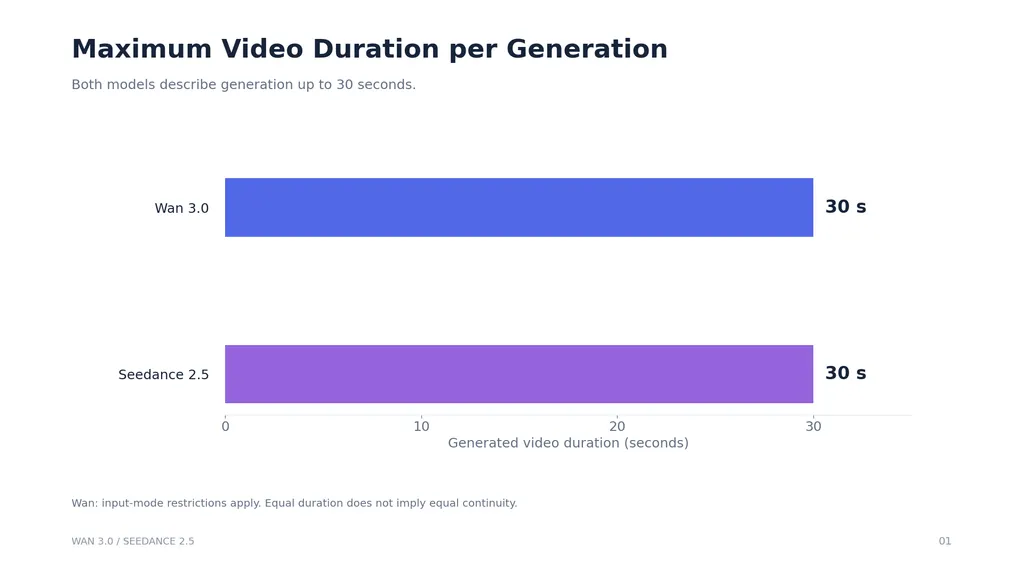
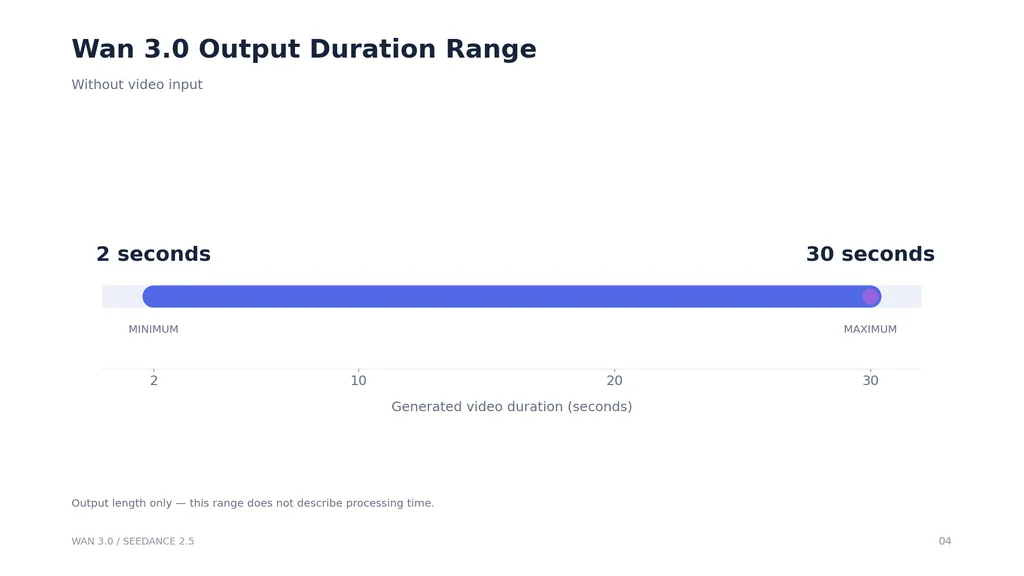
Single-generation duration | 2–30 seconds without video input | Up to 30 seconds |
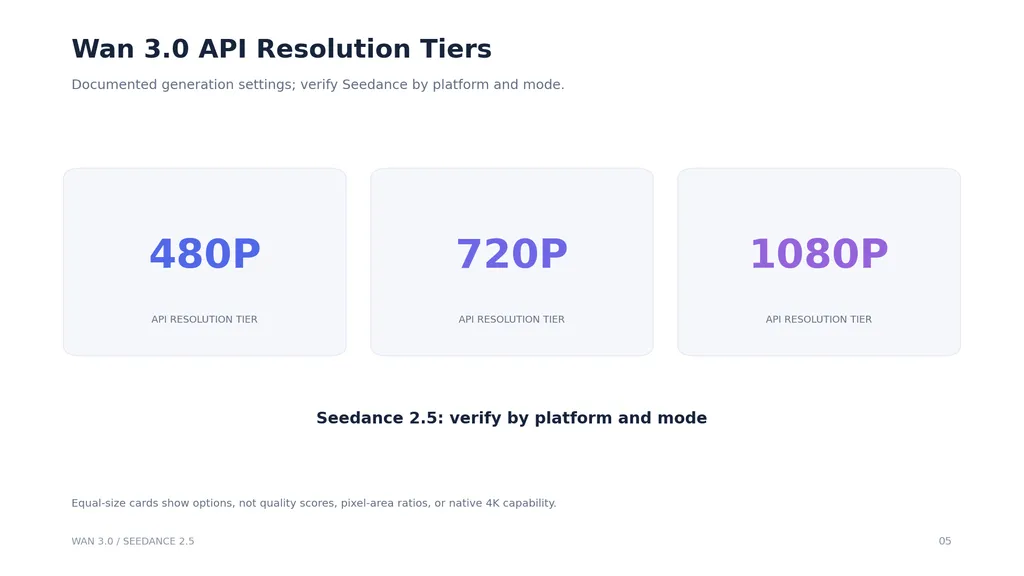
Resolution | API lists 480P, 720P, and 1080P | Verify the selected platform and mode |
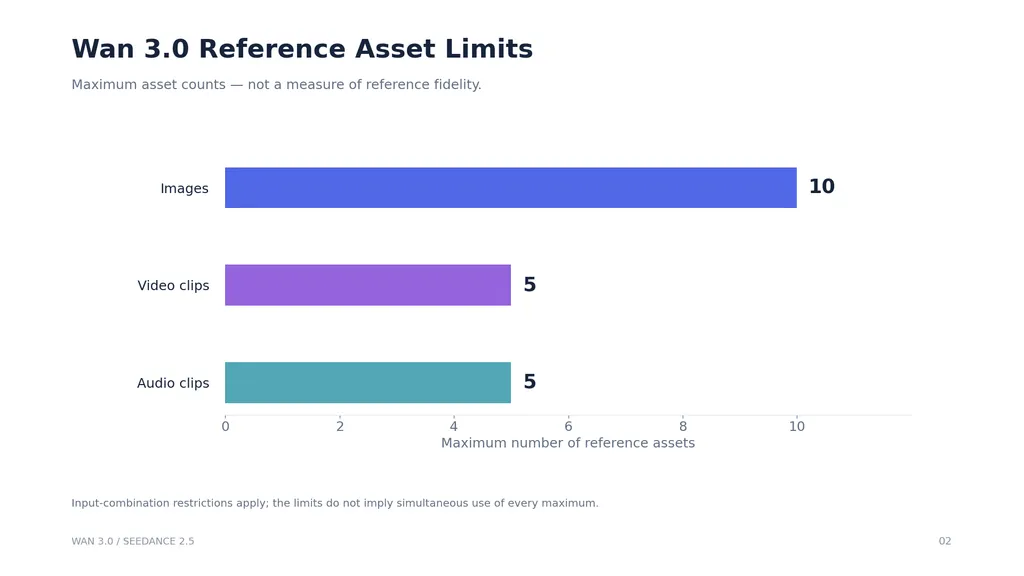
References | Up to 10 images, 5 videos, and 5 audio clips, subject to combination rules | Audiovisual references; verify channel limits |
Documents and webpages | Documented file and public-webpage inputs | Equivalent limits not established in the reviewed official material |
Production controls | First-frame, last-frame, and reference-based modes | Audiovisual editing, white-model control, and green-screen editing |
Main evaluation priority | Asset fidelity and source-material handling | Performance, compositing, and editing control |
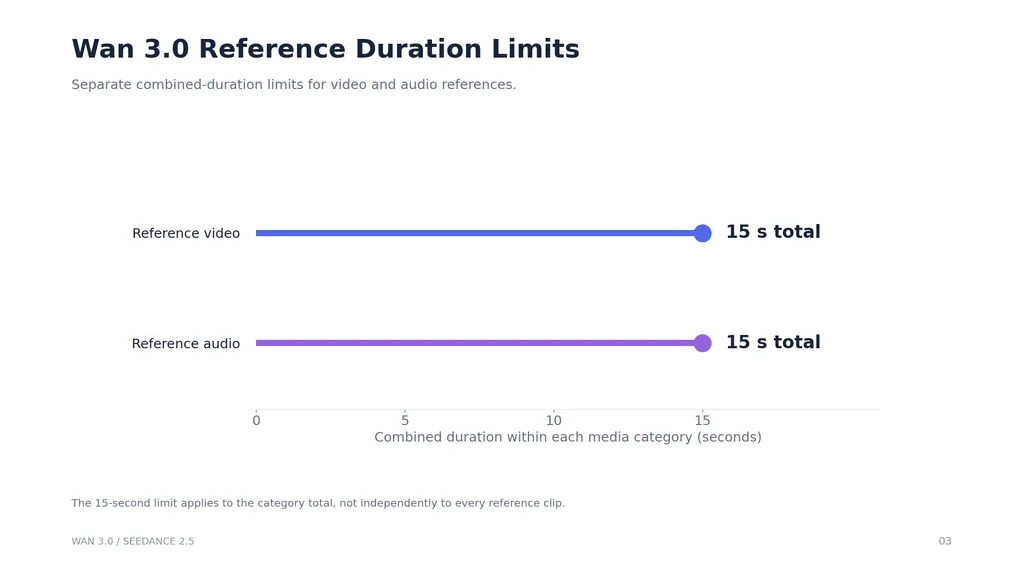
Wan limits reference video and audio to 15 seconds combined per media category. With video input, combined input and output duration cannot exceed 30 seconds.
Choose the Platform Before Comparing Features
Wan is documented through Alibaba Cloud Model Studio. Seedance’s official page directs users toward Dola and BytePlus Playground/API access. Confirm account eligibility, regional availability, and available controls before committing.
Record the provider, model identifier, mode, and date. Different interfaces can expose different settings, so a model name alone is insufficient for a reproducible comparison.
Wan 3.0 vs Seedance 2.5 Video Quality: What the Cases Show
Our research found useful scene comparisons in Curious Refuge’s published review. Its results suggest different strengths, but its selected examples do not establish a repeatable success rate.
Reference Fidelity: The Antique-Market Case
The review constructed an antique market using character sheets, location and layout references, and supporting props. Both models incorporated source elements, but the reviewers preferred Wan because Seedance introduced more creative liberties and noticeable artifacts.
For asset-led production, that distinction matters. An attractive reinterpretation can fail when it changes required objects.
Label each reference as mandatory or interpretive. Product shape and wardrobe may be fixed; lighting may allow creative freedom. Score fidelity separately from visual appeal.
Action and Compositing: Alien Chase and Asteroid Cases
The alien-chase example favored Seedance’s lighting and character integration. The asteroid example also favored its overall effects integration, despite some convincing individual effects from Wan.
The lesson is to inspect relationships between elements: contact shadows, movement, scale, and environmental lighting. A detailed character can still look disconnected from the scene.
Success with a relatively static reference scene does not establish reliability during complex action. Test the movement your project actually requires.
Emotional Performance: The Café Conversation
In the café dialogue case, the reviewers found persuasive emotion in Wan’s facial performance, alongside background continuity and skin-rendering problems. They preferred Seedance’s overall emotional result.
Evaluate both acting and continuity. An expressive close-up may become unusable if the next shot changes background geometry or character appearance.
These cases justify testing Seedance early for demanding narrative work. They do not prove it will outperform Wan on every prompt.
Wan 3.0 vs Seedance 2.5 Pricing: Compare Approved Footage
This comparison does not establish a verified, equivalent-setting price winner. Seedance 2.5 provider quotes, resolution, inputs, discounts, and billing rules must match before a price ratio becomes meaningful.
Compare Equivalent Generation Quotes
Pricing condition | Record before comparing |
|---|---|
Service | Provider, model, and mode |
Output | Duration, resolution, aspect ratio, and audio |
Inputs | Reference media and associated charges |
Billing | Failed-generation policy and credit conversion |
Timing | Quote date and applicable discounts |
Avoid comparing an entry-level quote with a higher-resolution or differently configured generation.
Also distinguish generation duration from turnaround time. Queueing and review can affect delivery schedules even when the direct charge is acceptable.
Calculate Cost per Approved Second
Cost per approved second = generation charges plus attributable repair labor cost, divided by approved output seconds.
Count every attempt, but count selected footage only once. Keep charges and labor visible separately so the source of expense remains clear.
A lower-priced generation wins economically when it meets the brief with manageable rework. A higher-priced option can justify its cost when it reduces rejection or repair sufficiently.
Track failure categories. Product distortion, identity drift, incorrect dialogue, and background changes require different solutions; the cheapest response is not always another identical attempt.
Wan vs Seedance Resolution, References, and Audio
Resolution, reference fidelity, and audio accuracy answer different production questions. Do not combine them into a single quality score that hides a mandatory failure.
1080p and 4K: Separate Generation from Export
Wan’s API lists 480P, 720P, and 1080P. Reviewed Seedance materials describe different output capabilities across products and channels, so this article does not assign it a universal resolution ceiling.
Check three things: requested generation tier, subsequent enhancement, and downloaded dimensions.
A 4K export does not by itself establish native 4K generation. Inspect fine detail during movement, particularly packaging text, facial features, and object edges. Larger dimensions cannot repair changing geometry.
Reference Capacity Is Not Reference Accuracy
More references provide additional instruction capacity, but do not measure adherence.
Assign each asset a role: identity, wardrobe, product, setting, motion, or style. Remove conflicting examples and state which details must remain unchanged.
For product footage, inspect shape and materials throughout the clip. For characters, inspect identity during turns and expressions. The opening frame is only the first checkpoint.
Audio and Lip Sync Require Version-Specific Evidence
The published singing comparison contains an important boundary: its Seedance example uses version 2.0, not 2.5. It cannot establish a Seedance 2.5 lip-sync victory.
Test dialogue, singing, and environmental sound separately. Review mouth timing, speaker assignment, requested wording, and source-audio preservation.
Audio generation and faithful reproduction are different tasks. A plausible new performance may still fail when the brief requires an exact recording.
Wan 3.0 vs Seedance 2.5: Practical Production Workflows
Choose according to the material you have and the decisions you need to preserve. Workflow suitability can matter as much as the best-looking sample.
Wan for Documents and Product Briefs
Wan documents support for formats including PDF, PowerPoint, Word, spreadsheets, and Markdown. It permits one file or one webpage link, with those inputs mutually exclusive.
For a product-concept video, extract mandatory facts before generation: features, dimensions, materials, and prohibited claims. Check the output against that list.
Accepting a document does not establish factual accuracy. Inspect numbers, diagrams, and technical relationships independently from visual quality.
Seedance for Controlled Revisions
Seedance’s official positioning includes audiovisual editing and production controls. Confirm their availability in the interface you plan to use.
Begin with an approved clip and request one specific change. If lighting changes, inspect identity, wardrobe, camera behavior, and background afterward.
A successful revision changes the target while preserving approved decisions. Judge unwanted changes outside the target as part of editing quality, rather than accepting any attractive replacement.
The Multi-Tool Character-Trailer Case
Our research identified a creator-reported trailer of approximately one minute combining Seedance 2.5, Suno V6, Filmora, and existing 3D character assets.
The example illustrates a production chain: reusable assets establish identity, generated clips provide footage, and editing assembles the sequence. It does not establish measured time savings, revenue, or generation success rates.
Keep scripts, source assets, and approved references portable. This allows a difficult shot to move between tools without rebuilding its creative context.
How to Test Wan 3.0 vs Seedance 2.5 Fairly
Compare shared capabilities first, then test distinctive features separately. This distinguishes execution quality from workflow advantages.
Define Acceptance Before Generating
Select representative project shots and identify mandatory requirements: character identity, product accuracy, action, continuity, and audio.
Match source assets, duration, aspect ratio, and comparable output settings. Set a comparable trial budget and retain rejected generations.
Reject mandatory failures before scoring aesthetics. Strong camera movement should not compensate for an altered product.
Review Every Attempt and the Complete Sequence
Record | Decision value |
|---|---|
Platform, model, date, and settings | Identifies what was tested |
References and prompt | Preserves creative conditions |
Attempts and rejection reasons | Reveals reliability |
Charges and repair time | Establishes production cost |
Sequence-level review | Exposes continuity problems |
For an ending-frame continuation, inspect posture, speed, lighting, and background position at the join. A matching still frame does not guarantee continuous movement.
Finally, test the models’ distinctive controls against a real task. Their value comes from solving a production problem, not simply increasing the feature count.
Conclusion
Wan 3.0 is a useful starting point for reference-led scenes and document-based experiments, while Seedance 2.5 merits priority testing for demanding performances, compositing, and controlled editing. Published cases provide direction, but your own acceptance criteria should determine the choice. Select the model that preserves required details and delivers approved footage at a sustainable total cost, then review the assembled sequence before treating individual shots as finished.
FAQ
Which Is Better for Character Consistency: Wan 3.0 or Seedance 2.5?
Neither is established as universally better. The reviewed examples favor Wan in one reference-heavy scene and Seedance in several demanding cinematic scenes. Test identity during movement and across adjacent shots using comparable assets and trial conditions. Retain failures when assessing reliability; a selected best result cannot establish consistency.
How Can I Continue a Video Without the Character Changing?
Use an approved ending frame when the selected interface supports that workflow, alongside consistent identity references. Specify the continuing action and avoid unnecessary new directions. Review the join for posture, speed, lighting, and background changes. Ending-frame guidance provides a starting condition, not a guarantee of seamless movement.
Why Does My Reference Image Get Blocked?
A rejection can reflect the platform’s image policies or processing requirements rather than a generation-quality limitation. Check the displayed reason, accepted formats, and applicable reference rules. The same model may be offered through interfaces with different restrictions. Do not assume an ordinary portrait will be accepted by every service.
Can a Free Video Editor Fix Seams Between Generated Clips?
An editor can trim, overlap, or blend visually compatible clips. It cannot reliably repair changed identity, contradictory movement, or displaced objects. Determine whether the seam is a timing issue or a generation failure. Use editing for compatible transitions and regenerate when the underlying continuity is wrong.
Should I Use Wan or Seedance for a Longer Video?
Plan a longer video as controlled shots with reusable character and scene references. Both official descriptions support generation up to 30 seconds, subject to mode-specific conditions. Check extension options in your chosen platform, then evaluate continuity across the assembled sequence. Maximum clip duration alone does not establish longer-video reliability.