
Qwen Image Edit frente a FLUX.2 Klein 9B: ¿qué editor de imágenes con IA es mejor para uso comercial?
 Yifan Zhao14 min de lectura ·
FLUX.2 Klein 9B suele ser la opción más sólida para flujos comerciales que exigen realismo, conservación de identidad y resultados listos para producción, mientras Qwen Image Edit se adapta mejor a ediciones estructuradas con control preciso y preservación de composición. La elección depende de si el equipo prioriza realismo visual o precisión de edición.
Para los equipos comerciales, editar con IA ya no consiste solo en crear imágenes atractivas. El reto es mantener detalles de productos, identidad humana, coherencia de marca y eficiencia productiva al crear grandes volúmenes de contenido. Las ediciones incoherentes aumentan revisiones manuales, retrasan campañas y generan recursos de marca poco fiables. Muchos equipos exploran flujos de diseño con IA desde el briefing hasta la entrega para mejorar el paso del concepto a la producción final.
Los flujos creativos modernos necesitan más de un modelo de IA. Virse ayuda a combinar capacidades distintas en un entorno colaborativo. Los planes de pago ofrecen más de 40 modelos, incluidos Nano Banana 2 y GPT Image 2, con uso ilimitado y plazas de equipo ilimitadas. Los nuevos usuarios reciben créditos gratuitos para crear 10 imágenes con Nano Banana 2 o un vídeo con Seedance 2.0, facilitando explorar flujos de IA antes de ampliar la producción. Los equipos también pueden comparar soluciones mediante recursos sobre las mejores herramientas de diseño con IA, agentes de diseño con IA para flujos creativos, y cómo usar IA en diseño gráfico.
Al integrar imágenes de IA en la producción comercial, los equipos necesitan sistemas más sólidos para mantener coherencia entre campañas, productos y recursos de marca. Comprender sistemas de diseño, prompts de diseño con IA y flujos creativos estructurados ayuda a crear procesos de producción asistida más fiables.
Qwen Image Edit frente a FLUX.2 Klein 9B: diferencias en edición comercial con IA
La edición con IA ha pasado de simples modificaciones visuales a un reto de producción.
Los profesionales no solo preguntan:
«¿Puede la IA cambiar esta imagen?»
Preguntan:
- ¿Puede preservar el producto original?
- ¿Puede mantener a la misma persona tras editar?
- ¿Puede cumplir los estándares de marca?
- ¿Puede escalar a cientos de recursos?
Un editor útil comercialmente debe equilibrar varias capacidades:
Capacidad | Importancia para edición comercial |
|---|---|
Preservación de identidad | Mantiene coherentes modelos, productos y recursos de marca |
Realismo de materiales | Hace que los productos resulten físicamente creíbles |
Seguimiento de instrucciones | Determina si los cambios pedidos se aplican bien |
Calidad visual | Influye en si los recursos están listos para producción |
Escalabilidad | Determina si se produce contenido con eficiencia |
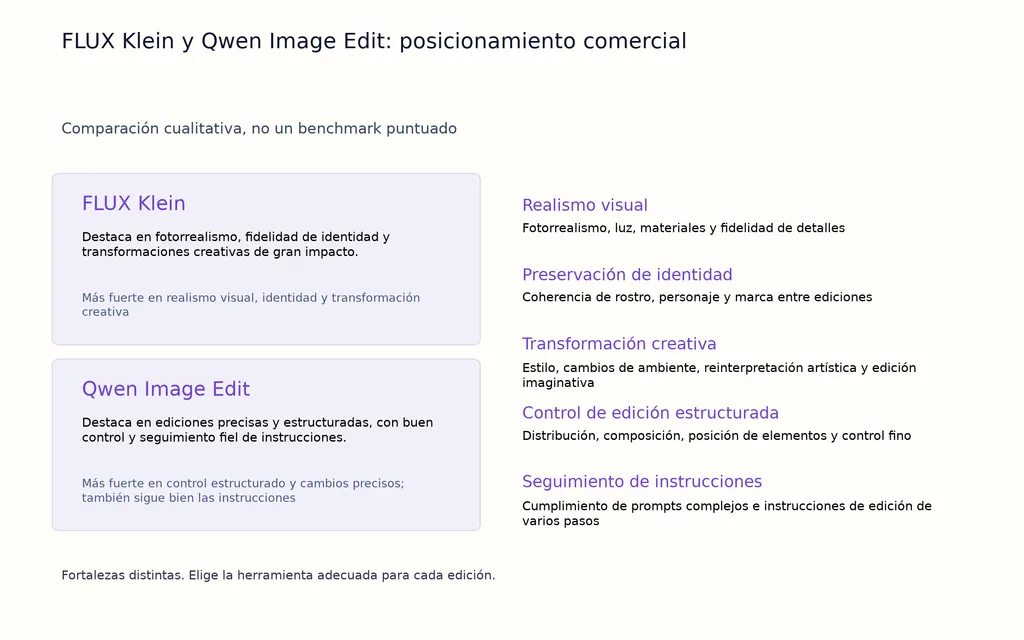
FLUX.2 Klein 9B y Qwen Image Edit se optimizan para prioridades distintas.
FLUX Klein se centra en producción visual realista, mientras Qwen Image Edit prioriza control de edición estructurada y comprensión de instrucciones.
Para las empresas, la mejor pregunta no es «¿qué modelo gana?».
La mejor pregunta es:
¿Qué editor encaja con el problema de flujo que necesitas resolver?
Análisis de FLUX.2 Klein 9B: por qué destaca en edición comercial
FLUX Klein se centra en producción visual comercial realista
La edición comercial tiene estándares distintos de la creación experimental con IA.
Una imagen creativa no es automáticamente un recurso empresarial útil.
Los profesionales necesitan imágenes que parezcan:
- realistas
- fiables
- coherentes
- listas para mostrar al cliente
Esto es especialmente importante para:
- imágenes de productos para ecommerce
- campañas de moda
- visuales publicitarios
- materiales de marketing de marca
Según la investigación comparativa de terceros incluida en nuestro análisis, FLUX Klein destaca cuando se prioriza la calidad visual comercial.
El motivo es práctico.
Los clientes juzgan los productos por detalles visuales:
- reflejos en el vidrio
- textura de la tela
- calidad superficial de materiales
- coherencia de iluminación
Si estos detalles parecen artificiales, la imagen puede fracasar comercialmente aunque la composición sea atractiva.
Desde la perspectiva del diseño con IA, el éxito comercial depende menos de crear imágenes impresionantes y más de crear recursos fiables.
Para procesos creativos repetibles, es cada vez más importante combinar generación realista y producción estructurada. Los flujos con técnicas de diseño gráfico con IA y estrategias eficaces de prompts de diseño con IA ayudan a mejorar la coherencia y reducir ajustes manuales.
Caso: FLUX Klein para editar fotografía de producto
Por qué importa el realismo de materiales en ecommerce
Una de las aplicaciones más valiosas es transformar fotos básicas de productos en imágenes listas para marketing.
Un flujo típico:
Foto original del producto
↓
Edición de escena con IA
↓
Varias versiones de campaña
↓
Revisión humana del diseño
↓
Distribución de marketing
Los ejemplos incluyen:
- productos de cuidado de la piel en ambientes prémium
- relojes en escenas de estilo de vida lujoso
- productos alimentarios adaptados a campañas
En los casos comparativos de terceros incluidos en la investigación, FLUX Klein mostró ventajas en:
- apariencia de materiales
- realismo de iluminación
- calidad fotográfica comercial
Estas ventajas son especialmente valiosas en productos con:
- vidrio
- metal
- cosméticos
- superficies reflectantes
Para el ecommerce, el objetivo no es solo crear un fondo nuevo.
El objetivo es preservar los rasgos del producto que hacen que el cliente confíe en lo que ve.
Una buena imagen de producto debe parecer una fotografía profesional, no un concepto generado por IA.
Por qué se suele preferir FLUX Klein para ecommerce y publicidad
Los equipos necesitan coherencia, no solo creatividad
Un error común es creer que las empresas necesitan una única imagen perfecta de IA.
En realidad, los equipos suelen necesitar:
- decenas de variantes de productos
- varios formatos de campaña
- recursos de marketing estacionales
- versiones de contenido localizadas
El reto es mantener:
- exactitud del producto
- identidad de marca
- coherencia visual
FLUX Klein encaja bien cuando el resultado debe parecer fotografía profesional.
Las aplicaciones habituales incluyen:
- visuales de productos para ecommerce
- campañas publicitarias
- imágenes de marketing de estilo de vida
- contenido de marca para redes sociales
Pero el realismo es solo una parte de la edición comercial.
Algunos flujos necesitan otra fortaleza:
controlar con precisión qué cambia y qué no.
Ahí es donde Qwen Image Edit resulta competitivo.
Análisis de Qwen Image Edit: ventajas de la edición estructurada con IA
Qwen Image Edit se centra en modificaciones controladas
No toda edición comercial exige una transformación visual drástica.
Muchos flujos profesionales exigen precisión.
Ejemplos:
- sustituir solo el fondo
- eliminar un objeto
- cambiar un elemento del producto
- preservar la distribución original
- mantener la composición existente
Estas tareas exigen seguir bien las instrucciones.
Nuestro análisis de conversaciones sobre diseño con IA muestra que muchos equipos tienen menos problemas generando ideas que controlando las revisiones.
El reto es:
«Cambia exactamente lo que pedí, pero no modifiques todo lo demás».
Qwen Image Edit encaja mejor cuando se prioriza:
- modificaciones estructuradas
- preservación de composición
- edición basada en referencias
- cambios controlados
Análisis de benchmarks: por qué distintas pruebas dan distintos ganadores
Las comparaciones suelen medir capacidades distintas
Una razón de la aparente incoherencia entre comparaciones es que las evaluaciones se centran en objetivos distintos.
Un modelo puede rendir mejor en una categoría y peor en otra.
La investigación incluye dos enfoques comparativos:
Evaluación centrada en calidad visual
Estas evaluaciones priorizan:
- realismo
- calidad fotográfica
- detalles de materiales
- apariencia comercial
En estos escenarios, FLUX Klein suele destacar.
Evaluación centrada en inteligencia de diseño
Estas evaluaciones priorizan:
- comprensión de prompts complejos
- renderizado de texto
- tareas de diseño estructuradas
- organización de información
En estas áreas, los modelos Qwen Image muestran ventajas.
Comparación de benchmarks de edición
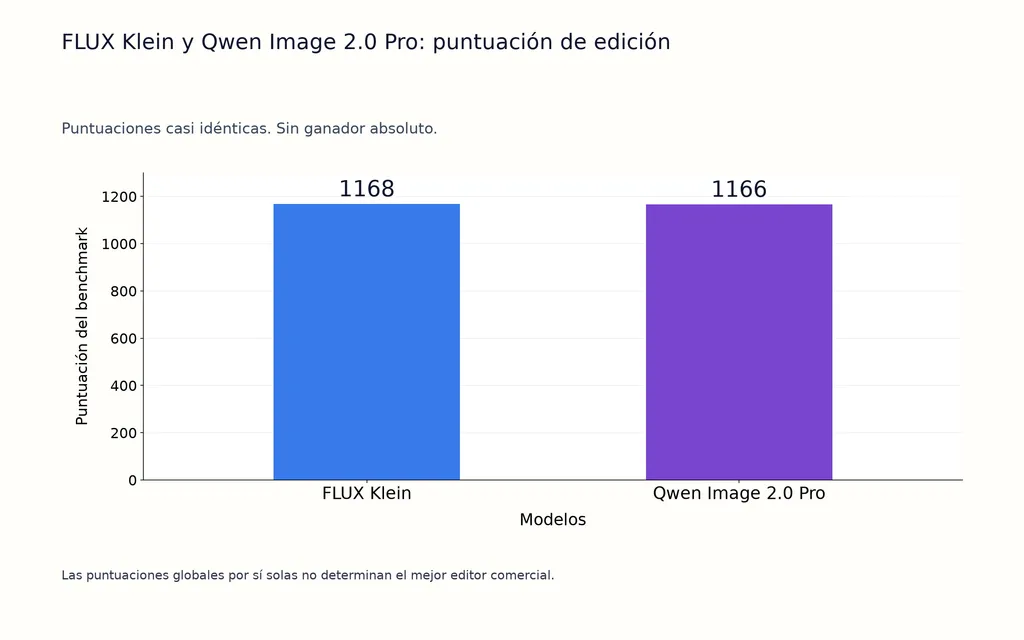
En los datos de evaluación de edición incluidos en la investigación:
- FLUX Klein: 1168
- Qwen Image 2.0 Pro: 1166
La diferencia es muy pequeña.
Esto sugiere una conclusión importante:
Las puntuaciones globales por sí solas no determinan el mejor editor comercial.
La decisión real depende de la tarea de producción.
Una marca de publicidad de producto realista puede preferir FLUX Klein.
Un equipo que realiza cambios estructurados puede beneficiarse de Qwen Image Edit.
El futuro no consiste en encontrar un ganador universal.
Consiste en ajustar la capacidad de IA adecuada al flujo creativo adecuado.
FLUX Klein frente a Qwen Image Edit para identidad y edición de moda
Por qué preservar la identidad es el reto clave de la edición comercial
En moda, publicidad y marca profesionales, lo más difícil no es generar una imagen nueva.
Es modificar una imagen existente conservando la identidad original.
Los equipos suelen editar recursos ya aprobados:
- cambiar ropa
- adaptar entornos de campaña
- crear variaciones estacionales
- producir varias versiones de marketing
La imagen editada debe conservar:
- la misma persona
- la misma sensación de marca
- la misma calidad visual
- el mismo reconocimiento del cliente
Nuestra revisión de debates muestra que la coherencia de identidad es una de las mayores preocupaciones al adoptar edición con IA.
Un resultado impresionante no sirve si el modelo, producto o recurso de marca deja de ser coherente.
Caso: transferencia de identidad en edición comercial de modelos
FLUX Klein destaca en edición humana compleja
Una evaluación de terceros incluyó una tarea difícil de transferencia de identidad.
Los requisitos eran:
- preservar la identidad de una persona
- mantener características del vestuario
- transferir la pose de otra referencia
En ese escenario, FLUX Klein conservó mejor:
- identidad facial
- apariencia de la ropa
- coherencia visual general
La limitación era que detalles finos, como las manos, aún podían necesitar retoques.
Qwen Image Edit mostró fuerza en comprensión estructurada de imágenes, pero resolvió peor este caso concreto de sustitución de identidad.
La lección comercial es importante:
Para moda, ecommerce y publicidad, la métrica más valiosa no es solo la calidad.
Es:
¿Puede modificar el recurso manteniendo reconocible a la persona?
Caso: cambio de ropa con IA para ecommerce de moda
El mejor editor de ropa debe preservar a la persona, no solo el atuendo
El cambio virtual de ropa muestra claramente la diferencia entre generación y producción con IA.
Una empresa de moda puede querer crear:
- varios atuendos para un modelo
- variantes estacionales de productos
- campañas publicitarias localizadas
La IA debe mantener:
- estructura corporal
- coherencia facial
- pose
- iluminación
- comportamiento realista de la tela
Enfoque de FLUX Klein
FLUX Klein suele encajar mejor cuando la imagen final debe parecer una fotografía profesional de campaña.
Fortalezas:
- apariencia humana realista
- textura natural de la piel
- mayor coherencia de materiales
- mejor integración de persona y entorno
Posible limitación:
A veces introduce cambios creativos no solicitados explícitamente.
Ejemplos:
- accesorios adicionales
- detalles de estilo inesperados
- pequeños cambios visuales
Enfoque de Qwen Image Edit
Qwen Image Edit puede aportar valor cuando se necesitan cambios más controlados.
Fortalezas:
- comprender instrucciones detalladas
- mantener relaciones estructurales
- seguir requisitos específicos de modificación
Posible limitación:
Para preservar identidades humanas con gran realismo, puede hacer falta revisión adicional.
Conclusión comercial
La elección depende del objetivo del flujo.
Para:
«Crear una nueva imagen realista de campaña de moda».
FLUX Klein suele ser la opción más sólida.
Para:
«Modificar solo elementos concretos preservando la estructura original».
Qwen Image Edit resulta más competitivo.
Caso: transformación de estilo y edición creativa
Transformar creativamente y editar para producción exigen fortalezas distintas
Otro uso comercial es transformar imágenes existentes a nuevos estilos.
Ejemplos:
- fotografía a ilustración
- exploración de conceptos de campaña
- adaptación visual para redes sociales
- experimentación de estilo de marca
Estas tareas difieren de la edición para ecommerce.
Los criterios pasan a ser:
- interpretación artística
- coherencia de estilo
- impacto visual
FLUX Klein para transformación creativa
FLUX Klein suele destacar cuando se busca una expresión visual más fuerte.
Ventajas:
- interpretación de estilo más rica
- transformación más marcada
- resultado artístico más potente
Aplicaciones adecuadas:
- campañas de entretenimiento
- conceptos publicitarios creativos
- exploración visual
Qwen Image Edit para transformación controlada
Qwen Image Edit resulta útil para preservar la estructura original.
Ventajas:
- cambios controlados
- preservación de referencias
- modificaciones predecibles
Aplicaciones adecuadas:
- actualizaciones de productos
- revisiones estructuradas
- ajustes de recursos de marca
FLUX Klein frente a Qwen Image Edit: comparación de usos comerciales
Escenario comercial | Modelo recomendado | Motivo |
|---|---|---|
Imágenes publicitarias de productos | FLUX Klein | Gran realismo y calidad visual comercial |
Visuales de productos para ecommerce | FLUX Klein | Más adecuado para resultados fotográficos |
Edición de modelos de moda | FLUX Klein | Buena coherencia de identidad en los casos probados |
Cambio de ropa con IA | FLUX Klein | Mejor para modificar personas con realismo |
Cambios de fondo controlados | Qwen Image Edit | Útil para retoques precisos y específicos |
Cambios que preservan la distribución | Qwen Image Edit | Mejor cuando importa la estructura original |
Exploración visual creativa | FLUX Klein | Mayor transformación visual |
Revisiones estructuradas de diseño | Qwen Image Edit | Mejor flujo orientado a instrucciones |
¿Cómo deben crear las empresas un flujo de edición con IA?
El mejor flujo combina capacidades de IA distintas
Un error común es buscar un modelo que resuelva todos los problemas de diseño.
Los flujos profesionales suelen tener varias etapas:
- exploración de conceptos
- edición de recursos
- revisión de calidad
- ampliación de producción
Cada modelo puede apoyar etapas distintas.
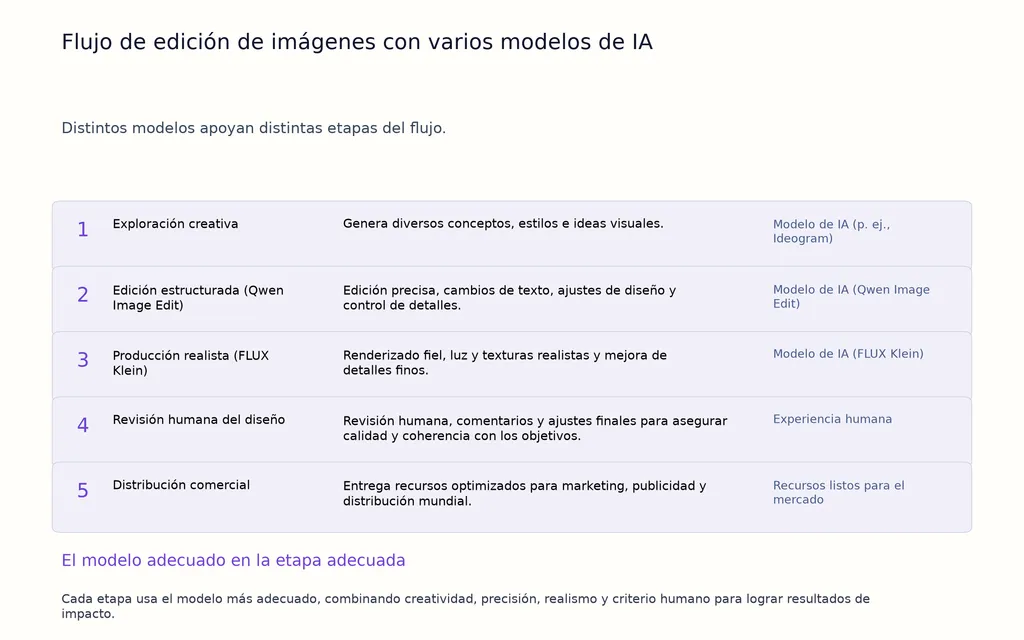
Ejemplo de flujo: contenido de productos para ecommerce
Paso 1: prepara los recursos originales
El equipo comienza con:
- fotografía de producto
- directrices de marca
- requisitos de campaña
El objetivo es definir qué debe permanecer igual.
Paso 2: explora direcciones creativas
La IA puede ayudar a probar:
- entornos
- conceptos de campaña
- variaciones visuales
Qwen Image Edit sirve para exploración controlada basada en referencias.
Paso 3: crea los visuales comerciales finales
FLUX Klein puede apoyar:
- escenas de productos realistas
- imágenes publicitarias
- recursos de campaña pulidos
Paso 4: revisión humana del diseño
La revisión profesional sigue siendo importante.
El equipo debe comprobar:
- exactitud del producto
- coherencia de marca
- percepción del cliente
La IA acelera la ejecución, pero el criterio creativo determina la idoneidad comercial.
Ejemplo de flujo: producción de campañas de moda
Los equipos de moda suelen crear muchas variantes a partir de pocas fotos aprobadas.
Un flujo práctico:
Imágenes originales del modelo
↓
Edición de ropa y entorno con IA
↓
Revisión de calidad
↓
Adaptación de campaña
↓
Publicación multicanal
El reto principal no es crear una imagen impresionante.
Es mantener coherencia en toda la colección.
Por eso importan más la identidad, el control del flujo y la producción escalable que la calidad aislada.
Coste y escalabilidad: elegir un modelo de edición para gran producción
El volumen cambia cómo se evalúan los modelos
Para un creador individual, la calidad visual puede ser lo principal.
Para las empresas, la escalabilidad es igual de importante.
Una empresa que crea pocas imágenes puede priorizar el mejor resultado posible.
Una empresa que crea miles de recursos también debe considerar:
- eficiencia de costes
- velocidad de producción
- acceso del equipo
- estabilidad del flujo
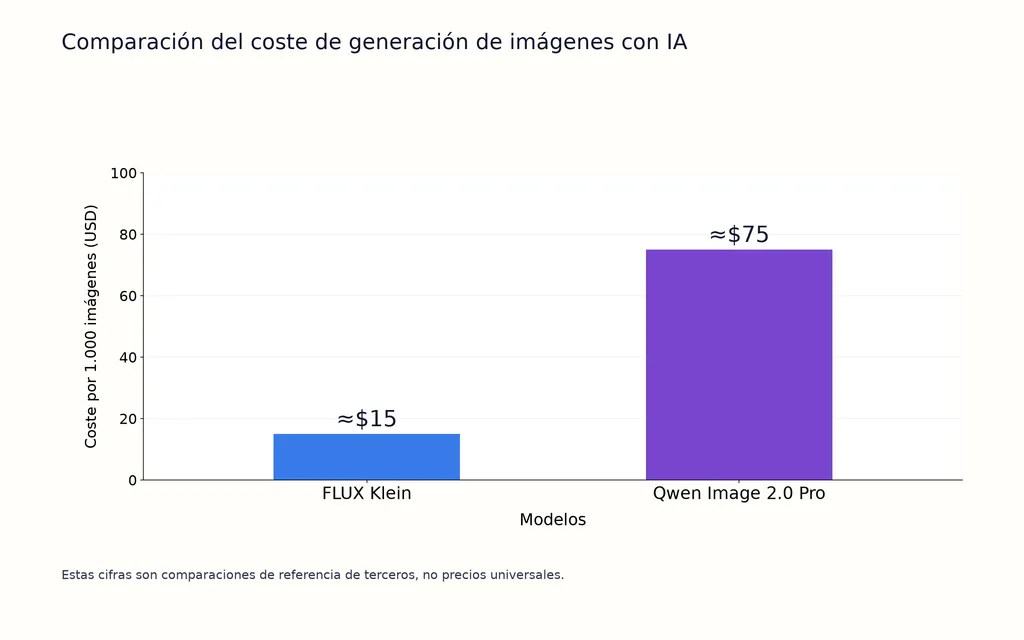
Según los datos comparativos de costes de terceros incluidos en la investigación:
Para generar imágenes:
- Qwen Image 2.0 Pro: unos $75 por 1.000 imágenes
- FLUX Klein: unos $15 por 1.000 imágenes
Para editar imágenes:
- Qwen: unos $75 por 1.000 imágenes
- FLUX: unos $17 por 1.000 imágenes
Estas cifras son comparaciones de referencia de terceros, no precios universales.
La implicación comercial es clara:
En proyectos pequeños, puede dominar la calidad.
A gran escala, los costes pueden influir en todo el flujo de contenido con IA.
Cómo elegir entre Qwen Image Edit y FLUX Klein para tu empresa
Un marco práctico de decisión
En lugar de preguntar:
«¿Qué editor de imágenes con IA es mejor?»
Pregunta:
«¿Qué problema comercial estoy resolviendo?»
Elige FLUX Klein si priorizas:
- fotografía comercial realista
- visuales de productos para ecommerce
- imágenes de calidad publicitaria
- producción de campañas de moda
- coherencia de identidad humana
- producción visual a gran escala
Elige Qwen Image Edit si priorizas:
- modificaciones precisas
- instrucciones estructuradas
- preservación de composición
- cambios basados en referencias
- revisiones controladas
Considera ambos modelos cuando:
Tu flujo incluye:
- exploración creativa
- edición estructurada
- producción visual final
El diseño comercial con IA avanza hacia flujos multimodelo, con responsabilidades creativas repartidas entre sistemas.
Recomendación final: FLUX Klein frente a Qwen Image Edit para edición comercial
FLUX.2 Klein 9B y Qwen Image Edit no se sustituyen directamente. Representan dos enfoques comerciales distintos: FLUX se centra en producción visual realista y Qwen en control de edición estructurada.
Para ecommerce, publicidad, moda y visuales de marca, FLUX Klein suele ser mejor porque el éxito comercial depende mucho del realismo, la identidad coherente y la calidad de producción. Para cambios precisos que deben mantener la estructura original, Qwen Image Edit ofrece una alternativa valiosa.
El futuro no lo definirá un ganador universal. Los mejores equipos combinarán capacidades especializadas de IA con criterio humano y elegirán el modelo adecuado para cada etapa.
Preguntas frecuentes
¿Es FLUX mejor que Qwen para editar imágenes con IA?
FLUX Klein suele ser mejor para tareas comerciales que exigen realismo, calidad de producto y conservación de identidad. Qwen Image Edit encaja mejor en ediciones estructuradas donde importan más el control preciso y la composición original.
¿Qué editor de IA es mejor para fotos de productos de ecommerce?
FLUX Klein suele ser una buena opción para ecommerce porque la fotografía de producto depende de materiales, luz y presentación realistas. Qwen Image Edit sirve para modificaciones controladas del producto.
¿Preserva FLUX Klein mejor la identidad que Qwen Image Edit?
En algunas pruebas de transferencia de identidad de terceros incluidas en nuestra investigación, FLUX Klein mantuvo mejor la identidad humana y la ropa. Sin embargo, depende del tipo de imagen, la complejidad y el grado de preservación requerido.
¿Deben las empresas usar FLUX y Qwen juntos?
Sí. Un flujo multimodelo puede dar mejores resultados que depender de un solo editor. Se puede usar Qwen para ediciones estructuradas y FLUX para imágenes comerciales realistas.
Más del blog de Virse
Flujo de trabajo
GPT Image 2.5 Noise and Oversharpening: Why Some Images Still Look AI-Generated
9 de octubre de 2026 by Yifan Zhao
Flujo de trabajo
GPT Image 2.5 Keeps Changing My Image: How to Use a "Keep List" for Reliable Edits
9 de octubre de 2026 by Yifan Zhao
Flujo de trabajo
GPT Image 2.5 Editing Drift: Why Images Get Blurry, Cropped or Worse After Multiple Edits
9 de octubre de 2026 by Yifan Zhao