
MiniMax H3 Pricing Explained: API, Hailuo, Self-Hosting and Real Video Cost
 Yifan Zhao9 min de lectura ·
MiniMax H3 pricing starts at $0.08 per second for 768P and $0.13 per second for 2K through the official API, so a 10-second video costs $0.80 or $1.30 before reference inputs and retries. These costs are easier to evaluate alongside a broader MiniMax H3 review and an understanding of how to use MiniMax H3 in real production workflows. MiniMax’s current PAYG documentation also prices 768P-to-2K regeneration at $0.05 per second. The real production cost, however, depends on how many generations actually become usable assets.
For creative teams, that distinction matters. Rejected concepts, reference video, additional images, regeneration and repeated attempts can quickly push cost per approved video above the advertised price per second. Across practical MiniMax H3 workflows, iteration count often matters as much as nominal generation cost, while MiniMax H3 Reddit feedback also shows how hardware, references and optimization can change the real economics. In practice, a more economical workflow is often to explore at 768P and pay for 2K only after a direction passes creative review.
Virse helps turn that process into a repeatable design workflow. Its infinite canvas, multi-Agent creative workflows, shared project context and long-term memory let designers organize references, develop variations and preserve brand knowledge across a project instead of treating every AI generation as an isolated prompt.
How Much Does MiniMax H3 Cost?
The official MiniMax H3 API costs $0.08/sec at 768P and $0.13/sec at 2K. MiniMax’s current model specification supports output durations from 4 to 15 seconds, 24 FPS video and native stereo audio.
Resolution | Per Second | 10 Seconds |
|---|---|---|
768P | $0.08 | $0.80 |
2K | $0.13 | $1.30 |
768P → 2K | $0.05 | $0.50 |
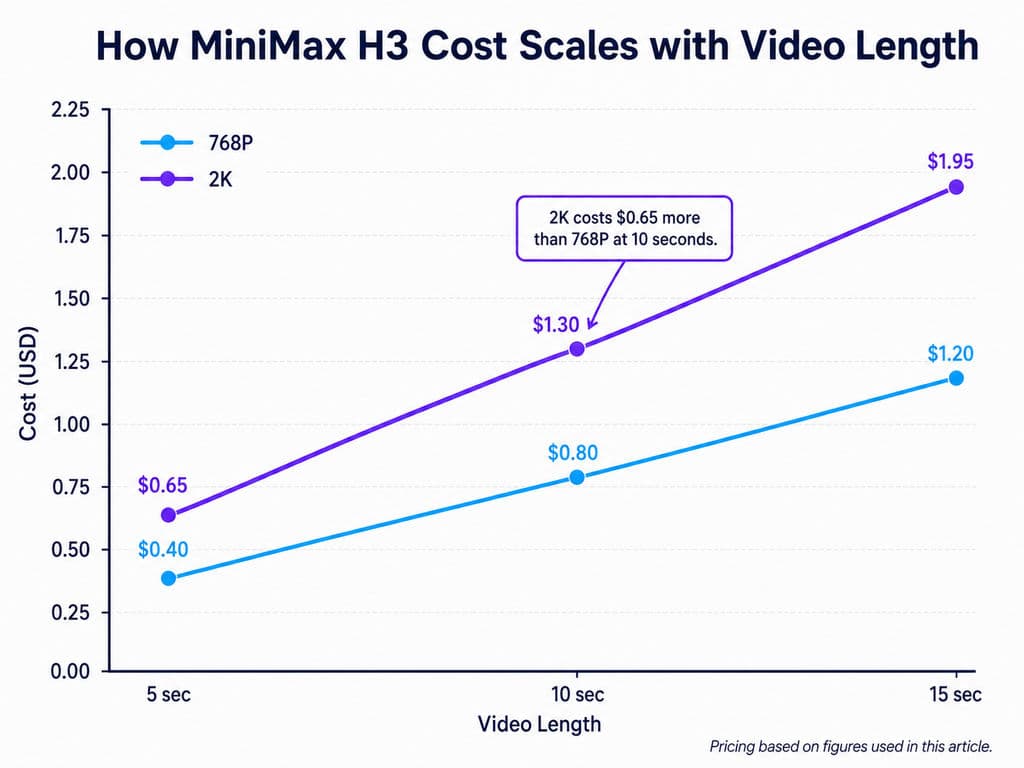
A 5-second 2K result costs $0.65, while 15 seconds costs $1.95. For 768P, the same durations cost $0.40 and $1.20.
MiniMax H3 Reference Image and Video Pricing
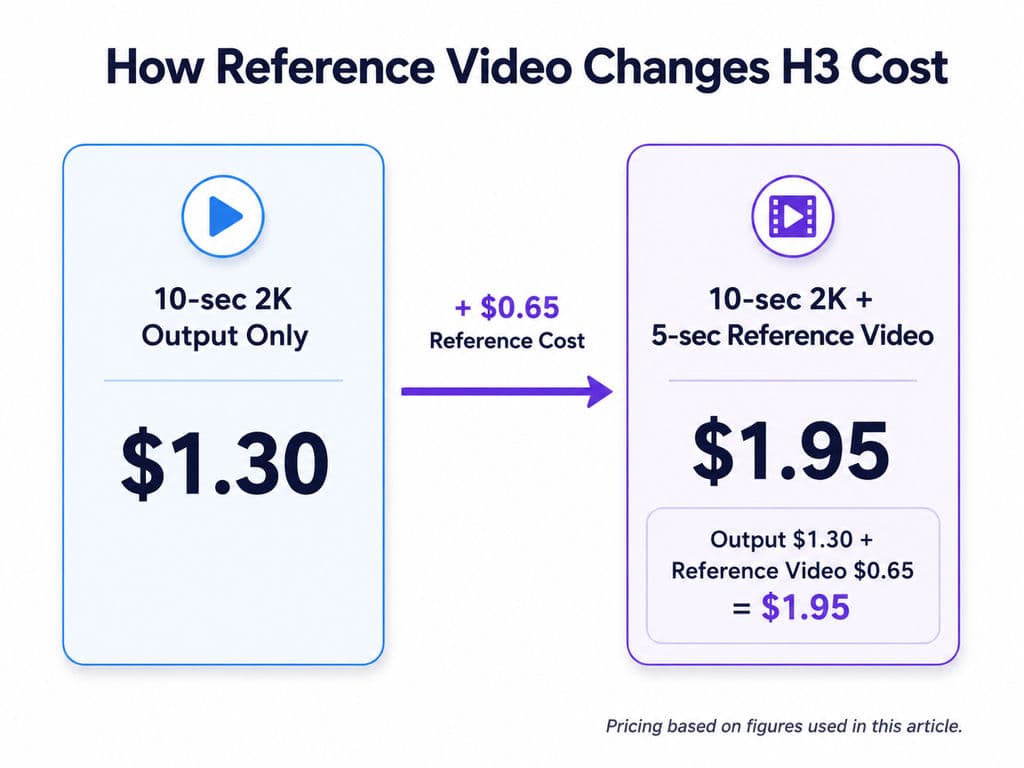
Output is only one part of H3 billing. MiniMax’s PAYG rules make audio input free and include the first five images; each additional image costs $0.04. Reference video is billed by input duration at $0.08/sec when generating 768P and $0.13/sec for 2K.
For example, a 10-second 2K output with a 5-second reference video costs $1.95: $1.30 for output plus $0.65 for the reference video. These input costs become especially important in MiniMax H3 Motion Transfer, where video, image and audio references may all contribute to the final generation.
MiniMax H3 2K Regeneration Pricing
Regenerating an existing 768P result to 2K costs $0.05/sec, but MiniMax also rebills materials from the original generation. Its current regeneration rules make the first five images free again, charge $0.025 for each additional image and bill original reference video at $0.05/sec.
That means $0.08 + $0.05 = $0.13/sec applies cleanly to output-only generation, but reference-heavy workflows require a separate calculation.
What Is the Real MiniMax H3 Cost per Usable Video?
The most useful H3 pricing metric is cost per approved video, not cost per generated second. Our review of recurring user questions found that retries and rejected outputs are often more important to production economics than the headline API rate.
There is no verified universal H3 success-rate benchmark. A budget that assumes every first generation is approved should therefore be treated as a best-case scenario.
Case Study: 10 H3 Candidates and 2 Final Winners
Consider a design team exploring ten 10-second concepts but expecting to keep only two. This model is derived directly from official output pricing and does not claim to represent a measured production benchmark.
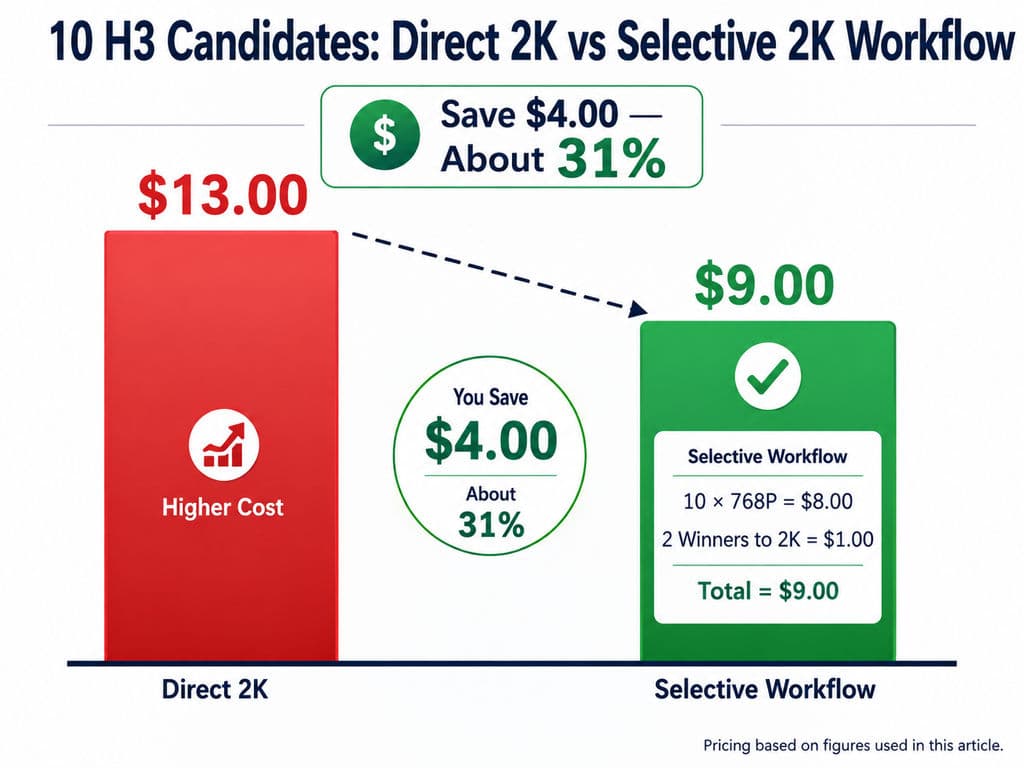
Generating all ten directly at 2K costs $13.
Generating all ten at 768P costs $8. Regenerating only two approved versions adds $1, producing a total of $9.
That is a $4 saving, or about 31%, compared with generating every candidate at 2K.
The important lesson is not that regeneration itself is cheaper. The saving comes from avoiding 2K spending on concepts that will be rejected.
Case Study: What Repeated Generation Does to H3 Cost
A third-party billing experiment included in our research recorded $9.23 across 13 billing events, covering H3 tests, reference workflows, a final ad and several input-condition experiments. The same test estimated approximately $1.52 in marginal generation cost for one new 10-second ad, including roughly $1.40 for video and $0.12 for a base image.
At 30 assets, that one-attempt model becomes about $45.60. But if approved assets regularly require two or three attempts, production spend rises accordingly. This is why teams should track attempts per approved asset alongside price per second.
Why Short H3 Tests Can Reduce Iteration Risk
H3 charges linearly by duration, so testing a difficult movement or composition for five seconds can be more economical than repeatedly generating a full 15-second scene. A 5-second 2K test costs $0.65 versus $1.95 for 15 seconds.
In design workflows, shorter tests are especially useful for validating camera direction, transformations, character motion or reference adherence before extending the complete sequence.
Why Is MiniMax H3 Pricing Cheaper on Hailuo?
Hailuo and the MiniMax Developer API use different pricing models. Hailuo’s current H3 page estimates $0.073–$0.120/sec for 2K depending on plan, compared with the official API list price of $0.13/sec.
The Hailuo figure is an effective subscription or credit-based price, not a reduced Developer API PAYG rate. If a creator fully uses an efficient plan, the effective cost can be lower; unused credits can push the real unit cost higher.
For manual creative work, Hailuo can therefore be attractive. For applications that require automation, batch generation, logging or integration with other creative systems, Developer API pricing is the more relevant benchmark.
Does the MiniMax Token Plan Include H3?
No. MiniMax’s current Token Plan documentation lists Plus at $20/month, Max at $50/month and Ultra at $120/month, but identifies MiniMax H3 as a special model not currently covered by the included quota. Purchased Credits can still pay for H3 at PAYG-equivalent rates.
How Does H3 Architecture Affect Pricing?
H3 is a multimodal generation pipeline, not simply a text-to-video endpoint. MiniMax’s official model card describes three major stages: H3-Context-IR, H3-Base and H3-Regenerate-2K.
H3-Context-IR Cost
Context-IR interprets relationships between text, images, audio and reference video before turning them into structured context for generation. MiniMax prices it at $0.90 per million input tokens and $3.60 per million output tokens through its PAYG schedule .
One official 10-second text-to-video example used 5,650 input and 2,915 output tokens, producing an estimated Context-IR cost of about $0.0156. A more complex Ref2VA example in our research used 33,323 input and 5,976 output tokens, equivalent to roughly $0.0515 at the same rates.
In these examples, context processing is measurable but remains much smaller than the video-generation charge.
Why H3 Regeneration Is Not Simple Upscaling
H3-Base produces the 768P candidate. For 2K, MiniMax’s technical description says H3 feeds that result together with the original context back into the model, allowing it to regenerate fine details rather than relying on a conventional standalone super-resolution process.
That architecture explains why selective 2K regeneration fits naturally into a design-review workflow.
Is MiniMax H3 Self-Hosting Cheaper Than the API?
Self-hosting can become economical at high utilization, but GPU hourly price alone does not establish a lower cost. MiniMax currently releases H3-Base checkpoints for local use, while Context-IR remains hosted and Regenerate-2K is not yet open-sourced. The official SGLang deployment example uses four GPUs.
A complete self-hosting calculation must include compute utilization, storage, orchestration, engineering, failed jobs and idle capacity—not just rental price.
A Practical H3 Hybrid Cost Model
MiniMax itself documents a hybrid workflow: hosted Context-IR, locally deployed H3-Base and hosted 2K regeneration.
Using the official 10-second Context-IR example, hosted preprocessing costs about $0.0156 and 10 seconds of regeneration costs $0.50. Against the $1.30 direct 2K API price, that leaves roughly $0.78 as a theoretical budget for running the local Base stage before matching direct API cost.
This is not a full TCO break-even figure because it excludes infrastructure and engineering overhead, but it gives high-volume teams a useful benchmark to test.
Commercial deployments also require a license review. The current H3 Community License contains territorial and commercial conditions, including additional authorization requirements for qualifying products above $20 million in annual revenue.
What Is the Cheapest MiniMax H3 Workflow?
For most professional creative teams, the cheapest reliable workflow is not simply choosing the lowest price per second. It is reducing the number of expensive generations that never reach production.
- Explore at 768P. Test composition, motion and references at $0.08/sec.
- Use shorter clips for uncertain ideas. Validate difficult moments before extending duration.
- Review before 2K. Regenerate only candidates that have passed creative selection.
- Control reference inputs. Long reference videos and extra images can materially increase cost.
- Track cost per approved asset. Record attempts, reference usage and final 2K promotion rate.
For automated production, MiniMax currently allows 2 concurrent H3 V2 tasks on the free tier and 15 on paid accounts, according to its rate-limit documentation . Teams should also validate media URLs, formats, dimensions and duration before submission rather than relying entirely on upstream validation.
Conclusion
MiniMax H3 pricing is straightforward at the API level: $0.08/sec for 768P, $0.13/sec for 2K and $0.05/sec for 2K regeneration. What determines real production economics is everything around those rates—references, rejected concepts, retries, resolution decisions and infrastructure. For most design teams, the strongest cost strategy is to use 768P as a creative selection layer, keep reference inputs focused and promote only approved work to 2K. Choosing where to use MiniMax H3 selectively can matter just as much as the nominal API price. The metric worth optimizing is cost per usable final video.
FAQ
How much does H3 cost for a 10-second video?
The official API charges $0.80 for a 10-second 768P video and $1.30 for 2K. MiniMax’s current PAYG pricing charges reference video and additional images separately, so reference-heavy workflows can cost more than the base output rate.
Why is H3 cheaper on Hailuo than through the API?
Hailuo estimates $0.073–$0.120/sec for H3 2K depending on plan, according to its current product page . This is a subscription or credit-based effective cost, while $0.13/sec is the Developer API PAYG list price. They are different commercial models rather than conflicting official prices.
Is 768P → 2K cheaper than direct H3 2K?
For output-only cost on one clip, no: $0.08/sec plus $0.05/sec equals the $0.13/sec direct 2K rate. It becomes cheaper at the project level when multiple 768P candidates are generated and only selected winners receive 2K regeneration. Extra reference materials can change the calculation because regeneration rebills original inputs.
Can H3 be fully self-hosted?
Not with the complete official 2K pipeline today. MiniMax’s model documentation releases H3-Base for local deployment, while H3-Context-IR remains hosted and H3-Regenerate-2K is not yet open-sourced. A hybrid workflow is therefore the closer match to the official 2K production pipeline.
Más del blog de Virse
Producto

What Is Product Design in 2026? What Product Designers Actually Do
21 de septiembre de 2026 by Vincent
Producto
GPT Image 2.5 Pricing: Flare vs Sunburst & the Real Cost per Image
14 de septiembre de 2026 by Vincent
Producto
GPT Image 2.5 Review: Does It Finally Fix AI Image Editing Drift?
14 de septiembre de 2026 by Vincent