
What Is an AI-Powered Design System for Brands?
Vincent10 min de lectura ·
An AI-powered design system is a brand system that combines reusable design rules, components, assets, examples, and project knowledge with AI that can understand and apply them during creative work.
Traditional design systems make brand and product decisions easier for people to reuse. AI-powered systems extend that idea by helping AI retrieve the right assets, follow established patterns, generate controlled variations, and carry creative context across a workflow.
For brands, the goal is not simply to generate more content. It is to increase creative output without losing the visual rules, product accuracy, and accumulated design knowledge that make a brand recognizable.
Platforms such as Virse.ai are moving in this direction by helping teams retain brand context, visual preferences, and project knowledge across the creative process, so AI-generated work can stay closer to established brand standards instead of starting from scratch each time.
How Is an AI-Powered Design System Different From a Traditional Design System?
Traditional design systems are primarily designed to help people reuse approved decisions.
Figma libraries are a familiar example. A library can contain reusable components, styles, and variables that teams share across files and projects. When source assets change, designers can review and apply those updates to designs that use them.
That model creates a reliable source of truth, but people still make most decisions about which asset to use, how to apply it, and whether the result fits the context.
An AI-powered design system adds a machine interpretation and execution layer.
Traditional Design System | AI-Powered Design System |
Designers browse guidelines and libraries | AI can retrieve relevant rules and assets |
Components are manually selected | AI can assist with applying established patterns |
Templates define common structures | AI can create controlled variations |
Knowledge lives mainly in documentation | Context can include previous projects and decisions |
Production work is manually repeated | Agents can assist repetitive execution |
Designers interpret rules | AI applies explicit rules, with designers reviewing judgment calls |
This does not make traditional systems obsolete. In fact, structured components, variables, tokens, and libraries are part of the foundation an AI system needs.
The difference is that the system begins moving from passive documentation toward active execution.
What Makes an AI Design System Brand-Consistent?
Brand consistency requires more than uploading a brand guideline PDF to an AI model.
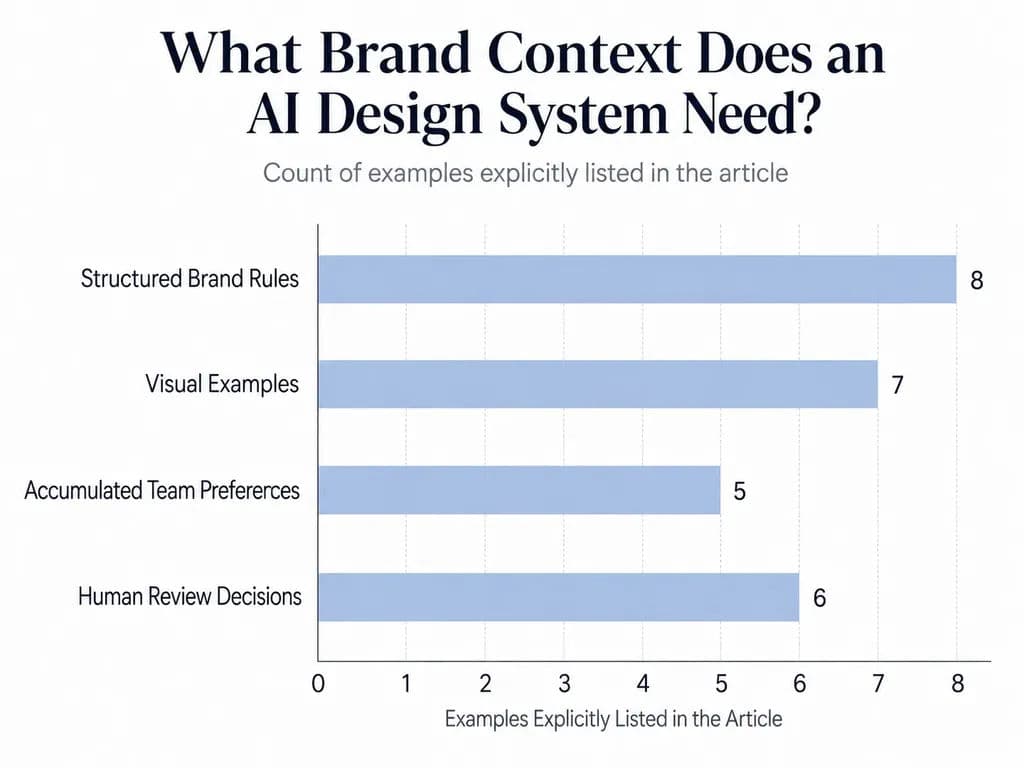
A strong AI-powered system needs several layers of context.
Structured brand rules
The easier a rule is to express structurally, the less the AI has to guess.
Useful examples include:
- approved colors
- typography
- spacing
- component relationships
- image ratios
- logo constraints
- naming conventions
- semantic design tokens
Design tokens are particularly relevant because they represent design decisions as reusable data. In October 2025, the Design Tokens Community Group published the first stable version of its vendor-neutral specification for exchanging tokens betweendesign toolsand platforms. The specification includes support for theming, aliases, token relationships, and multi-brand systems.
From an AI design perspective, this matters because machine-readable brand knowledge is more reliable than repeatedly asking a model to interpret prose.
Reusable components and approved assets
Components remain important even when AI enters the workflow.
Figma, for example, describes components as reusable building blocks that help teams maintain consistent designs across projects. Variables can also represent reusable values and design tokens inside a system.
The AI layer should not unnecessarily regenerate elements that already have an approved source.
Logos, product geometry, legal information, UI components, and signature brand assets are often better treated as fixed anchors, while backgrounds, compositions, supporting graphics, or concept directions can remain more flexible.
Visual examples
Rules alone rarely capture a complete brand language.
AI also benefits from examples of:
- approved campaigns
- rejected directions
- product imagery
- moodboards
- layouts
- packaging
- previous explorations
From aproduct designperspective, the difference between "minimal" and "our brand's version of minimal" often exists in these examples rather than in a written rule.
Project context
A brand system should understand not only global brand rules but also what is happening in the current project.
This is where canvas-based AI workflows become useful.
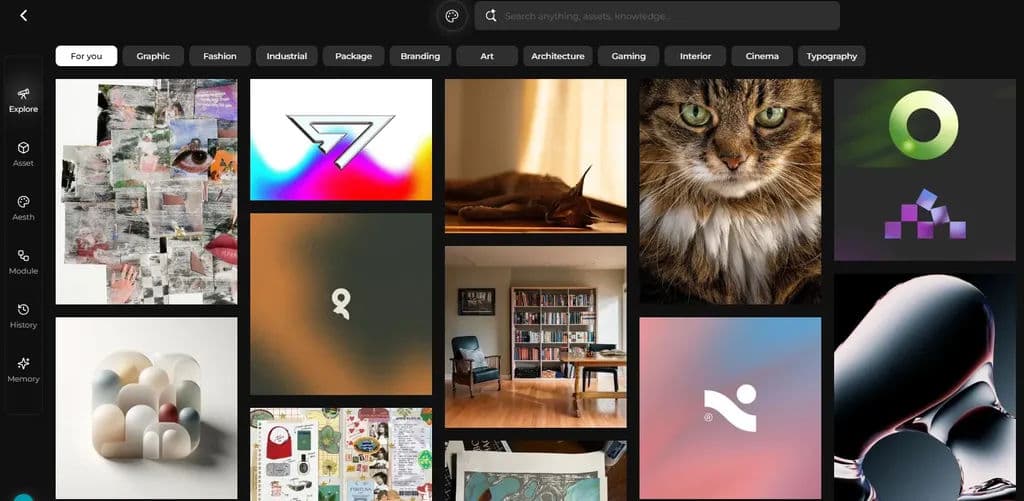
In Virse, designers can organize assets, references, intermediate outputs, nodes, and connections on a shared canvas. The Agent can interpret the wider canvas context instead of depending only on an isolated text prompt.
For example, connecting a product image to a reference board and several campaign directions creates relationships that communicate design intent visually.
This kind of context complements structured systems such as component libraries. Tokens describe what values are valid; project context helps explain which decisions matter right now.
Long-term memory and team knowledge
One of the less structured parts of a design system is the knowledge accumulated through repeated projects.
Design teams gradually develop preferences around:
- which directions usually work
- how strictly a rule should be interpreted
- what kinds of imagery feel wrong
- how a product is normally presented
- which visual decisions were approved previously
Virse is designed to retain information about designers' and teams' aesthetic preferences, brand specifications, and previous project experience.
Because its Agent can also use nodes, connections, and the wider creation process as context, the aim is to preserve more than the final asset. The system can build context around how the team arrived at a design decision, reducing the need to explain the same brand direction from zero in every new task.
This suggests an important principle:
An AI-powered design system should combine explicit rules with accumulated creative knowledge.
Human review
No system can reduce brand identity entirely to tokens and constraints.
AI can identify an approved component or continue an established visual direction. It is less reliable at deciding whether deliberately breaking that direction is strategically valuable.
Designers should therefore remain responsible for decisions such as:
- definingart direction
- judging originality
- interpreting cultural context
- selecting concepts
- approving exceptions
- deciding when brand rules should change
The strongest workflow is not unrestricted AI generation. It is constrained execution with human creative judgment.
How to Build an AI-Powered Design System for Your Brand
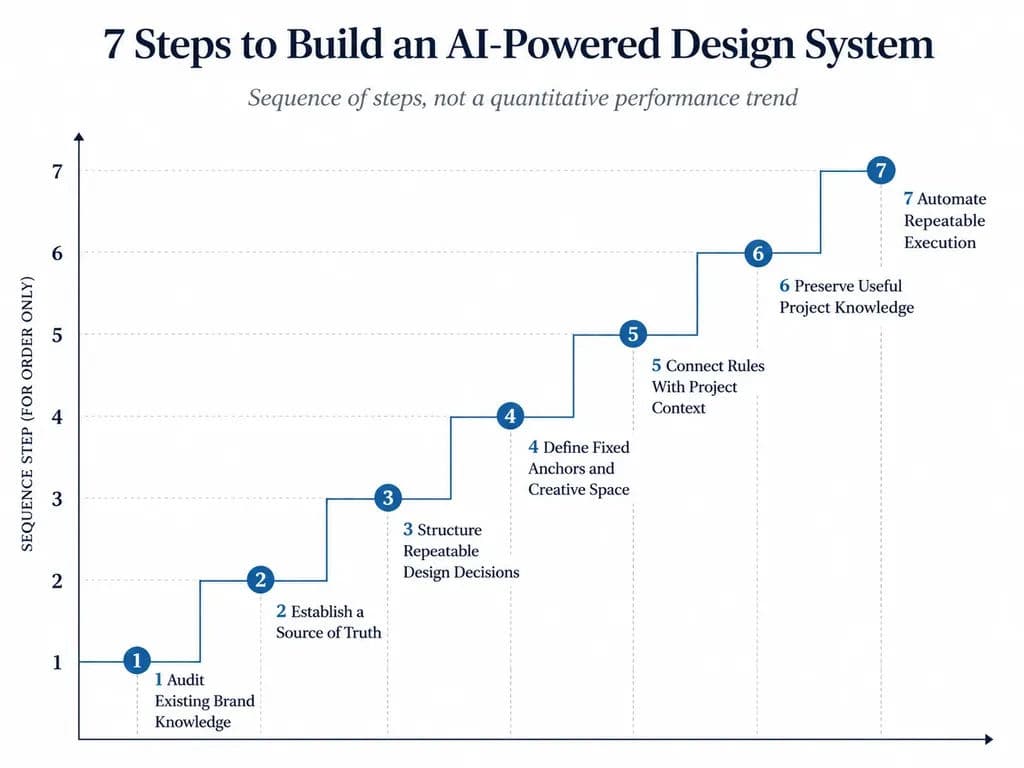
A practical system can be built in seven steps.
Audit existing brand knowledge
Collect brand guidelines, Figma libraries, templates, logos, imagery, previous campaigns, packaging, typography, product assets, and approved references.
Establish a source of truth
Resolve outdated assets and conflicting rules before adding AI.
If three versions of a logo already exist in the team's folders, AI will not automatically know which one represents the current standard.
Structure repeatable design decisions
Represent colors, typography, spacing, components, semantic roles, and other deterministic rules as structured information wherever possible.
Existing systems such as Figma libraries can remain part of this layer rather than being replaced.
Define fixed anchors and creative space
Specify what AI is allowed to change.
For example:
Fixed: logo, product geometry, legal copy, typography system.
Flexible: backgrounds, compositions, lifestyle environments, campaign variations.
This prevents unnecessary regeneration of brand-critical assets.
Connect rules with project context
Give AI access to the references and materials relevant to the current task.
In a canvas workflow such as Virse, designers can spatially organize these relationships rather than translating every decision into prompt language.
Preserve useful project knowledge
Approved outputs and repeated preferences should become reusable context.
Long-term memory is particularly valuable here because brand consistency is partly the accumulation of hundreds of small decisions that rarely appear in the official guideline document.
Automate repeatable execution
Only after the system has usable context should teams automate production tasks such as:
- asset variations
- repetitive revisions
- style continuation
- format adaptation
- reference analysis
- asset organization
- batch image production
The workflow becomes:
Brand source of truth → structured rules → project context → AI execution → human review → reusable knowledge
Where AI-Powered Design Systems Help Brands Most
AI-powered systems tend to provide the most value where creative volume is high but the visual constraints are already understood.
Product and campaign variations
A brand may need the same product shown with different models, backgrounds, campaign contexts, or compositions.
Virse gives the example of generating model imagery for multiple eyewear styles already placed on the canvas. The Agent can work from the products and surrounding project context rather than treating every image as an unrelated generation task.
The benefit is not just batch output. It is keeping the product, references, and creative direction connected throughout production.
Finding and reusing existing assets
Generation is not always the right answer.
Sometimes the fastest workflow is simply finding the correct existing component or design.
Figma's AI-assisted search, for example, can help designers find components and related designs using descriptive prompts, images, or canvas selections. This illustrates an important direction for AI-powered systems: AI can improve retrieval as well as generation.
Style continuation
After a campaign direction is approved, designers often need many additional assets without reinventing the concept.
This is where persistent context becomes useful.
Instead of rewriting prompts such as "make it feel like our previous campaign," an AI workflow can use previous outputs, references, and team preferences as context for subsequent work.
Multi-agent production
Larger brand projects contain multiple parallel tasks.
Virse supports multiple Agents working on different areas of the same project—for example, reference analysis, packaging exploration, and marketing asset generation—while sharing project context.
This suggests a useful model for creative scaling:
specialized AI agents execute different parts of a shared design system, while designers coordinate direction and approval.
What AI Can and Cannot Automate in a Brand Design System
The useful question is not whether AI can design. It is which decisions are repeatable enough to delegate.
AI Can Assist With | Human Direction Still Matters For |
Batch generation | Brand strategy |
Finding assets and components | Creative direction |
Style continuation | Concept selection |
Applying known rules | Intentional rule-breaking |
Repetitive revisions | Cultural interpretation |
Asset organization | Originality and differentiation |
Format variations | Final aesthetic judgment |
This distinction matters because the highest-value design decision may take only a few minutes, while executing that decision across dozens of assets can take hours.
AI creates the most value when it reduces execution work without removing creative ownership.
How Virse Fits Into an AI-Powered Brand Design Workflow
An AI-powered brand system does not have to be one product.
A team might use Figma for structured components, libraries, and variables, a token system for machine-readable design decisions, and specialized AI tools for generation or automation.
Within that wider stack, Virse focuses on the collaborative creative layer.
Its approach is based on four ideas:
Canvas-based context: Agents work with references, assets, nodes, relationships, and outputs inside the creative workspace rather than depending only on chat.
Long-term memory: previous aesthetic preferences, brand requirements, and project experience can become persistent context.
Multi-Agent collaboration: different Agents can work on separate tasks while sharing the same project environment.
Designer-led execution: AI focuses on repetitive and execution-heavy work such as batch generation, style continuation, asset organization, and iterative revisions rather than assuming that one prompt should replace the entire professional design process.
This makes Virse most relevant not as a replacement for existing design-system infrastructure, but as a potential AI execution and collaboration layer around it.
A Figma library can tell a team which component is correct. A design token can specify the exact approved value. A persistent AI workspace can add another dimension: what the team is currently trying to achieve, what it has already explored, and what it learned from previous creative decisions.
For brands, the long-term opportunity is therefore bigger than AI-generated visuals.
It is a design environment where brand rules, reusable assets, project context, accumulated knowledge, and creative execution remain connected over time.
Más del blog de Virse
Inspiración

MiniMax H3 Reddit Review: What Real Users Think After Local Testing
7 de agosto de 2026 by Yifan Zhao
Inspiración
What Is Art Direction? Definition, Examples, and How to Create an Art Direction
6 de agosto de 2026 by Yifan Zhao
Inspiración

What Are Wireframes? A Practical Guide to UX Wireframing
6 de agosto de 2026 by Yifan Zhao