Nano Banana 2.1 vs GPT Image 2.5: Which Handles Image Editing Better?
Vincent12 分钟阅读 ·
Nano Banana 2.1 is better for realistic photography and clean marketing visuals, while GPT Image 2.5 excels at structured layouts, product visualization, and detailed editing. Neither wins every task. The better choice depends on image quality, prompt accuracy, editing consistency, speed, and cost.
Great-looking AI images can still fail when models ignore instructions or change important details. A 90-generation editing experiment revealed character duplication and background drift, while a 66-call API comparison exposed missing products, unwanted logos, and layout errors. These failures lead to more revisions, inconsistent assets, and higher costs.
Virse simplifies AI image creation with an infinite canvas, collaborative AI agents, shared context, and long-term memory. Designers can organize references, manage revisions, and maintain creative direction in one workspace while retaining full creative control.
Nano Banana 2.1 vs GPT Image 2.5: What Are the Key Differences?
Both models support text-to-image generation and image editing, but their practical strengths vary by task.
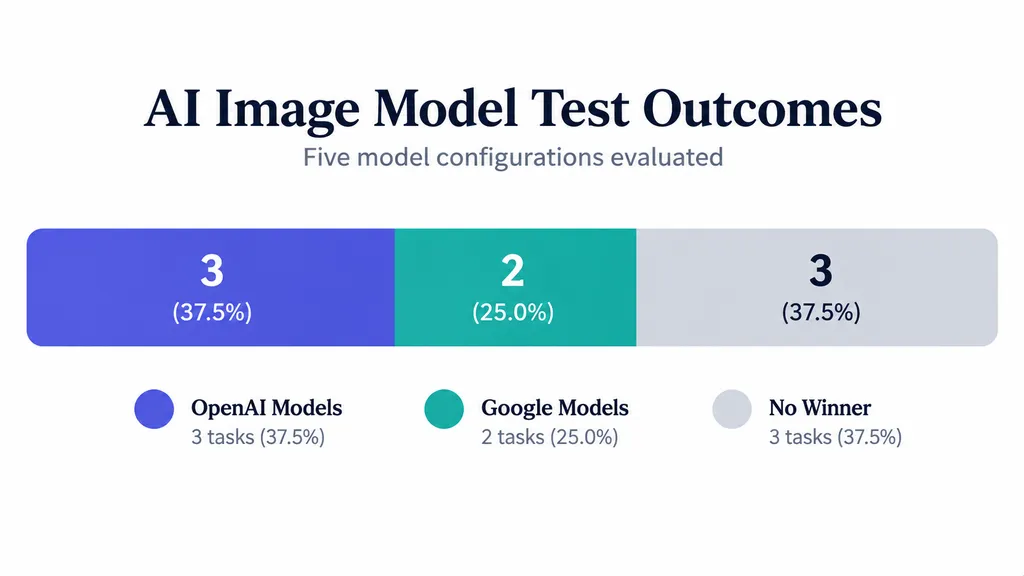
In an independent October 8, 2026 comparison by Anass Kartit, five model configurations were evaluated using eight prompts. OpenAI configurations won three tasks, Google configurations won two, and three had no winner.
This was not a strict 3–2 victory for GPT Image 2.5 over Nano Banana 2.1. The evaluation included Nano Banana 2, Nano Banana Pro, GPT Image Flare and Sunburst.
Nano Banana 2.1 vs GPT Image 2.5: Strengths and Limitations
Nano Banana 2.1 demonstrated strengths in:
- Natural portraits and photographic lighting.
- Clean marketing thumbnails.
- Competitive 1K generation speed.
- Accurate English text in selected tests.
Its limitations included missing objects, structural errors, and character duplication during repeated editing.
GPT Image 2.5 demonstrated strengths in:
- Commercial product compositions.
- Structured educational posters.
- Detailed clothing transformations.
- Rapid concept generation with Flare.
Its weaknesses included unwanted accessories, extra text, and background reconstruction.
The essential distinction is that image quality, prompt adherence, and editing fidelity are separate capabilities.
A beautiful image may still fail a design brief if it changes packaging, omits required content, or introduces unauthorized branding.
Nano Banana 2.1 vs GPT Image 2.5: Which Generates More Realistic Images?
Realistic Portraits, Lighting, and Natural Textures
Nano Banana 2.1 is worth testing for documentary-style photography and natural environments.
In Kartit's eight-prompt comparison, Google's three configurations produced convincing portraits featuring wrinkles and soft window lighting. Both GPT Image 2.5 variants generated attractive results but added an unrequested red hat.
This illustrates a common production problem: photorealism does not guarantee prompt accuracy.
Our review of published visual comparisons also identified recurring concerns about repetitive vegetation, artificial shadows, excessive sharpness, and stylized natural textures.
For architectural and landscape imagery, designers should evaluate material realism, geometry, lighting direction, and natural irregularity rather than judging sharpness alone.
Product Photography and Commercial Image Quality
GPT Image 2.5 demonstrated stronger product completeness in a collectible-toy packaging test.
The prompt requested a shiny chef figurine inside its packaging. Nano Banana 2.1 generated an empty package, while both GPT Image variants included the figurine.
Another task involved wireless earbuds on wet slate with water droplets and directional lighting. Multiple configurations produced attractive commercial imagery, although some modified the surrounding environment.
For e-commerce, these differences matter because an aesthetically polished image can still misrepresent a product.
Professional product imagery should prioritize object completeness, geometry, materials, color accuracy, and packaging relationships before artistic presentation, especially when creating product mockups with AI.
Nano Banana 2.1 vs GPT Image 2.5: Which Follows Complex Prompts Better?
Prompt adherence measures whether an AI model includes required elements, preserves specified relationships, and avoids unwanted additions.
Independent evaluations show that both models can follow detailed instructions, but neither is consistently error-free.
Case Study: Missing Objects, Extra Logos, and Layout Errors
The eight-prompt comparison revealed several distinct failures.
Collectible packaging: Nano Banana 2.1 omitted the toy, while GPT Image 2.5 generated the packaged product.
Portrait photography: GPT Image 2.5 added an unrequested hat.
YouTube thumbnail: Nano Banana 2.1 produced the cleanest result, while GPT Image Flare introduced company logos.
Educational poster: GPT Image Sunburst followed the requested four-step structure. Flare added unnecessary sentences, while another Google configuration produced unsuitable poster proportions.
These errors fall into two categories.
Omission errors remove required objects, labels, or relationships.
Addition errors introduce unauthorized accessories, logos, statements, or visual elements.
For brand-sensitive production, addition errors are particularly important because they may appear intentional and escape casual review, affecting brand consistency.
Text Rendering, Multilingual Accuracy, and Layout Control
Both model families can generate complex text successfully.
In Kartit's comparison, all five configurations correctly reproduced a five-line English chalkboard menu.
However, a separate nine-prompt study published by LaoZhang AI on October 8, 2026 identified errors involving Japanese and Chinese text.
Nano Banana 2.1 changed formatting on an English poster, added unwanted text to a Japanese sign, and converted the requested Chinese price "38元" into "三十八元".
All three tested models—including Nano Banana Pro and GPT Image 2.5—also rendered a simplified Chinese character using its Japanese form.
The study used one generation per prompt, so these observations cannot establish general failure rates.
For multilingual commercial graphics, exact wording, character forms,typography, and layout must be reviewed independently.
Nano Banana 2.1 vs GPT Image 2.5: Which Is Better for Image Editing?
Editing existing images requires a model to change requested elements while preserving everything else.
Image editing drift is the unintended modification of backgrounds, identities, colors, composition, or other visual elements during successive edits.
Two independent experiments reveal why editing consistency deserves separate evaluation.
Case Study: Photo Restoration and Outfit Replacement
In Kartit's restoration task, both models preserved the main subject's identity but violated different constraints.
Nano Banana 2.1 maintained the studio background while darkening the subject's skin tone.
GPT Image 2.5 preserved skin tone more closely but replaced the original background with blue.
Neither fully satisfied the preservation requirements.
The outfit-replacement task produced a different outcome.
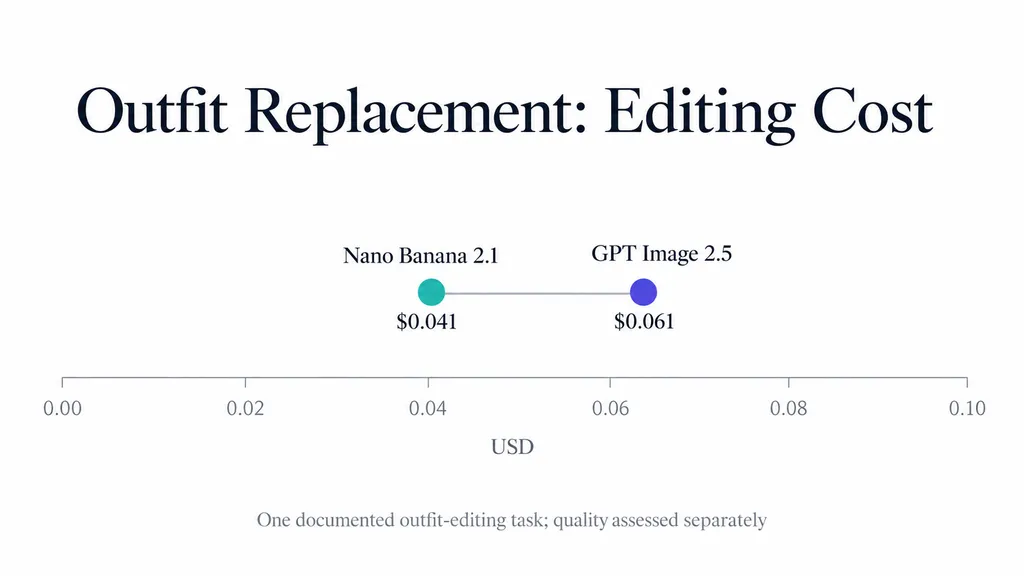
Both models retained the person's face, hands, and surrounding room. GPT Image 2.5 generated more detailed tuxedo features, including a shawl collar and pocket square.
Reported costs were approximately $0.041 for Nano Banana 2.1 and $0.061 for GPT Image 2.5.
The example illustrates why editing detail, preservation accuracy, and price should be evaluated separately.
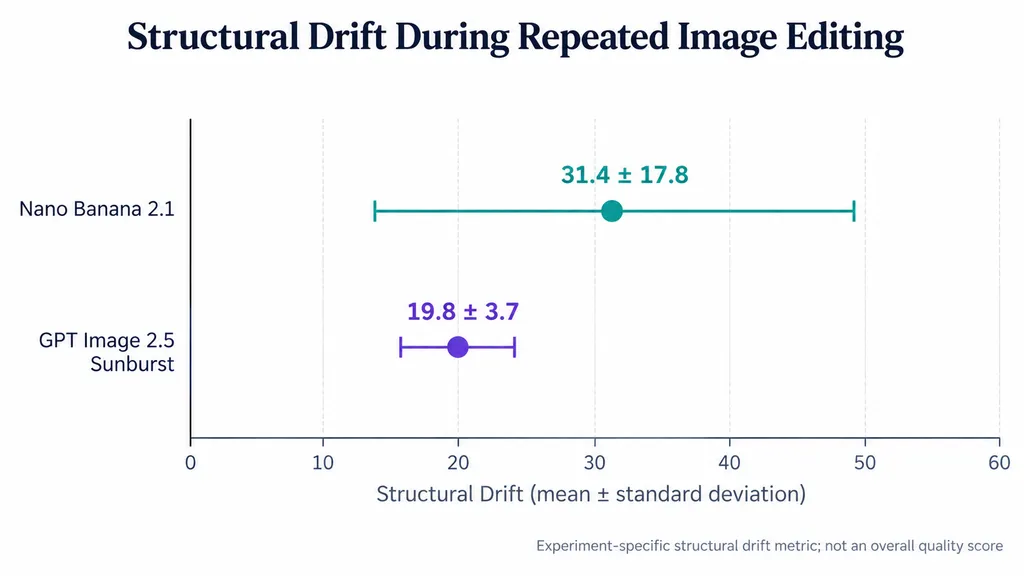
Case Study: 90 Generations Reveal Multi-Round Editing Drift
A separate publicly documented experiment compared Nano Banana 2.1, GPT Image 2.5 Sunburst, and Ideogram 4.5 across 90 generations.
Each model completed three ten-round editing chains involving clothing and accessory modifications. Every new edit used the previous output.
The experiment reported:
Nano Banana 2.1
- Structural drift: 31.4 ± 17.8.
- Changed pixels: 80.85%.
- LPIPS: 0.37.
GPT Image 2.5 Sunburst
- Structural drift: 19.8 ± 3.7.
- Changed pixels: 79.23%.
- LPIPS: 0.47.
These are experiment-specific metrics, not universal model scores. Test configurations were not fully matched, and different perceptual metrics did not consistently agree.
The observed failures were more informative.
Nano Banana 2.1 duplicated the subject during round six of one editing chain. The image contained two characters instead of one, and the error persisted.
GPT Image 2.5 maintained one subject but progressively repainted an unedited background, transforming a dusk sky into a saturated sunset.
Structural failures are usually obvious. Subtle background drift can be harder to detect because the resulting image may still look polished.
How to Reduce Character and Background Drift
For professional editing workflows:
- Preserve the approved original image as a permanent reference.
- Specify exactly what may change.
- Identify identity, background, and composition constraints.
- Compare important outputs against the original.
- Test whether modifications can be reversed.
- Restart from an approved reference when errors accumulate.
For fashion imagery, prioritize identity and garment consistency. For product photography, focus on geometry, color, and packaging preservation.
Repeated-editing reliability should be tested separately from single-image quality.
Nano Banana 2.1 vs GPT Image 2.5: Pricing, Speed, and API Costs
Real Generation Costs From 66 API Calls
Kartit's October 2026 comparison recorded 66 API calls costing $4.36 in total, including discarded generations.
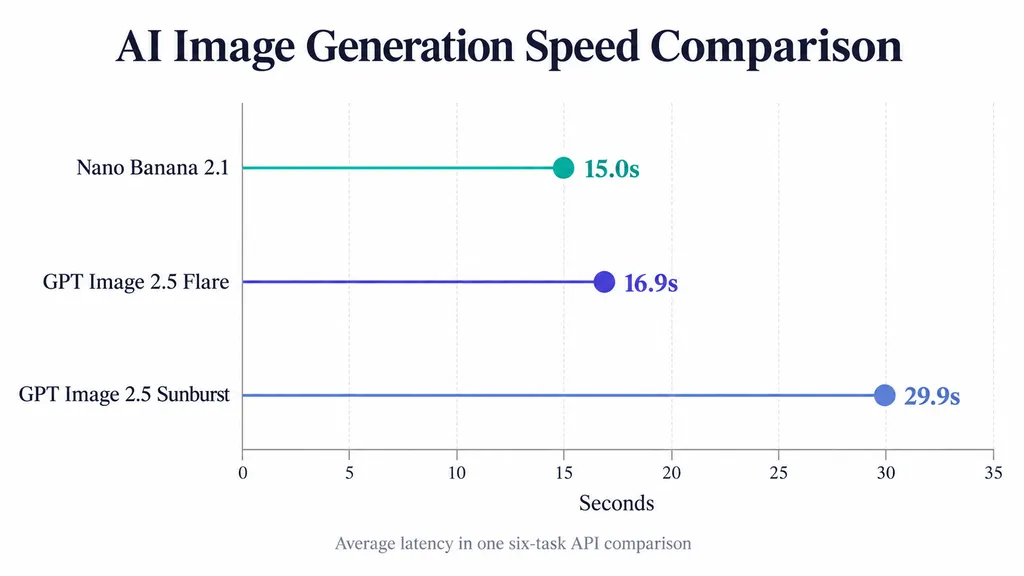
Across six text-to-image tasks, the reported averages were:
Nano Banana 2.1, 1K
- Average cost: $0.0438.
- Average generation time: 15.0 seconds.
GPT Image 2.5 Flare, High
- Average cost: $0.0326.
- Average generation time: 16.9 seconds.
GPT Image 2.5 Sunburst, High
- Average cost: $0.0326.
- Average generation time: 29.9 seconds.
GPT Image 2.5 High was approximately 25.6% cheaper than Nano Banana 2.1 in this text-to-image sample.
Importantly, Nano Banana's $0.0418 figure reported elsewhere in the study was the cost of one thumbnail, whereas $0.0438 was the six-prompt average.
The Google costs were calculated from reported token usage; GPT Image costs reflected OpenRouter billing. Output dimensions and billing methods differed.
These figures describe specific October 2026 conditions, not universally comparable current prices.
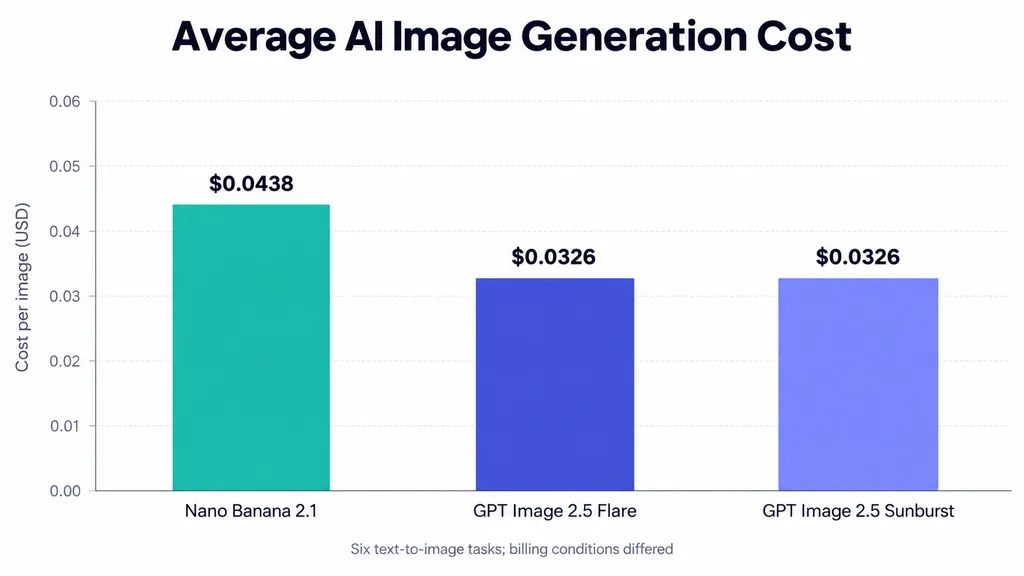
Image Resolution, Quality Settings, and Costs
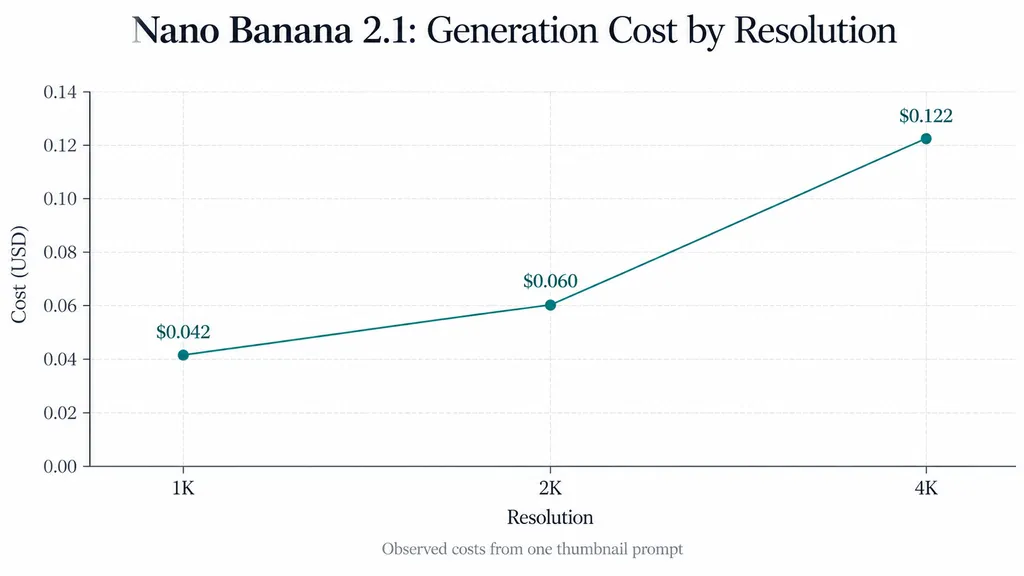
A pricing sweep using one thumbnail prompt produced the following Nano Banana 2.1 costs:
- 1K: $0.042.
- 2K: $0.060.
- 4K: $0.122.
For GPT Image 2.5, the tested OpenRouter settings produced:
- Low: $0.0039.
- Medium: $0.0087.
- High: $0.0326.
- XHigh: $0.0578.
- Max: $0.1297.
In those configurations, increasing Nano Banana's resolution changed image dimensions, while GPT Image's tested quality levels returned the same 1536 × 864 dimensions.
This is specific to the tested provider and settings, not a universal restriction on GPT Image output resolution.
Resolution, rendering quality, and billing tiers should be evaluated independently.
GPT Image 2.5 Flare vs Sunburst: Which Is Faster?
Flare averaged 16.9 seconds per image, compared with Sunburst's 29.9 seconds.
That made Flare approximately 43% faster in the six-task sample.
However, a separate LaoZhang AI evaluation reported 17–33 seconds for Nano Banana 2.1 and 58–76 seconds for GPT Image 2.5 Sunburst through a different API route.
These results demonstrate that provider infrastructure and request configuration materially affect latency.
Flare is worth testing for rapid concepts, while Sunburst deserves evaluation for selected structured-layout and editing tasks.
Why Cost per Usable Image Matters Most
For commercial production, the cheapest API request is not necessarily the most economical.
Cost per usable image = Total generation spending ÷ Number of accepted images
For example, if 100 generations cost $0.04 each but only 40 meet the brief, the effective generation cost is $0.10 per accepted image.
This is an illustrative calculation, not a measured acceptance rate for either model.
Teams should also account for review time, failed generations, manual corrections, and consistency across approved assets.
Nano Banana 2.1 vs GPT Image 2.5: Which Should Designers Choose?
Best AI Image Model for Different Creative Tasks
Based on the reviewed evidence, the following are reasonable starting points:
- Natural photography: Nano Banana 2.1 for photographic atmosphere and lighting.
- Architecture and landscapes: Nano Banana 2.1, with texture and geometry checks.
- YouTube thumbnails: Nano Banana 2.1 for clean compositions.
- Educational posters: GPT Image 2.5 Sunburst for structured layouts.
- Collectible packaging: GPT Image 2.5 for object completeness.
- Fashion editing: GPT Image 2.5 for detailed clothing.
- UI concepts: GPT Image 2.5 Flare for rapid iteration.
- Photo restoration: Test both against preservation requirements.
- Long editing chains: Test both for accumulated drift.
These are task-specific recommendations, not guaranteed performance rankings.
A Practical Multi-Model AI Design Workflow
Professional teams can improve production reliability by organizing generation around approved references and measurable requirements.
- Define the creative brief. Specify subjects, visual references, branding, and output requirements.
- Generate parallel concepts. Test models suited to the specific task.
- Validate prompt compliance. Check required objects, unwanted additions, and typography.
- Preserve approved references. Keep original assets accessible throughout revisions.
- Perform controlled edits. Monitor identity, background, geometry, and composition.
- Measure production efficiency. Track approved outputs, revisions, and total generation spending.
This is where Virse's canvas-based workflow becomes relevant.
Its infinite canvas helps designers organize visual assets and express relationships between references and creative outputs. Multiple AI agents can collaborate on different tasks using shared project context, while long-term memory is designed to retain team preferences and brand guidelines.
These capabilities support a more connected creative process, although their effects on generation accuracy or production costs have not been independently quantified here.
The goal is to let AI handle repetitive execution while designers remain responsible for creative decisions.
FAQ
Is Nano Banana 2.1 Better Than GPT Image 2.5?
Neither model consistently wins across all creative tasks. Nano Banana 2.1 demonstrated strengths in selected photographic and thumbnail tests, while GPT Image 2.5 performed well in structured posters, product packaging, and outfit editing. Both experienced instruction failures and editing drift. The better choice depends on image quality, preservation requirements, generation speed, and production cost.
Why Does Nano Banana 2.1 Ignore Instructions or Change Characters?
Complex prompts and repeated editing can introduce missing objects, incorrect relationships, or unintended reconstruction. Documented examples include an empty collectible package and character duplication during a ten-round editing sequence. To reduce these risks, specify required elements, identify what must remain unchanged, preserve original references, and inspect outputs after significant edits.
Does GPT Image 2.5 Change Backgrounds or Create Repeating Textures?
It can. Published editing experiments identified unwanted background reconstruction, including a studio-background replacement and changes to a dusk scene. Visual comparisons have also raised concerns about repetitive natural textures. These outcomes vary by prompt and configuration. Designers should compare edited outputs with approved references and assess preservation separately from overall visual quality.
Which Is Cheaper and Faster: Nano Banana 2.1 or GPT Image 2.5?
In one October 2026 comparison, Nano Banana 2.1 averaged $0.0438 and 15.0 seconds per text-to-image generation. GPT Image 2.5 High averaged $0.0326, with Flare taking 16.9 seconds and Sunburst 29.9 seconds. Billing methods and resolutions differed, and editing costs can reverse the price advantage. Compare total spending against approved outputs.
Conclusion
Nano Banana 2.1 and GPT Image 2.5 are better understood as complementary AI image tools than competitors with one definitive winner. Nano Banana 2.1 is a promising choice for realistic photography, natural environments, and clean marketing visuals, while GPT Image 2.5 performs strongly in selected structured compositions, product visualization, and detailed editing tasks. Independent research also demonstrates that missing objects, unwanted additions, multilingual text errors, and accumulated editing drift can compromise otherwise attractive images. For professional designers, the most reliable strategy is to select models by task, preserve approved visual references, verify important modifications, and measure the cost of producing usable assets. Combining these practices with a collaborative design workflow helps teams use AI more systematically while keeping creative judgment under human control.