
GPT Image 2.5 Review: Does It Finally Fix AI Image Editing Drift?
Vincent14 min de leitura ·
Does GPT Image 2.5 finally fix AI image editing drift? Mostly—but not completely. Compared with GPT Image 2, it is much better at preserving faces, references, composition, and approved visual details across repeated edits. Its biggest upgrade is not raw image quality, but more precise editing, stronger reference fidelity, and better multi-turn consistency. Flare focuses on speed, while Sunburst is built for higher-precision creative work.
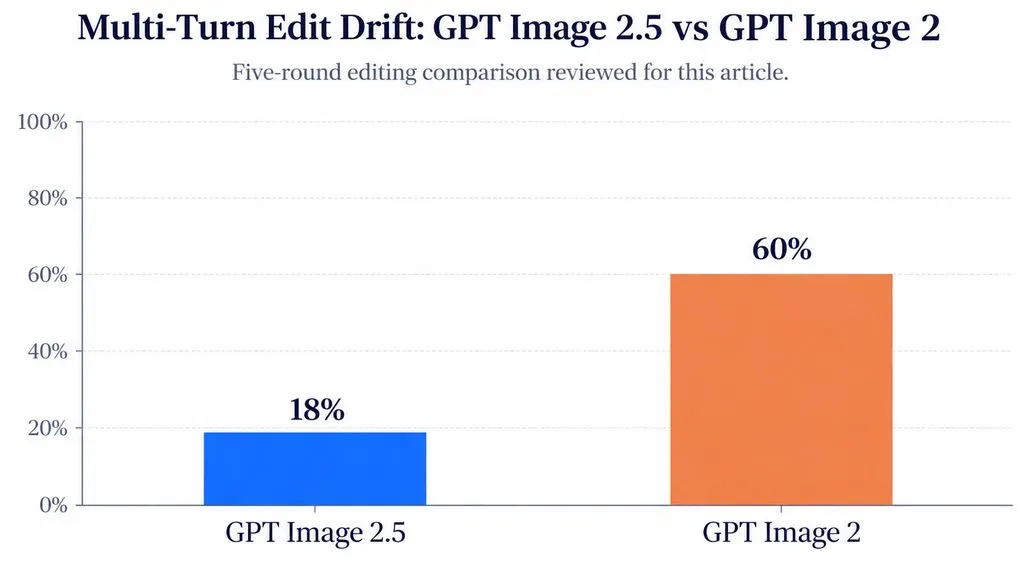
This matters because AI image editing often breaks after the first good result. Changing one detail can accidentally change the face, composition, background, or texture. In one five-round comparison reviewed for this article, GPT Image 2.5 changed about 18% of pixels per edit versus roughly 60% with GPT Image 2. One UI workflow also reported around 2× faster generation at roughly half the cost with Flare Medium. The real question is not which model makes the best first image, but which one requires less rework to reach a usable final asset.
For professional workflows, GPT Image 2.5 works best as part of a broader creative system. Virse connects references, assets, decisions, and AI-generated variations in one workspace, with an infinite canvas, multi-Agent collaboration, shared project context, and long-term design memory. This makes it easier to explore faster, preserve approved directions, and manage revisions without restarting from isolated prompts.
What Is New in GPT Image 2.5 Compared With GPT Image 2?
GPT Image 2.5 improves both image generation and the process around it. The most important changes are sharper details, more natural lighting, richer textures, stronger reference fidelity, more precise editing, and better consistency across repeated edits.
For designers, the last three are the most consequential because they determine whether a promising image can survive an actual AI design workflow revision cycle.
Image Quality Improved, but It Is Not the Main Upgrade
GPT Image 2.5 can produce sharper details and more natural-looking lighting and textures than the previous generation. It also handles more complex visual instructions and layouts more reliably.
However, our review does not support treating raw image quality as the defining improvement.
In professional workflows, an excellent first image has limited value if changing a jacket also changes the face, or replacing a product forces the entire composition to be regenerated. The ability to preserve an approved direction is more valuable than a small increase in one-shot visual quality.
GPT Image 2.5 Reduces Unwanted Changes During Editing
One of the strongest quantitative cases in our research involved five consecutive edits.
GPT Image 2.5 changed approximately 18% of the pixels per edit, compared with about 60% for GPT Image 2 in the same reported test.
Pixel difference is not a perfect measure of semantic consistency, so this should not be treated as a universal benchmark. But it captures an important production improvement: targeted edits are less likely to reconstruct unrelated parts of the image.
That matters when changing clothing while preserving a face, replacing a background without altering a subject, recoloring an illustration while maintaining line work, or swapping a product while keeping the composition intact.
Content Drift and Quality Drift Are Different Problems
Multi-turn consistency still has limits.
Content drift occurs when an edit unexpectedly changes a face, pose, object, composition, or color that should remain fixed.
Quality drift occurs when the correct content survives but repeated editing introduces oversharpening, synthetic texture, repetitive patterns, or excessive micro-detail.
Across the workflow cases reviewed for this article, GPT Image 2.5 appears to improve content drift more convincingly than quality drift. For longer sessions, keep clean checkpoints and branch from an earlier approved image when texture begins to deteriorate.
Sketch, Image Comments, and Templates Improve the Editing Loop
GPT Image 2.5 is also supported by workflow features that reduce dependence on text-only prompting.
Sketch lets users communicate composition or shape visually. Image comments make it easier to point to a specific area that needs changing. Templates provide starting structures for common creative formats such as posters, merchandise, flyers, and product imagery.
From a design perspective, these features matter because creative intent is often easier to express spatially than verbally. They push the interaction closer to visual collaboration and away from repeatedly rewriting prompts.
GPT Image 2.5 Flare vs Sunburst: Which Should You Use?
Flare prioritizes speed, throughput, and iteration. Sunburst prioritizes precision, reference fidelity, and detailed creative control.
They should be treated as different production strategies rather than simple low-quality and high-quality modes.
GPT Image 2.5 Flare Is Better for Fast Production
Flare makes the most sense for UI exploration, campaign variations, social assets, visual brainstorming, moodboards, and rapid A/B testing.
OpenAI reports that Images 2.5 can reduce generation latency by up to 50% compared with Images 2.0, while Flare is positioned as the faster production-oriented API option.
The workflow evidence is similarly useful. In one UI production case, Flare Medium was reported at roughly 2× the speed and about half the cost of the previous GPT Image 2 Medium workflow.
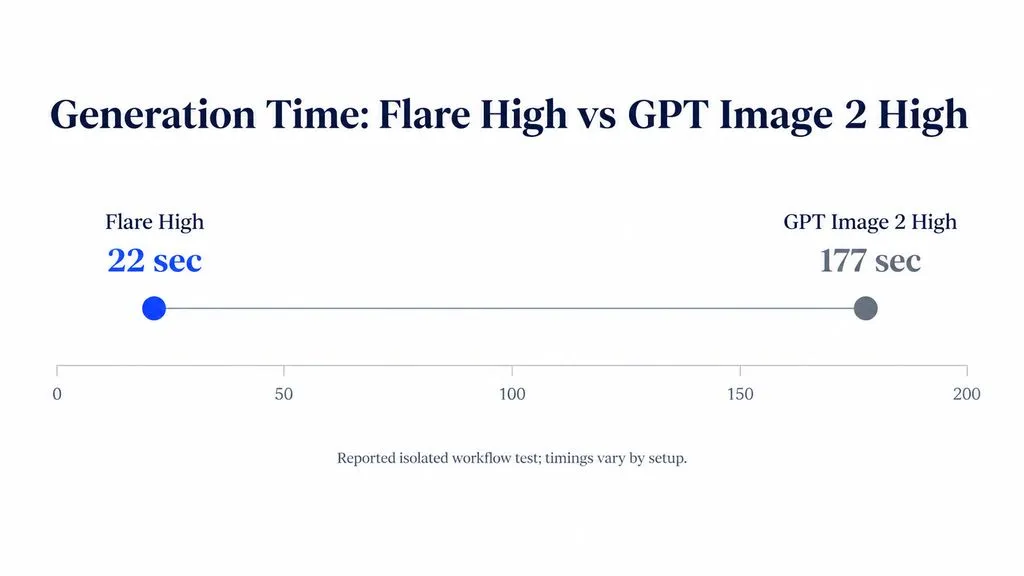
Another isolated test recorded 22 seconds for Flare High versus 177 seconds for GPT Image 2 High.
These numbers should not be generalized to every environment, but they illustrate why Flare changes the economics of exploration: designers can evaluate more directions before committing to one.
GPT Image 2.5 Sunburst Is Better for Precision
Sunburst intentionally trades additional generation time for more precise creative control.
It is better suited to character references, complex image constraints, multi-reference tasks, important campaign assets, and edits where identity or product fidelity matters more than immediate feedback.
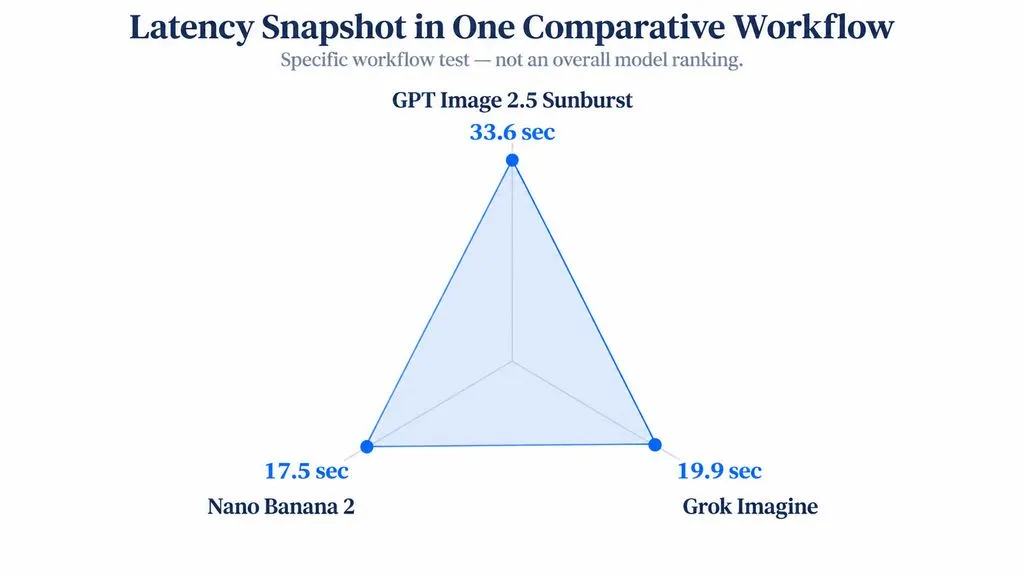
One comparative workflow reviewed for this article recorded 33.6 seconds for Sunburst, compared with 19.9 seconds for Grok Imagine and 17.5 seconds for Nano Banana 2 in that specific setup.
Sunburst was slower, but speed was not the purpose of the test. The task involved moving a weak character reference into a new environment while preserving the subject.
The Best Workflow Uses Flare and Sunburst Together
For professional design work, I would not use one variant for every stage.
A stronger workflow is:
- Explore broadly with Flare.
- Select the strongest direction before increasing generation cost.
- Add stronger references and preservation requirements.
- Use Sunburst for reference-sensitive or high-value refinement.
- Move stubborn pixel-level corrections into a dedicated editing tool.
This separates fast creative exploration from expensive precision work.
How Good Is GPT Image 2.5 Character Consistency and Reference Fidelity?
Reference fidelity is one of GPT Image 2.5's strongest production advantages because an approved reference can become the foundation for multiple related assets.
One Character Reference Can Become a Small Asset System
A game-development case in our research began with one full-body character image and expanded it into a 4×4 sprite sheet with 16 frames, targeting approximately 128-pixel pixel art.
The character remained visually consistent enough for rapid prototyping across multiple actions.
But some frames introduced left-right leg errors and other motion inconsistencies. This reveals an important distinction: identity consistency does not guarantee anatomical or temporal consistency.

Character Sheets Can Improve AI Storyboard Consistency
The same principle is valuable in AI filmmaking.
A recurring workflow problem is character drift between shots: the face changes, clothing shifts, or distinctive features disappear.
A stronger process is:
Cast sheet → storyboard frames → approved visual references → video generation
The cast sheet acts as a reusable identity anchor. GPT Image 2.5 does not need to replace the entire filmmaking pipeline to create value; it can make the upstream visual system more stable before motion generation begins.
Is GPT Image 2.5 Good for UI Design?
GPT Image 2.5 is particularly useful for UI concept generation and visual-direction exploration, especially when Flare makes it economical to test multiple layouts.
Flare Makes UI Exploration More Practical
The reported 2× speed and roughly 50% lower cost in one UI workflow matters because product design benefits from breadth early in the process.
Instead of spending too much time refining the first plausible interface, designers can compare several compositions, hierarchies, and visual systems before choosing a direction.
From a product design perspective, this is where faster image generation creates real value: it increases the number of ideas a team can afford to reject.
The Image-to-Interface Gap Still Matters
A strong generated UI image is still a flat visual.
It does not automatically contain reusable components, responsive behavior, interaction states, accessibility decisions, design tokens, or application structure.
Our review of recurring user questions shows that image-to-interface conversion remains a major bottleneck. GPT Image 2.5 can accelerate concept development, but production implementation still requires structured design and front-end tools.
GPT Image 2.5 for Slides, Game Assets, and AI Filmmaking
Some of the strongest use cases appear when GPT Image 2.5 becomes one stage inside a larger creative pipeline.
AI Presentation Design Can Be Extremely Fast
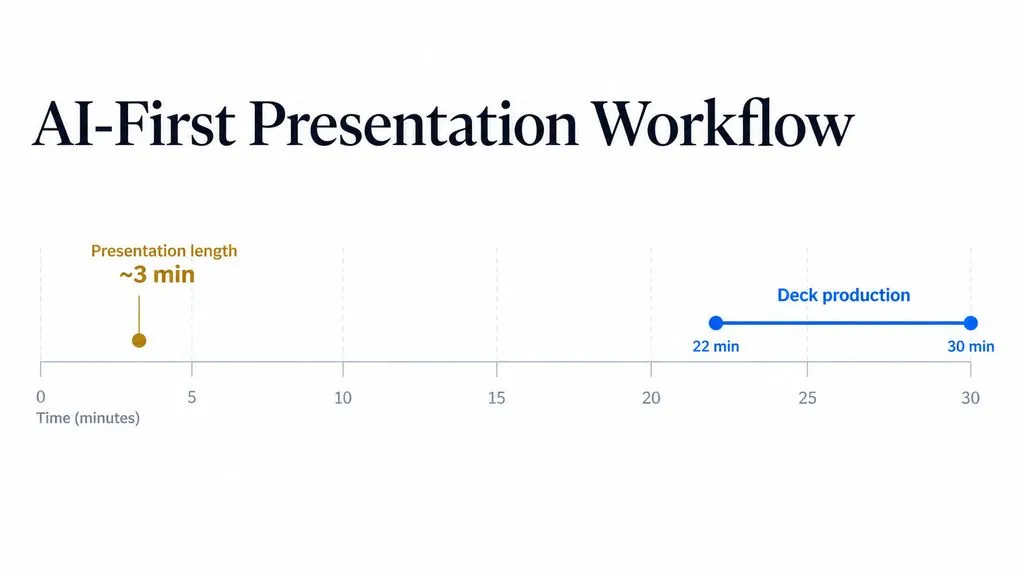
One documented presentation workflow produced a deck in approximately 22–30 minutes, depending on the version of the process recorded during the research.
The presentation was designed for roughly three minutes of speaking time.
The workflow used existing brand or website material as context and generated visually coherent slides rather than manually constructing every page.
The limitation is editability. A flat slide image does not provide independent text boxes, charts, icons, or layout layers. Rapid creation can therefore become slow revision when stakeholders request many small changes.
Game Assets Benefit From Reference-First Generation
The 16-frame sprite example shows how one approved character can quickly become a family of prototype assets.
This is useful during early game development, where teams need enough visual consistency to test an idea before investing in polished animation.
The output still requires QA for hands, poses, limb direction, and frame-to-frame logic.
AI Filmmaking Benefits From Consistent Visual Anchors
For filmmaking, GPT Image 2.5 is most useful as a visual consistency layer before video generation.
A stable character sheet can anchor storyboard frames, which then move into downstream video tools such as Seedance.
The value is not “AI makes the entire film.” It is reducing identity reconstruction every time the shot changes.
GPT Image 2.5 vs Nano Banana Pro: Which Is Better?
There is no credible universal winner across all visual tasks.
Our review found stronger evidence for GPT Image 2.5 in multi-turn editing, reference control, complex instruction adherence, and preserving approved visual decisions.
Some comparative workflows favored Nano Banana Pro for natural skin, photographic texture, or particular product-image tasks.
GPT Image 2.5 Is Stronger When Revision Control Matters
A model can win a one-shot realism comparison and still create a worse production workflow.
If changing clothing alters the face, or replacing a background requires recreating the entire image, every revision becomes expensive.
For professional work, I would evaluate final usable asset cost: generation time, retries, drift, cleanup, and tool switching rather than first-image aesthetics alone.
Photorealism Still Has No Clear Winner
The evidence does not support calling GPT Image 2.5 the universal leader in photorealism.
Reported limitations include oversharpening, synthetic microtexture, excessive patterning, and texture degradation after repeated edits.
This reinforces the central finding of this review: GPT Image 2.5's clearest advantage is control over an evolving visual asset, not simply maximum realism in one generation.
What Are the Biggest GPT Image 2.5 Problems?
GPT Image 2.5 improves the middle of the creative workflow, but the last mile still requires careful QA.
Hands, Anatomy, and Local Repairs Still Fail
Hands, wrists, limb direction, small characters, and object interactions remain unreliable.
In one case reviewed for this article, a problematic wrist was edited several times without a satisfactory correction and was eventually repaired in Photoshop.
This shows why semantic editing is not yet the same as pixel-level retouching.
Repeated Editing Can Damage Texture
Even when the subject remains stable, repeated edits can accumulate artificial detail.
Grass, skin, fabric, trees, and other textured regions can become oversharpened or develop repetitive patterns.
For longer editing sessions, treat approved images as checkpoints instead of assuming the newest output should always become the master.
Transparency Still Needs Verification
Transparency can also be inconsistent.
One documented logo workflow produced approximately 85% usable transparency, while another object test left only about half of the expected area transparent. In some cases, asking for transparency through wording alone resulted in a visual checkerboard rather than genuine transparency.
Always verify the exported alpha channel instead of judging transparency by appearance.
Typography and Structured Editability Remain Separate Problems
GPT Image 2.5 can generate convincing posters, slides, and UI visuals, but visual appearance is not the same as structured editability.
Text still requires review, while generated designs do not automatically provide editable vectors, layers, components, or presentation objects.
Dedicated design tools remain important whenever the final deliverable must be precisely editable.
Can GPT Image 2.5 Reliably Deliver Native 4K Output?
Not consistently across the workflows reviewed for this article.
The important distinction is between requesting 4K, receiving a native high-resolution file, and using third-party enhancement to reach 4K.
A 4K Request Does Not Guarantee a 4K File
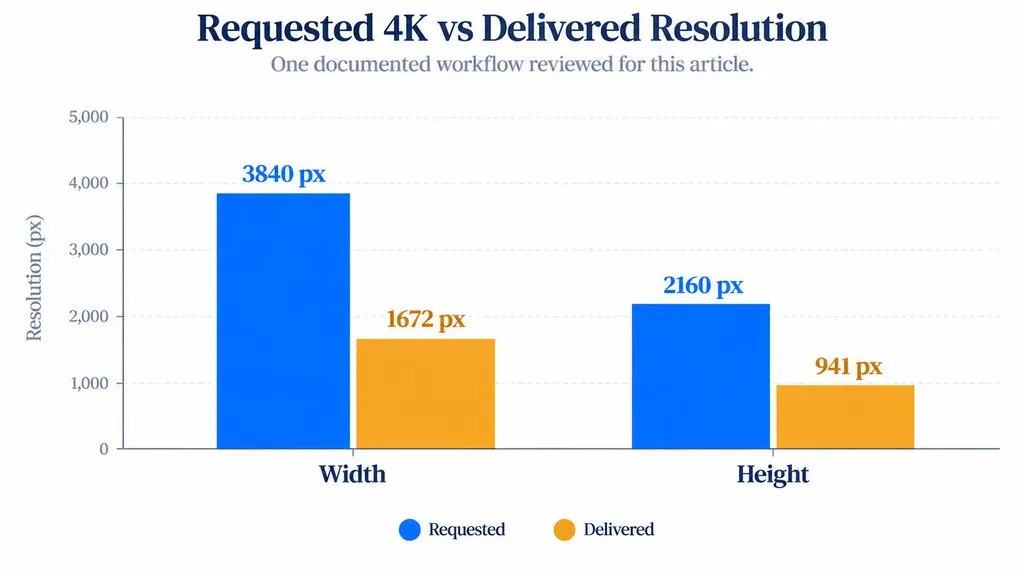
One documented workflow requested 3840×2160 but received an image around 1672×941 pixels.
A subsequent upscale request appeared to increase perceived sharpness without changing the underlying dimensions.
This does not prove that GPT Image 2.5 cannot produce higher resolutions. It shows that requested resolution and delivered resolution should not be treated as the same thing.
Third-Party 4K Workflows Are Different From Native Output
Another workflow used Magnific to produce 4K output at a reported cost of approximately $1 per image.
That pipeline may include its own enhancement or upscaling, so it should not be treated as proof that the same resolution was generated natively by GPT Image 2.5.
For professional delivery, always inspect the exported pixel dimensions.
Who Should Use GPT Image 2.5?
GPT Image 2.5 is most valuable when a project depends on iteration, consistency, and asset reuse.
UI and product teams can use Flare for broader visual exploration. Brand teams can maintain stronger references across variations. Game developers can expand characters into prototype asset families. AI filmmakers can stabilize storyboards before video generation. Marketing teams can revise campaign imagery without recreating every approved element.
It is less decisive for workflows that need only one attractive image, rely on pixel-perfect retouching, or require fully editable structured assets from the beginning.
The more revision cycles a project contains, the more valuable GPT Image 2.5 becomes.
Conclusion
GPT Image 2.5 matters because it moves AI image creation from isolated generations toward visual assets that can survive a real creative workflow. Its strongest advantages are lower edit drift, better reference fidelity, faster Flare production, and more practical character, UI, storyboard, slide, and game-asset workflows—not a universal leap in photorealism. Hands, anatomy, texture degradation, exact local corrections, inconsistent high-resolution delivery, transparency edge cases, and limited structured editability still require specialist tools. For professional creative teams, the strongest approach is therefore hybrid: use GPT Image 2.5 to explore faster, preserve approved visual decisions, and accelerate revisions, then move precision-critical work into the tools best suited to final delivery.
FAQ
Is GPT Image 2.5 better than GPT Image 2?
For editing-heavy workflows, yes, the improvement is meaningful. One five-round comparison reviewed for this article measured about 18% pixel change per edit with GPT Image 2.5 versus roughly 60% with GPT Image 2. The strongest upgrade is revision stability and reference preservation rather than a universal leap in first-image quality.
Should I use Flare or Sunburst?
Use Flare for speed, volume, UI exploration, and early creative iteration. Use Sunburst when reference fidelity, character identity, complex constraints, or precision matter more than latency. For professional workflows, Flare for exploration followed by selective Sunburst refinement is usually more efficient than using one variant throughout.
Is GPT Image 2.5 better than Nano Banana Pro?
Not for every task. GPT Image 2.5 shows stronger evidence in multi-turn editing, reference control, and complex instruction adherence, while some comparative workflows favor Nano Banana Pro for natural photographic texture or specific product imagery. The better option depends on whether the project prioritizes realism, revision stability, reference fidelity, or product accuracy.
Can GPT Image 2.5 generate true 4K?
Native 4K delivery is not consistently demonstrated across the workflows reviewed here. One 3840×2160 request produced an image around 1672×941 pixels, while third-party pipelines have achieved 4K through additional processing. For production use, verify the exported pixel dimensions rather than assuming a 4K request guarantees a native 4K file.
Mais do blogue da Virse
Produto
GPT Image 2.5 Pricing: Flare vs Sunburst & the Real Cost per Image
14 de setembro de 2026 by Vincent
Produto
How Much Is Kling 3.0? 2026 Pricing, Credits, and Real Cost per Video
8 de setembro de 2026 by Yifan Zhao
Produto
What Is a Product Mockup? How to Make It Look Real Without Misleading Customers
7 de setembro de 2026 by Vincent