
Nano Banana Review: Pro vs Nano Banana 2 for Character Consistency
 Yifan Zhao12 min de leitura ·

Nano Banana 2 is the best Nano Banana model for most designers who need fast iteration, scalable image production, 4K output, and character-editing performance comparable to Pro. Nano Banana Pro is the better choice for complex multi-reference compositions, demanding object or environment edits, and high-value assets where precision matters more than speed or cost. Neither model guarantees perfect character consistency across every pose, camera angle, costume, scene, or editing round. Teams comparing production costs should also account for Nano Banana pricing and understand how to use Nano Banana to edit photos.
That limitation becomes expensive in production. A character may retain the same face while body proportions, clothing construction, tattoos, accessories, or secondary subjects gradually change. Repeated edits can also modify areas that were never meant to be touched, forcing designers to regenerate images, compare versions, reconstruct prompts, and manually track approved references. The real challenge is not producing one impressive image — it is maintaining creative direction across an entire campaign, storyboard, product line, or visual narrative. A structured AI design workflow from brief to delivery and a consistent art direction process can reduce that production drift.
Virse helps professional design teams turn disconnected AI outputs into a controlled creative workflow. Its infinite canvas lets designers organize, connect, compare, and refine references and generated assets while multiple agents work on different project tasks with shared context. Virse also retains aesthetic preferences, brand rules, and project knowledge, making batch generation, style continuation, asset organization, and multi-round revision easier to manage—without removing the designer from art direction, review, or final approval. This approach aligns with broader AI design Agent creative workflows and AI design systems.
Nano Banana Review Verdict: Which Model Should You Choose?
Choose Nano Banana 2 for most day-to-day creative production. Choose Nano Banana Pro when a task combines several characters, products, environments, style references, typography, or strict brand constraints.
Google positions Nano Banana 2 as the general-purpose model with the best overall balance of performance, intelligence, cost, and latency. Pro is positioned for professional asset production and complex instructions. Nano Banana 2 Lite is the lowest-cost, highest-throughput option, but Google states that it is not optimized for multiple reference inputs or sequential multi-turn editing.
Requirement | Best Choice | Why |
Fast concept exploration | Nano Banana 2 | Low latency and flexible resolution |
Recurring single character | Nano Banana 2 | Character-editing benchmark is comparable to Pro |
Complex multi-reference scene | Nano Banana Pro | Higher point estimate for multi-input editing |
Object or environment reconstruction | Nano Banana Pro | Higher point estimate in Google’s editing evaluation |
High-volume image production | Nano Banana 2 | Lower standard API cost |
Maximum throughput at 1K | Nano Banana 2 Lite | Lowest price and latency |
Final pixel-accurate retouching | Traditional editor | Generative models may alter non-target regions |
What Are the Nano Banana Models?
Original Nano Banana
The original Nano Banana is Gemini 2.5 Flash Image. It introduced the family’s conversational approach to image generation and editing, allowing users to describe changes in natural language rather than create masks or node-based workflows.
Google now classifies it as the legacy model. It remains useful for low-latency 1024-pixel generation, but Google recommends moving to newer models for improved quality, speed, resolution, and pricing.
Nano Banana 2
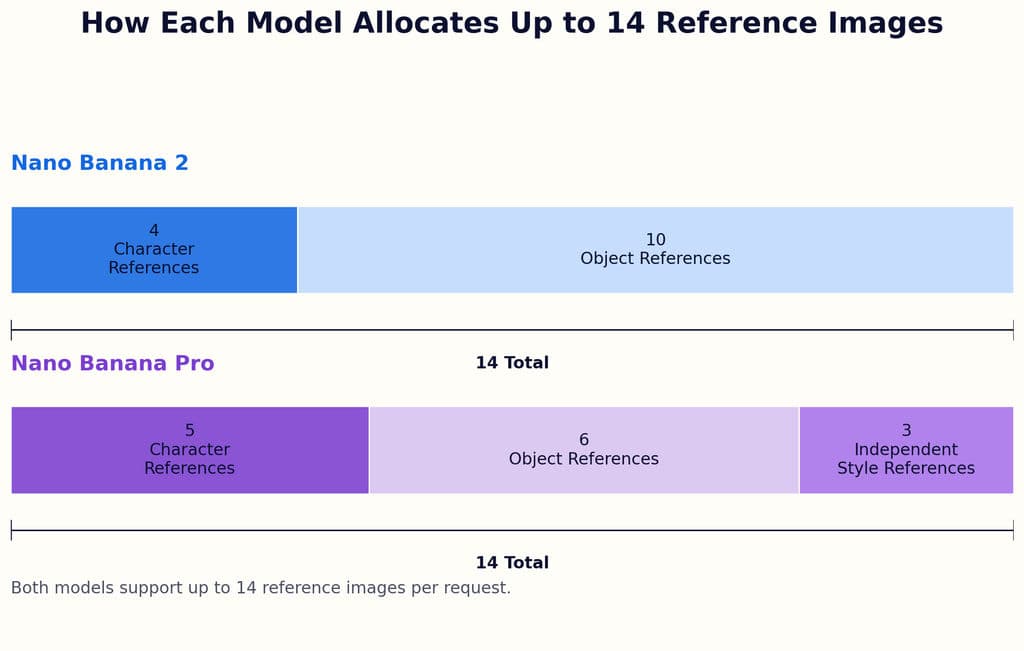
Nano Banana 2 is Gemini 3.1 Flash Image, the current general-purpose model. It supports 0.5K, 1K, 2K, and 4K output, wider aspect ratios, thinking, web and image-search grounding, improved text rendering, and conversational editing.
It can use up to 10 high-fidelity object references and four character references within a workflow. For designers creating product variations, marketing assets, storyboards, or recurring characters, this combination of reference capacity and lower cost makes it the strongest default option.
Nano Banana Pro
Nano Banana Pro is Gemini 3 Pro Image, designed for professional asset production and complex visual instructions. It supports up to six object references, five character references, and three dedicated style references, with up to 14 reference images in total.
Pro is particularly relevant when identity, product fidelity, visual style, typography, composition, and environment must all be controlled in the same generation. Its advantage is not guaranteed superiority on every image; it is a stronger configuration for briefs with many interacting constraints.
Nano Banana 2 Lite
Nano Banana 2 Lite is Gemini 3.1 Flash Lite Image. It is Google’s fastest and cheapest model in the family and currently supports 1K output. However, it is not optimized for multiple reference inputs or long sequential editing workflows, so it is less suitable for a character consistency review centered on cross-scene identity and multi-turn revisions.
Nano Banana Character Consistency Review: What Does Consistency Mean?
Character consistency is the ability to preserve a subject’s recognizable identity and design across different images, poses, camera angles, scenes, and editing rounds. A similar face alone is not enough.
Our review uses five dimensions:
- Identity consistency: facial structure, apparent age, skin details, and recognizable features.
- Body consistency: height, build, silhouette, and body proportions.
- Wardrobe consistency: clothing construction, colors, hairstyle, jewelry, tattoos, and accessories.
- Style consistency: line quality, textures, lighting language, and rendering method.
- Scene continuity: stability across poses, viewpoints, environments, and sequential edits.
This distinction matters because single-image subject preservation, cross-scene character consistency, and multi-turn editing continuity are separate capabilities. A successful background replacement does not prove that the same character will remain stable across 30 independently generated scenes.
Nano Banana Research Methodology
This review synthesizes official Google documentation, DeepMind model cards, published image-editing research, documented workflow cases, and 24 recurring questions identified in our review of public evaluations and production discussions. Those questions concentrated on body drift, side-profile consistency, local-edit overreach, multi-character scenes, platform differences, repeated-edit degradation, factual accuracy, and production cost.
External cases are not presented as our own generation tests. Official benchmark numbers are identified as Google evaluations, while independent examples are used only to explain practical workflow patterns.
Nano Banana Pro vs Nano Banana 2 Character Consistency Results
Character Editing Performance Is Comparable
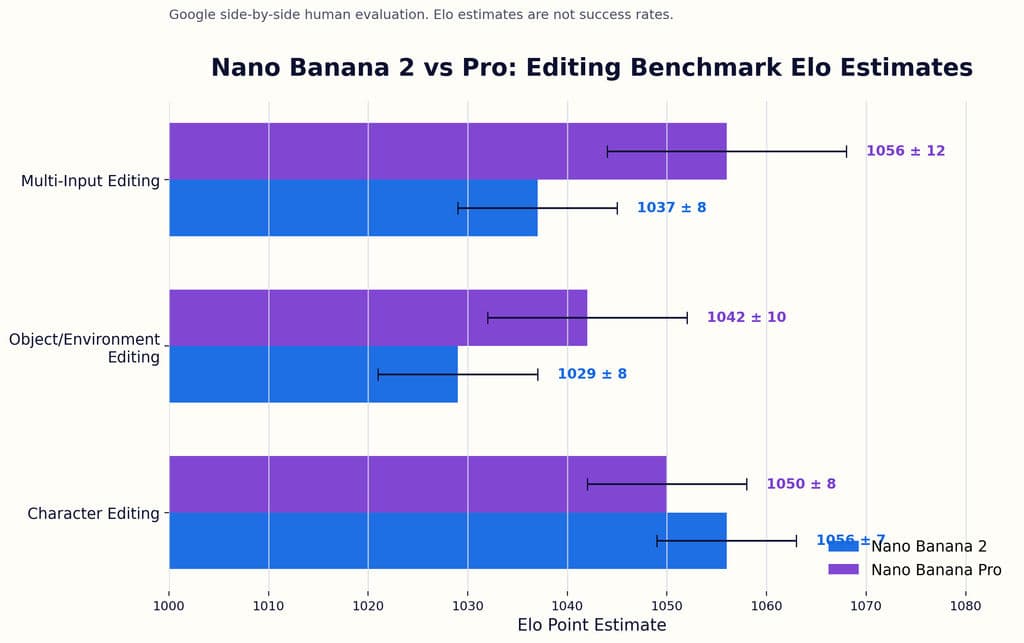
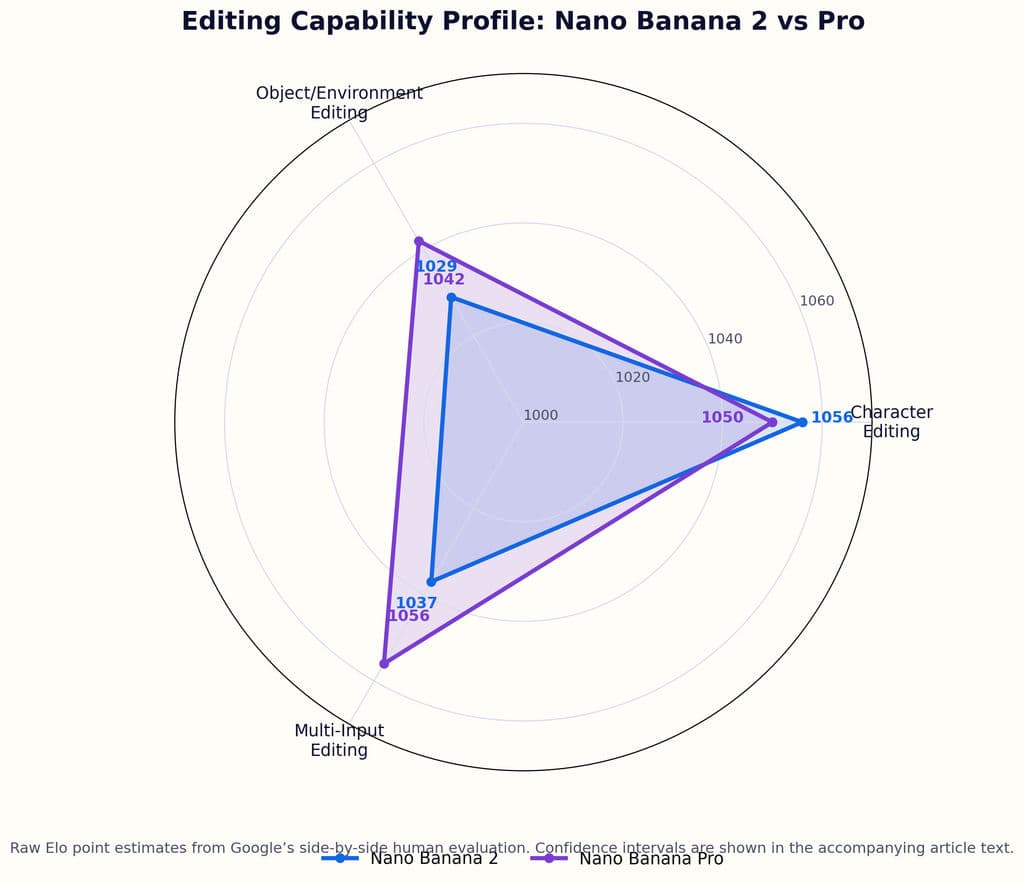
In Google’s side-by-side human evaluation, Nano Banana 2 with thinking and search received a character-editing Elo estimate of 1056 ± 7, while Nano Banana Pro received 1050 ± 8. Because the intervals overlap, the correct conclusion is that their measured character-editing performance was comparable, not that Nano Banana 2 definitively defeated Pro.
For a single recurring person or mascot with clear references, Nano Banana 2 should therefore be sufficient in many workflows. Pro becomes more relevant when character identity must coexist with more complex environmental, object, typography, or style constraints.
Pro Had Higher Point Estimates for Complex Editing
Nano Banana Pro received a 1056 ± 12 point estimate for multi-input editing, compared with 1037 ± 8 for Nano Banana 2 with search. Pro also received 1042 ± 10 for object and environment editing, compared with 1029 ± 8 for Nano Banana 2.
These results suggest a practical advantage for Pro on complex briefs, although overlapping confidence ranges mean they should not be treated as universal pass rates or guaranteed outcomes.
Face Consistency Is Not Full Character Consistency
Our review of documented workflows found a recurring pattern: facial identity often remains recognizable while body shape, clothing details, accessories, or secondary subjects change. This is especially visible when moving from a frontal portrait to a side profile, full-body pose, action scene, or group composition.
Google’s own model card acknowledges that character consistency between input and output images is not always perfect. It also lists small text, spatial localization, and partial instruction-following as areas that still need improvement.
Nano Banana Pro vs Nano Banana 2 Pricing and Value
Metric | Nano Banana Pro | Nano Banana 2 |
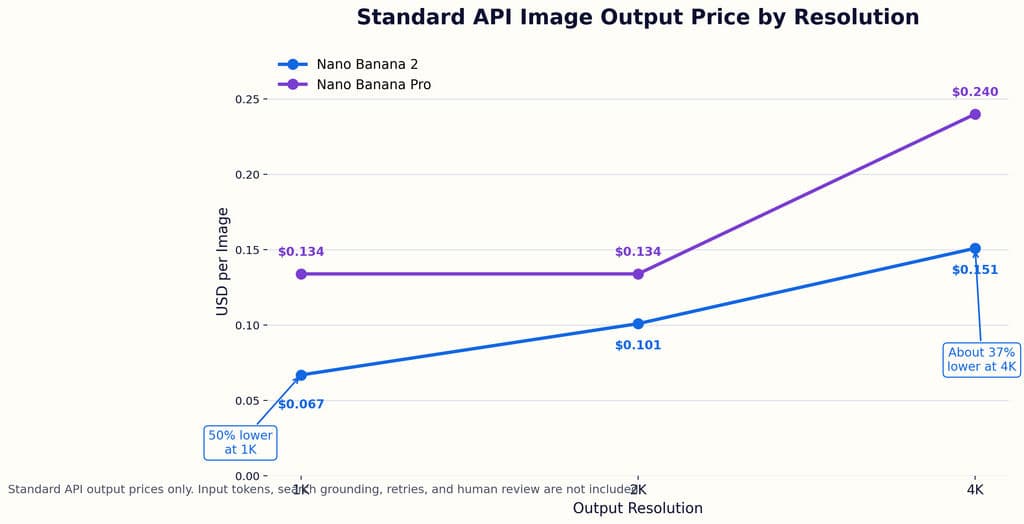
Standard 1K output | $0.13 | $0.07 |
Standard 2K output | $0.13 | $0.10 |
Standard 4K output | $0.24 | $0.15 |
Character references | Up to 5 | Up to 4 |
Object references | Up to 6 | Up to 10 |
Dedicated style references | Up to 3 | Not separately allocated |
Best fit | Complex professional assets | High-volume general production |
At standard API rates, Nano Banana 2 costs 50% less than Pro for a 1K output and about 37% less for a 4K output. These figures exclude input tokens, search grounding beyond included allowances, rejected generations, retries, and human review.
The cheapest image is not always the least expensive production choice. A useful calculation is:
Real production cost = API fees + failed outputs + retries + review time + correction work + asset management.
For large campaigns, use Nano Banana 2 for exploration and variations, then reserve Pro for scenes whose complexity justifies its higher cost.
Nano Banana Case Studies: What the Evidence Reveals
Five-Round Editing Can Preserve Composition but Lose Identity Details
In one documented five-round Nano Banana 2 workflow, the main composition of two people clinking glasses remained recognizable, while skin tone, tattoos, bracelets, and sleeves changed during successive edits.
The case demonstrates an important distinction: composition continuity may remain stronger than identity-detail continuity. A sequence can still look structurally correct while becoming unusable for a branded character, fashion subject, or visual narrative.
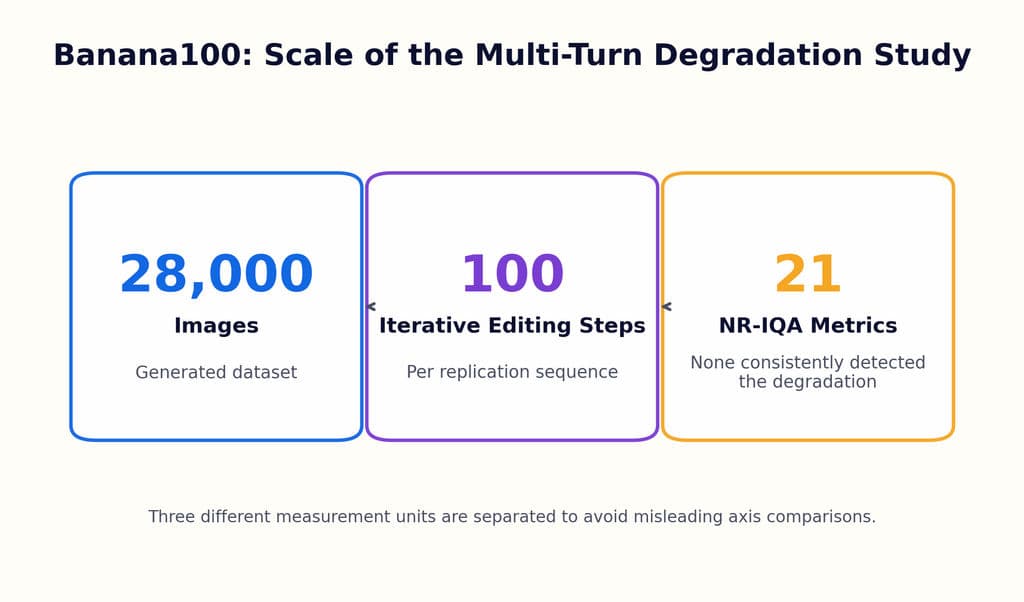
Banana100 Found Degradation Across 28,000 Images
The Banana100 study created a dataset of 28,000 images generated through 100 iterative editing steps with Nano Banana Pro. Researchers found that minor artifacts accumulated into severe visible degradation and that none of 21 commonly used no-reference image-quality metrics consistently identified the decline.
For professional workflows, this supports a clear rule: do not keep editing the latest output indefinitely. Save approved checkpoints and return to the last clean image when facial detail, texture, instruction following, or object fidelity begins to drift.
Local Editing Can Change Untouched Areas
Generative image editing reconstructs an output conditioned on the source image and instruction; it does not behave like a conventional editable layer. Research has documented spatial misalignment, texture distortion, and hallucinated content in workflows that require pixel-level fidelity.
This explains why changing an eyebrow, reflection, jacket color, or background can also affect body shape, skin texture, lighting, or composition. Visual plausibility should never be confused with structural preservation.
How to Improve Nano Banana Character Consistency
Build a Controlled Character Reference System
Use a reference set containing:
- A frontal portrait
- A three-quarter view
- A side profile
- A full-body image
- A clear view of clothing and accessories
Avoid references that contradict one another in hairstyle, apparent age, costume, body shape, or visual style. More references do not automatically improve consistency if they introduce conflicting signals.
Separate Fixed Identity From Editable Variables
Use a prompt structure such as:
Preserve Maya’s facial structure, apparent age, body proportions, hairstyle, navy jacket construction, silver necklace, and black boots. Change only the pose, camera angle, environment, and lighting.
The phrase “change only” reduces ambiguity by separating permanent attributes from scene variables.
Change One Variable at a Time
A reliable sequence is:
- Establish the approved character.
- Change the pose.
- Change the camera angle.
- Change the environment.
- Change the lighting.
- Reuse the approved result as the next reference.
- Return to the last clean checkpoint when drift appears.
Google similarly recommends including previously generated images in subsequent prompts and supplying a pose reference for difficult angles.
Manage Consistency as a Design-System Problem
Prompt quality alone cannot manage a large visual project. Teams also need to track references, selected outputs, failed generations, revision history, visual rules, and approval status.
Virse can serve as the canvas-based workflow layer for this process. Designers can keep connected references and outputs visible on one infinite canvas, assign different tasks to multiple agents, and retain project and brand context across revisions. This makes it easier to extend an approved direction across campaign formats, products, scenes, or markets while keeping human review central.
Nano Banana Image Editing, Text, and Factual Accuracy Risks
Nano Banana 2 performs strongly in Google’s visual-quality and infographic evaluations, especially when search grounding is enabled. However, Google still identifies hallucinations, small-text problems, imperfect character consistency, and spatial confusion as known limitations.
Before publishing an infographic or product visual:
- Verify every number and factual claim against its original source.
- Check product geometry, labels, logos, and packaging details.
- Compare faces, bodies, clothing, and backgrounds with the references.
- Rebuild critical typography as editable text.
- Complete pixel-sensitive corrections in a conventional editor.
All Gemini API-generated Nano Banana images also include Google’s SynthID watermark.
Nano Banana Review Conclusion
Nano Banana 2 is the strongest default model for most AI-assisted design workflows because it combines character-editing performance comparable to Pro with lower pricing, faster iteration, flexible resolutions, and stronger production scalability. Nano Banana Pro remains the more appropriate choice for complex multi-reference scenes, demanding object or environment edits, and premium assets with many interacting constraints. Neither model provides unlimited character locking or non-destructive editing, so reliable results still depend on structured references, controlled prompts, saved checkpoints, factual verification, asset management, and human quality control.
FAQ
Is NB2 Better Than NB Pro for Character Consistency?
NB2 and NB Pro produced comparable character-editing results in Google’s current human evaluation. NB Pro had higher point estimates for multi-input and object or environment editing. Start with NB2 for one recurring character and high-volume production; use NB Pro when several characters, products, styles, and environments must be controlled together.
Why Does NB Change the Body When Editing a Face?
NB generates a new conditioned image rather than changing only the requested pixels. A facial instruction can therefore affect body proportions, clothing, lighting, or background details. Clearly state what must remain unchanged, modify one variable per round, and return to the last approved reference when drift begins.
Is NB2 a Downgrade From NB Pro?
The available official benchmark does not support a general downgrade claim. NB2 received higher point estimates for overall preference, visual quality, general editing, and character editing, while NB Pro scored higher on selected complex-editing categories. Results still vary according to references, platform, prompt design, resolution, and task complexity.
Can NB Replace Photoshop?
NB can replace many concept exploration, relighting, background, recontextualization, and image-variation tasks, but it cannot replace Photoshop for exact masks, editable layers, pixel-level preservation, or reversible corrections. The strongest production workflow uses NB for generative exploration and a conventional editor for final precision and quality control. For that hybrid workflow, see how to use Nano Banana in Photoshop.
Mais do blogue da Virse
Produto
GPT Image 2.5 Pricing: Flare vs Sunburst & the Real Cost per Image
14 de setembro de 2026 by Vincent
Produto
GPT Image 2.5 Review: Does It Finally Fix AI Image Editing Drift?
14 de setembro de 2026 by Vincent
Produto
How Much Is Kling 3.0? 2026 Pricing, Credits, and Real Cost per Video
8 de setembro de 2026 by Yifan Zhao