FLUX 3 Image Pricing: How Much Does It Really Cost?
Vincent読了 11 分 ·
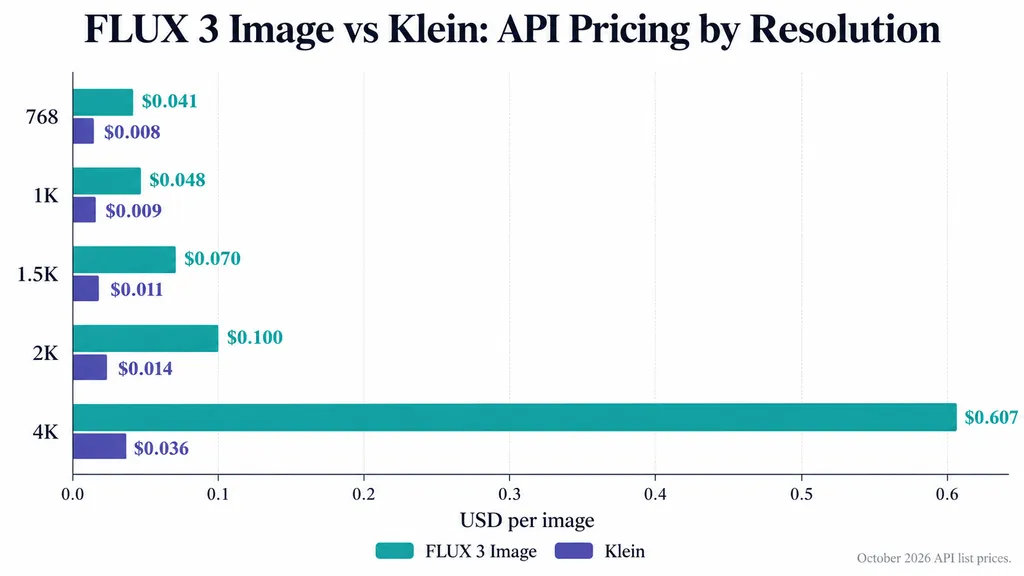
FLUX 3 Image pricing starts at $0.041 per image at 768 resolution, costs $0.048 at 1K, $0.100 at 2K, and reaches $0.607 at 4K. FLUX 3 Image Klein is considerably cheaper, ranging from $0.008 to $0.036 per image. At 4K, the standard model costs approximately 12.65 times its 1K price, making output resolution a critical factor in production budgets.
However, the real expense goes beyond API pricing. Repeated editing attempts, unwanted changes to approved designs, and high-resolution generations can increase costs. Our analysis of documented creative workflows, including a commercial poster involving six client revisions, illustrates why cost per usable image matters more than the advertised price per generation.
Virse brings FLUX 3 Image into a connected AI design workflow. Create and edit images at 1K, 2K, or 4K, compare results across AI models, and organize references, variations, and revisions on an infinite canvas. Instead of rebuilding work across separate tools, try Virse to develop product visuals, marketing assets, and creative concepts in one workspace, from initial exploration to final refinement.
How Much Does FLUX 3 Image Cost Per Image?
FLUX 3 Image uses pay-as-you-go API pricing, without mandatory subscriptions or seat fees. The base cost depends on the model, selected output resolution, and number of generated images.
FLUX 3 Image API Pricing by Resolution
Resolution | FLUX 3 Image | Klein | Standard/Klein |
768 | $0.04 | $0.01 | 5.13× |
1K | $0.05 | $0.01 | 5.33× |
1.5K | $0.07 | $0.01 | 6.36× |
2K | $0.10 | $0.01 | 7.14× |
4K | $0.61 | $0.04 | 16.86× |
USD per generated image. October 2026 standard API list prices.
Black Forest Labs charges according to the resolution tier selected in the API request, even when internal processing uses another resolution.
Its published standard-model pricing applies equally to text-to-image and image-to-image operations.
Consequently, changing a small object in an existing image is not automatically cheaper than generating a new image at the same resolution.
Why Is FLUX 3 Image 4K Pricing So Expensive?
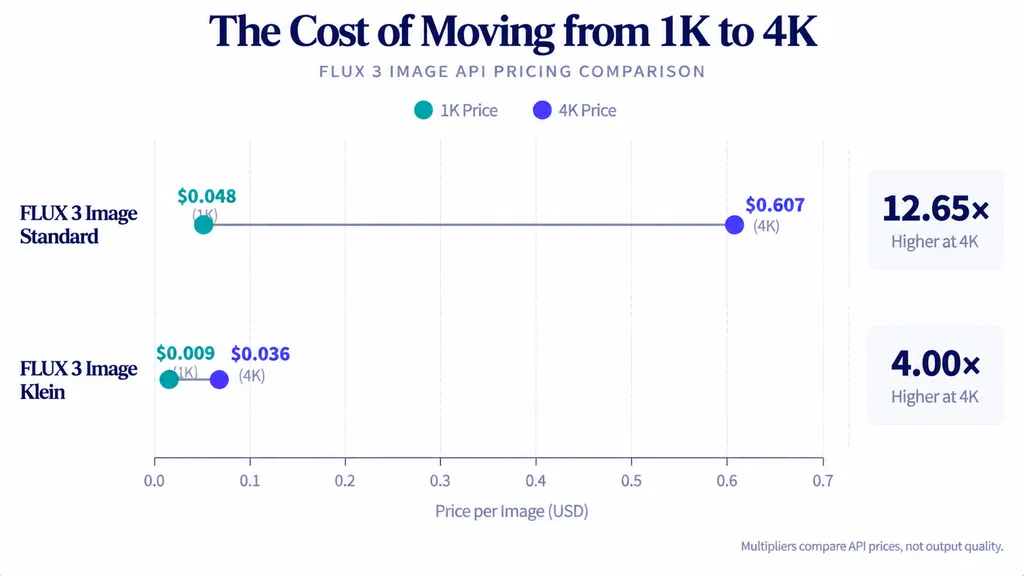
At $0.607, standard FLUX 3 Image's 4K rate is 6.07 times its 2K price and 12.65 times its 1K price.
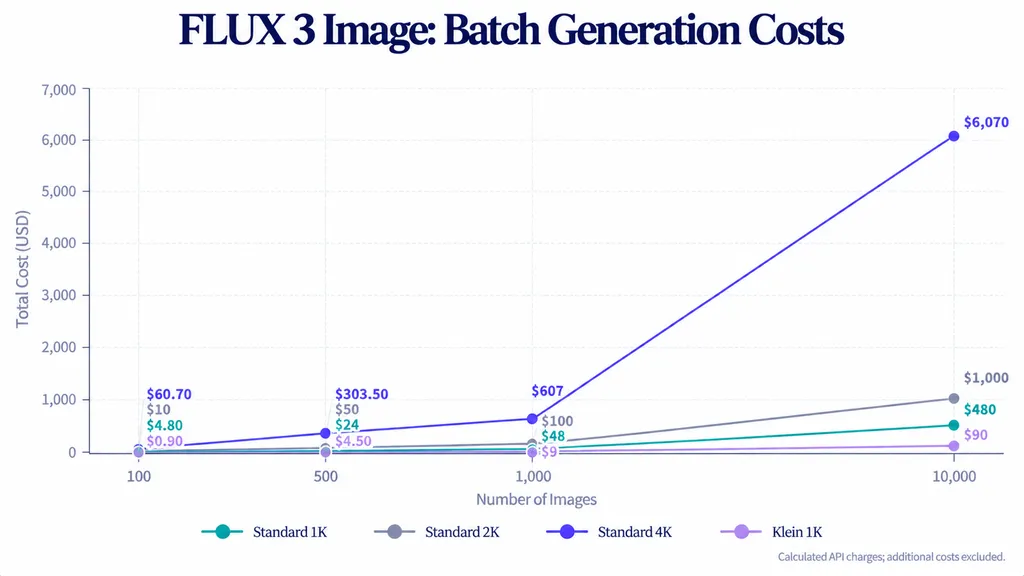
For 100 images, the base cost increases from $4.80 at 1K to $10 at 2K and $60.70 at 4K.
This creates an important distinction between creative exploration and final production.
For advertising concepts and product photography, 1K may provide sufficient detail to evaluate composition, lighting, and visual direction.
Higher-resolution generation becomes more relevant when an image is selected for detailed review or final delivery.
However, regenerating at 4K may introduce visual changes. Higher resolution should be treated as another production stage, not a guarantee of an identical upgraded image.
FLUX 3 Image vs Klein Pricing: Which Offers Better Value?
FLUX 3 Image Klein is cheaper at every published resolution, but lower API prices do not automatically mean lower production costs.
At 1K, Klein costs $0.009 compared with $0.048 for the standard model. At 4K, the price difference expands to $0.036 versus $0.607.
What Makes FLUX 3 Image Klein Different?
Klein is a 5.6-billion-parameter open-weights model supporting image generation, image editing, and multi-reference composition.
It supports up to 10 reference images and bounding-box controls for positioning elements or targeting localized changes.
The hosted implementation also provides pixel restoration designed to preserve unedited regions.
Black Forest Labs reports median API latency of 4.54 seconds for 1MP generation and 7.18 seconds for editing. These are provider-reported benchmarks, not independently reproduced measurements.
Klein's relatively low API cost makes it attractive for concept variations, product-background experiments, and targeted image revisions.
Is Klein Good Enough for Professional Photography?
An independently documented photography workflow provides evidence beyond API pricing.
The test involved editing clothing while checking whether body structure and surrounding visual details remained consistent.
Test Condition | Recorded Result |
GPU | NVIDIA RTX 5090 |
RAM | 64 GB |
Image size | 3,000 × 4,000 |
Inference steps | 16 |
Processing time | Approximately 230 seconds |
Body-shape preservation | 3 of 4 attempts |
Three of four editing attempts preserved body shape, suggesting promising localized editing behavior under those conditions.
However, the same evaluation raised concerns about original image-generation quality.
Editing an approved photograph and generating a new professional photograph are different creative tasks.
The small sample cannot establish a general editing success rate.
For professional use, evaluate anatomy, fabric texture, lighting continuity, product fidelity, and unchanged background details before selecting Klein for repeated production.
How Much Do 100 or 1,000 FLUX 3 Images Cost?
Batch expenses are calculated by multiplying the selected per-image rate by the number of generated images.
FLUX 3 Image Batch Pricing Examples
Images | Standard 1K | Standard 2K | Standard 4K | Klein 1K |
100 | $4.80 | $10.00 | $60.70 | $0.90 |
500 | $24.00 | $50.00 | $303.50 | $4.50 |
1,000 | $48.00 | $100.00 | $607.00 | $9.00 |
10,000 | $480.00 | $1,000.00 | $6,070.00 | $90.00 |
Calculated API charges before retries, additional services, or production expenses.
At 1K, generating 1,000 images costs $48 with standard FLUX 3 Image versus $9 with Klein.
At 4K, the equivalent costs are $607 and $36.
For ecommerce catalogs, marketing campaigns, and large creative libraries, these differences can substantially affect production budgets.
Why Cost per Usable Image Matters More Than API Price
An API-generated image is not necessarily an approved design.
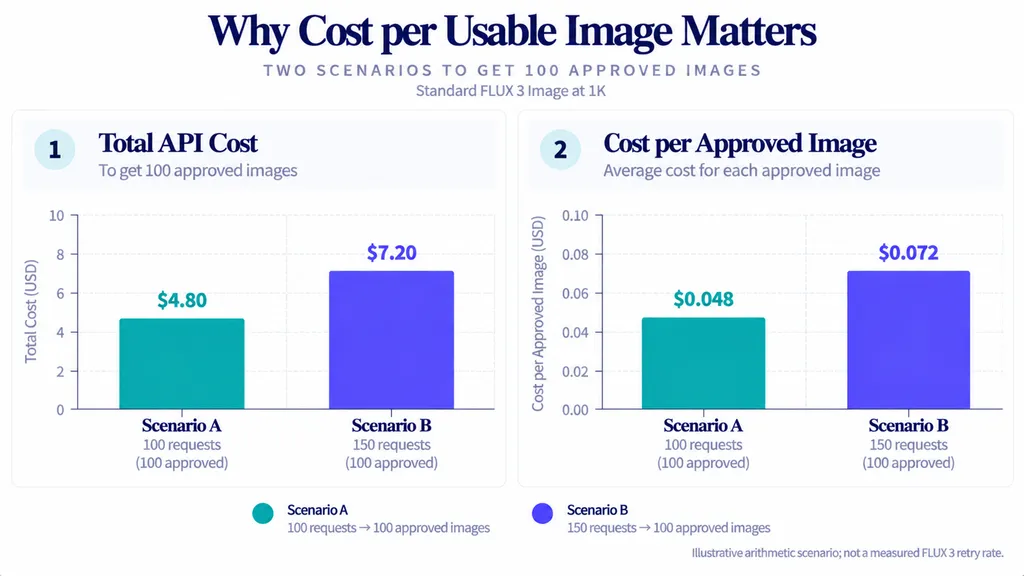
Consider an illustrative project requiring 100 acceptable images. If 150 standard-model requests at 1K are needed, the base expense increases from $4.80 to $7.20.
The effective generation cost becomes $0.072 per approved image.
This is a mathematical scenario, not a measured FLUX 3 failure rate.
Cost per usable image = Total generation and editing charges ÷ Approved images
A cheaper model may require more corrections, while a more expensive model may justify its price through fewer editing attempts.
The actual result depends on the workflow and acceptance standards.
How Much Does FLUX 3 Image Editing Really Cost?
FLUX 3 Image editing follows resolution-based API pricing, but commercial projects often require multiple editing stages rather than a single generation.
Case Study: Six Client Revisions to a Cafe Poster
A documented commercial poster workflow illustrates how FLUX 3 Image can support iterative creative production.
The original composition included a sleeping cat, a bin near the entrance, and branded cafe signage.
The project involved six client notes and combined FLUX 3 Image, Scumble, and ComfyUI.
The documented workflow included:
- Base composition: Create the initial poster using bounding boxes to control object placement.
- Reference integration: Incorporate a supplied photograph of a coffee cup.
- Object removal: Remove the unwanted bin and reconstruct the surrounding background.
- Localized adjustment: Reposition the cat without rebuilding the entire composition.
- Character addition: Add a barista using a supplied reference image.
- Final refinement: Apply visual styling while retaining editable versions.
The final image measured 7,036 × 3,962 pixels.
The project reported approximately $0.50 in Black Forest Labs usage during introductory promotional pricing.
This was one documented project, not an average commercial production cost. Complete request counts, standard-rate billing, and manual labor expenses were unavailable.
Nevertheless, the case demonstrates a valuable production principle: localized revisions can preserve approved creative decisions and reduce unnecessary recreation of finished elements.
For agencies managing client feedback, version control is essential to maintaining visual consistency throughout revisions.
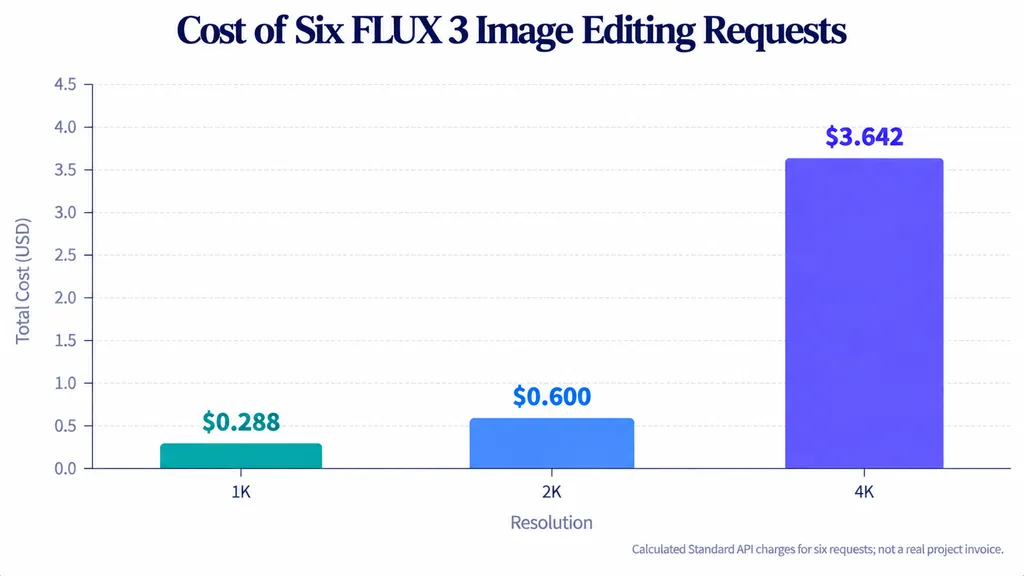
How Much Would Multiple FLUX 3 Editing Requests Cost?
Consider six standard-model editing requests at the same resolution.
Resolution | Six Requests |
1K | $0.29 |
2K | $0.60 |
4K | $3.64 |
These are calculated examples, not a reconstruction of the cafe project's actual billing.
Additional requests, external editing services, and manual corrections increase final delivery expenses.
The relevant budgeting question is how many billable steps are needed to produce an approved asset, not simply how much one generation costs.
FLUX 3 Image API vs Local Deployment: Which Is Cheaper?
FLUX 3 Image Klein offers downloadable model weights, providing an alternative to hosted API usage.
Local execution changes the cost structure from per-image API charges to hardware, electricity, processing time, and operational expenses.
How Fast Is FLUX 3 Klein on Local GPUs?
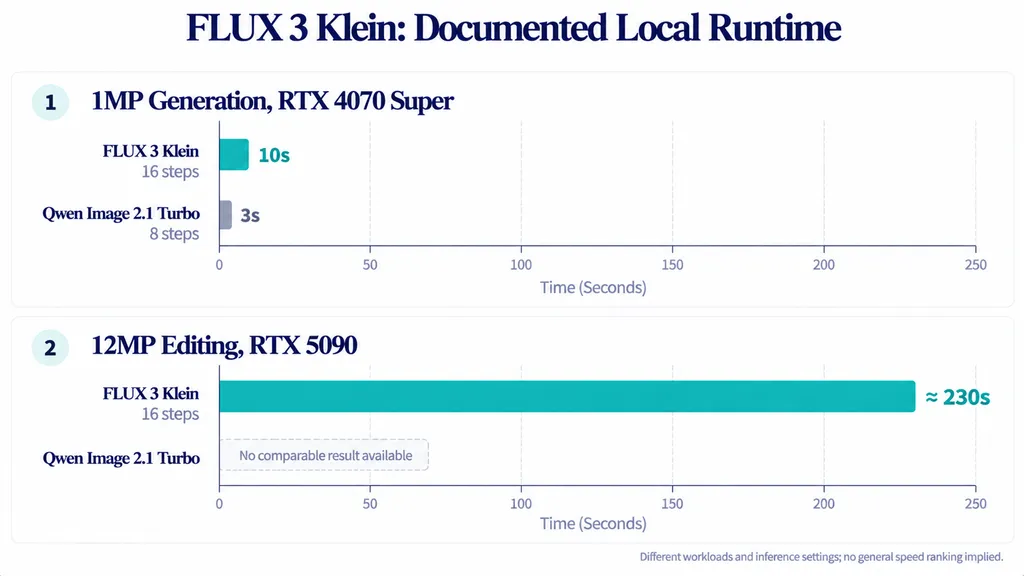
Two documented technical cases illustrate different local workloads.
Test | Klein Result | Comparison |
RTX 4070 Super, 1MP | 10 seconds, 16 steps | Qwen Image 2.1 Turbo: 3 seconds, 8 steps |
RTX 5090, 12MP | Approximately 230 seconds, 16 steps | No controlled comparison |
The RTX 4070 Super test showed different execution times under the reported settings, but the models used different inference-step counts.
The RTX 5090 case illustrates the processing demands of high-resolution local editing.
Neither establishes a universal speed ranking.
API price, generation latency, and approved output quality must be evaluated separately.
Is Self-Hosting FLUX 3 Klein Free?
Local execution avoids hosted API generation charges, but it does not eliminate production costs.
GPU ownership or rental, electricity, maintenance, setup, and applicable licensing requirements remain relevant.
Open weights should not be interpreted as unrestricted commercial permission.
For occasional image generation, hosted API pricing simplifies budgeting.
For sustained production, local deployment may be worth evaluating when infrastructure control, workload volume, or data-handling requirements justify the investment.
The available evidence does not establish a universal financial break-even point.
Which FLUX 3 Image API Provider Is Cheapest?
Black Forest Labs provides direct API access, while third-party services may offer different billing arrangements.
Our review of documented pricing questions highlights a recurring comparison problem: apparently similar provider quotations can represent different resolution tiers or charging methods.
How to Compare FLUX 3 API Providers
Before selecting a provider, verify:
- Model version: Standard FLUX 3 Image or Klein.
- Resolution: Compare identical output tiers.
- Billing method: Normalize per-image and compute-based rates.
- Additional charges: Review service fees and failed-request policies.
- Performance: Evaluate latency, availability, and usable output quality.
DeepInfra appears in documented provider-pricing discussions, but the available evidence does not establish a verified provider-wide lowest price.
Use official BFL rates as a pricing reference and compare third-party quotations under equivalent conditions.
The cheapest API request is not necessarily the cheapest completed creative task.
How to Reduce FLUX 3 Image Costs in Professional Workflows
Effective cost control combines appropriate resolution selection, targeted editing, model evaluation, and accurate production tracking.
Generate Concepts at Lower Resolution
Use 1K for initial exploration when it provides sufficient visual detail.
Reserve higher-resolution generation for selected compositions or deliverables requiring greater detail.
This approach is particularly useful for advertising concepts, product imagery, and large variation sets.
Preserve Approved Details During Editing
Use reference images, localized editing controls, and version management to minimize unnecessary changes.
The commercial cafe poster case illustrates how individual revisions can build upon an existing composition.
In Virse, generated images, references, and successive edits can remain together on the canvas, making creative decisions easier to compare and review.
Evaluate Klein Before Scaling Production
Test Klein against representative tasks rather than adopting it solely because of lower pricing.
Compare subject consistency, typography, product fidelity, background preservation, and required corrections.
Its lower API rates justify evaluation, but deliverable quality should determine the final model choice.
Track Costs Using Standard Prices
Record request counts, resolution tiers, editing time, approved outputs, and related expenses.
Black Forest Labs offered a 50% launch discount for standard FLUX 3 Image generations from October 1 to October 8, 2026.
That promotional period has ended.
Use regular list rates for ongoing budgets unless a current provider agreement specifies otherwise.
FAQs
How much does FLUX 3 Image cost at 1K, 2K, and 4K?
Standard FLUX 3 Image costs $0.048 at 1K, $0.100 at 2K, and $0.607 at 4K. Generating 1,000 images produces calculated base API charges of $48, $100, and $607, respectively. Additional editing requests, external services, and manual production work may increase the final expense.
Is FLUX 3 Klein cheaper, and can I use it for free?
Klein costs $0.009 per image at 1K and $0.036 at 4K, substantially less than standard FLUX 3 Image. Downloadable open weights support local execution without hosted API charges, but hardware expenses and licensing conditions still apply. Free local execution does not automatically mean unrestricted commercial deployment.
How much does FLUX 3 image editing cost?
FLUX 3 image-to-image editing follows the selected model's resolution-based API rates. Six standard-model editing requests at 1K would cost $0.288 in base charges. A documented cafe poster project reported approximately $0.50 during promotional pricing, but that individual result does not establish typical commercial editing costs.
Which FLUX 3 API provider is cheapest, and is local deployment worth it?
No verified same-condition comparison establishes a universally cheapest provider. Compare exact model versions, resolutions, billing rules, and service performance. Local Klein deployment may be worth evaluating for sustained workloads, but GPU expenses, maintenance, licensing, processing time, and approved output quality determine its actual financial value.
Conclusion
FLUX 3 Image pricing ranges from $0.041 to $0.607 per standard-model image, while Klein costs $0.008 to $0.036. Klein offers substantial API savings, particularly at 4K, but professional value depends on editing consistency, processing time, and approved output quality. The documented cafe poster project demonstrates the importance of localized revisions and version control, while independent GPU tests reveal the operational considerations of local deployment. For designers and creative teams, the most effective approach is to choose appropriate resolutions, preserve approved assets, test models against actual deliverables, and measure cost per usable image. Virse supports this workflow by bringing FLUX 3 Image, alternative AI models, reference materials, and revisions into a connected creative environment, helping teams move from initial concepts to refined visual assets without fragmenting the design process.