
Wan 3.0 Pricing: What You’ll Really Pay for Usable Videos
 Yifan Zhao9 min de leitura ·

Wan 3.0 pricing starts at $0.0425 per second for 480p and $0.17 per second for 1080p on OpenRouter—approximately $0.43 or $1.70 for a 10-second video. The better deal depends on your provider, settings, and how many attempts produce a clip you can actually use.
A low advertised rate can become expensive when product details change, motion misses the brief, or credits run out before approval. Compare cost per accepted clip, upfront commitments, and retry policies before paying; evaluate Prime’s higher rate against the time it actually saves.
For more room to explore, Virse’s paid plans offer unlimited use across a broad selection of models and unlimited seats, giving your team space to compare creative directions and refine ideas together. Sign up to receive starter credits and try the workflow before upgrading; choose from the models included in your plan.
How Much Does Wan 3.0 Cost by Provider?
Wan 3.0 API Pricing and Prime Rates
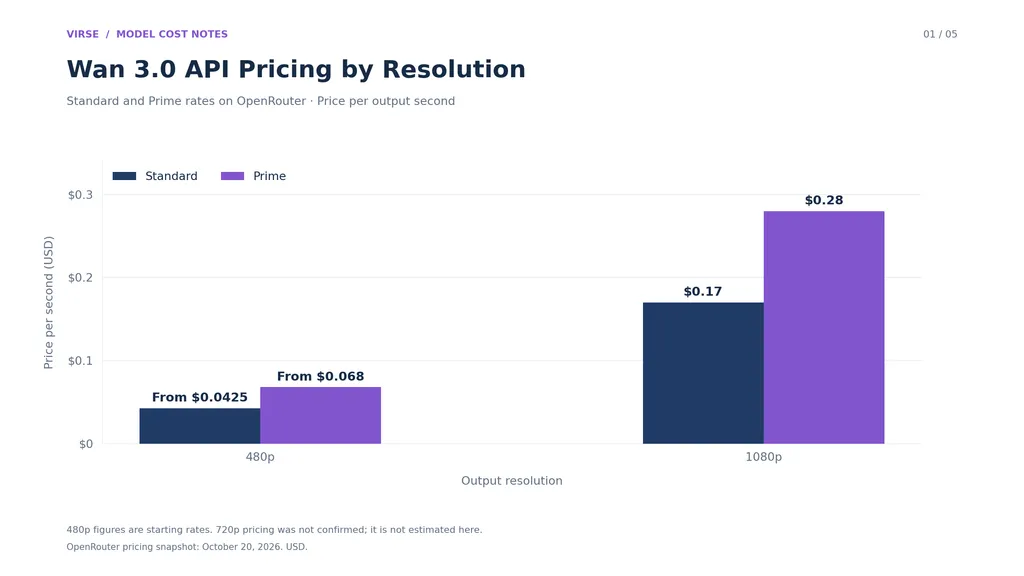
The clearest resolution-specific quotes in our research come from OpenRouter. WaveSpeedAI publishes starting prices per run, which require further configuration details before comparison.
Provider | Model | Resolution | Published rate |
|---|---|---|---|
OpenRouter | Wan 3.0 | 480p | From $0.0425/second |
OpenRouter | Wan 3.0 | 720p | Not confirmed |
OpenRouter | Wan 3.0 | 1080p | $0.17/second |
OpenRouter | Wan 3.0 Prime | 480p | From $0.068/second |
OpenRouter | Wan 3.0 Prime | 1080p | $0.28/second |
WaveSpeedAI | Non-Prime routes | Unspecified | From $0.47/run |
WaveSpeedAI | Prime routes | Unspecified | From $0.71/run |
OpenRouter displayed a 15% discount on its standard Wan 3.0 listing when checked. WaveSpeedAI’s figures come from its August 31 guide, which identifies an August 29 source check. Its generation preview remains necessary for a configuration-specific quote.
These are provider prices, not a universal Alibaba price list. A per-run minimum cannot establish whether WaveSpeedAI is cheaper than a particular OpenRouter job.
Compare Current Quotes, Not Historical Review Prices
The Pixmax review in our research quoted $0.05, $0.10, and $0.20 per second for 480p, 720p, and 1080p. These are historical article quotes, not verified current checkout prices.
No current resolution-specific 720p rate was confirmed in the checked OpenRouter listing. Obtain the selected job’s quote rather than assigning an unlabeled provider rate to 720p.
Prioritize a configuration-specific quote over a review table. Save its date, rate, and discount conditions alongside your generation settings.
What Does Wan 3.0 Cost for 10- and 30-Second Videos?
Calculate Your Wan 3.0 Cost per Clip
Estimated output cost = applicable per-second rate × generated seconds.
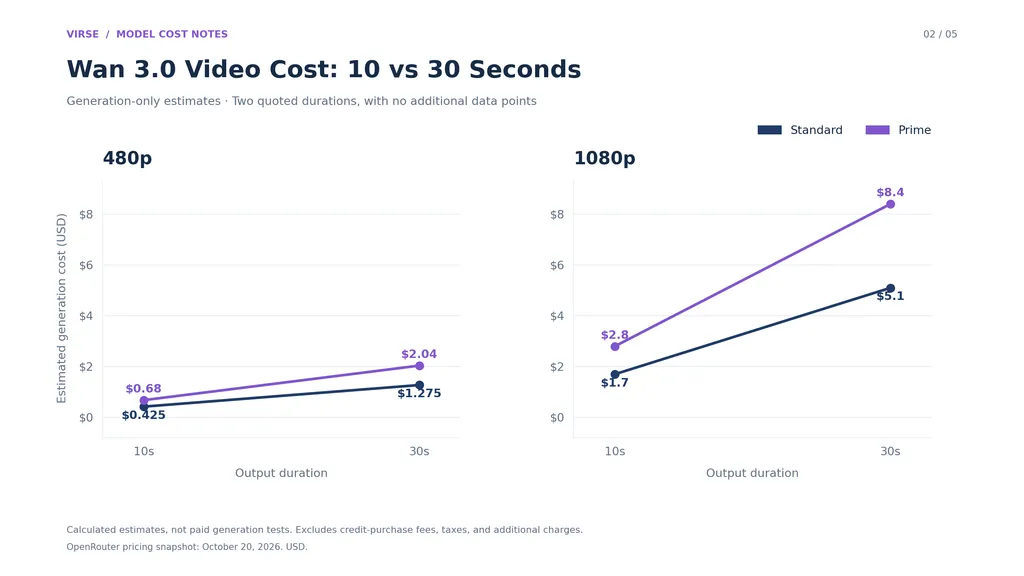
Applying the checked OpenRouter rates produces these generation-only estimates:
Model | Resolution | 10 seconds | 30 seconds |
|---|---|---|---|
Wan 3.0 | 480p | $0.425 | $1.275 |
Wan 3.0 | 1080p | $1.70 | $5.10 |
Wan 3.0 Prime | 480p | $0.68 | $2.04 |
Wan 3.0 Prime | 1080p | $2.80 | $8.40 |
Retain precision when calculating; final rounding follows the provider’s billing rules. These estimates exclude credit-purchase fees, taxes, and any additional input or service charges.
For standard Wan 3.0 at these rates, 1080p costs four times as much per output second as 480p. For exploratory work, lower-resolution drafts can therefore reduce spending before visual direction is approved. Evaluate fine product details at the intended delivery resolution.
Budgeting for 100 Videos
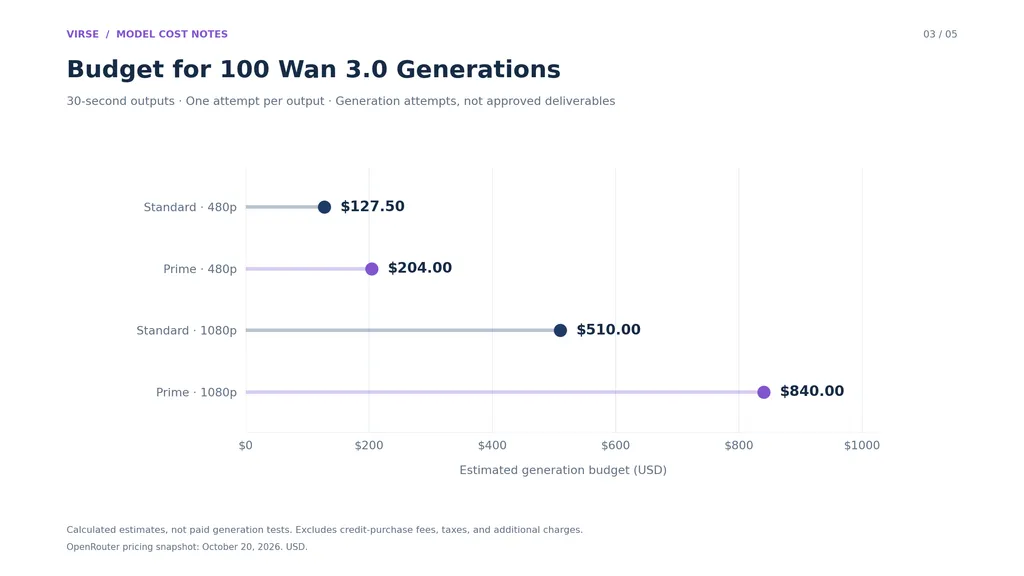
A batch estimate makes the impact of resolution and version easier to assess.
Configuration | 100 × 30-second outputs |
|---|---|
Standard, 480p | $127.50 |
Standard, 1080p | $510.00 |
Prime, 480p | $204.00 |
Prime, 1080p | $840.00 |
These are budgets for 100 generation attempts, not 100 approved deliverables. They exclude credit-purchase fees, taxes, and additional charges.
For a campaign requiring 100 approved videos, first run a representative pilot and record actual charges and approvals. Use those results to estimate the larger job. Without an observed acceptance rate, adding a precise retry allowance would create false confidence.
What Changes Your Actual Wan 3.0 Production Cost?
Measure Cost per Accepted Clip
A completed video can still fail creative review. For an ecommerce brief, packaging may change, product motion may misrepresent the item, or framing may leave insufficient room for copy.
Separate technical failures, completed but rejected outputs, and accepted clips. WaveSpeedAI’s cost guide also recommends tracking these outcomes separately.
Generation cost per accepted clip = actual generation charges after refunds ÷ accepted clips.
If no clips pass review, record the spending and zero accepted outputs. There is no finite accepted-clip cost to report.
For client delivery, add attributable editing and review costs to assess the complete production budget. Keep that figure separate from API spending so the source of overruns remains visible.
A Product-Video Budget Needs Acceptance Criteria
Before generating, define what approval requires: recognizable product details, suitable motion, usable composition, and the correct delivery format.
Then record:
Record | Why it matters |
|---|---|
Preview and final charge | Reveals differences between estimate and billing |
Settings and reference inputs | Makes comparisons reproducible |
Job status and refunds | Separates failures from charged completions |
Review outcome | Identifies spending that produced usable work |
Editing and review time | Captures costs beyond generation |
This workflow turns “the model feels expensive” into a specific diagnosis. The issue may be the rate, rejected outputs, or the work needed to finish otherwise usable clips.
OpenRouter Deposits, Fees and Refunds
OpenRouter’s pricing page and terms distinguish ongoing usage from purchasing credits. Standard has no recurring minimum-spend commitment, while the terms specify a $5 minimum credit purchase per transaction.
Billing item | Published OpenRouter rule |
|---|---|
Standard credit-purchase fee | 5.5%; review the final checkout total |
Unused-credit refund window | Request within 24 hours of purchase |
Refund exclusions | Platform fees; cryptocurrency payments |
Credit expiry | Unused credits may expire after 365 days |
Taxes | Published prices exclude applicable taxes |
Under OpenRouter’s published pricing and terms, OpenRouter model spending and money paid at checkout are different totals. Keep credit-purchase fees separate from the generation estimates above, particularly when comparing providers.
The unused-credit refund policy does not establish refunds for a completed video that misses your brief. OpenRouter’s general failed-attempt explanation refers to model-token billing; it does not provide enough video-specific detail to guarantee how every failed or cancelled Wan job is treated.
For video failures, check the job’s recorded charge and the applicable route policy. For reference-guided generation, use the configuration preview; WaveSpeedAI identifies references among its pricing variables.
Is Wan 3.0 Prime Worth Its Higher Price?
Compare the Prime Premium at Matching Settings
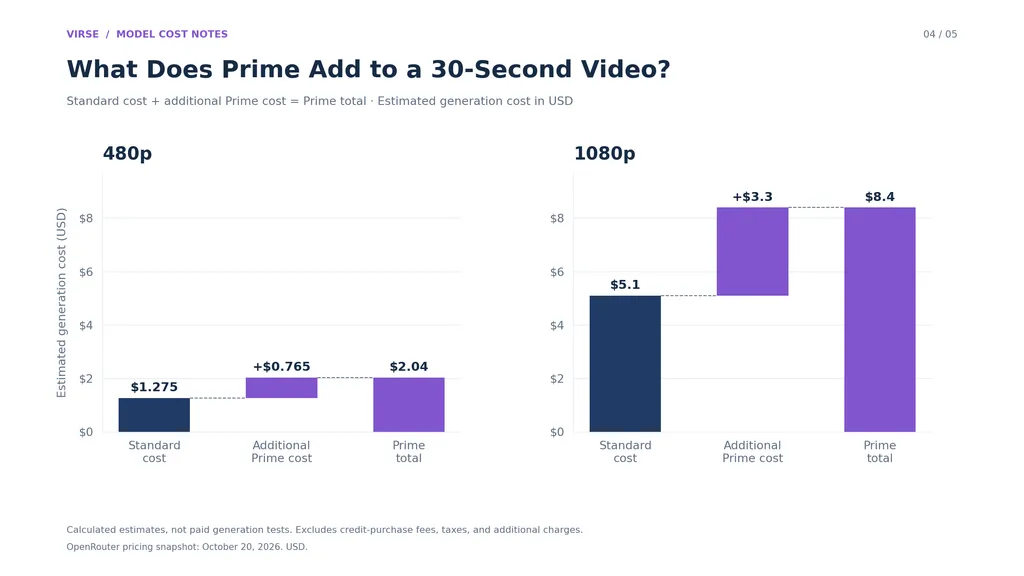
At OpenRouter’s displayed rates, Prime costs 60% more at 480p and approximately 64.7% more at 1080p than standard Wan 3.0.
Resolution | Standard, 30 seconds | Prime, 30 seconds | Additional cost |
|---|---|---|---|
480p | $1.275 | $2.04 | $0.765 |
1080p | $5.10 | $8.40 | $3.30 |
OpenRouter positions Prime as a fast-mode variant. That description supports evaluating it for turnaround; it does not establish superior quality or a guaranteed time saving for your brief.
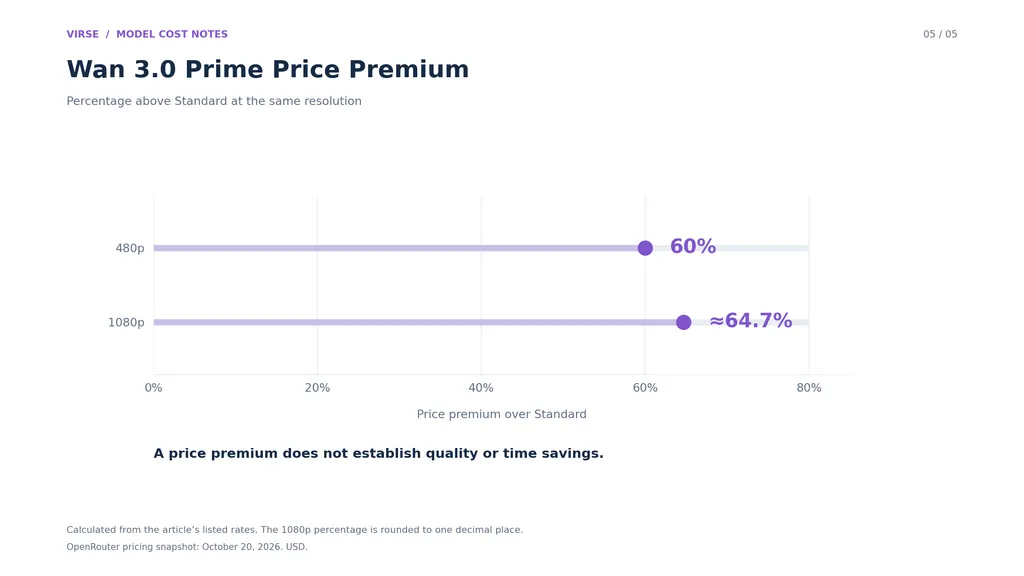
For a live creative review, faster results may keep decisions moving. For unattended batch generation, accepted-output cost may be the stronger purchasing criterion.
Test Prime Against Your Production Bottleneck
Use the same brief, supported input type, duration, resolution, and acceptance criteria for both versions. Record completion time, final charges, and review outcomes.
A useful Prime pilot measures time and spending per accepted output. This distinguishes faster generation from faster delivery: a quick result that needs substantial revision may not improve the schedule.
How Can You Reduce Wan 3.0 Costs Without Buying the Wrong Plan?
Choose Around Access and Project Duration
Our review of user questions identified two concrete purchasing situations.
In one case, a creator sought a cheaper alternative because their country limited access to the preferred cloud route. They still considered a suggested alternative expensive. No final bill was reported. The lesson is that an attractive rate has little practical value if account creation or payment is unavailable.
In another case, a creator wanted a single day of unlimited use and explicitly wanted to avoid an annual commitment. That establishes demand for flexible access; it does not confirm that a suitable Wan 3.0 day pass exists.
Situation | First check |
|---|---|
Occasional experimentation | Minimum deposit and trial eligibility |
Short production sprint | Commitment length and model-specific limits |
Recurring API production | Effective rates and spending records |
Restricted access | Country, account, and payment support |
Urgent iteration | Measured Prime turnaround and premium |
Reduce Waste Before Increasing Generation Volume
Approve the brief, reference assets, framing, and intended motion before generating expensive final-resolution outputs. Draft at lower resolution when suitable, then assess the selected direction at delivery quality.
Check the current quote before scaling. An advertised “unlimited” plan also needs model-specific checks for queue restrictions, fair-use limits, and exclusions. Our research did not establish a universally available unlimited Wan 3.0 offer.
Conclusion: Choose Wan 3.0 Pricing Around Approved Deliverables
Wan 3.0 offers calculable generation costs, but a useful budget connects those rates to the exact provider, configuration, and delivery brief. Compare equivalent jobs, preserve the quote, and measure actual spending against accepted clips. For creative teams, lower-resolution exploration and a representative pilot provide a stronger basis for choosing standard Wan 3.0, Prime, or another access route than an isolated starting price.
FAQ
What is the cheapest way to use Wan 3.0?
Our research does not establish a universal cheapest provider. Start with matching settings, then compare the generation quote, minimum deposit, discounts, and credit expiry. Confirm that the service supports your country and payment method. A low advertised rate can still require an unsuitable upfront commitment.
Is Wan 3.0 free, or is there an unlimited day pass?
The verified pricing sources establish paid access, but do not confirm a universal free tier or unlimited day pass. Trial credits require separate eligibility checks. If a platform advertises unlimited use, confirm Wan 3.0 inclusion, fair-use limits, queue restrictions, and any subscription requirements before paying.
How much should I budget for a 30-second Wan 3.0 video?
Using the checked OpenRouter rates, one standard generation is estimated at $1.275 for 480p or $5.10 for 1080p. Prime estimates are $2.04 and $8.40. These are output-rate calculations; the budget for an approved clip depends on actual charges and additional attempts.
What if Wan 3.0 is unavailable in my country?
Check alternative providers’ country support, account requirements, and payment options before depositing funds. Our review of user questions found access restrictions driving provider comparisons, but an alternative interface does not guarantee eligibility. Confirm access to the exact model and configuration you need.
Do cheaper Wan 3.0 providers produce worse videos or charge for failures?
Price alone cannot establish output quality or reliability. No controlled cross-provider generation test was available. OpenRouter’s unused-credit refunds are separate from job billing, and its general failure explanation does not settle every video-specific case. Compare equivalent requests and inspect results and recorded charges.