
MiniMax H3 vs LTX 2.5: Quality, Speed & Real Benchmarks
 Yifan Zhao11 min de leitura ·
MiniMax H3 is the better choice for complex motion, physics, scene logic, camera choreography, and reference-heavy generation, while LTX 2.5 is stronger for speed, rapid iteration, and high-resolution finishing. If you are deciding where to use MiniMax H3, the useful question is not which model is universally better, but which one reaches a usable shot faster for the type of video you need.
That difference can become expensive in production. In the MiniMax H3 workflows we reviewed, LTX 2.5 was about 6.8× faster in one RTX 5090 test and about 14× faster on DGX Spark, yet H3 remained more compelling when motion or physical interaction determined whether a shot succeeded. Our research therefore favors task-based AI model routing over a single-model winner.
Virse is designed for this multi-model way of working. Instead of separating models into isolated chat tools, Virse lets designers work with multiple AI Agents on a shared visual canvas, where project assets and context can carry across tasks. This kind of connected environment supports a broader AI design workflow from brief to delivery. Paid plans include unlimited use of more than 40 models, including Nano Banana 2 and GPT Image 2, plus unlimited seats. New users also receive signup credits that can cover up to 10 Nano Banana 2 images or one Seedance 2.0 video.

MiniMax H3 vs LTX 2.5: What Are the Core Differences?
H3 and LTX 2.5 differ most in where they spend computation and where they create production value.
Area | MiniMax H3 | LTX 2.5 |
|---|---|---|
Model size | 33B | 22B |
Complex motion | Strong | More variable |
Physics and interaction | Strong | Less reliable in difficult scenes |
Complex prompt execution | Strong tendency | Improved, but failures still occur |
Rapid iteration | Slow | Excellent |
Tested step pattern | Commonly around 20 | 8-step distilled workflow |
High-resolution finishing | More expensive | Major strength |
Multi-reference control | Major strength | Different workflow focus |
Local production stack | Supported but demanding | More complete |
Best role | Motion-critical generation | Iteration, upscale, finishing |
From a product-design perspective, H3 behaves like a high-compute specialist, while LTX 2.5 behaves more like a production engine.
That distinction is more useful than comparing still frames. A sharp video can still fail if an object disappears halfway through a shot, while a sophisticated motion model may be unnecessary for a simple product reveal.
MiniMax H3 vs LTX 2.5 Quality: Which Is Better for Motion and Physics?
The clearest way to compare quality is to separate temporal quality from spatial quality.
H3 Is Stronger When Motion Defines Whether a Shot Works
Our MiniMax H3 review repeatedly found H3 more compelling for:
- fighting and running
- full-body movement
- multi-character interaction
- object manipulation
- physical cause and effect
- cinematic camera movement
- prompts with several sequential actions
The important failure mode here is not a bad first frame. It is broken temporal logic: a hand passes through an object, a prop disappears, anatomy collapses during fast movement, or the requested action is only partially completed.
For motion-heavy hero shots, a slower generation can therefore be cheaper overall if it reduces rerolls.
LTX 2.5 Remains Competitive in Spatial Detail
LTX 2.5 should not be described as simply lower quality. In several reviewed cases, its outputs were preferred for frame sharpness, small-object stability, clothing detail, smoke, and local texture.
This makes LTX attractive for product shots, slower camera moves, atmospheric clips, and scenes with limited physical interaction.
The practical conclusion is simple: H3 has the stronger temporal-quality advantage, while LTX 2.5 can remain highly competitive in spatial quality.
LTX 2.5 vs H3 Speed: What Do Real Workflow Benchmarks Show?
Across all quantitative cases in our research, LTX 2.5 was faster.
Hardware and Output | H3 | LTX 2.5 | Result |
|---|---|---|---|
RTX 5060 Ti, ~12 sec, ~0.6MP | 29 min | 18 min | LTX saves ~11 min |
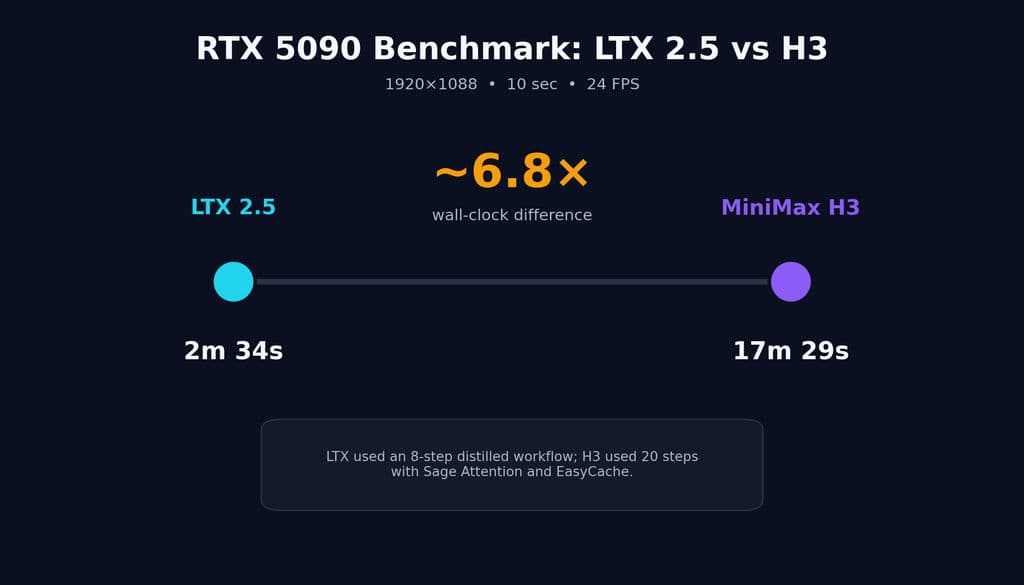
RTX 5090, 1920×1088, 10 sec, 24 FPS | 17m 29s | 2m 34s | ~6.8× faster |
DGX Spark, 1280×704, 5 sec, 24 FPS | 866 sec | 61.89 sec | ~14× faster |
These are workflow benchmarks, not universal model-speed multipliers.
RTX 5060 Ti Case: 29 Minutes vs 18 Minutes
In the RTX 5060 Ti case, LTX saved about 11 minutes on a roughly 12-second, 0.6MP generation.
However, the reviewed quality assessment favored H3 in physics, camera movement, aesthetics, and instruction accuracy.
This case illustrates why raw generation time is incomplete. For simple clips, LTX's time saving can dominate. For difficult movement, H3 may still achieve a usable result with fewer corrections.
RTX 5090 Case: 2:34 vs 17:29
For a 1920×1088, 10-second, 24 FPS target:
LTX 2.5: 2m 34s
H3: 17m 29s
That is about a 6.8× wall-clock difference.
But the configurations were not identical. LTX used an 8-step distilled workflow, while H3 used 20 steps with Sage Attention and EasyCache. The correct interpretation is therefore that the tested LTX workflow finished 6.8× faster, not that its transformer is intrinsically 6.8× faster.
DGX Spark Case: 61.89 Seconds vs 866 Seconds
On DGX Spark, a 1280×704, five-second, 24 FPS workflow with audio took:
LTX 2.5: 61.89 seconds
H3: 866 seconds
The observed difference was roughly 14×.
Our workload analysis is more revealing. Estimated token-step work was about 70,400 for LTX versus 651,200 for H3, a difference of approximately 9.25×. Per-token-step execution was far closer: roughly 0.879 ms for LTX and 0.959 ms for H3.
So the biggest advantage comes from doing much less total diffusion work, not from a 14× faster model core.
Why Is LTX 2.5 Faster Than H3?
LTX 2.5 gains speed through low-step inference, staged resolution processing, and lower token workload.
LTX Performs Most Diffusion Before Final Resolution
One reviewed LTX workflow generated around 640×352 for eight steps, applied latent 2× upscale, and used only a few high-resolution refinement steps.
That matters because full-resolution video diffusion is expensive. LTX avoids paying that cost throughout the entire sampling process.
H3 is also CFG-distilled, so the speed difference should not be simplified into “distilled LTX versus non-distilled H3.” The more useful distinction is LTX's low-step production strategy and lower total token-step workload.
H3 Becomes Expensive as Resolution Rises
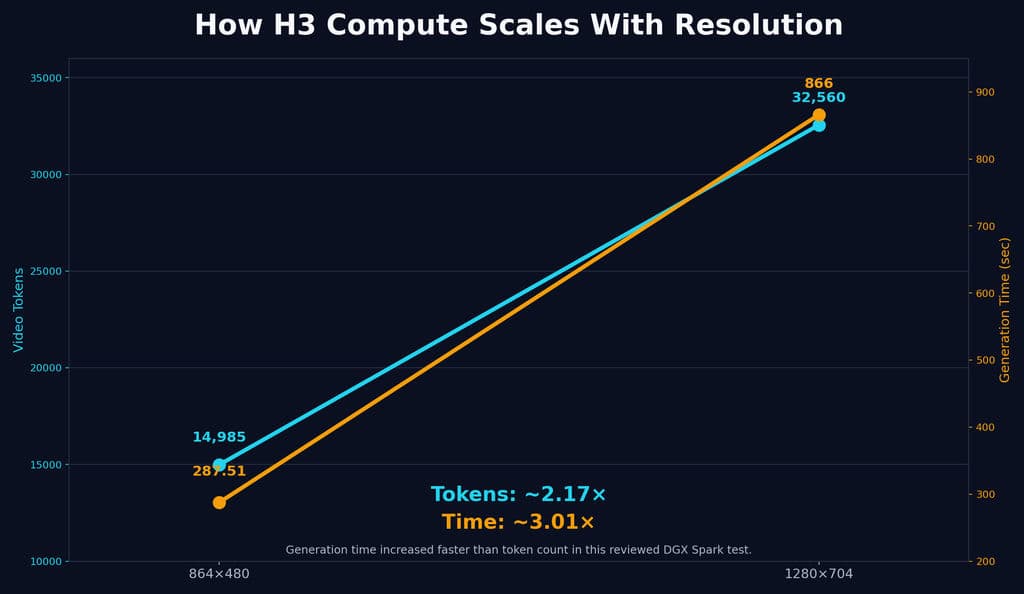
In one H3 DGX Spark test:
864×480: 14,985 tokens, 287.51 seconds
1280×704: 32,560 tokens, 866 seconds
Token count rose about 2.17×, but generation time rose about 3.01×.
This is why pushing H3 directly to higher resolutions can become costly and why separating motion generation from finishing can make sense.
H3 vs LTX 2.5 Quantization: Why Did NVFP4 Barely Beat INT8?
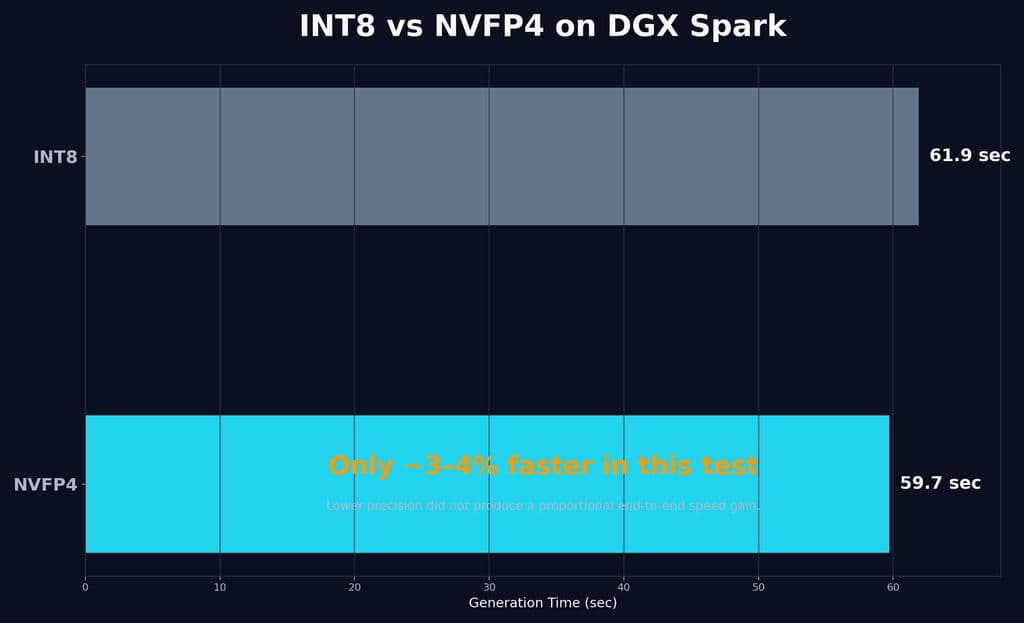
One DGX Spark comparison measured approximately:
INT8: 61.9 seconds
NVFP4: 59.7 seconds
That is only about a 3–4% improvement.
The lesson is practical: lower precision does not guarantee proportional end-to-end speed gains. Kernel support, memory behavior, tensor layout, model loading, and framework maturity can all become bottlenecks.
For local workflows, benchmark the quantization format on the actual hardware stack instead of choosing by bit depth alone.
MiniMax H3 vs LTX 2.5 for Local Deployment and Consumer GPUs
Both models can run locally, but LTX 2.5 is currently easier to build into a repeatable local production pipeline.
H3 Can Run Locally, but Hardware Constraints Matter
Our review of user questions repeatedly surfaced RTX 3060 12GB, RTX 3090 24GB, RTX 5090, 8GB cards, and DGX Spark.
The real issue is not whether H3 is local. It is how much compromise is required in resolution, quantization, memory, and generation time.
A 24GB-class GPU offers substantially more flexibility than 8GB or 12GB hardware, but our current research does not contain a standardized H3 GPU matrix. Specific speed or resolution promises should therefore not be generalized from isolated systems.
LTX 2.5 Has the Stronger Finishing Ecosystem
The reviewed LTX stack includes quantized checkpoints, VAE workflows, LoRA, ComfyUI support, spatial upscale, temporal upscale, and high-resolution finishing.
That surrounding ecosystem matters because professional production is not one generation step. It is ideation, selection, refinement, upscale, review, and delivery.
H3 vs LTX 2.5 for 2K, 4K, HDR, and Professional Finishing
High-resolution production exposes one of the clearest differences.
H3's workflow includes H3-Context-IR, H3-Base, and H3-Regenerate-2K. H3-Base can run locally, but the complete high-resolution workflow is less self-contained.
LTX 2.5 is stronger when teams need spatial refinement, temporal refinement, 4K-oriented finishing, HDR, EXR-oriented output, and repeated local iteration.
For professional video work, I would avoid spending maximum H3 compute on every pixel. Use expensive temporal reasoning where motion needs it, then hand finishing to the more efficient pipeline.
H3 vs LTX 2.5 for Audio, References, and Multishot Workflows
This is another area where the models diverge.
H3 Is Strong for Dense Multimodal Reference Control
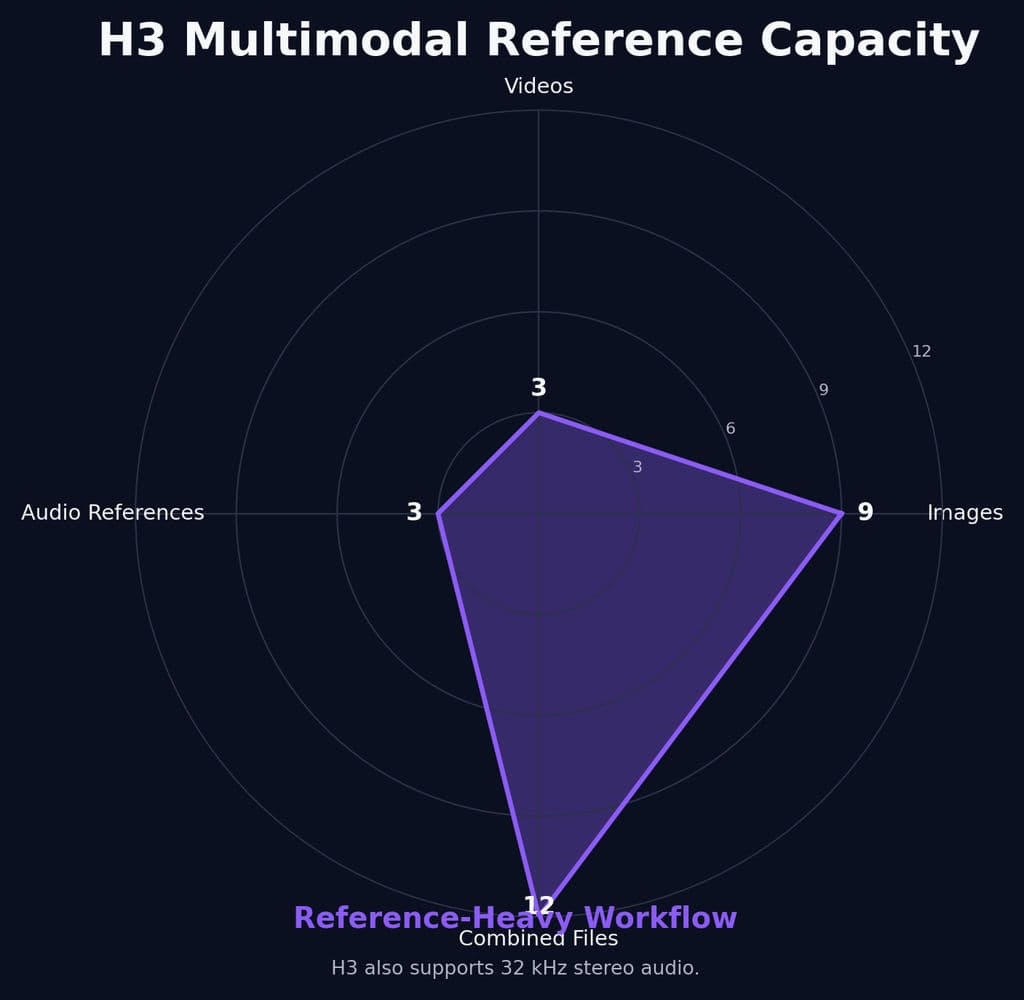
H3 supports 32 kHz stereo audio and a reference-heavy workflow involving images, videos, and audio inputs. The reviewed specification includes support for up to nine images, three videos, and three audio references, subject to combined file limits.
This makes H3 particularly interesting when a shot needs to preserve character, object, motion, or audio context across several inputs.
LTX 2.5 Is Better Suited to Structured Production Sequences
LTX 2.5's production direction emphasizes synchronized audio-video workflows, efficient long-form iteration, and multishot-oriented generation.
For teams producing multiple connected clips, this can matter more than dense reference control because the bottleneck shifts from single-shot fidelity to repeatable sequence production.
H3 + LTX 2.5 Workflow: Why Using Both Can Be Better
The most useful production strategy may be H3 first, LTX second.
H3 Handles Motion-Critical Generation
Our MiniMax H3 workflow research includes H3 workflows at roughly 0.4MP, Turbo LoRA configurations, eight-step experiments, and 640×384 source clips.
At this stage, focus on:
- movement
- interaction
- physics
- camera behavior
- temporal continuity
LTX Handles Upscale and Refinement
After selecting the strongest H3 result, use LTX for 2× upscale, spatial refinement, temporal refinement, or higher-resolution delivery.
This division keeps H3 focused on temporal intelligence and LTX focused on production efficiency.
The main risk is generative reinterpretation. Faces, products, logos, clothing, and small details can change during refinement, so identity-sensitive work needs visual QA.
MiniMax H3 vs LTX 2.5 Commercial License: What Should Teams Check?
Licensing can determine the decision before visual quality does.
In the reviewed H3 license, the standard Community License excludes the US, EU, UK, and South Korea, and larger commercial deployments face additional revenue and attribution conditions.
The reviewed LTX license has broader geographic coverage, but larger commercial users can still face licensing thresholds and legal restrictions.
The key rule is: open weights do not mean unrestricted commercial rights.
Enterprise teams should review geography, annual revenue, redistribution, attribution, product integration, and the current license version before deployment.
MiniMax H3 vs LTX 2.5 Decision Matrix
Production Scenario | Best Starting Point | Why |
|---|---|---|
Complex fight scene | H3 | Better temporal logic |
Full-body action | H3 | Stronger motion consistency |
Multi-character interaction | H3 | Better scene relationships |
Object manipulation | H3 | Stronger physics tendency |
Multi-reference generation | H3 | Dense multimodal control |
Rapid ideation | LTX 2.5 | Faster iteration |
Batch generation | LTX 2.5 | Better throughput |
Simple visual shots | LTX 2.5 | Strong quality at lower time cost |
4K/HDR finishing | LTX 2.5 | Stronger production stack |
Local pipeline | LTX 2.5 | More complete ecosystem |
Motion-heavy hero shot | H3 | Temporal quality justifies compute |
Motion + high-resolution delivery | H3 + LTX 2.5 | Best division of responsibilities |
The practical decision rule is simple: if a shot fails because the motion is wrong, start with H3. If the workflow fails because iteration or finishing is too expensive, start with LTX 2.5. If both matter, use them together.
FAQ
Is H3 better than LTX 2.5 for quality?
H3 is generally stronger when quality depends on motion, physics, object interaction, camera logic, or complex instruction execution. LTX 2.5 can remain highly competitive in frame sharpness and simpler scenes. The most useful comparison is therefore temporal quality versus spatial quality, not a single overall score.
Why is LTX 2.5 faster than H3?
The reviewed workflows show that LTX performs much less total diffusion work through low-step sampling and staged resolution processing. In one DGX Spark analysis, estimated workload was about 70,400 token-steps for LTX versus 651,200 for H3, while per-token-step execution was much closer.
Can H3 and LTX 2.5 run locally on consumer GPUs?
Yes, both can run locally, but practical requirements differ. H3 is more demanding in memory and inference time, while LTX 2.5 has a more production-friendly local stack. GPU suitability depends on VRAM, quantization, resolution, duration, and workflow configuration rather than model name alone.
Should I use H3 and LTX 2.5 together?
For motion-heavy shots that also need high-resolution delivery, yes. H3 can solve the difficult temporal stage at moderate resolution, while LTX can handle upscale and refinement. The trade-off is that generative refinement may alter identity-sensitive details, so final outputs should be checked carefully.
Conclusion
MiniMax H3 and LTX 2.5 are optimized for different production bottlenecks. H3 is the stronger choice when complex motion, physics, camera logic, references, or scene understanding determine whether a shot works; LTX 2.5 is better suited to fast iteration, batch production, local workflows, and high-resolution finishing. The RTX 5060 Ti, RTX 5090, and DGX Spark cases confirm a substantial LTX workflow-speed advantage, while token-step analysis explains why that advantage is larger than the difference in per-token compute alone. For professional creators, the strongest strategy is therefore not choosing one permanent winner, but routing each task to the model that solves it most efficiently—and using H3 for temporal generation plus LTX 2.5 for refinement when a shot needs both.
Mais do blogue da Virse
Produto

What Is Product Design in 2026? What Product Designers Actually Do
21 de setembro de 2026 by Vincent
Produto
GPT Image 2.5 Pricing: Flare vs Sunburst & the Real Cost per Image
14 de setembro de 2026 by Vincent
Produto
GPT Image 2.5 Review: Does It Finally Fix AI Image Editing Drift?
14 de setembro de 2026 by Vincent