
MiniMax H3 Reddit Review: What Real Users Think After Local Testing
 Yifan Zhao13 min de leitura ·
MiniMax H3 Reddit feedback is strongly positive about prompt adherence, complex motion, reference-based generation, native audio, and the fact that a powerful multimodal video model can run locally. These strengths also align with the broader findings in our MiniMax H3 review. The main complaints are equally consistent: generation can be slow, VRAM and RAM requirements are confusing, Ref2Vid can lose detail, distant subjects often degrade, and optimization can introduce quality trade-offs.
The most useful Reddit discussions are not asking whether H3 can produce an impressive demo. Users are testing whether it remains controllable through difficult actions, occlusion, references, audio, longer clips, and repeated local generations—many of the same challenges explored in MiniMax H3 Motion Transfer and practical MiniMax H3 workflows. The research collected for this review also shows why performance figures must be treated as individual user tests rather than standardized benchmarks: hardware, resolution, steps, quantization, cache settings, references, and system RAM differ substantially between workflows.
That distinction matters for designers. A model that produces one strong clip is interesting; a model that can repeatedly execute art direction without destroying identity, detail, or workflow speed is useful. This is why H3 becomes more relevant when it is part of a repeatable AI design workflow, rather than treated as an isolated generation tool.
What Do Reddit Users Think About MiniMax H3 Overall?
The overall MiniMax H3 Reddit sentiment is best described as impressed but highly experimental.
Users repeatedly praise four areas: instruction following, motion and physical interaction, multimodal references, and integrated audio. At the same time, current high-visibility discussions identify recurring defects including slow-motion-looking output, smeary blur, and unwanted background music, while another thread reports that people become difficult to recognize once they move into wider or more distant shots.
The enthusiasm also extends beyond conventional video generation. H3 is being used experimentally for image editing and generation, poster concepts, dashboards, infographics, voice generation, foley, and reference-driven content creation.
The resulting community verdict is more nuanced than “H3 has the best quality.” Its strongest attraction is that many capabilities that previously required separate models can now be explored inside one multimodal system.
MiniMax H3 Reddit Performance: VRAM, Speed and Local GPU Benchmarks
Local performance is one of the largest MiniMax H3 Reddit discussion clusters because “Can my GPU run it?” has very different answers depending on what users mean by run.
GPU and Memory | Reddit Test | Reported Time |
|---|---|---|
RTX 4090 Laptop 16GB | 960×540, 5 sec, 20 steps | 182 sec |
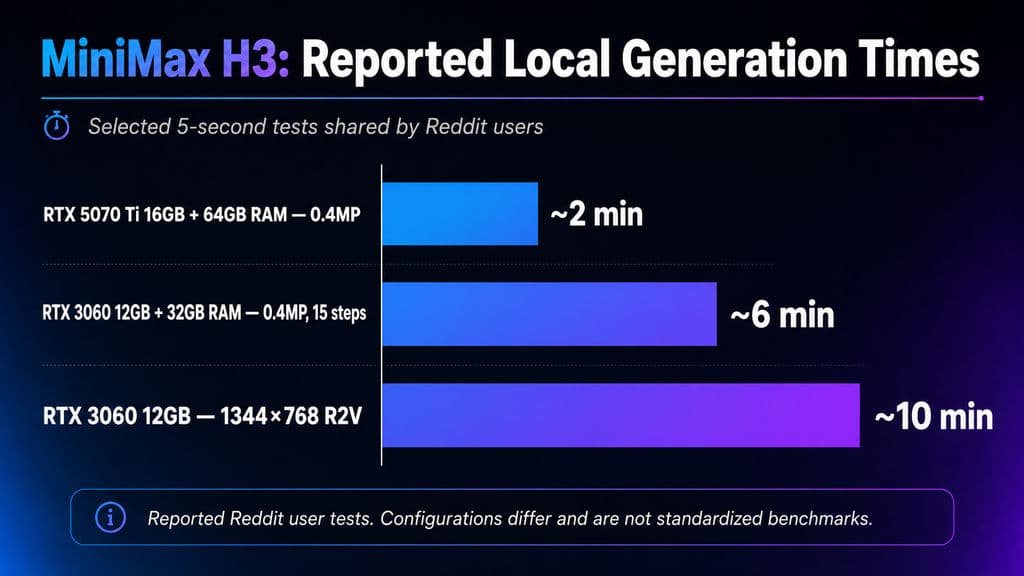
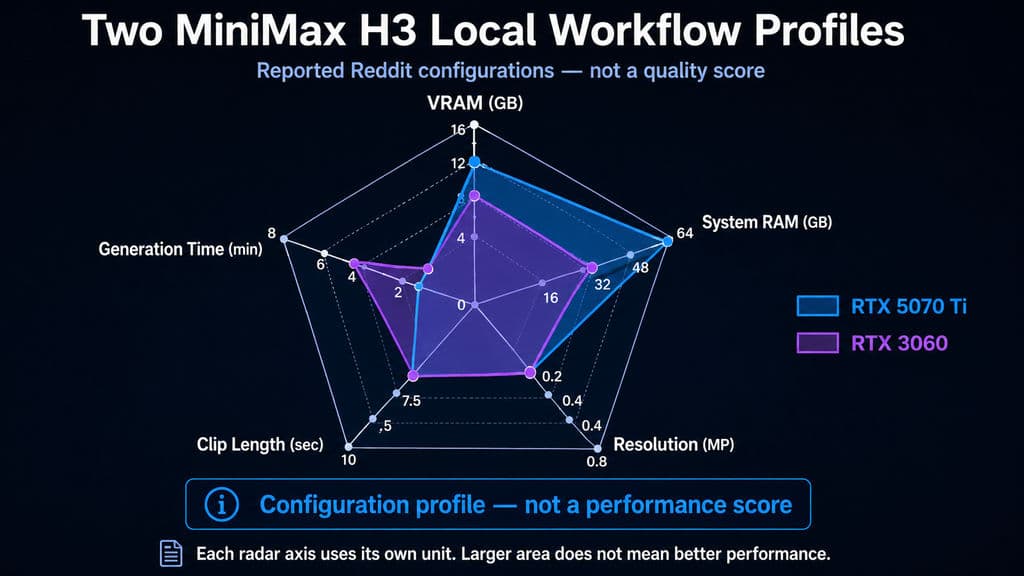
RTX 5070 Ti 16GB + 64GB RAM | 0.4MP, 5 / 10 / 15 sec | ~2 / 4.5 / 7 min |
RTX 3060 12GB + 32GB RAM | 0.4MP, 5 sec, 15 steps | ~6 min |
RTX 3060 12GB | 1344×768, 5 sec R2V | ~10 min |
RTX 3070 8GB + 32GB RAM | 0.4MP, 5 sec I2V | ~9–10 min |
RTX 3060 Laptop 6GB + 32GB RAM | 480p, 5 sec | ~700 sec |
6GB VRAM + 16GB RAM | 0.2MP, 5 sec T2V | 51:07 |
These results from the research set show that H3 can reach low-VRAM hardware, but minimum compatibility is not the same as productive iteration.
MiniMax H3 on 12GB VRAM Is Already Usable for Experimentation
A 12GB RTX 3060 user generated a 1344×768 five-second R2V clip in about 10 minutes using Turbo LoRA and SageAttention. Another 12GB test reported roughly six minutes for five seconds at 0.4MP and 15 steps.
That makes 12GB particularly interesting: it is low enough to represent common consumer hardware but fast enough for actual experimentation rather than a one-generation proof of concept.
MiniMax H3 on 6GB VRAM Shows Why “Supported” Is Misleading
At 6GB, successful generation is possible, but the experience changes dramatically. One test required 51 minutes and 7 seconds for a five-second 0.2MP T2V clip, while reference generation remained unsuccessful.
For creative work, iterations per hour is therefore a more meaningful metric than minimum VRAM. Teams deciding whether local compute or hosted access makes more sense should also consider MiniMax H3 pricing alongside raw hardware capability.
Why Reddit Users Praise MiniMax H3 Prompt Adherence, Motion and Consistency
The strongest qualitative praise for MiniMax H3 centers on its willingness to execute detailed instructions.
This matters because AI video often looks convincing until a prompt requires several things to remain true simultaneously: a specific action, persistent identity, physical contact, timing, sound, and camera behavior. A structured MiniMax H3 prompt becomes especially valuable as those constraints accumulate.
MiniMax H3 Case Study: Cat, Blanket and Cloth Physics
One RTX 5090 user deliberately asked a cat to crawl beneath a thick blanket, disappear, deform the blanket and mattress, then emerge again.
The experiment tested occlusion, object permanence, cloth physics, physical contact, and identity persistence. The user reported that H3 preserved the cat's face, fur pattern, and eye color better than previous LTX 2.3 attempts, which had produced melting or frozen behavior.
For professional animation and product content, this is more meaningful than a beautiful first frame. Objects need to remain themselves after movement and interaction.
Detailed H3 Prompting Can Become Its Own Bottleneck
Strong prompt adherence has an unexpected consequence: creators spend more time specifying what they want.
A developer building an H3-focused prompt assistant observed that defining camera movement, lighting, scene composition, timing, and actions could take longer than generating the resulting video.
From a design workflow perspective, this suggests that better models do not eliminate art direction. They increase the value of systems that can structure and reuse it.
MiniMax H3 R2V Reddit Feedback: How Reliable Is Reference-to-Video?
Reference-to-video is both one of H3's strongest attractions and one of the most inconsistent workflows in Reddit testing.
One RTX 3060 12GB configuration completed 1344×768 R2V in approximately 10 minutes. Yet another user with an RTX 5070 Ti 16GB reported a six-second R2V job taking hours, even though simpler I2V generation was much faster.
MiniMax H3 Ref2Vid Can Lose Significant Detail
Several users describe R2V outputs as softer or more artifact-heavy than I2V. A recent discussion found that changing the reference image sizing from “match” to “max” could improve quality, but at a substantial generation-time cost.
Another comparison found users getting visibly degraded reference detail, while others achieved much cleaner results with multiple references, expanded prompts, and better aspect-ratio alignment.
The lesson is important: H3 reference quality depends heavily on workflow construction, not merely model capability.
Lip-Sync and Distant Faces Remain Weak Points
Real user questions also identify eye flicker, face softness, deformation during image-plus-audio lip-sync, and distant characters becoming pixelated even at high resolution.
For commercial creative work, reference fidelity is therefore a better benchmark than generic cinematic quality.
MiniMax H3 Optimization on Reddit: SageAttention, EasyCache and Quantization
H3's speed has created an active optimization ecosystem around SageAttention, EasyCache, Turbo LoRA, INT8, FP4, GGUF, lower-resolution previews, and post-generation upscaling.
MiniMax H3 Case Study: RTX 5090 Drops From 75 to 30 Seconds
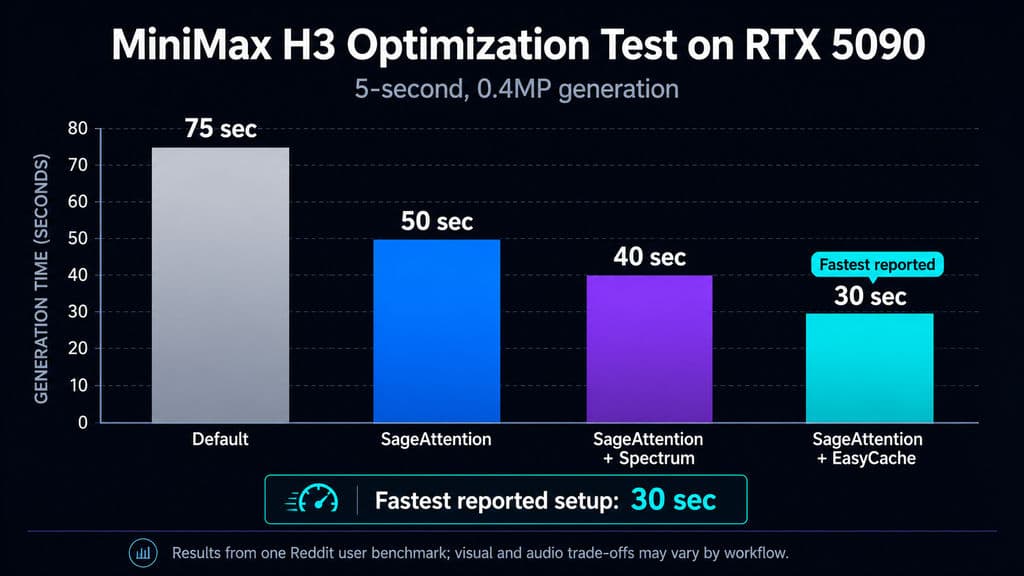
One current benchmark tested a five-second 0.4MP generation on an RTX 5090. Default inference took 75 seconds, SageAttention reduced it to 50 seconds, SageAttention plus Spectrum reached 40 seconds, and SageAttention plus EasyCache reached 30 seconds.
The tester did not notice obvious visual degradation in that comparison, but suspected EasyCache could affect audio quality more noticeably for music than dialogue.
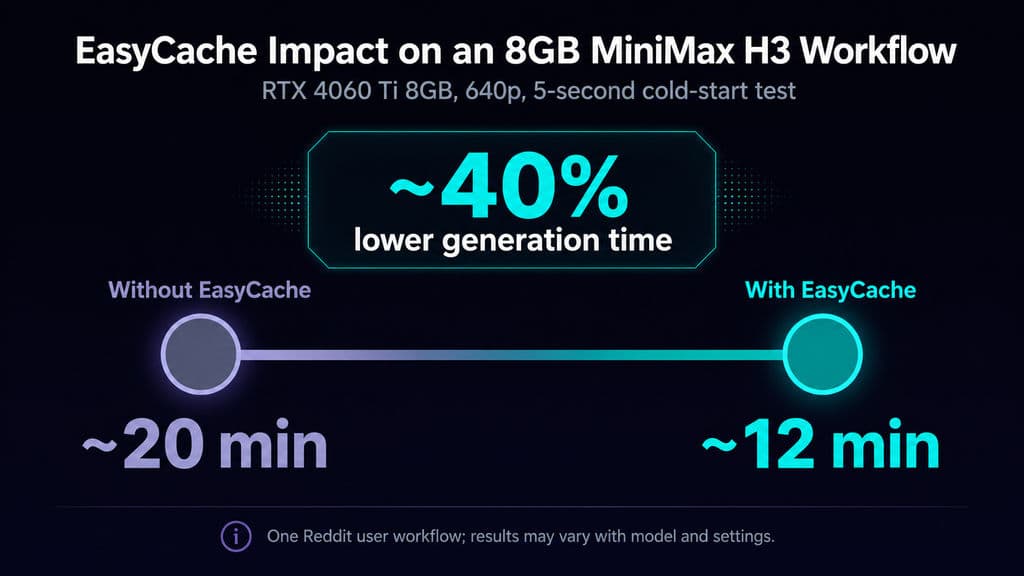
MiniMax H3 Case Study: EasyCache Cuts an 8GB Workflow by About 40%
A separate RTX 4060 Ti 8GB test reported a 640p five-second cold-start generation dropping from approximately 20 minutes to 12 minutes after adding EasyCache. Based on those reported numbers, generation time fell by about 40%.
For low-VRAM creators, optimization can determine whether H3 is a demo or a usable iterative tool.
A practical workflow is therefore to preview cheaply and finalize selectively: use lower resolution and stronger acceleration during exploration, then render selected concepts with more conservative quality settings.
MiniMax H3 Reddit Case Studies Beyond Standard Video Generation
Some of the most valuable H3 feedback comes from creators intentionally using the model outside its obvious role.
MiniMax H3 as a Poster, Dashboard and Infographic Generator
One ComfyUI experiment generated a short sequence and extracted a single frame, effectively treating H3 as a pseudo-image model.
The creator tested portraits, posters, magazine layouts, dashboards, infographics, charts, typography, and fantasy key art. H3 showed useful understanding of layout hierarchy, palettes, icons, and detailed art direction, but spelling errors, fake microtext, inaccurate chart data, and Video-VAE artifacts still required manual inspection.
This makes H3 interesting for concept exploration, not trustworthy final typography or data visualization.
MiniMax H3 as a Near-Real-Time Audio and Foley Generator
Another user reduced output to 32×32 pixels and used H3 primarily to generate audio. On an RTX 5090, many tests produced more seconds of audio than the generation itself required. The creator found roughly 45 seconds to be a more reliable range, while 60-second dialogue started losing coherence.
This creates a useful workflow: explore voices or sound effects cheaply, select the audio, then pass it back as reference for the final visual generation.
MiniMax H3 Case Study: 15-Second Multi-Shot Generation
A high-end RTX PRO 6000 Blackwell 96GB test generated an approximately 1MP, 15-second multi-shot sequence in 23 minutes using BF16 diffusion and text encoding. The creator reported completing most of the requested sequence in a single generation without frame repair or replacing text cards before final upscaling.
The broader lesson is that render time should be evaluated against total workflow time, not inference alone.
MiniMax H3 vs LTX 2.3 and Wan: What Does Reddit Prefer?
Reddit does not show a universal winner between MiniMax H3, LTX 2.3, and Wan.
In one same-prompt comparison, the creator reported H3 taking roughly three times longer than LTX 2.3, but preferred H3's result and wanted faster Turbo-style workflows.Another reference-video comparison found commenters preferring H3's acting and reaction behavior, while also emphasizing that H3 benefits from its own detailed, storyboard-like prompting style rather than identical prompts across models.
Wan remains an important local benchmark. One 12GB VRAM + 16GB RAM user produced a 640×480 R2V result in 13 minutes and specifically valued that the workstation remained usable during H3 generation, unlike their previous Wan workflow.
This suggests model choice should follow workflow requirements: LTX may make more sense for speed, while H3 becomes attractive when detailed direction, references, acting, motion, or integrated audio matter more.
What Are the Biggest MiniMax H3 Problems According to Reddit Users?
Across the research, six limitations recur most often.
Generation speed: five-second jobs range from minutes to more than 50 minutes, with some R2V workflows taking hours.
VRAM and RAM complexity: users struggle to choose between INT8, FP4, GGUF, offloading strategies, and different checkpoints.
Reference degradation: R2V may soften details or introduce artifacts even when the source material is clean.
VAE softness: one controlled VAE encode/decode experiment showed reduced facial and skin detail before diffusion was involved; higher-resolution workarounds could increase generation time by roughly 3–5× in that user's workflow.
Wide-shot quality: users report close-ups holding together better than distant or full-body subjects, which can become pixelated or unrecognizable.
Motion and audio artifacts: current feedback includes unwanted slow-motion aesthetics, smeary frames, and automatically generated background music when it was not requested.
These limitations explain why the Reddit conversation is increasingly shifting from “Can H3 generate this?” toward “How do I make H3 repeatably usable?”
MiniMax H3 Reddit FAQ: Real Questions Users Are Asking
Can MiniMax H3 run on 8GB VRAM?
Yes. Real users have successfully run H3 on 8GB GPUs, including an RTX 3070 producing five-second 0.4MP I2V in roughly 9–10 minutes. However, 32GB system RAM, quantization, offloading, and optimization can be critical. An 8GB configuration should be viewed as workable but optimization-heavy, not effortless.
Which MiniMax H3 model should I use with 12GB VRAM?
There is no single community answer for every workflow. Recent users recommend optimized INT8 configurations for some 12GB setups, while Turbo LoRA and SageAttention have also produced practical results. The strongest evidence is that 12GB systems can reach approximately 6–10 minute five-second generations under suitable configurations.
Why is MiniMax H3 R2V much slower than I2V?
R2V processes additional reference images, video, and potentially audio, increasing both memory and computation. Users experiencing extreme slowdown commonly experiment with shorter references, lower reference resolution, resizing before conditioning, and reduced offloading. The research includes a 5070 Ti case where six-second R2V stretched into hours.
Why does MiniMax H3 Ref2Vid sometimes look worse than I2V?
Reference scaling, aspect-ratio mismatch, conditioning complexity, and VAE reconstruction may all contribute. Users report that better reference preparation and expanded prompts can improve results, but there is no universal fix. Ref2Vid should therefore be tested as a separate workflow rather than assuming I2V quality will carry over automatically.
Do EasyCache, SageAttention or Turbo LoRA reduce MiniMax H3 quality?
They can introduce trade-offs, although the impact varies by configuration. Some tests report large speed gains without obvious visual loss, while others raise concerns about fine detail or audio quality. For production work, use acceleration aggressively for previews and compare selected final generations against less-compressed settings.
Why do MiniMax H3 faces sometimes look soft or plastic?
Part of the problem may come from the VAE. A controlled encode/decode test already showed facial and skin-detail loss without running the diffusion model. Reference workflows and lip-sync can add further flicker or deformation, so higher resolution, careful reference preparation, and post-generation inspection remain important.
Can MiniMax H3 generate longer than 15 seconds without character drift?
Users are actively experimenting with longer clips and continuation, and some report successful 10-second generations. However, the available community research does not establish reliable long-form identity consistency beyond H3's normal short-video workflow. For production, shorter controlled segments remain the safer choice.
Can MiniMax H3 be used for design and image generation?
Experimentally, yes. Users have produced poster concepts, dashboards, magazine layouts, infographics, portraits, and other still designs by extracting frames from short H3 sequences. Its detailed art-direction response is promising, but text accuracy, chart data, and small graphic details still require human verification.
MiniMax H3 Reddit Verdict: Is It Worth Using?
MiniMax H3 is worth serious experimentation for creators who prioritize controllability, motion, references, multimodal generation, and local workflow flexibility over raw inference speed. Reddit testing shows that it can perform demanding tasks on surprisingly accessible hardware, but the experience becomes substantially better as VRAM, system RAM, and workflow optimization improve.
The more interesting conclusion is that H3 exposes a broader shift in AI design: model quality is no longer the only bottleneck. Designers also need ways to organize references, reuse direction, compare iterations, coordinate multiple creative tasks, and preserve context across a project.
That is where workflow-oriented systems become relevant. Virse, for example, is positioned around a canvas-based design workflow in which AI assists professional designers, multiple agents can share project context, and team preferences or brand knowledge can persist across work rather than restarting from a blank prompt each time. The connection to H3 is not that Virse replaces the model; it is that increasingly capable models become more useful when they are embedded in a structured creative process.
The strongest signal from MiniMax H3 Reddit feedback is therefore not simply “better AI video.” Users want a model that understands demanding creative direction and a workflow that makes that capability fast, repeatable, and controllable.
Mais do blogue da Virse
Inspiração

What Is an AI-Powered Design System for Brands?
8 de agosto de 2026 by Vincent
Inspiração

What Is Art Direction? Definition, Examples, and How to Create an Art Direction
6 de agosto de 2026 by Yifan Zhao
Inspiração

What Are Wireframes? A Practical Guide to UX Wireframing
6 de agosto de 2026 by Yifan Zhao