ChatGPT Image 2.0 Pricing: Cost Per Image, Limits & Plus vs Pro vs API

Vincent10 分钟阅读 ·

ChatGPT Image 2.0 Pricing: Cost Per Image, Limits & Plus vs Pro vs API

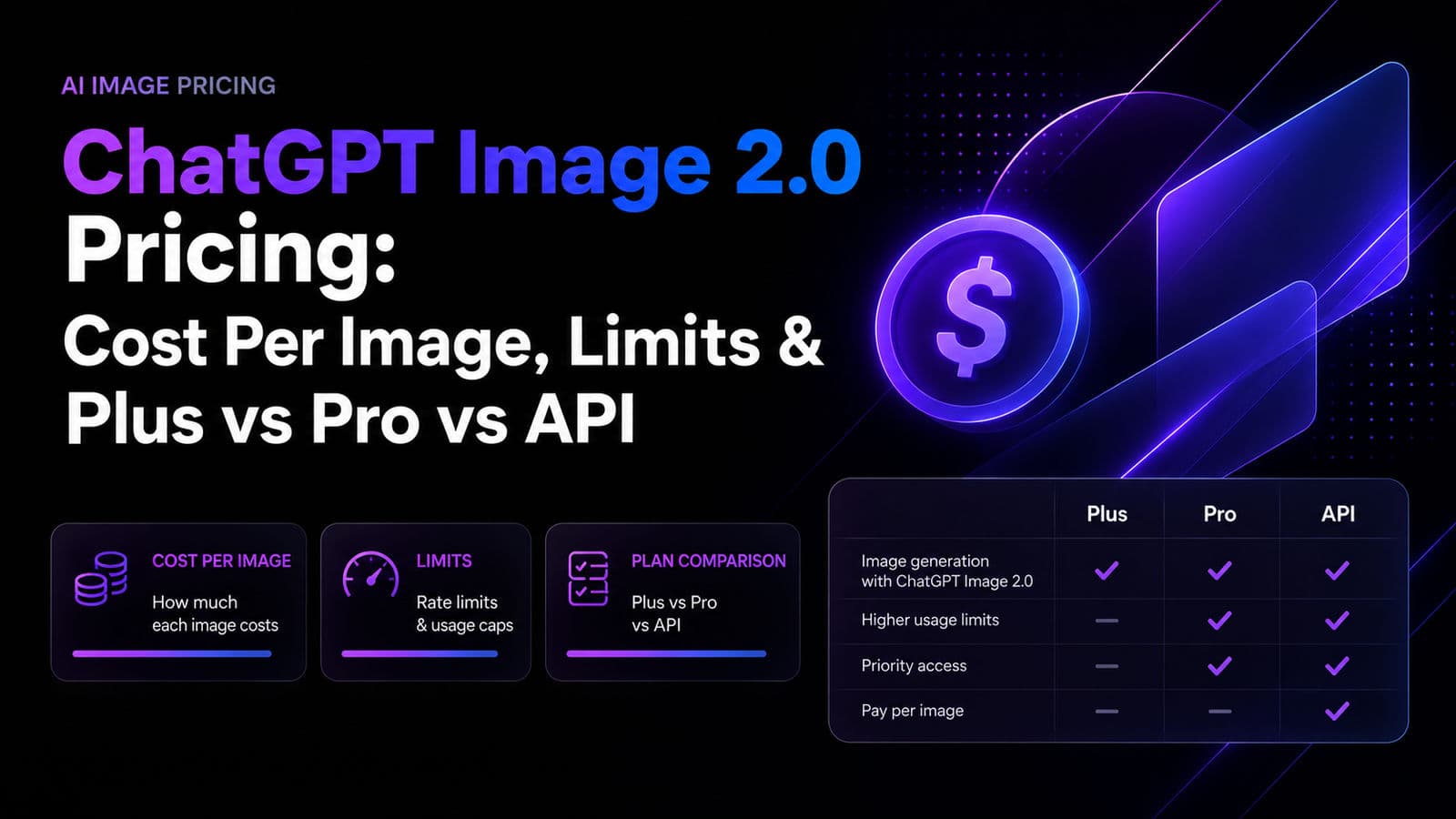
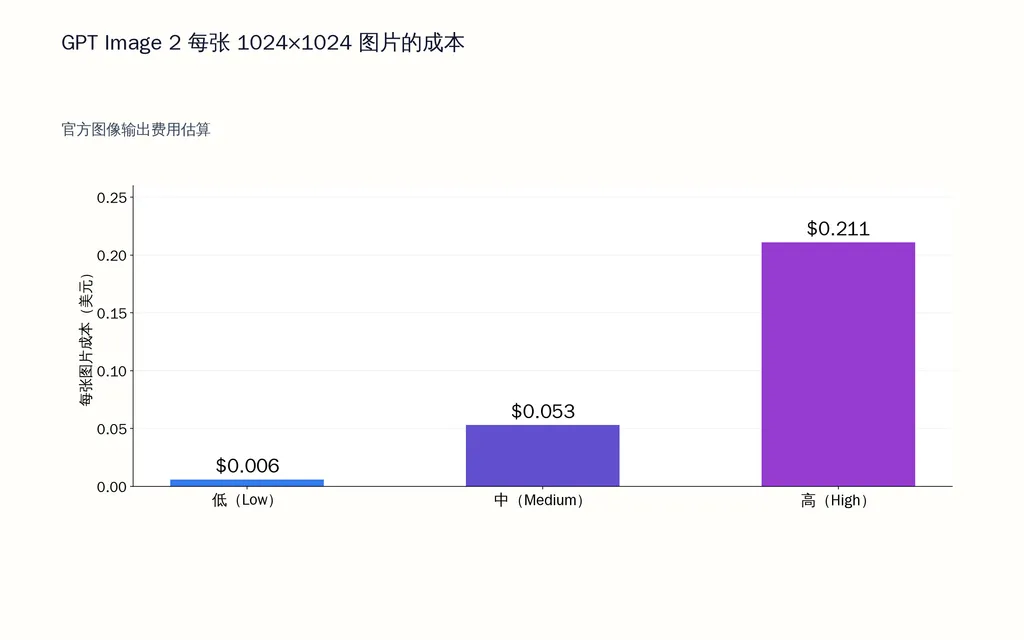
ChatGPT Image 2.0 pricing varies by access method, quality, and usage volume. ChatGPT Plus costs $20/month, Pro provides higher usage allowances, and API usage is billed separately. For 1024×1024 API images, OpenAI estimates about $0.006 Low, $0.053 Medium, and $0.211 High—roughly $6, $53, and $211 per 1,000 images before input and retry costs.

The problem is that price per generation is not the same as cost per usable image. Quality, retries, reference images, changing subscription limits, automation requirements, and designer review time all affect the final production budget. A workflow that looks cheap per generation may become expensive once multiple attempts are needed for approval.

The best choice therefore depends on total workflow cost, predictability, and production needs. Plus suits interactive creation, Pro fits heavier ChatGPT usage, and the API is easier to budget for automation and high-volume production.

For teams managing larger creative workflows, Virse adds a canvas-based workspace, multi-Agent collaboration, shared project context, and long-term memory, helping designers keep references, brand knowledge, and creative decisions organized while staying in control.

virse workforce

GPT Image 2 Price Per Image: Low, Medium, and High Pricing

OpenAI prices GPT Image 2 according to image-output tokens, with total request cost also affected by text prompts and image inputs. Standard GPT Image 2 pricing is currently $8 per million image-input tokens, $2 per million cached image-input tokens, and $30 per million image-output tokens. Batch image pricing is lower at $4, $1, and $15 respectively.

For common output sizes, OpenAI's current estimates are:

Quality

1024×1024

Portrait or Landscape

Low

$0.01

$0.01

Medium

$0.05

$0.04

High

$0.21

$0.17

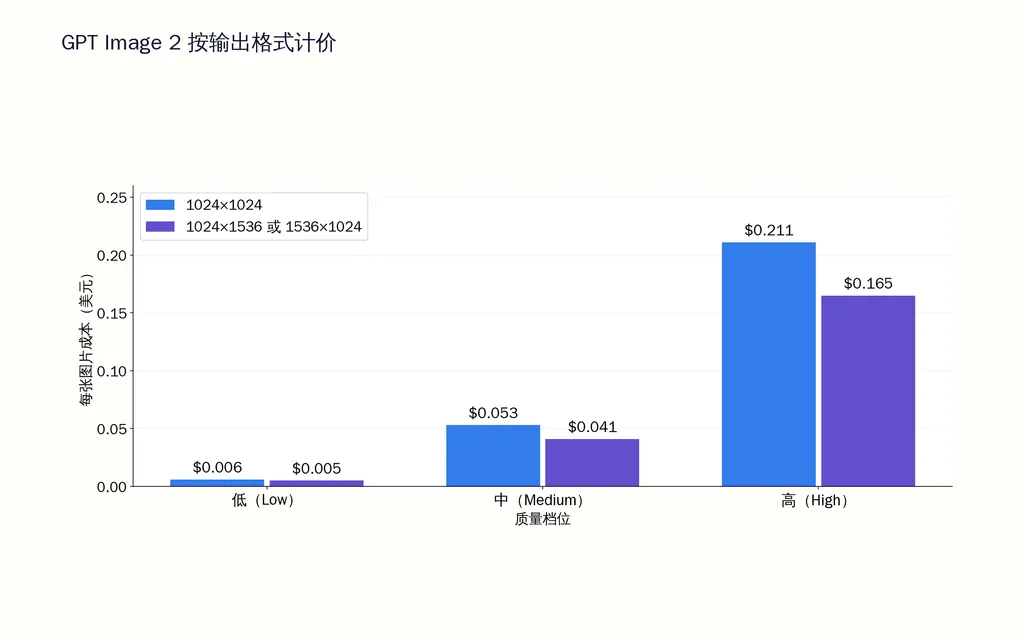
The portrait and landscape figures refer to 1024×1536 or 1536×1024. GPT Image 2 also supports many additional resolutions, including larger formats, so actual costs can vary by dimensions.

Bar chart comparing GPT Image 2 cost per 1024×1024 image: Low costs $0.006, Medium $0.053, and High $0.211.

When Low Quality Makes Sense

Low is best for broad exploration. At about $0.006 for a square image, 100 generations cost roughly $0.60 before additional inputs. That makes it practical for exploring compositions, camera angles, color systems, layouts, and visual directions before the team commits to one route.

In professional design workflows, paying High-quality prices during early ideation usually creates unnecessary cost. Use inexpensive generations while creative uncertainty is high.

Why Medium Is Often the Best Production Baseline

At approximately $0.053 per square image, Medium is a practical middle ground for social assets, concept development, marketing variations, moodboards, and routine creative production.

One recurring automation case in our research produced four social posts per day at about $0.05 per generated post, or roughly $0.20 per day. That closely matches Medium-level economics and gives a useful real-world reference for ongoing content production.

When High Quality Is Worth the Cost

High costs about $0.211 for a 1024×1024 output, roughly four times Medium. It is better reserved for final campaign assets, hero imagery, detail-sensitive product visuals, or client-facing deliverables.

The practical rule is simple: finalize direction first, then pay for rendering quality. Generating ten High-quality concepts when only one will survive review wastes more budget than moving the selected concept from Medium to High at the end.

Grouped bar chart comparing GPT Image 2 pricing by format: square images cost $0.006, $0.053, and $0.211 for Low, Medium, and High, versus $0.005, $0.041, and $0.165 for portrait or landscape.

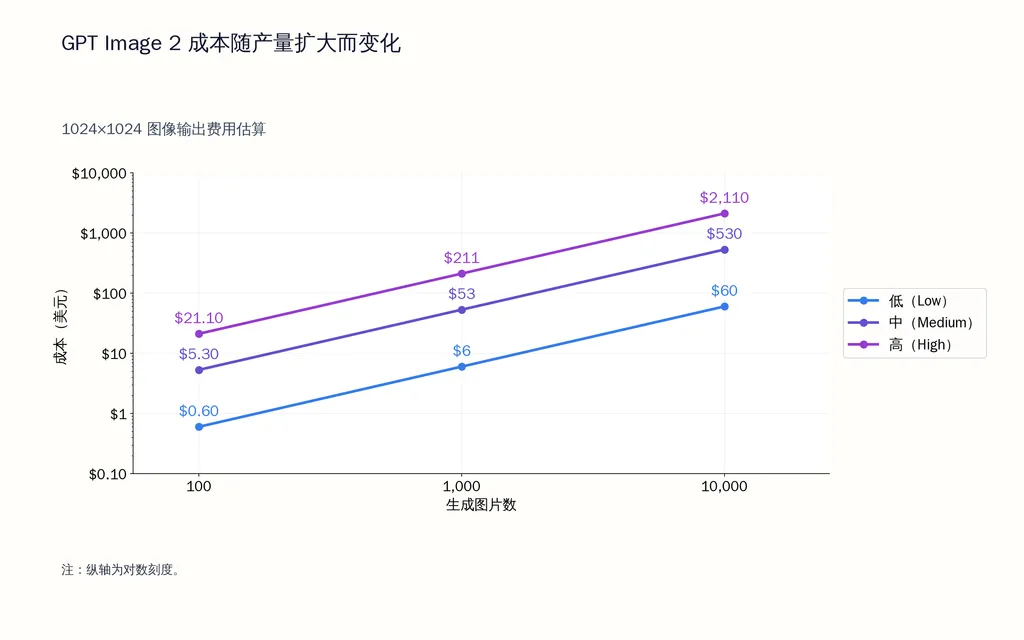
GPT Image 2 Cost Per 1,000 Images

For budget planning, cost per 1,000 outputs is easier to understand than token rates.

Volume

Low

Medium

High

100

$0.60

$5.30

$21.10

1,000

$6

$53

$211

10,000

$60

$530

$2,110

These are image-output estimates for 1024×1024 generations. Text prompts, reference images, editing inputs, and repeated attempts add to the final request cost.

Line chart showing GPT Image 2 production costs for 100, 1,000, and 10,000 images, ranging from $0.60 to $60 at Low, $5.30 to $530 at Medium, and $21.10 to $2,110 at High.

What Changes Above 1,000 Images Per Month

At low volume, a few cents rarely determine which workflow to use. At 1,000 or 10,000 images, provider choice, quality level, batching, and retry rate become material operating decisions.

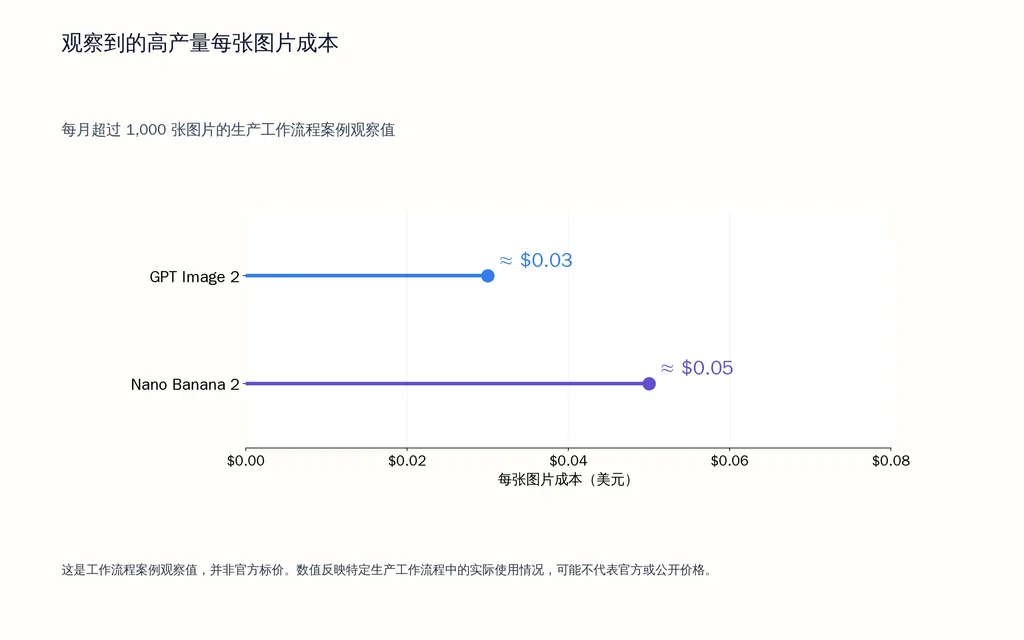
One high-volume case in our research generated more than 1,000 images per month and reported an effective third-party GPT Image 2 cost near $0.03 per image, compared with approximately $0.05 for Nano Banana 2 in the same workflow. These figures are production-case observations rather than OpenAI list prices, but they show how infrastructure can change unit economics at scale.

Comparison chart showing an observed high-volume workflow cost of approximately $0.03 per image for GPT Image 2 and $0.05 per image for Nano Banana 2.

ChatGPT Plus vs Pro vs GPT Image 2 API: Which Is Cheaper?

There is no universal winner because subscriptions buy access while the API buys measurable usage. ChatGPT Plus costs $20 per month, and OpenAI states that API billing is separate. OpenAI currently offers Pro tiers at $100 and $200, with usage allowances described as approximately 5× and 20× Plus respectively.

ChatGPT Plus Image Pricing and Limits

Plus is well suited to interactive design work: generating concepts, uploading references, refining an image conversationally, and exploring alternatives without building an API pipeline.

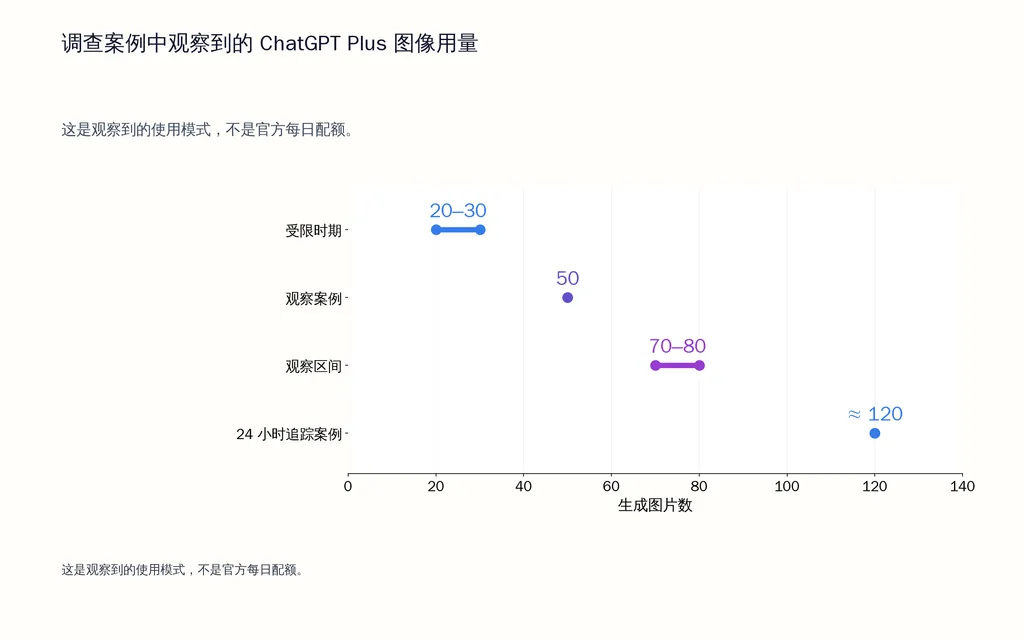
The tradeoff is capacity predictability. Our review found Plus usage observations ranging from approximately 20–30 images during constrained periods to around 50, 70–80, and roughly 120 images within 24 hours under different conditions. These figures should not be treated as official daily quotas. OpenAI itself states that Plus usage limits can vary with system conditions.

Range-and-dot chart showing reviewed ChatGPT Plus usage observations of 20–30, 50, 70–80, and about 120 images under different conditions; these are observed cases, not official daily limits.

ChatGPT Pro Pricing and High-Volume Limits

Pro makes more sense for heavy interactive users who want substantially more ChatGPT capacity. However, our review also identified high-volume projects where several hundred images were generated before temporary restrictions appeared. This supports an important distinction: higher usage allowance is not the same as guaranteed unlimited production throughput.

For a designer manually iterating throughout the day, Pro can be convenient. For a system that must produce an exact number of assets on schedule, capacity planning is easier through an API.

When the GPT Image 2 API Is Cheaper

The API becomes attractive when you need automation, predictable counting, batch production, or integration with a larger creative pipeline. A workflow generating 1,000 Medium square outputs starts around $53 in image-output cost, making unit economics much easier to model than subscription throughput.

For product variants, localization, agent-driven campaigns, or recurring social content, this predictability can be more valuable than the lowest theoretical monthly cost.

GPT Image 2 Cost Per Usable Image: The Metric That Matters

For professional design teams, cost per usable asset is more meaningful than cost per generation.

The calculation is straightforward: divide total generation spend by the number of assets that actually pass review.

If one Medium output costs $0.053 but a difficult composition requires three generations before approval, the image-output portion of that approved asset is already about $0.159.

Text Accuracy Can Reduce Retry Costs

One text-heavy evaluation in our research covered posters, infographics, product mockups, Japanese, Arabic, and Korean content. In that specific test, the earlier model achieved roughly 50% success, while GPT Image 2 reached about 99%. The earlier model was also reported to produce an incorrect or damaged word roughly once every five words.

This is not a universal benchmark, but it illustrates a critical production principle: a more reliable output can be cheaper even when its nominal generation cost is higher, because fewer attempts are discarded.

Photorealistic Work Can Reverse the Economics

Our research also found detailed photorealistic workflows requiring two or three correction rounds for issues such as grain, hair artifacts, or realism.

A typography-heavy poster and a photorealistic campaign image can therefore have very different cost-per-approval curves. Teams should measure retry rates by use case rather than assuming one quality setting is always the best value.

GPT Image 2 for Product Design and Commercial Images

Pricing is only one variable in commercial image production. Accuracy, consistency, and approval rate directly affect cost.

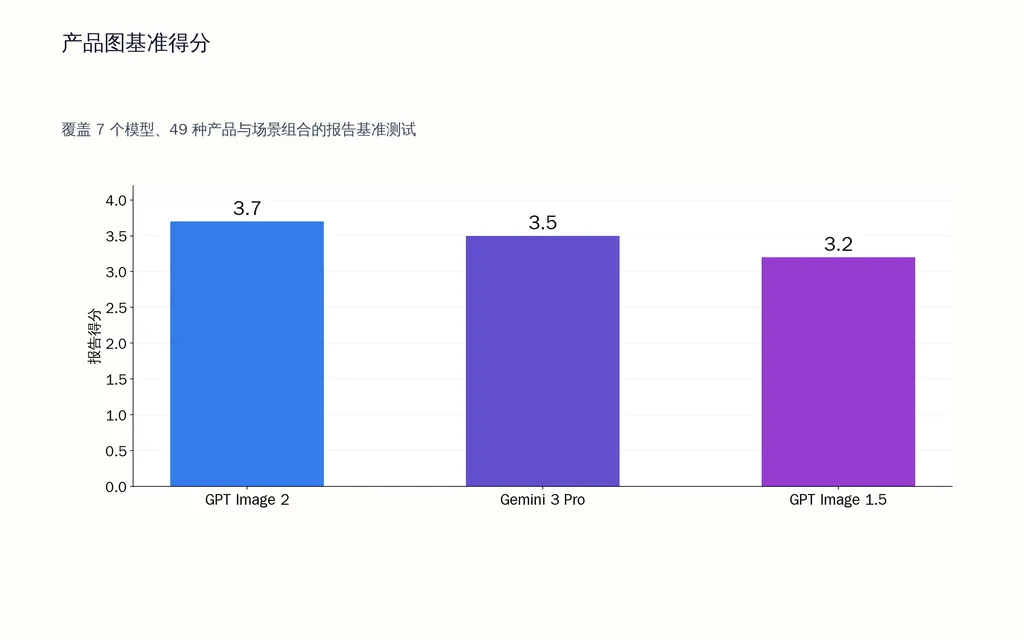
A product-image benchmark in our research compared seven models across 49 product-and-scenario combinations. GPT Image 2 received a reported score of 3.7, compared with 3.5 for Gemini 3 Pro and 3.2 for GPT Image 1.5.

Radar chart of reported product-image benchmark scores: GPT Image 2 scored 3.7, Gemini 3 Pro scored 3.5, and GPT Image 1.5 scored 3.2 in a benchmark covering seven models and 49 product-scenario combinations.

Why Product Accuracy Changes the Budget

E-commerce and product teams need more than visually attractive outputs. Packaging geometry, label text, material appearance, logos, proportions, and relationships between objects may all need to remain accurate.

A cheap image that changes the product is not a cheap asset if the team has to regenerate it. For commercial design, compare models by cost per approved asset, not only cost per output.

GPT Image 2 API Workflow Costs Beyond Generation

Compute cost can be easy to measure while designer time remains invisible.

One advanced workflow review in our research evaluated six API clients: Chatbox, LobeChat, OpenRouter Chat, TypingMind, Cherry Studio, and Jan. The workflow still lacked an ideal combination of image-first interaction, prompt versioning, reference-image management, custom endpoints, and side-by-side comparison.

Why Workflow Friction Can Cost More Than API Tokens

Saving a few cents per generation has limited value if designers spend additional time locating references, rebuilding prompt context, or manually comparing variations.

For professional creative production, measure generation cost, retry rate, approval rate, reference management, prompt history, automation compatibility, and review time together. The goal is not simply cheaper AI images; it is a more efficient design process.

How to Reduce GPT Image 2 Costs in a Design Workflow

A simple quality ladder works well for most professional teams:

  1. Explore with Low. Generate broad compositions and visual directions cheaply.
  2. Develop with Medium. Test stronger concepts, copy, product relationships, and campaign variations.
  3. Finish with High. Use the highest-cost setting only when additional detail affects the final deliverable.
  4. Track retries. Measure generations per approved asset, not just monthly API spend.
  5. Separate interactive and automated work. Use ChatGPT when conversation and manual iteration matter; use the API when predictable throughput and automation matter.
  6. Consider Batch for asynchronous work. GPT Image 2 Batch image-token pricing is currently about half the standard token rate, which can improve economics for suitable bulk jobs.

This workflow keeps expensive rendering close to final approval and makes AI image costs easier to manage as production scales.

FAQ

How much is GPT Image 2 per image?

For a 1024×1024 output, OpenAI currently estimates $0.006 Low, $0.053 Medium, and $0.211 High. Total request cost can be higher when text prompts, reference images, editing inputs, or retries are included.

How many images can Plus or Pro generate per day?

There is no reliable universal daily number. Our review found Plus observations ranging from roughly 20–30 to around 120 images under different conditions, while some Pro workflows reached several hundred before temporary limits. These are observed usage patterns, not official quotas.

Is API cheaper than Plus or Pro for 1,000 images?

It depends on quality and workflow. Around 1,000 square API outputs cost approximately $6 Low, $53 Medium, or $211 High before additional inputs. Plus and Pro can be economical for manual interactive work, while API usage is easier to forecast for automation and fixed-volume production.

Is GPT Image 2 better value than Nano Banana 2 or GPT Image 1.5?

There is no universal winner. One high-volume case in our research recorded approximately $0.03 per GPT Image 2 image versus $0.05 for Nano Banana 2, while a separate seven-model product benchmark scored GPT Image 2 at 3.7 versus 3.2 for GPT Image 1.5. The better value depends on retry rate, text accuracy, consistency, and cost per usable asset.

Conclusion

ChatGPT Image 2.0 pricing is best evaluated across three layers: subscription access, API unit economics, and real production cost. OpenAI currently estimates 1024×1024 GPT Image 2 outputs at about $0.006 Low, $0.053 Medium, and $0.211 High; Plus is better suited to interactive creative work, Pro provides substantially higher ChatGPT usage allowances, and the API offers clearer economics for automation and high-volume pipelines. For professional designers, however, the deciding metric should be cost per usable asset: once retries, reference images, consistency, approval rate, workflow tooling, and designer time are included, the cheapest image is not always the cheapest design workflow.

更多 Virse 博客文章