MiniMax H3 vs Wan 3.0: qual modelo de vídeo com IA você realmente deve usar?
 Yifan Zhao12 min de leitura ·
MiniMax H3 é a melhor escolha para controle local e fluxos do ComfyUI, iteração rápida e exploração de cenas guiada por prompts, enquanto Wan 3.0 é mais forte em movimento humano natural, anatomia e vídeos contínuos mais longos. A escolha certa depende menos de qual demonstração parece melhor e mais do tipo de tomada que você precisa produzir repetidamente.
O problema é que os fluxos de produção de vídeo com IA mudam quando velocidade, artefatos, consistência, hardware, referências e gerações malsucedidas entram na produção. H3 oferece mais controle aos criadores por meio de um fluxo de geração configurável, mas pode exigir mais ajustes; Wan 3.0 pode entregar movimentos mais naturais e sequências mais longas, mas seu valor depende de essas vantagens resolverem suas necessidades de produção reais.
Se quiser usar modelos criativos de ponta sem trocar de ferramenta o tempo todo, Virse reúne mais de 40 modelos em um mesmo fluxo de design profissional multimodelo. Os planos pagos incluem uso ilimitado de modelos como Nano Banana 2 e GPT Image 2 com assentos ilimitados, enquanto Seedance 2.5, Seedance 2.0 e MiniMax H3 já estão disponíveis na biblioteca de modelos. Novos usuários também recebem créditos de cadastro suficientes para cerca de 10 imagens Nano Banana 2 ou um vídeo Seedance 2.0.
MiniMax H3 vs Wan 3.0: comparação rápida para produção
A maior diferença não é apenas a qualidade visual. H3 é voltado à iteração controlável, enquanto Wan 3.0 é mais convincente quando o movimento natural e sequências ininterruptas mais longas são prioritários.
Requisito de produção | MiniMax H3 | Wan 3.0 |
|---|---|---|
Fluxo local | Forte | A pesquisa atual é mais voltada a API e serviços hospedados |
ComfyUI | Muito adequado | Menos central nas evidências atuais de fluxo |
Aderência aos prompts | Frequentemente preferido | Boa, mas menos favorecida em comparações diretas |
Cenas dinâmicas | Frequentemente preferido | Mais conservador |
Anatomia humana | Resultados variados | Frequentemente preferido |
Movimento corporal natural | Resultados variados | Frequentemente preferido |
Vídeo contínuo longo | Evidências atuais mais fracas | Exemplos bem-sucedidos de cerca de 30 segundos |
Fluxos com referências | Fortes, mas imperfeitos | Suporta criação com muitas referências |
Ajuste fino | Dificuldades relatadas com H3 destilado | Evidências atuais insuficientes |
Modelo de custo | Economia de GPU local | Economia do provedor ou da API |
Melhor aplicação | Produção iterativa | Tomadas focadas em movimento e duração |
Escolha MiniMax H3 quando o controle do fluxo importar
H3 é mais forte quando o modelo integra um sistema de produção maior. Os criadores podem ajustar referências, amostradores, agendadores, quantização, aceleração e pós-processamento em vez de aceitar uma configuração fixa de inferência.
Isso o torna especialmente útil para storyboards, anúncios, conceitos de videoclipes, exploração de tomadas e iteração em alto volume.
Escolha Wan 3.0 quando a tomada depender de movimento ou duração
Wan 3.0 merece prioridade quando uma cena depende de movimento de corpo inteiro, atuação prolongada, anatomia ou uma tomada contínua mais longa. Nesses casos, reduzir reparos de movimento ou a junção de clipes pode ser mais importante que um controle mais profundo da inferência local.
Qual tem melhor qualidade de vídeo: MiniMax H3 ou Wan 3.0?
“Qualidade de vídeo” é ampla demais para servir como classificação útil. Na produção, ela deve ser dividida em aderência aos prompts, dinâmica de câmera, anatomia, movimento natural, rostos e consistência temporal.
H3 é mais forte na exploração de cenas dinâmicas guiada por prompts
Nossa revisão dos casos comparativos torna H3 consistentemente mais atraente para movimento de câmera, mudanças de cena, cortes e exploração visual rápida.
Um exemplo prático é a pré-produção de uma tomada publicitária. Se quiser testar várias entradas, direções de câmera e transições antes de escolher uma composição, H3 costuma ser mais produtivo porque o fluxo favorece a iteração.
O compromisso aparece quando o movimento fica extremamente rápido ou a anatomia fica muito exposta. H3 pode projetar bem tomadas dinâmicas sem ser necessariamente o melhor modelo para todo corpo humano em movimento rápido.
Wan 3.0 é mais forte em anatomia e movimento humano natural
Wan 3.0 é mais convincente em tomadas com caminhada, giros, movimento da parte inferior do corpo, interação e atuação de corpo inteiro mais prolongada.
Isso importa porque um vídeo com IA pode parecer bom quadro a quadro e ainda falhar em movimento. Se a transferência de peso, os membros ou o tempo corporal parecerem pouco naturais, a tomada é inutilizável, independentemente da qualidade das texturas.
A conclusão prática é mais precisa do que dizer que Wan tem “qualidade melhor”: Wan 3.0 é mais forte em anatomia e movimento corporal natural, enquanto H3 é mais forte em aderência aos prompts, design de tomadas dinâmicas e iteração criativa.
MiniMax H3 é mais rápido que Wan 3.0?
Não existe resposta universal sobre tempo de geração porque hospedagem, GPU, resolução, duração, agendador, precisão e aceleração podem mudar drasticamente o resultado.
MiniMax hospedado pode ser muito mais rápido em fluxos específicos
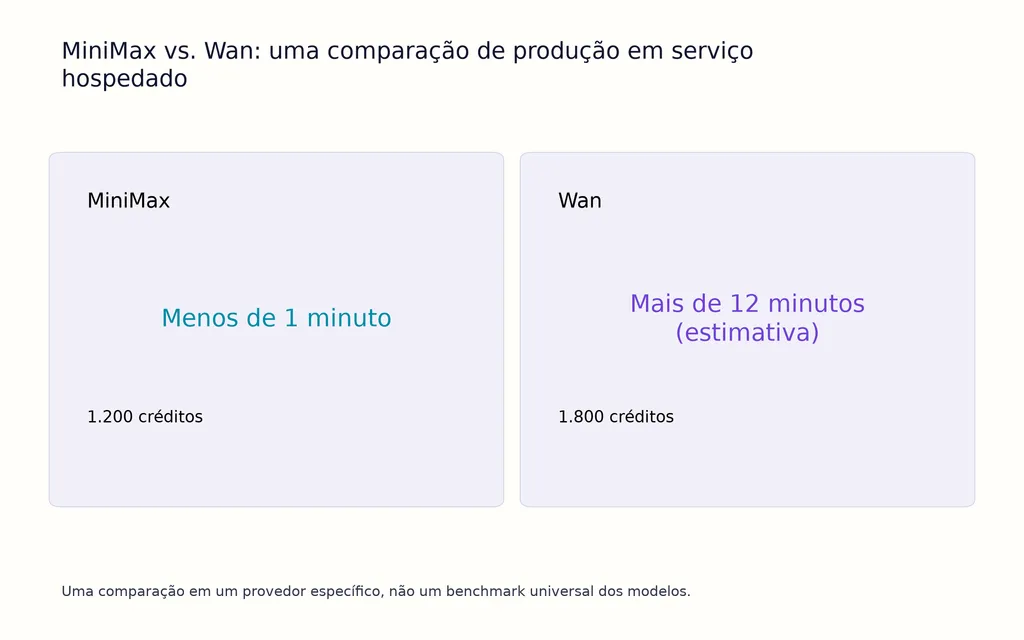
Em uma comparação hospedada com a mesma entrada, MiniMax terminou em menos de um minuto por 1.200 créditos, enquanto Wan mostrava estimativa acima de 12 minutos por 1.800 créditos.
É uma evidência útil sobre um ambiente de produção, não um benchmark universal de preço ou velocidade. A infraestrutura do provedor pode mudar a experiência tanto quanto o próprio modelo.
H3 local pode levar de 8 a 20 minutos em uma RTX 5090
H3 local apresenta uma situação muito diferente.
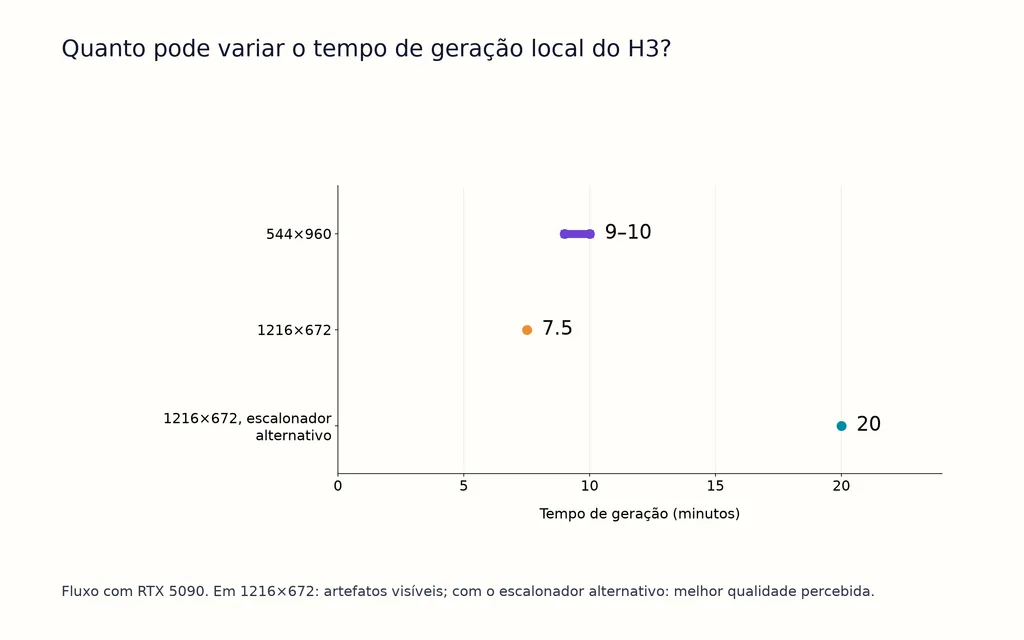
Um fluxo de RTX 5090 em 544×960 levou cerca de 9–10 minutos por geração. Outro teste em 1216×672 produziu dois resultados muito distintos:
- cerca de 8 minutos, com artefatos visíveis;
- cerca de 20 minutos, com uma configuração alternativa do agendador que gerou melhor qualidade percebida.
A lição é importante: menos etapas não significam automaticamente geração mais rápida. Toda a infraestrutura de inferência determina a latência real.
Spectrum reduziu o tempo do amostrador H3 em 45,29%
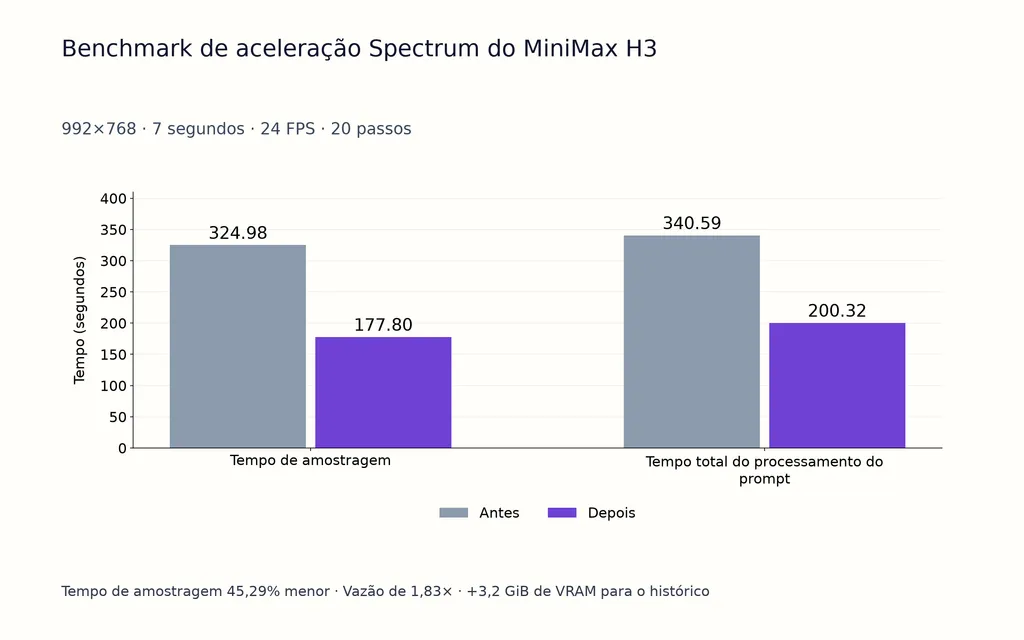
Um caso documentado de aceleração H3 usou:
- resolução de 992×768
- vídeo de 7 segundos
- 24 FPS
- 20 etapas
- H3 BF16 podado
O tempo do amostrador caiu de 324,98 para 177,80 segundos, uma redução de 45,29% e aproximadamente 1,83 vez a capacidade de processamento. O tempo de processamento completo do prompt caiu de 340,59 para 200,32 segundos, com cerca de 3,2 GiB adicionais de VRAM para o histórico.
Essa é uma das principais vantagens de produção de H3: o ecossistema ao redor pode mudar significativamente seu perfil de velocidade e custo.
Wan 3.0 é melhor que MiniMax H3 para vídeos longos?
O diferencial mais claro de Wan 3.0 é a capacidade de produzir sequências contínuas de cerca de 30 segundos em exemplos reais bem-sucedidos.
Gerações mais longas podem reduzir a junção de tomadas
Isso importa porque a produção audiovisual com IA costuma criar custos ocultos entre clipes.
Um fluxo de vídeo curto frequentemente exige gerar várias tomadas, combinar personagens, corrigir ambientes e esconder descontinuidades na edição. Uma geração contínua mais longa pode reduzir essas passagens.
Para tomadas de acompanhamento, microdramas, transições de ambiente e movimentos prolongados de personagens, menos pontos de edição podem valer mais que um pequeno aumento na qualidade de um quadro.
Trinta segundos não significam consistência garantida
Uma geração bem-sucedida de 30 segundos não prova que todas as tentativas de 30 segundos permanecerão estáveis.
As evidências atuais ainda são insuficientes para estabelecer taxas de sucesso repetíveis em identidade, vários personagens, movimento ou consistência do ambiente no fim da sequência.
Portanto, Wan 3.0 deve ser tratado como o candidato mais forte para formatos longos, não como solução que garante 30 segundos de consistência.
Quão consistentes são as referências e os personagens do MiniMax H3?
O controle por referências é uma grande vantagem de H3, mas mais referências não criam automaticamente um mundo estável.
H3 ainda pode apresentar desvios em fluxos com múltiplas referências
Nossa revisão encontrou tentativas de produção usando:
- referências de quatro ângulos;
- painéis de referência 2×2;
- referências de 360 graus;
- ambientes panorâmicos;
- imagens separadas de personagem e local.
Mesmo com essas entradas, a geometria dos cômodos, a posição dos objetos e a estrutura do ambiente ainda podiam mudar entre gerações.
A lição de produção é simples: reconhecer referências não é o mesmo que manter compreensão espacial persistente.
Separe referências de identidade, ambiente e tomada
Para fluxos H3 mais controláveis, separe as referências por finalidade:
- Referências de identidade para rosto, corpo e roupas.
- Referências de ambiente para materiais, arquitetura e disposição.
- Referências de tomada para enquadramento e posição da câmera.
Depois gere um clipe curto de validação antes de partir para uma passagem mais longa ou de maior resolução.
Isso não eliminará os desvios, mas facilita identificar e corrigir falhas de consistência.
Por que MiniMax H3 produz artefatos?
O principal risco de produção de H3 não é apenas a existência de artefatos. É que falhas semelhantes podem vir de várias partes do fluxo.
Tipos comuns de falha do H3
Nossa revisão encontrou repetidamente problemas com:
- tremulação;
- rostos distantes;
- anatomia deformada;
- movimento rápido;
- posicionamento de personagens;
- desvio do ambiente;
- aceleração agressiva;
- fluxos com muitas referências.
Uma distinção útil é que H3 pode criar bem um conceito de tomada dinâmica e ainda ter dificuldade com a estabilidade anatômica dentro dela.
Um fluxo prático de solução de problemas do H3
Comece com uma referência limpa e um clipe curto de base. Desative interpolação e ampliação, remova LoRAs de aceleração agressiva e teste separadamente mudanças de amostrador ou agendador. Só reintroduza a aceleração depois que o resultado básico estiver estável.
Isso isola a pergunta mais importante: a falha vem do próprio H3, das referências ou do conjunto de otimizações?
Custo de MiniMax H3 vs Wan 3.0: qual é mais barato na produção?
Uma geração mais barata não significa automaticamente uma tomada utilizável mais barata.
A melhor métrica de produção é:
Custo por tomada utilizável = custo de geração × tentativas necessárias
Se uma geração de baixo custo falha repetidamente por anatomia ou consistência, seu custo real sobe. Se uma sequência longa de Wan mais cara substitui vários clipes curtos e reparos de continuidade, o preço maior de geração ainda pode fazer sentido econômico.
H3 dá aos usuários locais mais influência sobre essa equação porque podem alterar resolução, precisão, etapas, aceleração, quantização e utilização da GPU. Wan 3.0 transfere mais dessa economia para o provedor.
O modelo com menor preço em créditos não é necessariamente o de menor custo de produção.
É possível ajustar ou ampliar MiniMax H3 com confiabilidade?
O ajuste fino do H3 precisa ser validado antes da produção
Os casos de treinamento em nossa pesquisa relataram dificuldade em ensinar novos conceitos a checkpoints H3 destilados por meio de fluxos do tipo LoRA.
Isso não significa que H3 não possa receber ajuste fino. Significa que pesos abertos não devem ser confundidos com facilidade de treinamento.
Se seu pipeline depende de personagens proprietários, produtos incomuns ou novos conceitos de movimento, valide cedo a qualidade do treinamento, em vez de presumir que o ajuste personalizado resolverá a consistência depois.
H3 com LTX 2.3 pode perder detalhes visíveis
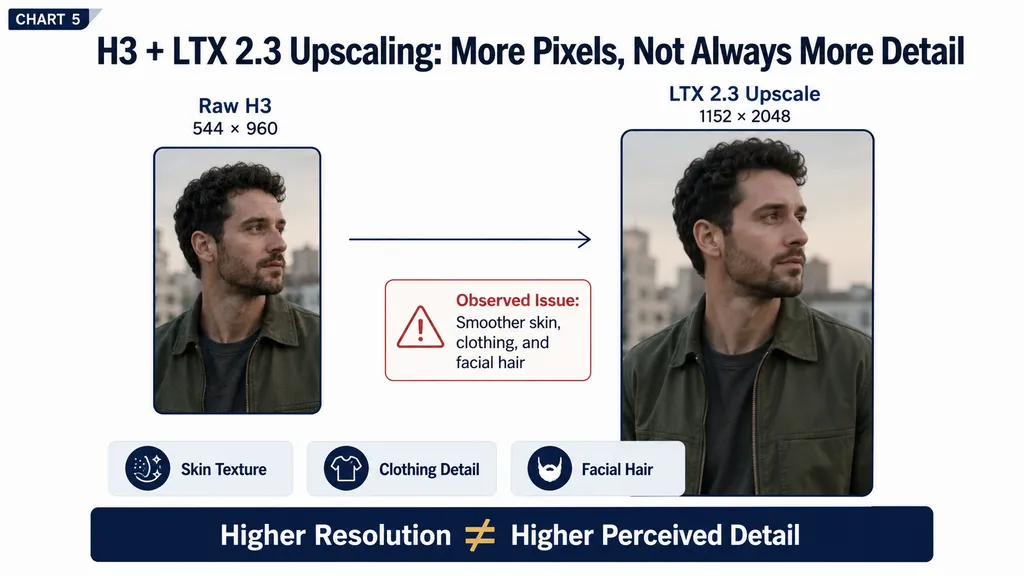
Um fluxo de RTX 5090 gerou em 544×960 e ampliou para 1152×2048 com LTX 2.3.
A saída maior não ficou automaticamente melhor. Os detalhes finos de pele, roupas e pelos faciais pareceram mais suavizados, deixando o resultado mais plástico.
É um alerta útil para produção: resolução maior e mais detalhe percebido não são a mesma coisa. Alternativas como RTX Super Resolution ou SeedVR2 merecem testes, e gerar diretamente em resolução maior às vezes preserva melhor a textura que uma ampliação agressiva.
MiniMax H3 vs Wan 3.0: melhor modelo de vídeo com IA por uso
Uso | Melhor ponto de partida | Motivo |
|---|---|---|
Criação de storyboards | H3 | Exploração visual rápida |
Conceitos publicitários | H3 | Fluxo forte de iteração |
Experimentos de câmera dinâmica | H3 | Melhor design de cenas guiado por prompts |
Produção local com ComfyUI | H3 | Mais controle da inferência |
Experimentação em alto volume | H3 | A otimização local muda a economia |
Movimento humano de corpo inteiro | Wan 3.0 | Melhor anatomia e movimento |
Atuação prolongada do personagem | Wan 3.0 | Animação mais natural |
Cenas contínuas mais longas | Wan 3.0 | Exemplos de cerca de 30 segundos |
Redução da junção de clipes | Wan 3.0 | Menos passagens de continuidade |
Consistência do ambiente | Nenhum vencedor claro | As evidências continuam incompletas |
Produção com muito ajuste fino | Teste primeiro | Os resultados de treinamento do H3 continuam variados |
Conclusão: você deve usar MiniMax H3 ou Wan 3.0?
Use MiniMax H3 quando o vídeo com IA integrar um fluxo de produção controlável e você valorizar inferência local, ComfyUI, iteração rápida, design de cenas guiado por prompts e a capacidade de otimizar velocidade e custo. Use Wan 3.0 quando a tomada depender mais de anatomia natural, movimento humano prolongado ou uma sequência contínua mais longa que reduza a junção de clipes. O melhor modelo não é o da demonstração mais impressionante; é aquele que produz mais tomadas utilizáveis dentro dos seus limites aceitáveis de tempo, custo, consistência, revisão e controle criativo.
Perguntas frequentes
H3 é melhor que Wan 3.0 para produção audiovisual com IA?
H3 é o ponto de partida mais forte para storyboards, exploração de cenas dinâmicas, fluxos locais do ComfyUI e iteração em alto volume. Wan 3.0 é mais convincente em movimento de corpo inteiro, anatomia e sequências contínuas mais longas. O melhor modelo depende de seu fluxo precisar de muitas tomadas curtas controláveis ou de menos tomadas, mais longas e focadas em movimento.
H3 pode rodar localmente e de quanta VRAM precisa?
A implantação local é uma das maiores vantagens de H3, mas não existe uma quantidade universal de VRAM para todo fluxo. Os requisitos mudam com o formato do checkpoint, quantização, resolução, duração, referências e aceleração. Uma configuração de Spectrum também exigiu cerca de 3,2 GiB adicionais de VRAM para o histórico a fim de obter a melhoria de velocidade medida.
Por que H3 produz artefatos e problemas de consistência?
As falhas de H3 podem vir do modelo, das referências, do amostrador, do agendador, da aceleração, da interpolação ou da ampliação. Problemas comuns incluem rostos, anatomia, tremulação, movimento rápido, posição de personagens e desvio do ambiente. Comece com uma geração básica simples e reintroduza os componentes de otimização um de cada vez.
H3 é mais rápido e barato que Wan 3.0?
Não em todos os casos. Uma comparação hospedada favoreceu MiniMax com menos de um minuto e 1.200 créditos, contra uma estimativa superior a 12 minutos e 1.800 créditos para Wan, enquanto os testes locais de H3 em RTX 5090 variaram de cerca de 8 a 20 minutos. O custo real depende do provedor, do hardware, das configurações e de quantas tentativas são necessárias para produzir uma tomada utilizável. Para uma visão mais ampla dos custos, veja os preços do MiniMax H3.