Wan 3.0 vs MiniMax H3: Which Gets Your Video Finished?
 Yifan Zhao9분 읽기 ·
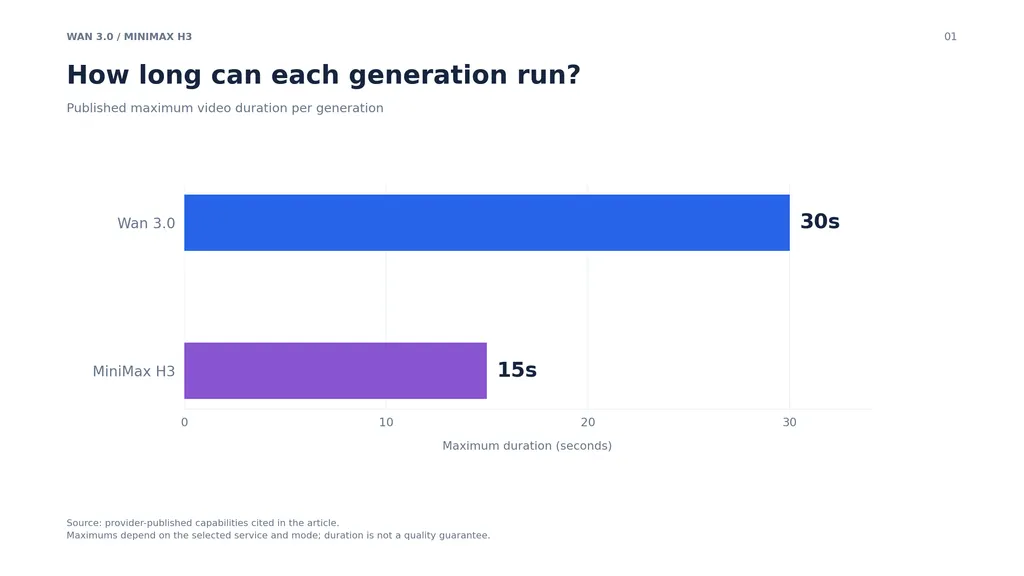
Wan 3.0 is the stronger starting point for longer videos and document-based briefs; MiniMax H3 is worth prioritizing for 2K finishing and local generation workflows, where licensing permits. For product ads and character videos, choose by what survives the full shot: product details, identity, motion, and sound.
A striking preview can become an expensive dead end when a logo changes, a prop disappears, or a revision disrupts approved footage. Compare the cost of an accepted video—including reference inputs, retries, and repairs—before committing your production budget.
Start exploring in Virse with credits awarded at signup, then choose a paid plan with unlimited use across a wide selection of models, including Seedance 2.5 and Kling 3, and unlimited seats. Bring your references, creative tools, and team into one workspace to develop more directions together, with room for every collaborator.
Wan 3.0 vs MiniMax H3: What Are the Main Differences?
Video duration, resolution, and input controls
Alibaba Cloud’s release guide and MiniMax’s technical documentation describe different production options:
Capability | Wan 3.0 | MiniMax H3 |
|---|---|---|
Published duration | Up to 30 seconds per generation | 4–15 seconds |
Output options | 480P, 720P, 1080P | 768p base; 2K through regeneration |
Inputs | Text, images, audio, video, documents | Text, images, video, audio |
Document workflow | Includes PPT, PDF, Word, spreadsheet formats | Not established in the reviewed documentation |
Editing | Changes to visuals, plot, dialogue | Generalized reference and editing |
Local workflow | Alibaba Cloud service covered here | Released base checkpoints; complete official workflow includes hosted stages |
For a product reveal, define when the object enters, what moves, and what must remain unchanged. Longer duration is useful only when the full action remains acceptable.
Why H3’s 2K workflow needs closer inspection
MiniMax’s release documentation separates context interpretation, base generation, and 2K regeneration. Its first/last-frame variant accepts optional boundary images. Its reference variant permits up to nine images, three video clips, and three audio clips, but only 12 files combined. Audio cannot be the sole reference; video and audio each have a 15-second aggregate limit.
A locally deployed H3 base is not the complete hosted 2K pipeline. Compare preprocessing and finishing as well as resolution.
Check framing, audio, and the actual service controls
Both model families support generated audio, but exposed controls vary by service. Confirm the required aspect ratio, sound settings, boundary-frame support, and reference combinations before migrating a workflow, including when evaluating alternatives such as Veo 3.1. A missing API field does not prove a missing model capability. For vertical delivery, verify framing before generation instead of relying on a crop afterward.
Wan 3.0 vs MiniMax H3 Video Quality: What Do the Cases Show?
Text-to-video case: atmospheric lighting versus prop continuity
Our research includes Atlas Cloud’s published 10-second forest-scene comparison. Its author assigned the following scores out of 10:
Evaluation | Wan 3.0 | MiniMax H3 |
|---|---|---|
Volumetric lighting | 6.5 | 7.8 |
Motion physics | 7.2 | 6.2 |
Audio synchronization | 7.2 | 6.8 |
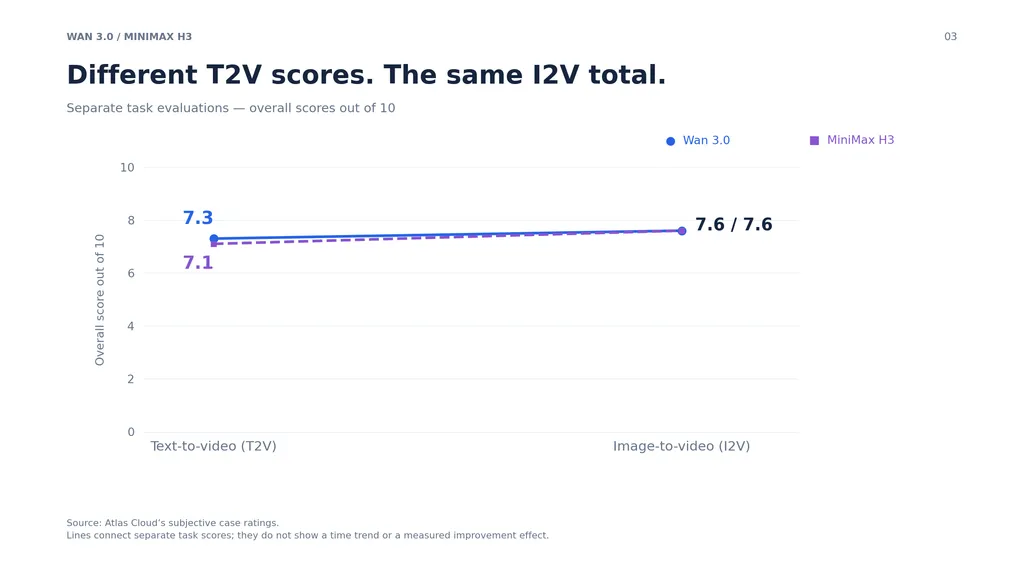
Overall T2V score | 7.3 | 7.1 |
Overall I2V score | 7.6 | 7.6 |
In the text-led case, the evaluator described stronger H3 light beams but a pumpkin appearing partway through the shot. Wan received a more favorable continuity assessment.
These are the publisher’s subjective sample ratings, not independently reproduced benchmarks. Inspect required objects throughout the shot instead of approving the lighting alone.
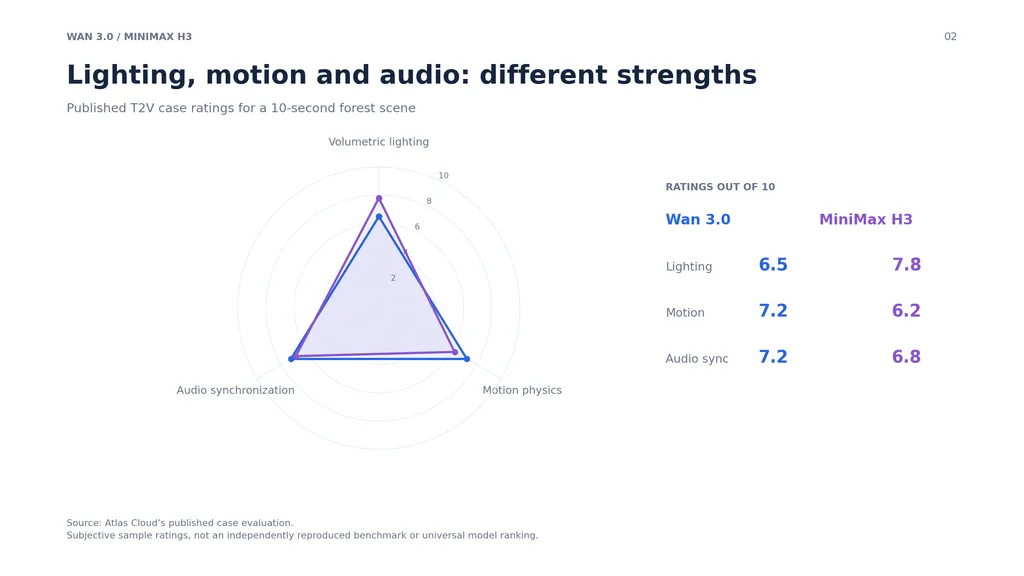
Image-to-video case: equal totals, different weaknesses
The image-led case used a reference frame, walking, turning, wind, and camera movement. Both models received 7.6 overall. The evaluator described stronger H3 cloth movement, while Wan’s wind response was more restrained; H3’s later face visibility suffered in shadow.
The production lesson is to separate identity, material motion, and visibility during review. An equal overall score can conceal different reasons to reject a shot.
For fashion, inspect fabric movement; for spokespersons, facial visibility. In product advertising, accurate geometry and readable branding can outweigh dramatic lighting.
These cases support task-specific evaluation, not a universal ranking. They establish neither repeated-trial success rates nor average repair time.
Wan 3.0 vs MiniMax H3 Workflows: What Can a Finished Project Teach Us?
H3 case study: a three-minute film on 16GB VRAM
A creator project examined in our research reports a three-minute historical montage produced using an RTX 5060 Ti with 16GB VRAM. The reported workflow combined ChatGPT-assisted prompts and reference images, individual 10-second H3 clips, an ACE-Step 1.5 soundtrack, and assembly in DaVinci Resolve.
Planning, visual generation, music, and editing were separate stages. The finished duration came from assembled clips, not one generation.
This creator account establishes neither minimum hardware requirements nor rendering speed.
For a small studio, approve a shot list, prepare reference images with a tool such as GPT Image 2, generate replaceable segments, and retain sound independently. Replace failed shots without rebuilding the timeline.
Wan document-to-video: turn a source file into a controlled brief
Alibaba’s release guide illustrates a café brand document becoming a promotional video and lists a document limit of one file or link, up to 100MB and 50 pages.
Treat this as a provider demonstration of the input workflow, not a measured production outcome. A document can contain conflicting priorities, outdated copy, or details that should never appear visually.
Before generating, extract the audience, principal claim, required product appearance, and closing message. Keep exact prices and legal copy editable. Give reviewers a clear approval standard.
Wan 3.0 vs MiniMax H3 Pricing: Which Costs Less to Deliver?
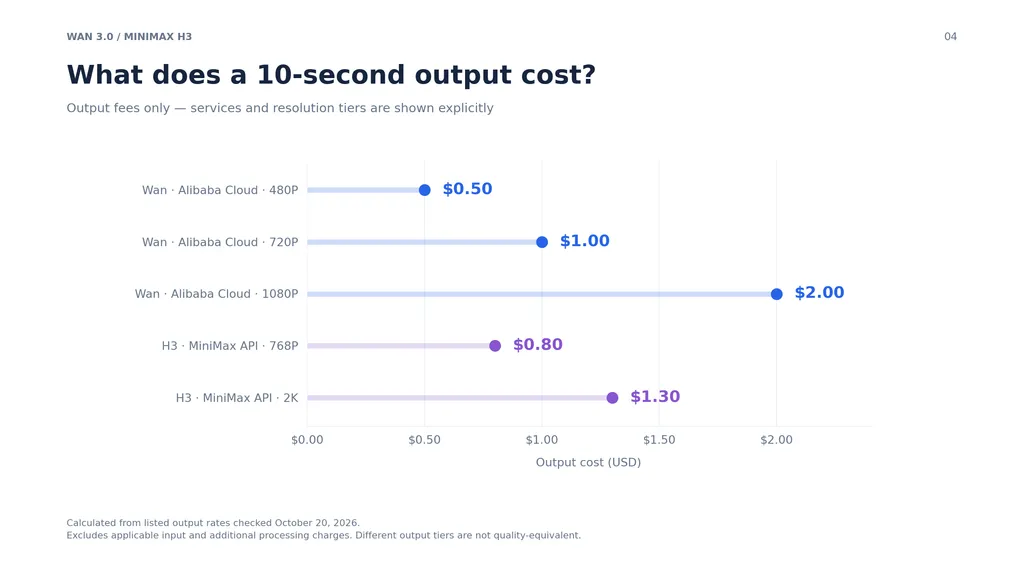
Official output prices and calculated clip costs
The following output rates were checked on October 20, 2026. Clip totals are arithmetic calculations from published rates, excluding applicable input charges and additional processing.
Service and output | Per second | 10-second output |
|---|---|---|
Wan, Alibaba Cloud, 480P | $0.05 | $0.50 |
Wan, Alibaba Cloud, 720P | $0.10 | $1.00 |
Wan, Alibaba Cloud, 1080P | $0.20 | $2.00 |
H3, MiniMax API, 768P | $0.08 | $0.80 |
H3, MiniMax API, 2K | $0.13 | $1.30 |
H3’s listed 2K output charge is lower than Wan’s listed 1080P charge, but these are different output tiers. Price alone does not establish equivalent quality or lower total delivery cost.
H3 reference charges can change the comparison
MiniMax separately lists video-input billing, free audio input, and an image allowance: the first five images are free, with additional images charged at $0.04 each for standard H3 generation. Its pricing also lists regeneration and context-processing charges.
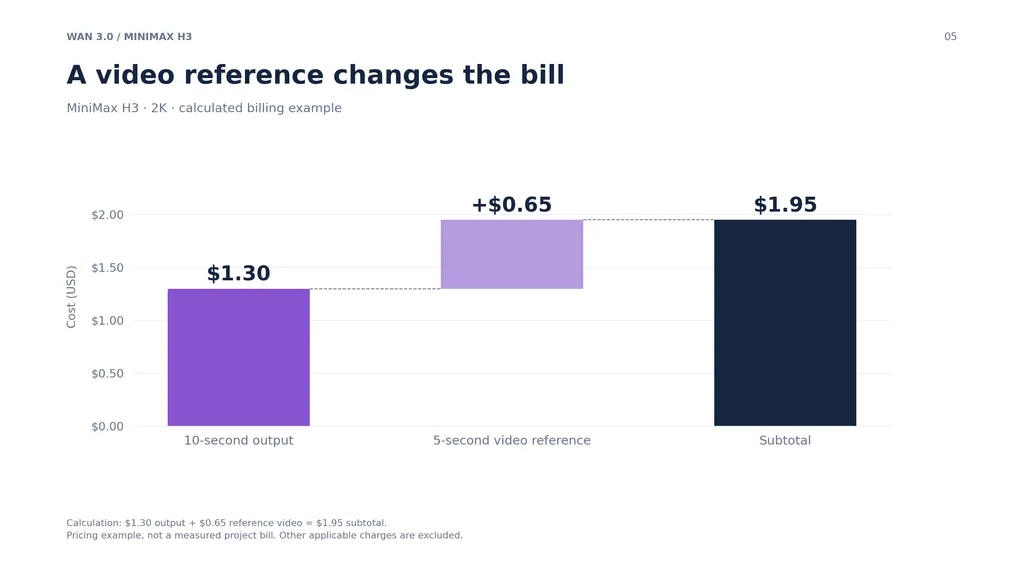
Calculated billing example: a 10-second H3 2K output costs $1.30 in output fees. Adding a five-second video reference at the published 2K input rate adds $0.65, producing $1.95 before other applicable charges.
This is a pricing calculation, not a measured project bill. It explains why a reference-heavy request should not be budgeted from output seconds alone.
Compare accepted output, retries, and repair time
Use the following calculation:
Generation cost per accepted clip = all generation and applicable input charges divided by accepted clips.
Include rejected attempts. If nothing passes review, report no accepted output rather than a finite unit cost.
Record repair time separately; state the labor rate when calculating a combined total. For different-length deliverables, compare cost per accepted second.
A generation invoice excludes the music production and timeline assembly illustrated by the three-minute project.
Wan 3.0 vs MiniMax H3 for Production: How Should You Choose?
Match the model to the approval bottleneck
Production requirement | Starting point | Acceptance check |
|---|---|---|
Longer generated sequence | Wan shortlist | Action and object continuity across the full duration |
Brief supplied as a document | Wan document workflow | Correct facts, selected content, editable critical copy |
2K finishing | H3 full workflow | Detail and identity in the regenerated export |
Local experimentation | H3 base, subject to current terms | Complete setup, usable output, operating effort |
Product or character campaign | Compare both | Repeatable identity and manageable revisions |
These are evaluation starting points. As in the forest case, check whether your product’s shape, position, and markings survive movement and occlusion.
Test revisions and audio before committing
Use a revision request that isolates one change: preserve the product and camera movement while changing only the lighting. Compare the revised result with the approved original, including sound.
Our review of user questions identified workflow-import difficulties, missing prompt information, unwanted opening sounds, and mismatches between recognizable appearance and voice. These are reported troubleshooting experiences, not measured failure rates.
Preserve the workflow version, model files, prompt, and references together. Review audio separately; retain approved narration when revising visuals.
Check local-deployment eligibility before choosing H3. According to MiniMax’s official guidance, design.minimax.io as of October 20, 2026, the EU, UK, US, and South Korea are excluded from the standard open-weight license territory. Organizations in those regions can apply for a separate license; API access is a distinct route. The official full 2K workflow also uses hosted context-processing and regeneration stages, so local base deployment does not establish an entirely offline 2K pipeline.
Wan 3.0 vs MiniMax H3: Conclusion
Wan 3.0 is the more natural starting point for longer generations and document-led briefs, while MiniMax H3 offers a distinct combination of reference controls, 2K finishing, and local base workflows. The reviewed cases show why neither specifications nor isolated samples settle the decision: lighting, continuity, fabric motion, sound, and revision effort can pull in different directions. Choose the workflow that preserves your approved assets and delivers acceptable results at a sustainable total cost.
Wan 3.0 vs MiniMax H3 FAQ
Can I make a multi-minute video with MiniMax H3?
Yes, by assembling shorter clips. The project reviewed above reports a three-minute result built from individual segments with separate music and editing. Plan continuity, transitions, and sound across the timeline. A completed film does not establish the maximum duration of a single generation or the time required to produce it.
Which is cheaper for reference-heavy videos: Wan 3.0 or MiniMax H3?
Compare the complete request, not just output seconds. H3’s published charges include applicable reference-video and additional-image fees. Wan pricing depends on service and output tier. Use the same brief, account for every billable input and retry, and compare accepted results. This article establishes no universal cost winner.
Why does an H3 clip contain an unwanted opening sound?
Our research found reports of short unintended vocal sounds, but it does not establish one confirmed cause. Review dialogue instructions and audio references, then isolate changes while troubleshooting. Trim or replace the track when appropriate. Treat suggested prompt changes as experiments, not guaranteed fixes or verified explanations of model behavior.
Which should I choose for product ads: Wan 3.0 or MiniMax H3?
Start with Wan for longer or document-led concepts; shortlist H3 for shorter 2K work. Then test your actual product references. Approve geometry, labels, motion, sound, and revision behavior separately. The reviewed forest cases show different strengths, but they do not establish a repeatable advertising-quality winner.
Is H3 free to run locally?
Released weights do not eliminate compute, storage, setup, or maintenance costs. The official full workflow also includes hosted components beyond the local base. Check current license eligibility, required processing stages, and final output requirements before estimating savings. Compare the complete intended workflow with hosted generation.