Nano Banana 2.1 Review: Is Google’s AI Image Model Ready for Professional Design Workflows?
 Yifan Zhao15분 읽기 ·
Nano Banana 2.1 is a strong AI image model for commercial design workflows, especially when designers need better text generation, product visuals, and more consistent creative outputs. However, it is not the best choice for every task—the right model depends on whether you need creative exploration, marketing production, or scalable visual content creation. As the AI image ecosystem grows, designers increasingly compare different AI image generators and AI design tools to find solutions that match specific creative requirements, from early concept development to final commercial production.
The biggest challenge with AI image tools is no longer generating images. It is creating assets that are actually usable. Designers and marketing teams still deal with inaccurate products, inconsistent characters, unreliable prompt execution, and repeated editing when AI outputs fail to match the original design intent. Building an effective AI design workflow requires more than selecting a powerful model—it also depends on better prompting strategies, structured iteration, and the ability to maintain consistency across different visual assets. Learning how to create more effective AI design prompts can help teams reduce unnecessary revisions and improve production efficiency.
Virse helps designers compare and use multiple AI models in one workflow. Paid plans provide access to multiple models with unlimited usage and unlimited seats, while new users can start with free credits after registration. Instead of managing separate AI tools, teams can explore different models, iterate faster, and build scalable AI-powered design workflows from one platform. This type of multi-model approach allows creative teams to select the right AI capability for different stages, including concept exploration, visual refinement, and commercial asset production.
What Is Nano Banana 2.1? A Practical Definition for Designers
Nano Banana 2.1 is an AI image generation and editing model designed to create and modify visual assets with stronger control over text, objects, style consistency, and commercial image requirements.
Unlike earlier AI image generators that mainly focused on producing visually impressive results, modern AI image models are increasingly evaluated by whether they can support real creative workflows.
Professional designers usually need AI assistance for:
- visual concept exploration
- product image creation
- marketing asset generation
- character development
- brand content production
- repetitive design tasks
The difference between an experimental image generator and a practical design tool is control.
A useful AI design workflow requires more than attractive images. It requires the ability to:
- maintain visual consistency
- follow creative direction
- support multiple revisions
- reduce manual production work
From a product design perspective, this represents a broader shift in AI adoption. The most valuable AI systems are becoming creative collaborators that help designers execute faster, rather than replacing professional decision-making.
Nano Banana 2.1 Features: What Makes This AI Image Model Different?
Stronger Text Generation for Posters, Ads, and Marketing Visuals
One of the strongest areas reported in Nano Banana 2.1 reviews is text generation inside images.
Text has historically been one of the biggest limitations of AI image models. Many systems can create visually attractive compositions but struggle with:
- readable typography
- accurate spelling
- structured layouts
- commercial messaging
This limitation is especially important because many business visuals are communication assets, not only illustrations.
Common examples include:
- advertising posters
- product promotions
- social media campaigns
- infographic graphics
- event marketing materials
In third-party testing scenarios, text-heavy image generation became one of the clearest areas where Nano Banana 2.1 demonstrated practical value.
For designers, this changes the workflow.
Instead of:
- Generate an image
- Export the result
- Replace incorrect text manually
- Rebuild layouts in another tool
A stronger text generation capability allows teams to move closer to:
- Define campaign requirements
- Generate visual directions
- Select promising concepts
- Refine final assets
The key advantage is not that AI replaces graphic designers. It is that designers spend less time fixing repetitive visual production problems.
Improved Character and Product Consistency Across Multiple Images
Consistency is one of the most important factors determining whether an AI image model can support professional workflows.
A single impressive image has limited business value if the same character, product, or visual identity cannot be reproduced.
Creative teams often need multiple versions of the same asset:
- different backgrounds
- different campaign scenes
- different advertising formats
- different social media variations
Our review of recurring AI image workflow questions shows that consistency remains one of the biggest concerns among professional users.
Common workflow challenges include:
- changing character appearance
- inconsistent product details
- different visual styles between generations
- unexpected changes during editing
Nano Banana 2.1 receives positive feedback for improving consistency compared with earlier AI image workflows, especially for commercial visuals and character-based content.
However, consistency should be understood as improved control, not perfect identity preservation.
For professional production workflows, designers still need:
- reference images
- visual guidelines
- review processes
- final quality checks
Nano Banana 2.1 Review: Real-World Tests and Design Workflow Insights
Case Study 1: Poster Generation and Typography Testing
Testing goal:
Evaluate whether Nano Banana 2.1 can handle commercial designs containing readable text.
Scenario:
A poster generation task was used to examine whether the model could combine visual composition with accurate typography.
Key finding:
Text generation was one of the strongest areas highlighted in external evaluations. Compared with common AI image workflows where designers must manually correct generated text, Nano Banana 2.1 showed stronger capability in producing text-based visuals.
Design implication:
This matters because commercial design is often about communication.
A poster is not successful only because it looks attractive. It must also deliver:
- the correct message
- readable information
- clear hierarchy
- brand consistency
For marketing teams, stronger typography generation makes AI outputs more suitable for early commercial workflows.
Case Study 2: Fox Comic Character Consistency Test
Testing goal:
Evaluate whether Nano Banana 2.1 could maintain a character identity across multiple images.
Scenario:
A fox comic-style generation task tested whether the same character could remain visually consistent across different scenes.
Key finding:
The model demonstrated improved ability to maintain character appearance between generations.
Design implication:
Character consistency is valuable for:
- storytelling projects
- educational content
- brand mascots
- social media series
Traditional AI image generation often produces disconnected images. Better consistency allows creators to approach AI-generated visuals as a connected content system.
Case Study 3: Product Visual Generation for Commercial Content
Testing goal:
Evaluate suitability for product-focused marketing images.
Scenario:
Product visualization tasks examined whether AI could create commercial-oriented scenes around existing products.
Key finding:
Nano Banana 2.1 performs strongly in product-focused visual generation, making it relevant for ecommerce and marketing workflows.
Design implication:
Teams can use AI to explore:
- different environments
- advertising concepts
- seasonal campaign directions
- lifestyle photography ideas
However, professional review remains necessary because commercial images must preserve:
- product shape
- material appearance
- brand details
Nano Banana 2.1 can accelerate visual exploration, but final commercial quality still depends on human design judgment.
Nano Banana 2.1 for Ecommerce and Marketing Design Workflows
How Can Businesses Use Nano Banana 2.1 for Product Images?
Nano Banana 2.1 is especially valuable for ecommerce teams because it helps transform product ideas into multiple visual directions faster.
Online businesses constantly need new visual assets for:
- product pages
- advertising campaigns
- social media content
- seasonal promotions
- marketplace listings
Traditional product photography often requires:
- Physical setup
- Studio preparation
- Photography sessions
- Retouching
- Multiple revision cycles
AI-assisted workflows change the early creative process.
A practical Nano Banana 2.1 workflow includes:
- Upload product references
- Define the desired environment and style
- Generate multiple visual concepts
- Select suitable directions
- Refine final commercial assets
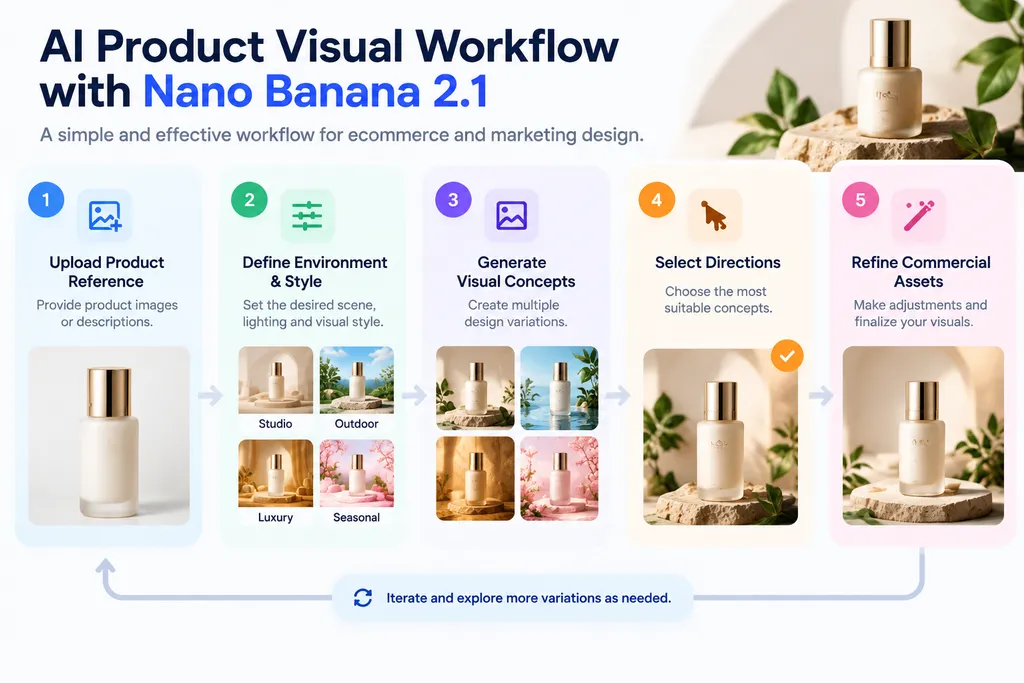
For example, a skincare brand may need several campaign concepts:
- clean studio photography
- natural outdoor lifestyle scenes
- premium luxury visuals
- seasonal promotional images
Instead of producing every direction manually, AI can help teams explore possibilities before investing in final production.
The biggest value is not replacing professional photography. It is reducing the time required to explore, test, and refine visual concepts.
However, ecommerce teams should still review AI outputs carefully because product accuracy matters.
Important checks include:
- product shape
- packaging details
- material appearance
- brand identity
How Does Nano Banana 2.1 Improve Marketing Content Production?
Marketing teams face increasing pressure to create more visual content across multiple channels.
Common challenges include:
- limited design resources
- short campaign timelines
- repeated asset requests
- multiple platform formats
Nano Banana 2.1 can support marketing workflows by helping teams create:
- campaign concepts
- promotional visuals
- social media graphics
- advertising variations
From a creative workflow perspective, the strongest value appears during iteration.
The process becomes:
Creative direction → AI exploration → human selection → refinement → final production
This approach allows designers to focus more on:
- visual strategy
- brand decisions
- user communication
- creative quality
rather than spending most of their time producing repetitive variations.
For teams evaluating AI design tools, this distinction matters. The goal is not simply generating more images. The goal is creating a more efficient design system.
Nano Banana 2.1 vs ChatGPT Images: Which AI Image Generator Is Better for Professional Design?
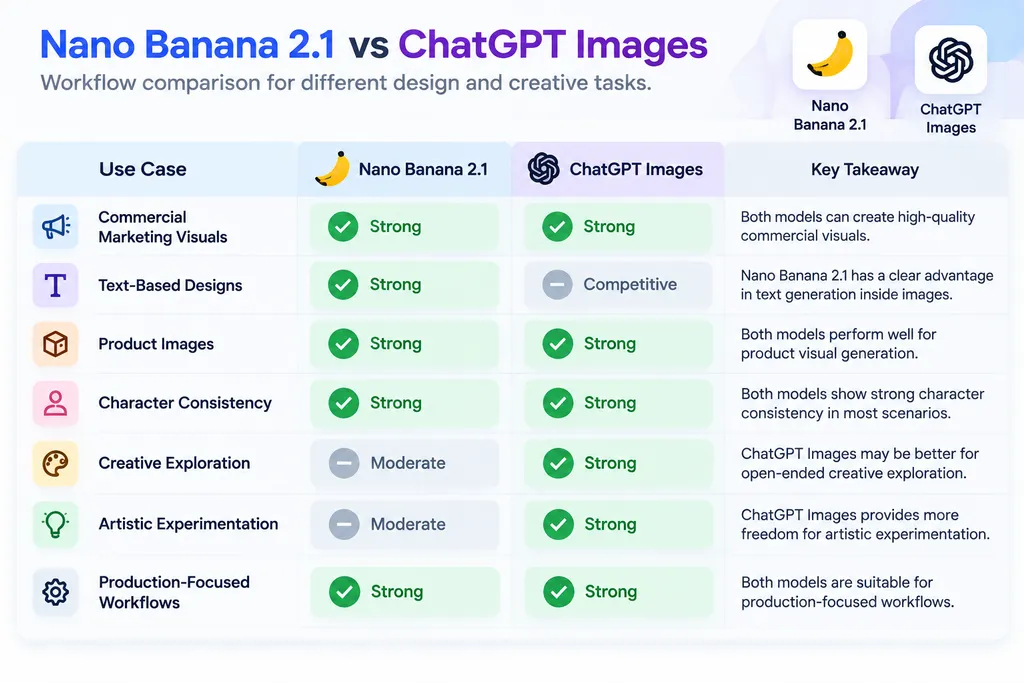
Nano Banana 2.1 and ChatGPT Images represent two different approaches to AI visual creation. Nano Banana 2.1 appears particularly strong for commercial production tasks, while ChatGPT Images may provide advantages in broader creative exploration.
The better choice depends on the workflow.
Professional designers usually need different capabilities at different stages:
- brainstorming
- concept development
- visual exploration
- asset production
- campaign scaling
A model that performs well in one area may not always be the best choice in another.
Capability | Nano Banana 2.1 | ChatGPT Images |
|---|---|---|
Commercial marketing visuals | Strong | Strong |
Text inside images | Strong advantage | Competitive |
Product image generation | Strong | Strong |
Character consistency | Strong | Strong |
Creative exploration | Moderate | Strong |
Artistic experimentation | Moderate | Strong |
Production-focused workflows | Strong | Strong |
Complex visual storytelling | Developing | Strong |
Nano Banana 2.1 vs ChatGPT Images for Commercial Design
Commercial design has different requirements from artistic image generation.
A brand campaign usually requires:
- accurate product representation
- readable messaging
- consistent visual identity
- multiple variations
- fast iteration
Based on current testing discussions and workflow analysis, Nano Banana 2.1 receives stronger attention in areas where commercial constraints matter.
Examples include:
- advertisement posters
- ecommerce product scenes
- branded marketing materials
The important difference is not only image quality.
The key question is:
Can the AI model help a designer complete the task faster with fewer corrections?
For example, a product launch campaign may require:
Initial concept:
- luxury product scene
- specific lighting direction
- brand atmosphere
Production variations:
- website banner
- social media image
- advertisement visual
- marketplace image
A useful AI workflow is not about producing one perfect image. It is about helping teams generate, compare, and refine multiple possible solutions.
When Should Designers Choose Nano Banana 2.1?
Nano Banana 2.1 may be a better fit when the priority is:
- commercial visuals
- product imagery
- text-based designs
- repeatable marketing assets
- faster visual production
ChatGPT Images may be preferable when the priority is:
- open-ended brainstorming
- artistic exploration
- experimental concepts
- creative storytelling
For many professional teams, the future workflow will not involve choosing only one model.
Instead, designers may combine different AI models depending on the task.
Platforms that allow access to multiple models can reduce tool switching and help teams choose the right model for each creative stage.
Nano Banana 2.1 Prompt Engineering: How Designers Can Create Better Results
What Makes a Good Nano Banana 2.1 Prompt?
The most effective Nano Banana 2.1 prompts are not simply longer descriptions. They communicate clear design intent.
A professional prompt usually includes:
Subject Definition
Clearly explain what should be created.
Examples:
- product type
- character identity
- main visual focus
Environment Description
Explain where the subject exists.
Examples:
- studio background
- outdoor environment
- retail setting
- editorial scene
Visual Direction
Define the intended design style.
Examples:
- premium product photography
- minimalist branding style
- cinematic lighting
- fashion editorial style
Material and Detail Requirements
Important for product design.
Include:
- surface texture
- material quality
- reflections
- manufacturing details
Typography Requirements
For commercial graphics:
- exact wording
- text placement
- hierarchy
- visual style
A structured prompt helps AI understand the relationship between creative goals and visual execution.
Why Does Nano Banana 2.1 Sometimes Fail to Follow Complex Prompts?
Prompt reliability remains one of the main challenges in AI image workflows.
Our review of recurring user questions shows that designers often encounter problems when prompts include too many requirements at the same time.
Common issues include:
- missing requested elements
- adding unnecessary objects
- changing important subjects
- misunderstanding relationships between multiple objects
This happens because AI image models interpret instructions through learned visual patterns rather than following fixed design rules.
Professional workflows usually improve results by:
- Breaking complex tasks into smaller steps
- Providing reference images
- Prioritizing the most important requirements
- Reviewing outputs between iterations
The key skill is shifting from writing longer prompts to expressing clearer creative intent.
Nano Banana 2.1 Limitations: What Designers Should Know Before Using It
Does Nano Banana 2.1 Replace Professional Designers?
Nano Banana 2.1 improves AI-assisted visual production, but it does not replace professional designers because successful design requires strategy, judgment, and creative decision-making beyond image generation.
A common misunderstanding about AI image tools is that better generation automatically creates a complete design solution.
In real workflows, designers still need to determine:
- whether the visual communicates the intended message
- whether the output matches brand standards
- whether the design solves the user problem
- whether the final asset is appropriate for the business context
AI can accelerate execution, but it does not replace:
- creative direction
- visual strategy
- user understanding
- design systems thinking
The most effective workflow is a collaboration between human creativity and AI assistance.
Designers provide:
- goals
- constraints
- aesthetic decisions
- quality evaluation
AI provides:
- faster exploration
- visual variations
- repetitive production support
What Are the Current Challenges of Nano Banana 2.1?
While Nano Banana 2.1 improves many practical image-generation capabilities, several challenges remain.
Complex Instruction Control
AI image models can still struggle with highly detailed requirements involving:
- multiple objects
- precise positioning
- complex interactions
- strict editing constraints
A prompt may describe the intended outcome clearly but still produce unexpected changes.
For professional teams, this means AI-generated assets often require:
- iteration
- review
- adjustment
rather than a single-generation workflow.
Long-Term Brand Consistency
Maintaining consistency across hundreds of visual assets remains difficult.
A company creating large-scale content needs more than image generation.
It also needs:
- brand guidelines
- reference libraries
- approval workflows
- asset management systems
This is why the next evolution of AI design tools is moving beyond individual prompts toward systems that understand:
- project context
- previous decisions
- team preferences
- brand requirements
The future value of AI design will depend not only on generation quality but also on workflow integration.
Who Should Use Nano Banana 2.1? A Practical Decision Framework
Nano Banana 2.1 is most valuable for users who need faster visual production, especially in ecommerce, marketing, branding, and content creation workflows.
User Type | Recommendation | Best Use Case |
|---|---|---|
Ecommerce businesses | Highly suitable | Product images and marketing visuals |
Marketing teams | Highly suitable | Campaign asset production |
Content creators | Suitable | Character-based content |
Product designers | Suitable | Concept exploration and visualization |
Brand designers | Suitable | Visual direction exploration |
Concept artists | Depends | Artistic freedom may matter more |
Is Nano Banana 2.1 Worth Paying For?
The answer depends on how frequently visual content is created.
For occasional users:
- free access may be enough to evaluate image quality
- simple creative experiments may not require advanced workflow capacity
For professional teams:
- unlimited generation capacity becomes more valuable
- comparing multiple models can improve creative decisions
- faster iteration can reduce production bottlenecks
This is where integrated AI design platforms become useful.
Instead of committing to one model for every task, designers can evaluate different AI capabilities within the same workflow.
Virse supports this type of multi-model workflow by allowing designers to access multiple AI models in one platform. Paid plans provide unlimited usage and unlimited seats, making it easier for teams to experiment, collaborate, and scale AI-assisted design production. New users can also start with free credits after registration.
The key advantage is flexibility: designers can choose the right AI capability for each stage of the creative process instead of rebuilding workflows around a single tool.
Conclusion
Nano Banana 2.1 represents a shift in AI image generation from creating impressive visuals toward supporting practical design workflows. Its strongest advantages are text generation, commercial-oriented visual creation, product imagery, and improved consistency, making it valuable for designers, marketers, and creative teams producing visual content at scale. However, it should be viewed as an AI design assistant rather than a replacement for professional expertise, because creative strategy, brand judgment, and quality control remain essential. The most effective approach is combining AI models, human creativity, and structured workflows to turn ideas into usable visual assets faster.
FAQ
Is Nano Banana 2.1 better than ChatGPT Images?
Nano Banana 2.1 and ChatGPT Images are designed for different creative workflows. Nano Banana 2.1 appears particularly strong for commercial design tasks such as product visuals, marketing graphics, and text-based image generation. ChatGPT Images may be better suited for broader creative exploration, brainstorming, and experimental concepts.
For professional designers, the best choice depends on the goal. Teams focused on scalable production may prefer tools that support structured AI design workflows, while creators exploring new ideas may prioritize flexibility and creative freedom.
What is Nano Banana 2.1 best used for?
Nano Banana 2.1 is best used for commercial visual workflows, including ecommerce product images, advertising graphics, branded content, and marketing assets. It is especially useful when teams need multiple visual variations while maintaining stronger consistency.
Common use cases include product concept visualization, campaign development, social media content creation, and promotional image generation. Businesses can combine AI generation with established AI design tools to create faster and more efficient production processes.
Can Nano Banana 2.1 create commercial images?
Yes. Nano Banana 2.1 can support commercial image creation, including product visuals, marketing graphics, advertising concepts, and branded content. However, businesses should still review generated assets before publishing to ensure product accuracy, brand alignment, and visual quality.
For ecommerce teams, AI-generated product visuals can help explore different creative directions before investing in final photography or production.
Does Nano Banana 2.1 maintain character consistency?
Nano Banana 2.1 improves character consistency compared with many earlier AI image workflows, making it more useful for storytelling, branded characters, and repeated content creation. However, perfect identity preservation across all generations remains challenging.
Professional workflows often rely on reference images, visual guidelines, and review processes to maintain consistent results across multiple assets.
Why does Nano Banana 2.1 sometimes fail to follow prompts?
Nano Banana 2.1 can struggle with complex prompts that include too many requirements, multiple objects, or detailed editing instructions. AI image models interpret instructions through learned visual patterns, which means outputs may not always match every detail exactly.
Better results usually come from clearer instructions, prioritizing important requirements, using reference materials, and improving AI design prompts through iterative refinement.