
How to Learn Graphic Design in 2026: A Step-by-Step Roadmap From Fundamentals to Portfolio
 Yifan Zhao9 menit baca ·
The best way to learn graphic design is to master visual fundamentals first, then improve through real projects, critique, and iteration. Start with typography, hierarchy, layout, grids, color, and composition, then learn Photoshop, Illustrator, Figma, or other tools as your projects require them. The goal is not software mastery; it is developing the judgment to explain what you designed, why it works, and who it is for.
Many beginners reverse this process. They spend months following tutorials or generating attractive visuals but still struggle when facing a blank canvas. Our review of public learner discussions found recurring gaps in typography, composition, grids, and independent decision-making. As AI makes visual production faster, selection, direction, consistency, and design judgment become even more important.
Virse helps turn that design thinking into a faster AI-assisted workflow. Its canvas-based Agent is designed to collaborate with designers rather than replace them, while current Virse plans offer unlimited model usage across 40+ models such as Nano Banana 2 and GPT Image 2, plus unlimited seats. New users receive credits for up to 10 Nano Banana 2 images or one Seedance 2.0 video, with Seedance 2.5, Seedance 2.0, and MiniMax H3 also available.
How to Learn Graphic Design Fundamentals From Scratch
Graphic design is visual problem solving. Before learning advanced effects, you need to understand how type, imagery, color, and space guide attention and communicate information.
Learn Graphic Design Principles in the Right Order
A practical sequence is:
- Visual hierarchy: Decide what viewers notice first, second, and third.
- Typography: Learn type selection, scale, line length, leading, tracking, and pairing.
- Layout and composition: Control balance, rhythm, grouping, and visual flow.
- Alignment and spacing: Build clear relationships between elements.
- Grid systems: Create repeatable structure instead of placing elements by instinct.
- Contrast: Use size, weight, color, and space to separate information.
- Color: Understand value, saturation, harmony, accessibility, and function.
- Concept: Connect visual decisions to the audience and communication goal.
A simple practice method is the three-second test. Look at a design briefly and ask what you noticed first, what message you understood, and what competed unnecessarily for attention. This trains hierarchy faster than adding more decorative effects.
Learn Production Basics Early
Graphic design also requires basic production knowledge. Learn the difference between raster and vector graphics, when to use RGB or CMYK, how resolution affects output, and which file formats are appropriate for print, web, social media, and editable source files.
These skills are less glamorous than composition, but they separate an attractive concept from a design that can actually be delivered.
How to Learn Graphic Design Software Without Tutorial Hell
Software should support the project, not become the entire curriculum.
For branding and vector graphics, start with Illustrator. For image manipulation and compositing, use Photoshop. For editorial and multi-page work, learn InDesign. For digital interfaces and collaborative layouts, Figma is a practical choice. Canva can be useful for fast production, but it does not replace design fundamentals.
Use Project-Triggered Software Learning
Instead of completing an entire software course before designing anything, start with a project.
If you are creating a poster and cannot mask an image, learn masking. If the typography feels weak, study type hierarchy. If the composition lacks structure, learn grids.
The learning loop becomes:
Problem → attempt → targeted learning → solution → critique
This matters because software changes. One long-career case in our review involved a designer with roughly 23 years of experience whose workflow moved from Photoshop and Illustrator toward extensive use of Figma. The tools changed; hierarchy, typography, and composition remained transferable.
How to Practice Graphic Design With Real Projects
The fastest practice projects have an audience, a problem, constraints, and deliverables.
“Make a coffee poster” is an exercise. “Create a campaign for a neighborhood coffee shop that wants to attract university students while keeping a handmade identity” is a design brief.
The second forces decisions about typography, imagery, color, tone, and hierarchy.
Reconstruct Strong Designs, Then Redesign Them
Choose a strong poster, magazine spread, packaging system, or campaign. Analyze its grid, margins, type scale, spacing, imagery, and color relationships.
First reconstruct the design. Then take the same information and create a different solution.
Reconstruction teaches you to recognize decisions. Redesign teaches you to make decisions.
Our review of learner questions found this distinction particularly useful because copying alone can improve software control without improving independent design judgment.
Progress From Single Graphics to Design Systems
Start with posters, flyers, and social graphics. Then move into editorial layouts, landing pages, identities, and campaigns.
Eventually, one project should include several connected outputs: for example, a logo, packaging, social assets, poster, and digital touchpoint.
This develops a professional skill that isolated exercises often miss: maintaining visual consistency across different formats.
What Real Learning Cases Reveal About Learning Graphic Design
Public learner experiences are useful when treated as individual cases rather than universal timelines.
Case Study: Two Years of Work Did Not Remove Foundation Gaps
One designer in our review had already worked in graphic design for about two years after transitioning from illustration, yet still identified gaps in typography, grids, composition, color, and design principles.
The lesson is that professional exposure does not automatically produce structured knowledge. You can become faster at repeating familiar work without becoming better at explaining or evaluating your decisions.
Case Study: Six Months Produced a Portfolio, but Not Strong Market Response
Another learner had practiced for roughly six months, created a portfolio, and begun applying for roles but received limited response.
This is not evidence that six months is universally too short. It shows the difference between having enough work to fill a portfolio and having work strong enough to demonstrate professional judgment.
At this stage, revising three strong projects may create more value than producing ten new ones.
Case Study: Structured Learning Connects Theory to Projects
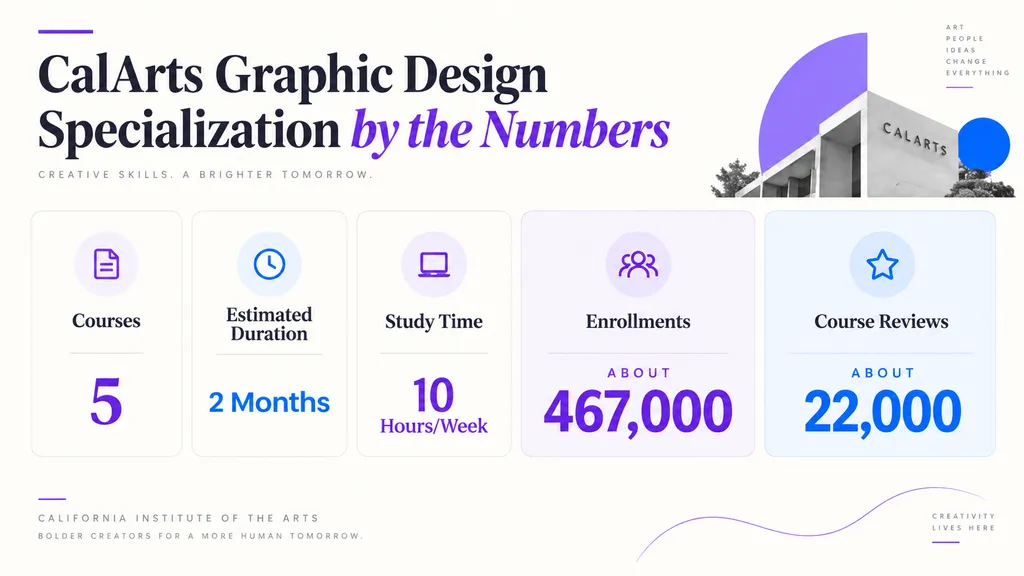
The current CalArts Graphic Design Specialization page lists a five-course series, beginner-level entry, approximately two months at 10 hours per week, about 467,000 enrollments, and roughly 22,000 course reviews.
Its useful lesson is not the certificate itself. It is the structure:
Learn a principle → apply it → receive feedback → combine it with other principles in a larger project.
That is a strong model for self-directed learning as well.
How to Build a Graphic Design Portfolio as a Beginner
A beginner portfolio should demonstrate how you think, not simply how many applications you know.
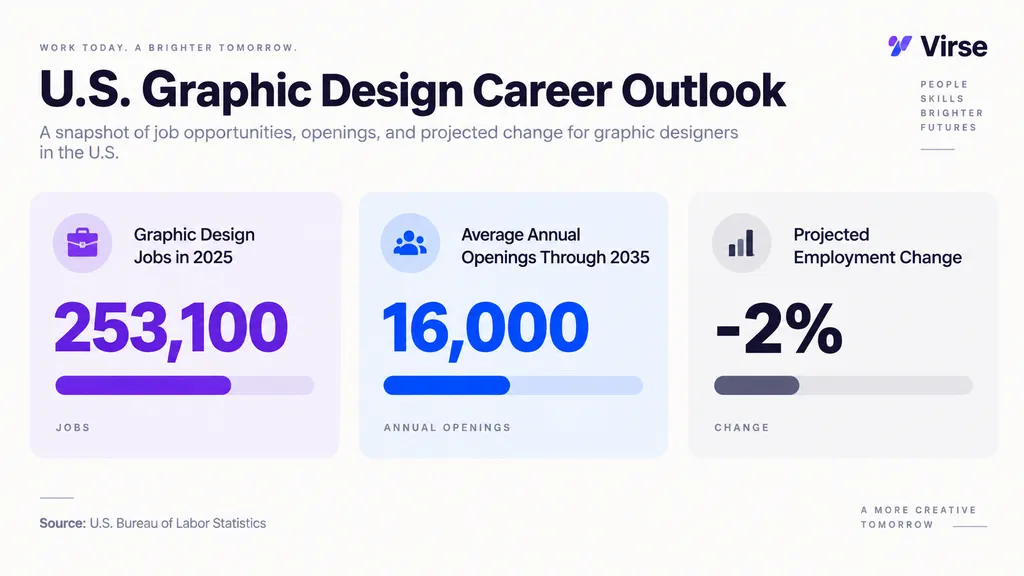
The current U.S. Bureau of Labor Statistics profile states that graphic design candidates should have a portfolio demonstrating creativity and originality. It also lists 253,100 U.S. graphic design jobs in 2025, about 16,000 projected openings per year through 2035, and a projected 2% employment decline.
Show Decisions, Iterations, and Systems
A strong case study should communicate:
Brief → audience → problem → research → concepts → iterations → visual system → applications → reflection
If you design a fictional restaurant identity, do not stop at the logo. Show how typography, color, imagery, menus, packaging, signage, and social assets work together.
For self-taught designers especially, three or four deep case studies usually reveal more ability than a gallery of disconnected images.
How AI Changes the Best Way to Learn Graphic Design in 2026
AI can accelerate image generation, reference exploration, moodboards, variations, and production. It cannot remove the need to judge whether an idea is appropriate for the audience or consistent with the design system.
The latest BLS outlook specifically notes that automated design tools, including AI, are expected to increase designer productivity while companies will still need designers for digital layouts and branding.
Use AI to Explore, Then Apply Design Judgment
A practical workflow is:
- Define the audience and problem.
- Establish references and visual direction.
- Explore multiple concepts.
- Generate or prototype variations.
- Evaluate hierarchy, typography, composition, and brand fit.
- Refine the strongest direction.
- Extend it into a consistent system.
- Compare the final result with the original brief.
The key skill is not generating the first image. It is directing, selecting, editing, and maintaining consistency across many outputs.
A 12-Week Roadmap to Learn Graphic Design
Weeks 1–2: Study hierarchy, alignment, spacing, and contrast. Produce four simple layouts.
Weeks 3–4: Focus on typography, grids, composition, and color. Create two posters and one editorial layout.
Weeks 5–6: Learn the essential functions of Illustrator or Figma through a branding or digital project.
Weeks 7–8: Add Photoshop and image-making through an image-led campaign.
Weeks 9–10: Complete one realistic multi-format brief with a clear audience and design system.
Week 11: Get critique and redesign your strongest project rather than starting another one.
Week 12: Turn that project into a complete portfolio case study.
This is a learning framework, not a promise of job readiness in 12 weeks. After building the foundations, specialize according to your interests: branding, editorial, UI and digital design, packaging, motion, or another field.
FAQ
Can I Learn Graphic Design by Myself, and How Long Does It Take?
Yes. Self-study can work when it includes fundamentals, projects, critique, revision, and portfolio development. There is no universal timeline. Some learners begin producing portfolio work within months, while others discover foundation gaps after years of practice. Measure progress by the quality of your decisions, not the number of tutorials completed.
What Should I Learn First: Design Principles, Photoshop, Illustrator, or Figma?
Start with basic design principles and learn software alongside projects. Use Illustrator for vectors and branding, Photoshop for image work, Figma for digital layouts, and InDesign for editorial projects. Do not wait to master a tool before designing, but do not confuse tool knowledge with design knowledge.
How Do I Practice Graphic Design and Build a Portfolio Without Clients?
Create realistic concept briefs with a target audience, problem, constraints, and multiple deliverables. You can also redesign an existing communication system or help a small organization when appropriate. Clearly label fictional work as concept work and show the process, iterations, and reasoning behind the final result.
How Do I Escape Tutorial Hell and Get Useful Design Critique?
Attempt a project before searching for tutorials, then learn only what you need to solve specific problems. When requesting critique, explain the brief, audience, objective, constraints, and what you are uncertain about. Ask specific questions such as whether the hierarchy is clear instead of simply asking whether the design looks good.
Conclusion: The Best Way to Learn Graphic Design
The best way to learn graphic design is to build visual judgment before chasing software mastery: study typography, hierarchy, composition, grids, spacing, contrast, color, and production basics; apply them to increasingly realistic projects; analyze strong work; seek critique; revise rather than constantly starting over; and turn your strongest projects into portfolio case studies that explain your decisions. AI can make exploration and production faster, but the durable skill remains the ability to understand a communication problem, choose the right visual direction, evaluate alternatives, and turn a promising idea into a coherent design system.
Artikel lainnya dari Blog Virse
Alur kerja
What Does a Graphic Designer Do? Real Tasks, Revisions, Tools & Workflow
23 September 2026 by Yifan Zhao
Alur kerja
What Is Graphic Design? Definition, Real Examples, Process & Tools
23 September 2026 by Yifan Zhao
Alur kerja
MiniMax H3 Guide: Character Consistency, VRAM, LoRA & Real Workflows
23 September 2026 by Yifan Zhao