
What Is Graphic Design? Definition, Real Examples, Process & Tools
 Yifan Zhao11 menit baca ·
Graphic design is the practice of using typography, images, color, layout, and other visual elements to communicate a clear message to a specific audience. It goes beyond making something attractive: effective graphic design helps people understand information, recognize what matters, remember a brand, and take an intended action.
The difficulty is that modern graphic design rarely ends with one polished image. Designers must explore directions, maintain consistency, handle revisions, adapt work across formats, and deliver assets that other people can actually use. Our research review shows that unclear creative direction, fragmented workflows, inconsistent outputs, and difficult handoffs often create as much friction as the visual execution itself.
Virse is built around this broader design workflow. Its canvas-based approach helps designers organize references, preserve project context, and coordinate AI-assisted creative tasks rather than reducing a project to one prompt. Virse's product materials describe an infinite-canvas, multi-Agent workflow with shared context and long-term design knowledge, while current Virse information lists paid plans with unlimited use of 40+ models, including Nano Banana 2 and GPT Image 2, plus unlimited seats. New users receive credits that can cover up to 10 Nano Banana 2 images or one Seedance 2.0 video, and Seedance 2.5, Seedance 2.0, and MiniMax H3 are available on Virse.
What Is Graphic Design and What Does It Actually Do?
The simplest graphic design definition is visual communication with a purpose.
Consider an event poster. It needs to communicate what the event is, when and where it happens, who it is for, and what viewers should do next. An attractive poster may catch attention, but if people cannot quickly find the date or venue, an important part of the design has failed.
This is why graphic designers work with hierarchy, clarity, context, and audience behavior, not decoration alone. A headline receives greater visual weight because it should be noticed first. Secondary information becomes smaller. Color can separate categories. Images can establish mood or explain a subject faster than text.
The same logic applies to packaging, presentations, social graphics, reports, and brand systems. Graphic design succeeds when visual decisions make information easier to understand and use.
What Are the Core Elements and Principles of Graphic Design?
Graphic design combines visual elements with principles that determine how those elements should work together.
Typography, Color, Images, and Layout
Typography controls readability and hierarchy through typeface, size, weight, spacing, and alignment. When every line looks equally important, viewers have to work harder to understand the message.
Color can direct attention, separate information, establish mood, and reinforce brand recognition. Images and illustrations can communicate product features, emotions, environments, or abstract ideas quickly.
Layout and space determine how all these elements relate. Good layout creates a reading path instead of forcing the audience to search for meaning.
What Graphic Design Principles Make These Elements Work?
Elements are the raw materials; principles determine how designers organize them.
Adobe's current graphic design guidance identifies principles including balance, hierarchy, contrast, alignment, repetition, proximity, white space, color harmony, and strategic typography. Figma likewise emphasizes balance, space, visual hierarchy, color, typography, and other structural elements.
In practice, hierarchy establishes what should be noticed first, contrast separates important elements, alignment creates order, and proximity shows which information belongs together. Repetition builds consistency, while white space prevents layouts from becoming visually crowded.
These principles explain why professional design is more than choosing attractive components. The designer's job is to make those components behave as a coherent communication system.
What Are the Main Types of Graphic Design?
The term graphic design covers a wide range of visual communication work.
Type of Graphic Design | Common Deliverables | Main Communication Goal |
|---|---|---|
Brand identity | Logos, typography, colors, guidelines | Build recognition and consistency |
Marketing design | Ads, brochures, campaign graphics | Capture attention and communicate an offer |
Packaging design | Boxes, labels, product graphics | Combine brand identity with product information |
Editorial design | Reports, books, magazines | Improve reading hierarchy and navigation |
Social media design | Posts, templates, campaign assets | Produce recognizable content efficiently |
Information design | Charts, diagrams, infographics | Make complex information easier to understand |
Event design | Posters, invitations, signage | Communicate event details quickly |
Environmental graphics | Wayfinding, exhibitions, signage | Help people understand and navigate spaces |
This broad scope also explains why some current graphic design roles overlap with content production, motion, UI/UX, marketing, or 3D. The disciplines are not identical, but graphic designers increasingly work inside multidisciplinary creative systems.
How Does a Professional Graphic Design Process Work?
A professional graphic design process usually starts before the designer opens Photoshop, Illustrator, Canva, or another production tool.
- Define the communication problem. Identify the audience, objective, channels, deliverables, timeline, constraints, approval process, and expected outcome.
- Translate references into creative direction. Determine what qualities should be kept, avoided, or differentiated instead of collecting inspiration without interpretation.
- Explore meaningful concepts. Test different visual ideas, not simply cosmetic variations of the same idea.
- Evaluate concepts against the brief. Check clarity, audience fit, technical requirements, scalability, and brand consistency.
- Refine through structured feedback. Feedback should identify the communication problem rather than request arbitrary visual changes.
- Prepare practical deliverables. Export files and templates that work in the client's actual print, digital, collaboration, or editing environment.
What Does a Graphic Designer Do Day to Day?
Graphic designers spend significant time researching, organizing information, developing layouts, selecting typography and color, creating visual assets, presenting concepts, incorporating feedback, and preparing final files.
The U.S. Bureau of Labor Statistics describes similar responsibilities, including determining project scope, creating visual concepts and layouts, selecting design elements, presenting work, incorporating recommended changes, and reviewing designs before publication.
The practical lesson is important: software executes design decisions, but it does not decide what the communication problem is or which solution best addresses it.
What Do Real Graphic Design Projects Teach Us?
Real projects reveal why briefing, scope, feedback, revision control, pricing, and handoff are part of graphic design—not administrative details separate from it.
Case Study: A $500–$550 First Logo Project
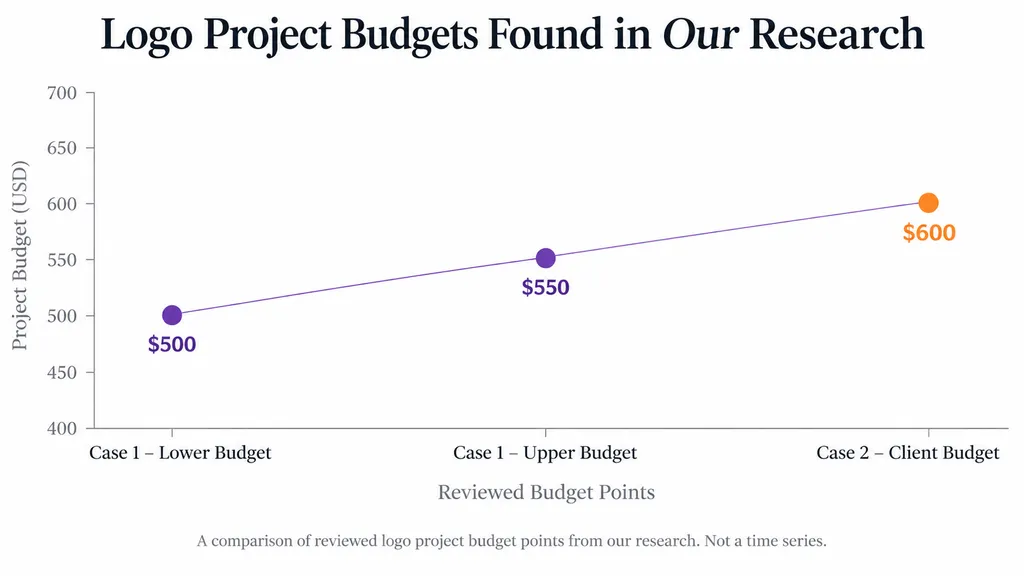
In one designer-reported case included in our research review, an entry-level freelancer received a commercial logo inquiry with a $500–$550 budget and limited previous client experience.
The uncertainty was not simply how to draw the logo. The designer needed to determine the scope, timeline, client communication process, revision limits, and appropriate deliverables.
One pricing scenario in the discussion modeled the project at roughly 10 hours of work, making a $500 fee equivalent to approximately $50 per project hour before overhead, administration, taxes, and additional revisions. This was an estimate, not a recorded final workload.
The broader lesson is that logo pricing cannot be separated from scope. A project with research, multiple concepts, extensive revisions, applications, and brand guidelines is fundamentally different from a tightly scoped logo deliverable.
Case Study: A $600 Logo Project With Five Concepts
In one client-reported case reviewed during our research, a small business paid $600 for a logo after supplying a questionnaire and multiple visual references.
Approximately three days later, the client received five concepts. From the client's perspective, two felt somewhat usable while three appeared substantially outside the expected direction. Revisions followed, but the client still felt the changes did not resolve the underlying mismatch.
This is not an objective quality benchmark; it is evidence of a creative-alignment problem.
The case demonstrates why references alone are insufficient. “We like these logos” is raw input. A stronger direction explains that the brand should feel technical but approachable, avoid luxury cues, remain legible at small sizes, work in one color, and differentiate itself from specific competitors.
Reference collection gathers inspiration. Creative direction turns inspiration into criteria designers can evaluate.
Case Study: Creating Brand Templates a Client Can Actually Use
Another case in our research involved a freelancer creating a logo, brand guidelines, and social templates for a small business that already relied on Canva.
The challenge was not simply which tool produced the most sophisticated source file. It was how the client would continue using the brand after handoff.
A practical workflow is to create core identity assets in professional design tools, then translate recurring social content into controlled templates that non-designers can edit without rebuilding the system.
No measurable performance improvement was reported in this case, so it should not be treated as proof that one tool increases productivity by a particular percentage. Its value is operational: a design system is only successful if it can survive real-world use.
What Is the Difference Between Graphic Design, Art, Logo Design, and Branding?
These areas can overlap visually, but their primary objectives differ.
Graphic design typically begins with an audience, message, and communication objective. Art may prioritize expression, exploration, or interpretation without the same functional requirement.
Logo design creates a recognizable identifier. Branding and brand identity design are broader systems that may include the logo, typography, colors, imagery, illustration, layout principles, templates, and usage guidelines.
A useful distinction is: a logo helps identify a brand; a brand design system determines how that brand behaves visually across many touchpoints.
This distinction matters because a business asking for “a logo” may actually need a repeatable system for presentations, social content, packaging, campaigns, or sales materials.
Which Graphic Design Tools Should Designers Learn?
Different graphic design tools solve different production problems.
Adobe Illustrator is commonly used for vector graphics such as logos, icons, and scalable illustrations. Adobe Photoshop is better suited to raster imagery, photography, compositing, and image manipulation. Canva can be useful for rapid production and client-editable templates, while collaborative tools such as Figma become relevant when graphic design overlaps with digital products and shared design systems.
The key lesson is that tool proficiency is not the same as design proficiency.
A designer who understands typography, hierarchy, composition, color, audience, and systems thinking can transfer those principles between applications. Knowing software shortcuts without understanding communication does not solve the underlying design problem.
How Is AI Changing Graphic Design?
AI is making visual production faster, especially for concept exploration, moodboards, image generation, asset variations, adaptation, and repetitive production.
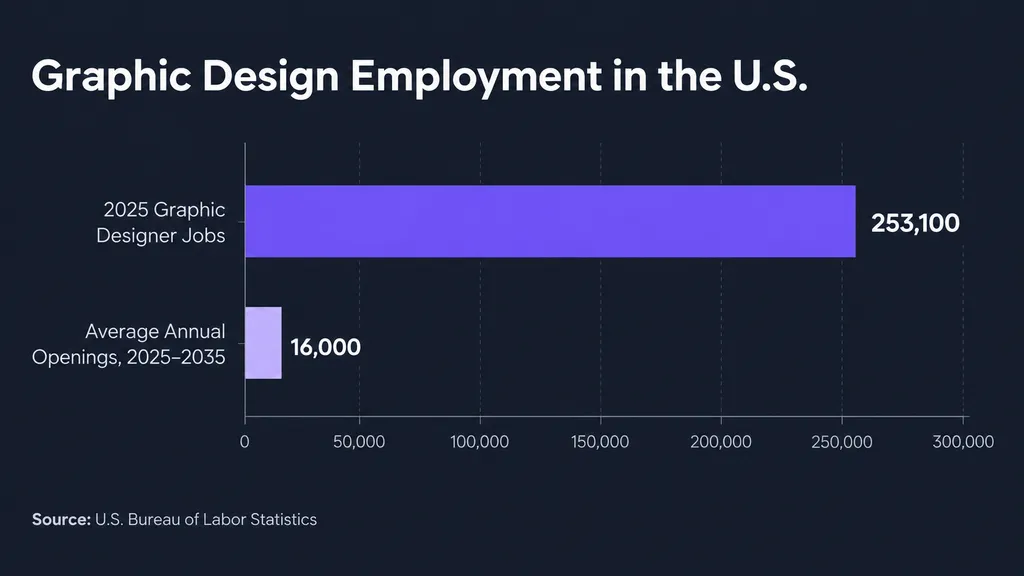
The U.S. Bureau of Labor Statistics reports 253,100 U.S. graphic designer jobs in 2025, a $62,960 median annual wage, a projected 2% employment decline from 2025 to 2035, and about 16,000 openings per year on average over that period. BLS also notes that automated design tools such as AI may increase productivity and reduce some labor demand, while organizations are still expected to need designers for visual layouts and branding.
The useful distinction is between generating visuals and directing a design system.
AI can produce twenty images quickly. A designer still needs to decide which direction matches the brief, whether typography works, whether brand details remain consistent, how the design extends across channels, and which outputs should be rejected.
This is where design Agents become relevant. Virse's workflow documentation describes Agents working inside an infinite canvas, sharing project context, coordinating different design tasks, and retaining design preferences and team knowledge. The goal is not simply “one prompt, one finished design,” but using AI to reduce repetitive execution while keeping designers responsible for direction and decisions.
FAQ
Is Graphic Design Art, and Does Every Design Need a Clear Purpose and Audience?
Graphic design can be artistic, but professional graphic design usually serves a communication purpose. The designer works with an audience, message, context, and intended result. A poster, package, identity, or campaign can be expressive while still being evaluated by whether people understand the information and whether the design performs its intended function.
Do I Need PS or Illustrator to Learn Graphic Design, and Can Canva Be Used Professionally?
No single application makes someone a graphic designer. PS is useful for raster imagery and compositing, Illustrator for vector design, and Canva for fast production and editable templates. The more transferable skills are typography, hierarchy, composition, color, audience understanding, concept development, and visual problem-solving.
What Is the Difference Between Logo Design and Branding, and How Much Should a Logo Cost?
A logo is a visual identifier, while branding can include typography, colors, imagery, templates, layout rules, and guidelines. There is no universal logo price because scope varies. Cases in our research included budgets of $500–$550 and $600, showing why research, concept count, revisions, applications, timeline, and deliverables should be defined before pricing is evaluated.
What Should a Designer Do if a Client Dislikes Every Concept?
Return to the brief before generating more options. Identify whether the mismatch comes from brand personality, audience, typography, imagery, references, or functional requirements. Convert subjective feedback into explicit criteria, agree on the revised direction, and then refine the work. More concepts do not solve a poorly defined creative direction.
Conclusion
Graphic design is the structured use of visual elements to help a specific audience understand information, recognize identity, and take action. The strongest graphic design combines typography, color, imagery, layout, design principles, research, creative direction, feedback, production knowledge, and practical handoff. The real project cases in our review show that successful work depends as much on defining the problem and managing the system as on producing the final image. As AI accelerates visual generation, that distinction becomes even more important: the enduring value of the graphic designer lies in deciding what should be communicated, directing how the visual system should work, evaluating what deserves to move forward, and ensuring the final result remains coherent and useful in the real world.
Artikel lainnya dari Blog Virse
Alur kerja
What Does a Graphic Designer Do? Real Tasks, Revisions, Tools & Workflow
23 September 2026 by Yifan Zhao
Alur kerja
How to Learn Graphic Design in 2026: A Step-by-Step Roadmap From Fundamentals to Portfolio
23 September 2026 by Yifan Zhao
Alur kerja

MiniMax H3 Guide: Character Consistency, VRAM, LoRA & Real Workflows
23 September 2026 by Yifan Zhao