Nano Banana 2.1 Pricing: API Cost Per Image, Calculator, and Commercial Image Generation Costs
 Yifan Zhao10 分钟阅读 ·
Nano Banana 2.1 pricing starts at approximately $0.0336 per 1K image, $0.0504 per 2K image, and $0.0756 per 4K image, based on current token-based pricing calculations. The final cost depends on image resolution, API usage, and production volume. For creators and businesses generating hundreds or thousands of visuals, the key decision is not only the price of one image, but whether Nano Banana 2.1 can deliver a cost-efficient production workflow. You can also compare its performance through Nano Banana 2.1 review and understand broader AI image generation options through AI design tools and other creative solutions.
Many teams underestimate the real cost of AI image generation. The biggest expenses often come from failed iterations, inconsistent visual styles, disconnected AI tools, and inefficient review processes rather than the image generation fee itself. A lower image price does not always mean a lower production cost if designers spend more time correcting outputs or rebuilding creative direction. Creating a structured AI design workflow, improving AI design systems, and using effective AI design prompts can help teams reduce unnecessary generations and improve creative efficiency.
Virse helps creative teams build a more efficient AI design workflow by bringing multiple AI models into one platform, offering unlimited usage on paid plans, and supporting unlimited team seats for collaboration. Instead of managing fragmented AI tools separately, teams can explore concepts, generate assets, and organize creative workflows in one environment. New users can also start with free credits after registration to test AI-powered design workflows before choosing a plan. For businesses producing commercial visuals, combining AI with structured processes such as AI for product design, graphic design workflows, and design systems can improve consistency, collaboration, and scalability.
How Much Does Nano Banana 2.1 Cost? Complete Pricing Breakdown
Nano Banana 2.1 pricing is based on token usage instead of a fixed price per image. This means the final cost changes depending on the amount of processing required for each generation.
The available pricing structure includes:
Usage Type | Price |
|---|---|
Input tokens | $1.50 per 1 million tokens |
Output tokens | $7.50 per 1 million tokens |
Image output tokens | $30 per 1 million tokens |
For image generation workflows, image output token costs are the main factor affecting the final price because generated visuals require additional computational resources.
Why Token-Based Pricing Matters for AI Design Teams
For occasional creators, generating a few images may not make pricing differences obvious.
For professional teams, the calculation is different.
A design team producing:
- product concept variations
- ecommerce visuals
- marketing campaign assets
- social media creatives
needs predictable production costs rather than simply the cheapest single generation.
Our review of user questions around AI image workflows shows that teams are increasingly asking a broader question:
Can this AI model reduce the total cost of producing finished creative assets?
The answer depends on more than model pricing. Workflow design, iteration efficiency, and asset management often determine the final business value.
What Is Nano Banana 2.1 Cost Per Image?
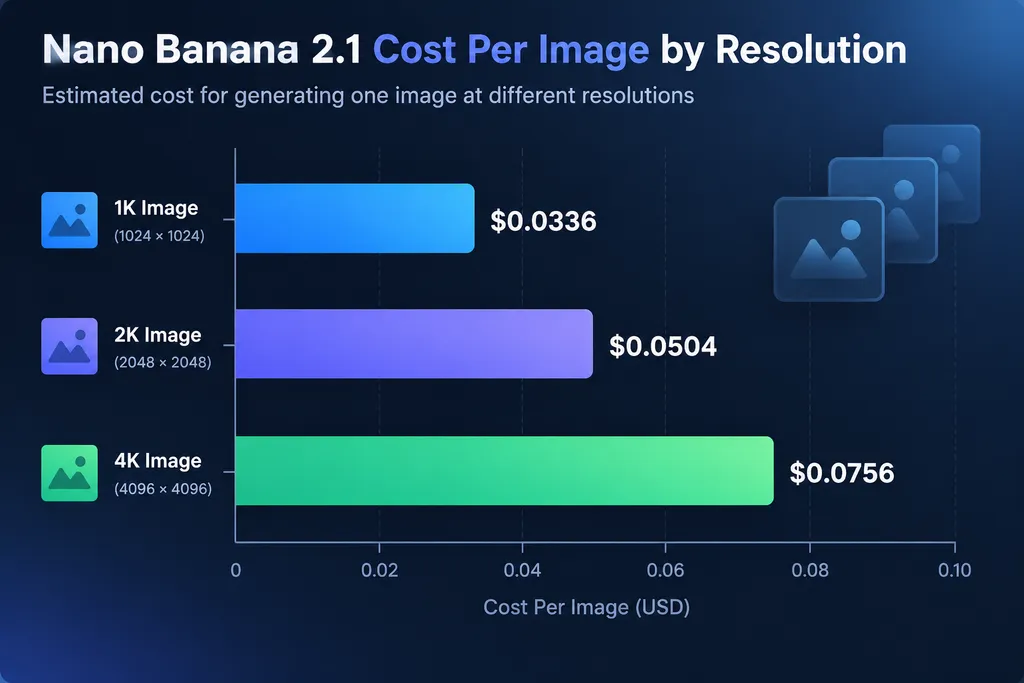
The Nano Banana 2.1 cost per image depends on output resolution. Higher-resolution images generally require more processing resources, which increases the generation cost.
Current estimated costs:
Resolution | Estimated Cost Per Image |
|---|---|
1K image | ~$0.0336 |
2K image | ~$0.0504 |
4K image | ~$0.0756 |
These estimates make Nano Banana 2.1 pricing easier to evaluate:
- 1K generation: suitable for concept exploration, social content, and early design testing
- 2K generation: suitable for marketing visuals and product presentation
- 4K generation: suitable for premium campaigns and final production assets
How Design Teams Can Control Resolution Costs
A common mistake in AI creative workflows is generating every image at maximum resolution.
A more efficient production process usually follows three stages:
- Exploration stage
Generate multiple directions using lower-cost outputs. - Selection stage
Review successful concepts and refine creative decisions. - Production stage
Generate high-resolution final assets only after approval.
This workflow reduces unnecessary generations and improves cost efficiency without limiting creativity.
How Much Does Nano Banana 2.1 Cost for 1,000 Images?
For businesses, the most important pricing question is often not “How much does one image cost?” but:
How much will my complete AI image production workflow cost?
Estimated Nano Banana 2.1 generation costs:
Image Volume | 1K Resolution | 2K Resolution | 4K Resolution |
|---|---|---|---|
100 images | $3.36 | $5.04 | $7.56 |
1,000 images | $33.60 | $50.40 | $75.60 |
10,000 images | $336 | $504 | $756 |
These estimates show why AI image pricing becomes especially important for commercial teams.
Example: Ecommerce Product Image Production
An ecommerce team may need hundreds of product visuals for:
- different backgrounds
- seasonal campaigns
- marketplace listings
- advertising variations
Traditional production requires repeated photography, editing, and asset preparation.
An AI-assisted workflow can instead:
- Prepare product references.
- Generate multiple visual directions.
- Select approved variations.
- Produce final assets for different channels.
The biggest value is not replacing designers or photographers completely. It is reducing repetitive production work while allowing creative teams to focus on visual decisions and quality control.
Nano Banana 2.1 vs Nano Banana 2 Pricing: Is the New Version Cheaper?
One of the most common questions from users comparing AI image models is whether Nano Banana 2.1 is cheaper than Nano Banana 2.
Available comparisons indicate that Nano Banana 2.1 has significantly lower estimated image generation costs.
Estimated Nano Banana 2 pricing:
Resolution | Nano Banana 2 Estimated Cost |
|---|---|
1K | ~$0.067 |
2K | ~$0.101 |
4K | ~$0.151 |
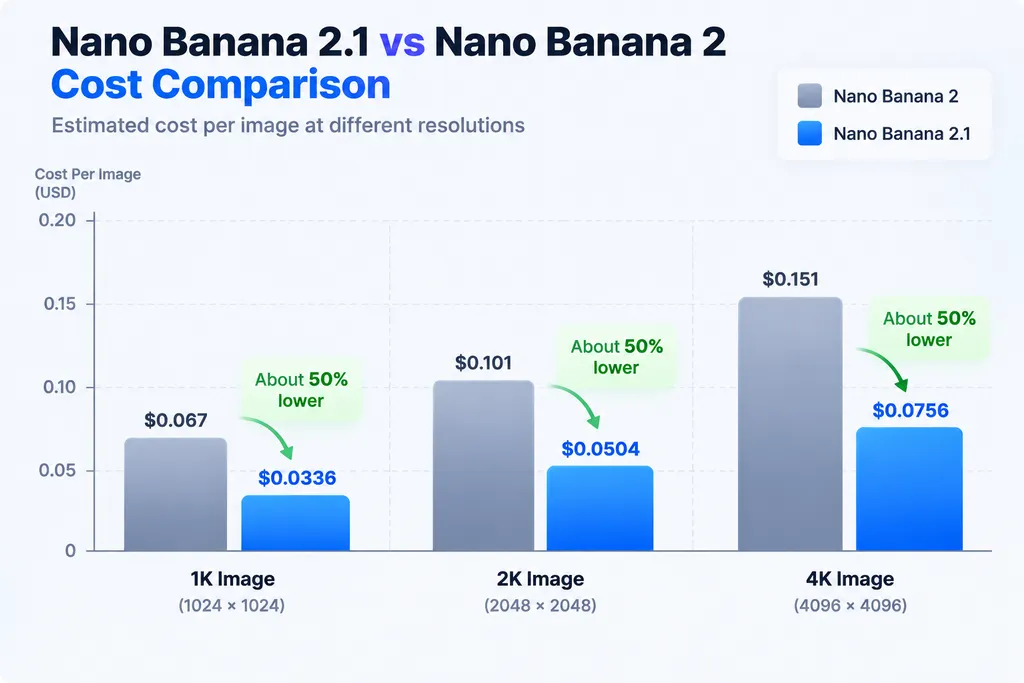
Comparison:
Resolution | Nano Banana 2 | Nano Banana 2.1 | Estimated Difference |
|---|---|---|---|
1K | ~$0.067 | ~$0.0336 | About 50% lower |
2K | ~$0.101 | ~$0.0504 | About 50% lower |
4K | ~$0.151 | ~$0.0756 | About 50% lower |
For small experiments, the difference may not significantly affect budgets.
For teams generating thousands of images monthly, lower generation costs can directly improve operational efficiency.
When Should Teams Choose Nano Banana 2.1?
Nano Banana 2.1 becomes more attractive when teams need:
- higher image production volume
- automated workflows
- scalable creative operations
- predictable generation costs
The right decision should consider not only model pricing but also the total workflow cost, including revisions, collaboration, and production speed.
How Much Does Nano Banana 2.1 Cost for Commercial AI Design Workflows?
Commercial AI image generation is most valuable when it solves practical production challenges.
Design teams commonly use AI image tools for:
- visual exploration
- product concepts
- campaign variations
- asset adaptation
- creative testing
Our research into AI workflow questions shows that teams often face three major challenges:
- Maintaining consistency across large numbers of generated assets
- Reducing repetitive manual production tasks
- Managing AI costs as usage grows
The solution is not simply generating more images.
A stronger workflow combines:
- clear creative direction
- reference-based generation
- structured review processes
- reusable design systems
Modern AI design workflows are increasingly moving toward collaboration models where AI supports professional designers rather than replacing creative judgment. Platforms that combine multiple agents, shared context, and visual workflows aim to help teams manage repetitive tasks while preserving human decision-making.
Example: Product Design and Marketing Asset Workflow
A product team may use Nano Banana 2.1 for:
- early concept visualization
- packaging exploration
- lifestyle scenes
- campaign mockups
The most effective approach is usually not asking AI to complete the entire design process.
Instead:
- designers define the creative direction
- AI generates variations
- teams review and refine outputs
- final assets follow brand standards
This creates a balance between automation and professional design control.
Nano Banana 2.1 API vs Subscription: Which Option Is Better?
Choosing between API access and subscription tools depends on workflow requirements.
Option | Best For | Advantages | Limitations |
|---|---|---|---|
API | Developers and production teams | Automation, scalability, integration | Requires technical setup |
Subscription tools | Individual creators | Simple access, faster adoption | Less workflow customization |
Team platforms | Creative organizations | Collaboration and workflow management | Requires process adoption |
When Nano Banana 2.1 API Makes More Sense
API access is usually better when teams need:
- batch generation
- automated production
- integration with existing systems
- cost tracking
For example, a company producing thousands of product images may benefit from API-based workflows because manual generation becomes inefficient.
When Subscription Tools Are Enough
Subscription solutions may be better for:
- occasional creators
- designers testing AI workflows
- smaller creative projects
The best option depends on production scale, collaboration needs, and workflow complexity.
How to Reduce Nano Banana 2.1 Image Generation Costs
Reducing AI image costs requires improving the entire workflow, not only choosing a lower-priced model.
1. Improve Creative Direction Before Generation
Clear references and structured prompts reduce unnecessary iterations.
2. Match Resolution With Purpose
Use:
- lower resolution for exploration
- medium resolution for review
- higher resolution for final delivery
3. Create Reusable AI Design Systems
Teams can improve efficiency by building:
- reference libraries
- visual guidelines
- approved styles
- repeatable workflows
4. Measure Cost Per Final Asset
The most useful metric is not only:
“how much does one generation cost?”
It is:
how much does it cost to produce one approved final asset?
A workflow with fewer failed attempts can outperform a cheaper model with inefficient production processes.
Conclusion
Nano Banana 2.1 pricing makes AI image generation more accessible for professional creative workflows, especially when teams understand cost per image, resolution choices, and production volume. With estimated costs ranging from about $0.0336 to $0.0756 per image, teams can plan AI production budgets more effectively. The strongest results come from combining affordable generation with structured creative workflows, where AI handles repetitive production tasks while designers maintain control over quality, consistency, and creative direction.
FAQ
How much does Nano Banana 2.1 cost per image?
Nano Banana 2.1 costs approximately $0.0336 for 1K images, $0.0504 for 2K images, and $0.0756 for 4K images based on available pricing calculations. Actual costs may vary depending on API usage conditions and implementation details. Users who want to understand the model’s overall performance can also read this Nano Banana 2.1 review and compare it with other AI image solutions.
For teams evaluating AI image generation costs, pricing is only one factor. Image quality, editing capability, and workflow efficiency can also affect the final production cost. Businesses can explore AI design tools to understand how different platforms support professional creative workflows.
Is Nano Banana 2.1 cheaper than Nano Banana 2?
Available comparisons indicate that Nano Banana 2.1 has lower estimated image generation costs than Nano Banana 2, with reductions of around 50% across common resolutions. This makes it more suitable for teams producing larger volumes of AI-generated visuals.
For users comparing AI image models, differences in image quality, editing control, and consistency are also important. You can explore the comparison between ChatGPT Image 2 vs Nano Banana or review Nano Banana pricing for additional cost information.
How much does 1,000 Nano Banana 2.1 images cost?
Estimated costs for 1,000 Nano Banana 2.1 images are about $33.60 at 1K resolution, $50.40 at 2K resolution, and $75.60 at 4K resolution. These estimates help businesses evaluate whether AI-generated images fit their production budgets.
For commercial teams producing large numbers of visuals, controlling revisions and maintaining consistent output quality are also important. Building structured workflows with AI design workflow methods can help teams reduce unnecessary generations and improve production efficiency.
Is Nano Banana 2.1 worth using for commercial projects?
Nano Banana 2.1 can be valuable for commercial workflows that require scalable image production, such as product visuals, marketing assets, and design exploration. Its value depends on workflow efficiency, image volume, consistency requirements, and production goals.
Teams using AI for professional creative work may also benefit from understanding AI for product design workflows and how AI can support product concepts, marketing visuals, and creative testing. For maintaining consistent visual direction across assets, AI design systems can also help organize repeatable production processes.
Should I use Nano Banana 2.1 API or subscription?
API access is generally better for teams requiring automation, batch generation, and integration. Subscription-based tools are often better for individuals who need simpler workflows. The right choice depends on technical requirements, production volume, and collaboration needs.
Teams building scalable creative pipelines may want to compare different AI design agent creative workflows and explore how automation can support larger production environments. For creators who need easier access without technical setup, comparing different AI design tools can help identify a suitable workflow.