MiniMax H3 Max vs H3: velocidade, qualidade, resolução e qual você deve usar
 Yifan Zhao11 min de leitura ·
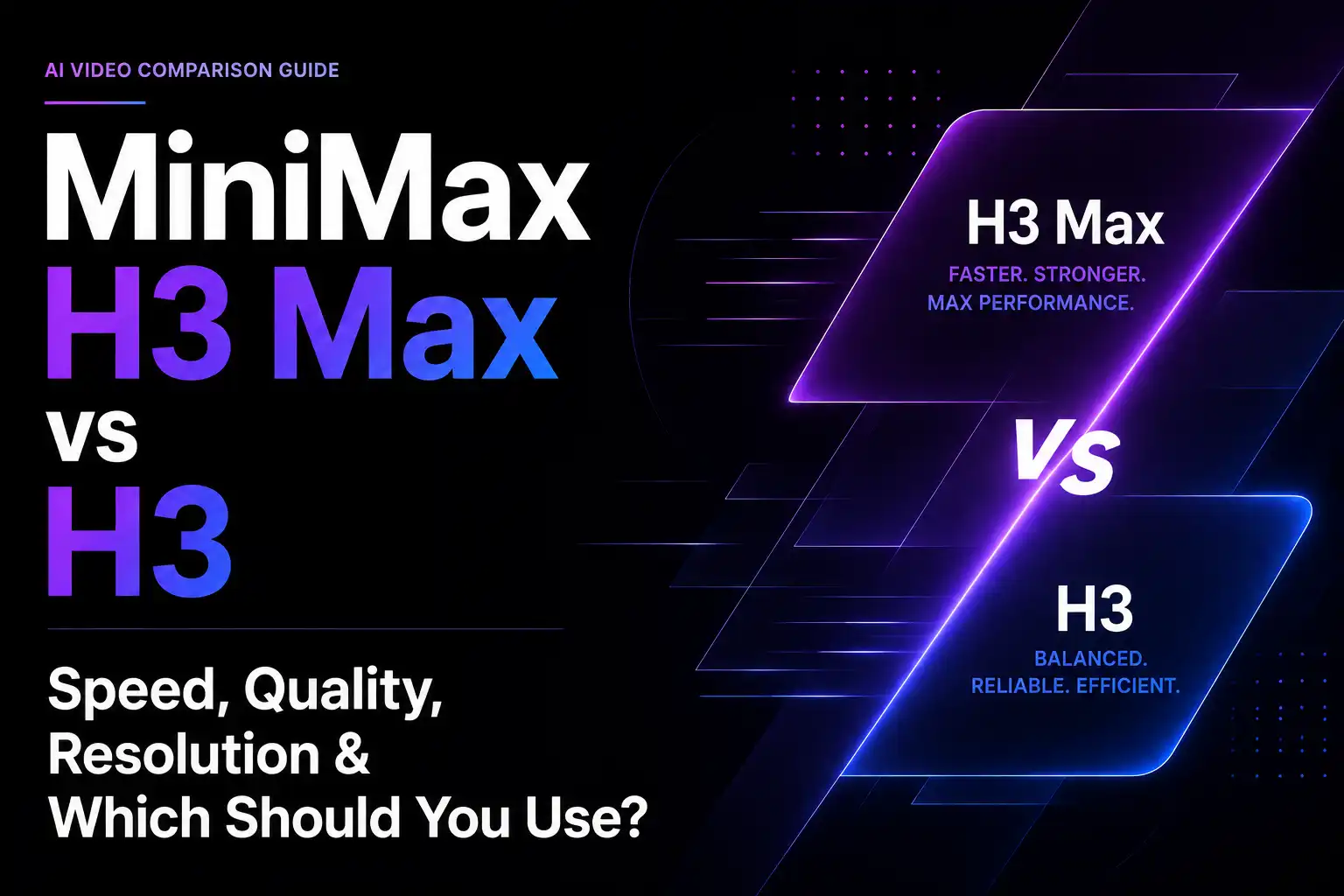
MiniMax H3 Max é melhor para velocidade, iteração rápida em 768p e geração em alto volume, enquanto MiniMax H3 é melhor quando você precisa de saída em resolução maior, pesos abertos, fluxos locais, edição ou controle de produção mais profundo. H3 Max pode gerar um clipe de cinco segundos em 768p em menos de três segundos na infraestrutura otimizada da fal, tornando-se o modelo de exploração mais forte.
Essa diferença importa porque cada movimento de câmera, ação ou variação de prompt malsucedidos tem um custo de iteração. Em fluxos profissionais de vídeo com IA, a abordagem mais eficiente costuma ser explorar rapidamente primeiro e usar mais computação só depois que a direção da tomada for aprovada.
Virse facilita gerenciar esse fluxo multimodelo em um único espaço de design com tela infinita. Os planos pagos incluem uso ilimitado de mais de 40 modelos, como Nano Banana 2 e GPT Image 2, além de assentos ilimitados. Seedance 2.5, Seedance 2.0 e MiniMax H3 já estão disponíveis, enquanto novos usuários recebem créditos de cadastro que cobrem até 10 imagens Nano Banana 2 ou um vídeo Seedance 2.0.
MiniMax H3 Max vs H3: quais são as principais diferenças?
As maiores diferenças são latência, resolução, flexibilidade de implantação e como cada modelo se encaixa no pipeline de produção. H3 Max é uma variante H3 com pós-treinamento otimizada pela fal para velocidade e aderência aos prompts. H3 continua sendo o sistema de pesos abertos mais amplo.
Recurso | H3 Max | H3 |
|---|---|---|
Ideal para | Exploração rápida | Produção controlada |
Resolução | 480p, 768p | 768p, 2K; 4K na fal |
Velocidade para 5 s em 768p | Menos de 3 segundos | Muito mais lento |
Duração | 5–15 segundos | 5–15 segundos |
Áudio nativo | Sim | Sim, estéreo |
Primeiro/último quadro | Sim | Sim |
Referências multimodais | Sim | Sim |
Edição | Vias limitadas | Recursos dedicados |
Pesos públicos | Não confirmado | H3-Base lançado |
Fluxos locais | Menos estabelecidos | Ecossistema compatível |
A arquitetura oficial de pesos abertos da MiniMax define H3-Base em 768p e H3-Regenerate-2K para saída 2K. Seu modelo de referência aceita até nove imagens, três clipes de vídeo, três clipes de áudio e 12 arquivos no total. O endpoint H3 hospedado atual da fal também oferece saídas 480p, 768p, 2K e 4K, portanto o limite de resolução disponível depende da via utilizada.
Velocidade de MiniMax H3 Max vs H3: quanto mais rápido é H3 Max?
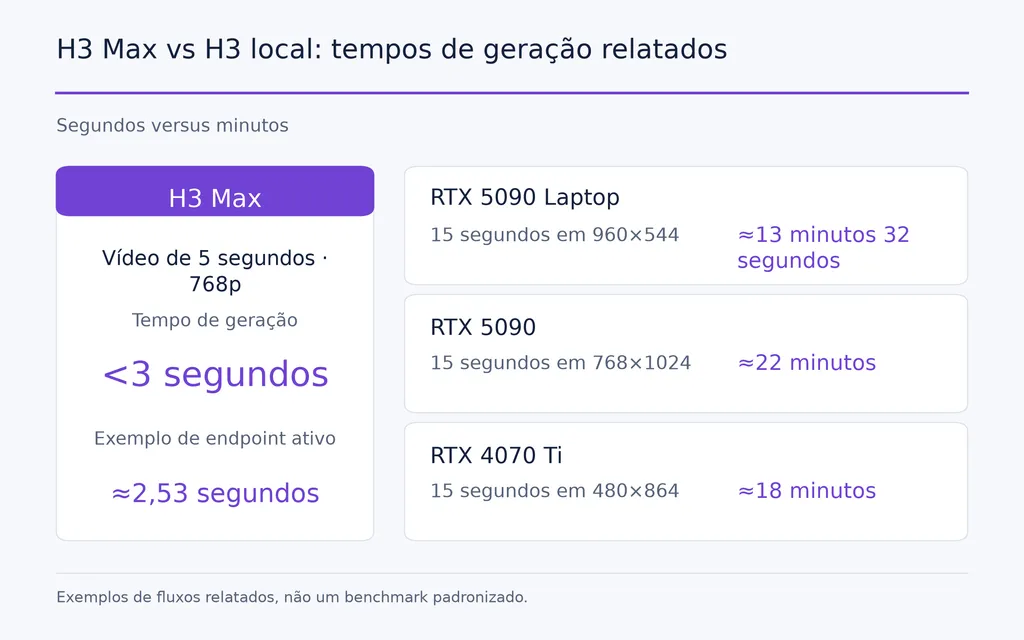
Velocidade é a vantagem mais clara de H3 Max. A fal relata geração de cinco segundos em 768p em menos de três segundos e cerca de 35 vezes a capacidade de processamento do endpoint oficial do MiniMax H3. Um exemplo de endpoint ativo relata aproximadamente 2,53 segundos de inferência no backend.
Para o trabalho criativo, a métrica importante não é só segundos por vídeo. É quantas ideias você consegue avaliar antes de escolher uma direção.
Estudo de caso: testar 15–20 conceitos em vez de esperar por um
Nossa revisão de fluxos de produção com H3 Max encontrou um caso em que saídas de cinco segundos em 768p retornavam em menos de três segundos, permitindo cerca de 15–20 variações de conceito no tempo antes gasto esperando um único resultado mais lento.
Para publicidade, visualização de produtos, storyboards e campanhas sociais, essas tentativas extras permitem testar posição de câmera, movimento, iluminação, ritmo e comportamento do sujeito antes de a equipe definir a tomada final.
H3 Max reduz o custo de descobrir que uma ideia não funciona.
Estudo de caso: H3 local pode transformar um clipe de 15 segundos em minutos de renderização
H3 local oferece controle, mas os tempos de geração relatados podem ser muito maiores. Nossa pesquisa inclui aproximadamente 13 minutos e 32 segundos para gerar 15 segundos em 960×544 em uma RTX 5090 Laptop, cerca de 22 minutos para 15 segundos em 768×1024 em uma RTX 5090 e cerca de 18 minutos para 15 segundos em 480×864 em uma RTX 4070 Ti.
São configurações relatadas, não benchmarks padronizados. Etapas, quantização, LoRAs, cache, descarregamento de memória e configuração de GPU afetam o desempenho. A lição prática é mais duradoura: H3 local se beneficia de prévias curtas em baixa resolução antes de renderizações completas caras.
Qualidade de MiniMax H3 Max vs H3: H3 Max sacrifica qualidade pela velocidade?
As evidências atuais não sustentam descrever H3 Max como uma versão turbo de baixa qualidade do H3. A fal afirma que o pós-treinamento se concentrou em aderência aos prompts, estética e qualidade visual, e não apenas em reduzir etapas de inferência.
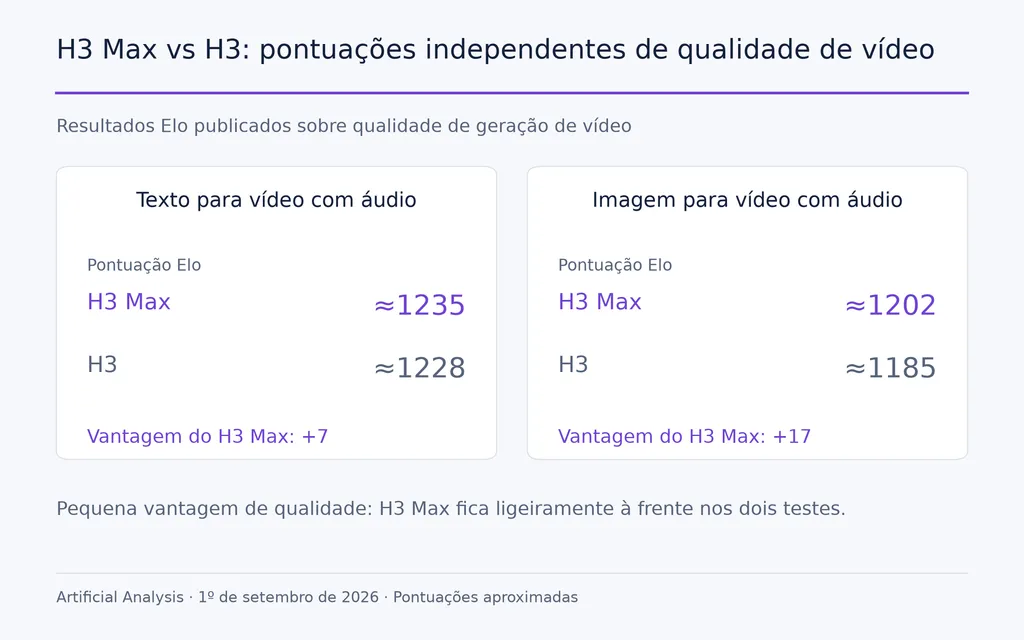
Em 1º de setembro de 2026, a Artificial Analysis atribui a H3 Max cerca de 1.235 Elo em texto para vídeo com áudio, contra 1.228 do H3. Em imagem para vídeo com áudio, H3 Max marca cerca de 1.202 contra 1.185 do H3. A vantagem de qualidade é mensurável, mas muito menor que a vantagem de latência.
O que nossa revisão de fluxos mostra sobre a qualidade real do vídeo
Nossa pesquisa encontrou menos concordância sobre qualidade visível do que sobre velocidade. Alguns fluxos revisados consideravam H3 Max próximo do H3 padrão, outros preferiam sua aderência aos prompts e outros ainda favoreciam H3 ou modelos alternativos para tomadas principais específicas.
Isso é normal na produção profissional de vídeo, porque “qualidade” não é uma única métrica. Avalie separadamente aderência aos prompts, geometria do sujeito, consistência temporal, comportamento do movimento, estabilidade facial e sincronização entre áudio e vídeo.
Em um vídeo de produto, a geometria pode importar mais que a textura cinematográfica. Em uma sequência de personagem, identidade e consistência do movimento podem dominar. Uma pequena vantagem no ranking não deve substituir a revisão de cada tomada.
Resolução de MiniMax H3 Max vs H3: 768p, 2K ou 4K é melhor?
H3 Max é otimizado para 480p e 768p, enquanto H3 oferece um limite de finalização consideravelmente maior. H3 Max suporta proporções comuns e gera até 768p.
A documentação aberta do H3 da MiniMax descreve H3-Base gerando em 768p antes de H3-Regenerate-2K reprocessar o vídeo junto com seu contexto multimodal original. Isso difere da ampliação convencional baseada apenas em pixels, pois a regeneração pode reutilizar as instruções originais ao reconstruir detalhes finos.
O endpoint H3 hospedado atual da fal também oferece níveis de saída 2K e 4K, embora a documentação publicada do sistema de pesos abertos da MiniMax descreva atualmente a arquitetura oficial de regeneração até 2K.
Estudo de caso: faça a prévia primeiro e amplie apenas a tomada escolhida
Nossa pesquisa encontrou um fluxo H3 que gerava em 544×960 em cerca de 9–10 minutos e depois ampliava os resultados escolhidos para 1152×2048 usando uma etapa de ampliação com LTX 2.3.
Outros testes mostraram grandes lentidões conforme as cargas locais do H3 avançavam para mais megapixels, especialmente quando a pressão de VRAM acionava o descarregamento de memória.
O princípio de produção é simples: não gaste resolução máxima em uma ideia ainda não aprovada. Use 768p para julgar composição e movimento e só invista em computação de alta resolução quando o detalhe adicional trouxer valor real à entrega.
Preços de H3 Max vs H3: qual oferece mais valor?
Os preços mudam rápido, então a comparação útil inclui tanto o custo por segundo quanto o custo por tomada aprovada.
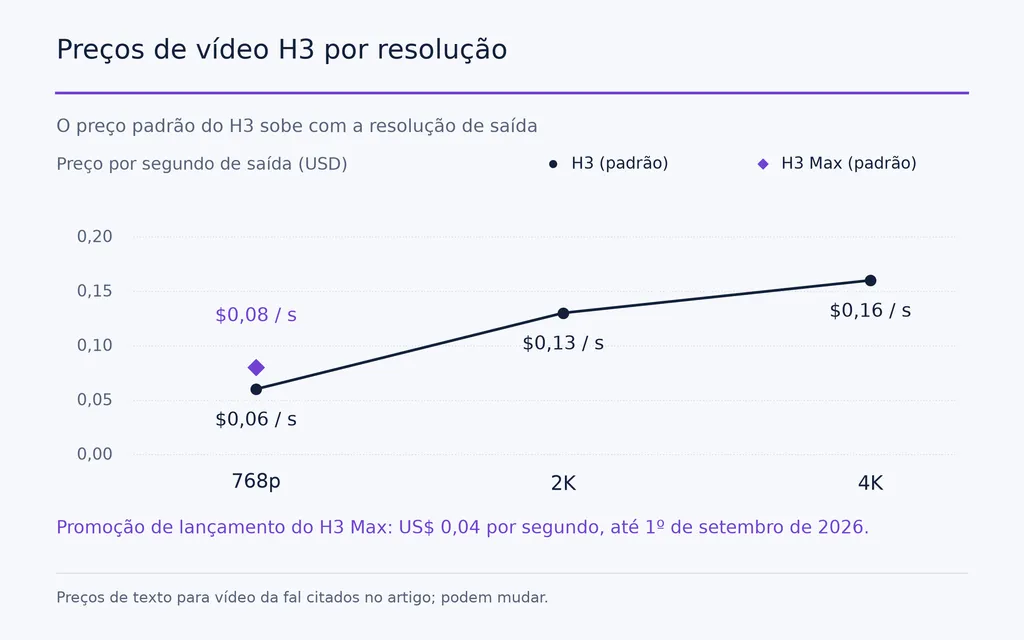
A fal lista a tarifa padrão de H3 Max em 768p como US$ 0,08 por segundo de saída e exibiu uma promoção temporária de lançamento a US$ 0,04 por segundo, encerrada em 1º de setembro de 2026. H3 padrão atualmente lista US$ 0,06 por segundo em 768p, US$ 0,13 em 2K e US$ 0,16 em 4K no endpoint de texto para vídeo da fal.
Isso significa que o preço bruto por segundo não explica sozinho o valor de H3 Max. Sua vantagem é a capacidade de processamento: a equipe pode rejeitar ideias fracas mais cedo em vez de esperar minutos por cada experimento.
Estudo de caso: H3 local troca gasto com API por tempo de GPU
Um fluxo local revisado produziu cerca de 15 segundos em 768×1024 em aproximadamente 22 minutos em uma RTX 5090 com 64 GB de RAM. O custo de geração via API era praticamente zero, mas o fluxo ainda consumia tempo de GPU, eletricidade, capacidade de hardware e atenção do operador.
Isso cria duas economias diferentes:
H3 Max otimiza o tempo até o resultado. H3 local otimiza propriedade e controle.
Para uma equipe de design, a melhor métrica costuma ser o custo por decisão criativa aprovada, não apenas por segundo gerado.
H3 Max vs H3 para referências, edição, prompts e uso local
Os dois modelos agora oferecem mais que texto para vídeo básico. H3 Max na fal inclui texto para vídeo, imagem para vídeo, condicionamento pelo primeiro e último quadro e referência para vídeo com entradas de imagem, vídeo e áudio. Sua via de referência permite até 12 arquivos no total.
H3 continua mais maduro para controle de produção. Sua arquitetura oficial de referência suporta nove imagens, três vídeos, três clipes de áudio, geração pelo primeiro e último quadro, contexto multimodal e recursos dedicados de edição. Os checkpoints H3-Base estão disponíveis publicamente para frameworks locais como ComfyUI, vLLM, SGLang e Diffusers.
Os prompts mudam entre H3 Max e H3?
H3 Max é adequado para instruções de tomada rápidas e explícitas, e a fal oferece modos de expansão de prompt que enriquecem automaticamente a entrada. Para explorar conceitos rapidamente, especifique sujeito, ação, movimento de câmera, ambiente, iluminação, tempo e som.
Para fluxos H3 complexos com referências, atribua uma função específica a cada recurso. Uma imagem pode definir identidade, um vídeo pode definir movimento ou linguagem de câmera e um clipe de áudio pode definir voz ou paisagem sonora. O sistema Context-IR da MiniMax foi projetado para interpretar essas relações multimodais, portanto funções explícitas para as referências reduzem a ambiguidade.
Qual você deve usar: MiniMax H3 Max ou H3?
Escolha H3 Max quando seu gargalo for a velocidade de iteração. Ele é especialmente forte em exploração de conceitos, desenvolvimento de storyboards, variações publicitárias, testes rápidos de imagem para vídeo, automação via API e fluxos 768p nos quais gerar mais opções melhora a decisão criativa.
Escolha H3 quando seu gargalo for controle ou finalização. Ele é mais adequado à implantação local, experimentação com pesos abertos, fluxos multimodais mais profundos, edição e saída de maior resolução.
O melhor fluxo profissional: H3 Max primeiro, H3 quando necessário
- Defina a tomada com sujeito, ação, câmera, tempo, estilo e áudio.
- Explore variações rapidamente com H3 Max.
- Revise em 768p movimento, geometria, identidade e composição.
- Rejeite direções fracas antes da ampliação.
- Transfira as tomadas escolhidas para H3 quando resolução maior, edição, referências ou controle local agregarem valor.
- Finalize no nível da sequência, verificando consistência visual, áudio, ritmo e resolução de entrega.
Nos fluxos revisados, o princípio recorrente é reduzir rapidamente a incerteza e depois finalizar seletivamente com alta qualidade.
Conclusão
MiniMax H3 Max vence em velocidade e iteração criativa rápida, enquanto MiniMax H3 continua sendo a plataforma de produção mais forte quando importam resolução maior, pesos abertos, controle local, edição ou fluxos multimodais mais profundos. As gerações de cinco segundos em menos de três segundos do H3 Max podem mudar significativamente quantas ideias uma equipe avalia, e os benchmarks atuais de preferência mostram que essa velocidade não exige um sacrifício evidente da qualidade geral. Para muitos fluxos profissionais, a resposta mais forte não é uma escolha binária entre H3 Max e H3, mas H3 Max para encontrar rapidamente a tomada certa e H3 para finalizar o trabalho escolhido quando o controle ou a resolução adicionais justificarem o custo.
Perguntas frequentes
Qual é a diferença entre H3 Max e H3?
H3 Max é uma variante H3 com pós-treinamento focada em velocidade, otimizada pela fal para gerar rapidamente em 480p e 768p. H3 é o modelo de produção de pesos abertos mais amplo, com implantação local, referências multimodais extensas, edição e saída hospedada de maior resolução. Escolha H3 Max pela velocidade de iteração e H3 quando controle ou flexibilidade de finalização forem mais importantes.
H3 Max é realmente 35 vezes mais rápido que H3 sem perder qualidade?
A fal relata aproximadamente 35 vezes a capacidade de processamento do endpoint oficial do H3, com uma geração H3 Max de cinco segundos em 768p concluída em menos de três segundos. Os rankings independentes atuais de preferência também colocam H3 Max ligeiramente à frente do H3 em texto para vídeo e imagem para vídeo com áudio, embora a diferença de qualidade seja muito menor que a de velocidade.
H3 Max pode rodar localmente ou gerar 2K ou 4K?
H3 Max atualmente se concentra na geração hospedada em 480p e 768p, e esta análise não confirmou um checkpoint oficial do H3 Max disponível para download. Os pesos H3-Base estão disponíveis publicamente para fluxos locais. A MiniMax documenta uma arquitetura oficial de regeneração 2K, enquanto o endpoint H3 hospedado da fal também oferece atualmente um nível de saída 4K.
Devo usar H3 Max para renderizações finais ou apenas para conceitos?
H3 Max pode ser usado na entrega final quando 768p atende aos requisitos do projeto e a saída escolhida passa pela revisão de qualidade. Sua maior vantagem continua sendo a exploração rápida. Para tomadas principais que exigem resolução maior, edição, controle multimodal extenso ou personalização local, H3 oferece um fluxo de finalização mais amplo.