
Fashion Design Sketches: 40 Ideas & How to Draw Your Own
 Yifan Zhao19 min de leitura ·
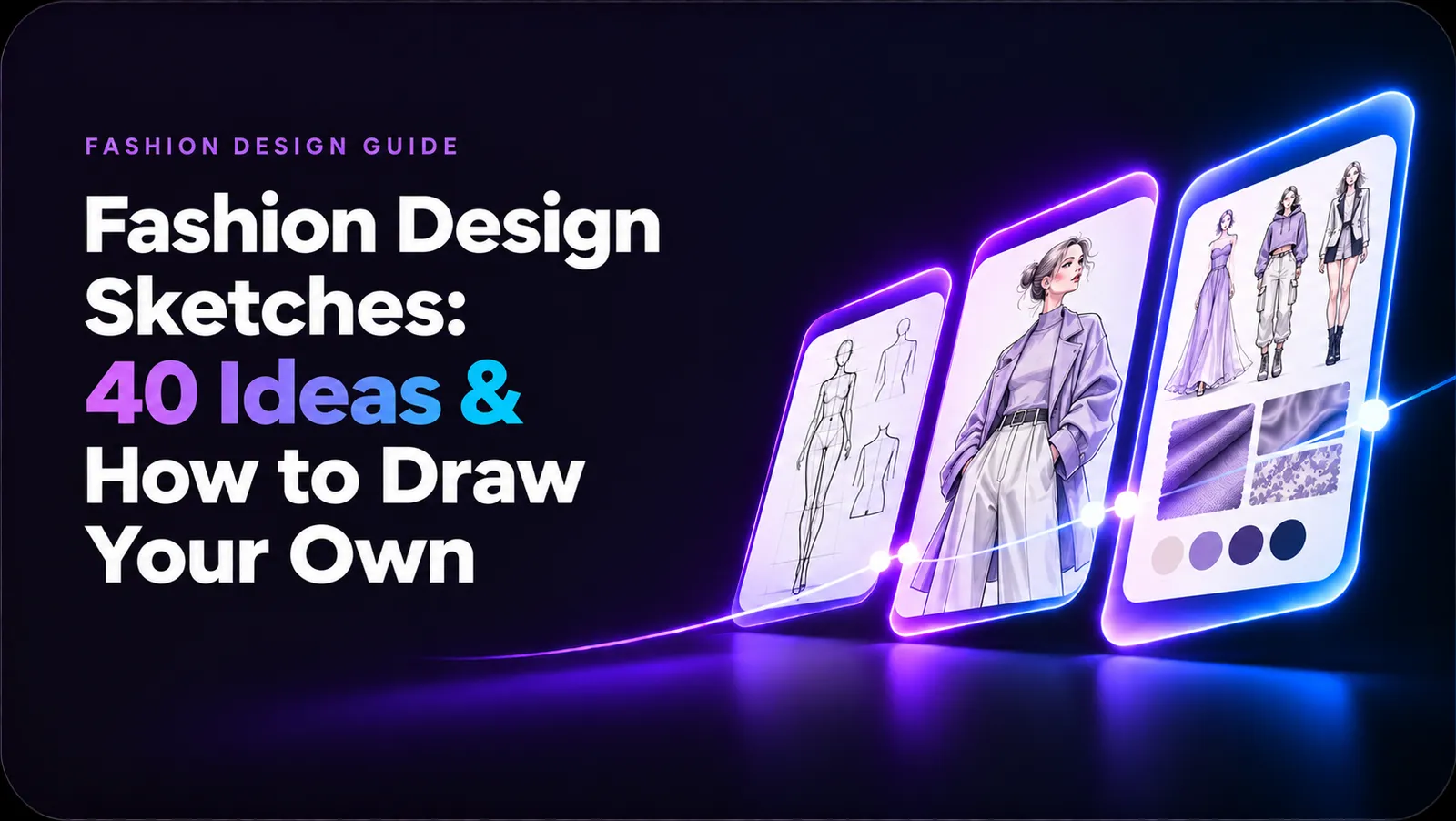
Fashion design sketches are drawings that turn clothing ideas into visual concepts, showing silhouettes, proportions, fabrics, colors, and garment details before production. They range from quick pencil drawings to polished fashion illustrations and technical flats used in clothing development.
You don't need exceptional drawing skills to get started. The bigger challenge is learning how to translate an idea into a garment that looks convincing and could actually be made. Beginners often struggle with human proportions, fabric folds, realistic silhouettes, and the difference between artistic illustrations and construction-ready designs.
This guide covers 40 fashion design sketch ideas, a step-by-step drawing workflow, fabric rendering techniques, and practical ways to turn sketches into wearable garments. You can also use Virse's AI Canvas to explore fashion concepts, compare visual styles, and refine early ideas while keeping your creative references in one workspace.
What Are Fashion Design Sketches?
Fashion design sketches are visual representations of clothing concepts used to communicate a designer's ideas before garments are created. They help designers explore silhouettes, fabrics, proportions, colors, and construction details without immediately producing physical samples.
A fashion sketch can be a rough drawing completed in seconds or a detailed illustration showing how a garment should look and fit.
Three drawing formats serve different purposes:
Drawing Type | Main Purpose | What It Shows |
|---|---|---|
Rough fashion sketch | Capture and explore ideas | Basic shapes, silhouettes, and garment concepts |
Fashion illustration | Present the creative vision | Stylized figures, colors, textures, and overall appearance |
Technical flat sketch | Communicate garment construction | Front and back views, seams, closures, and structural details |
Fashion illustrations prioritize artistic presentation, while technical flats focus on accurate garment information.
Fashion sketches are not sewing patterns or tech packs. Sewing patterns define the shapes of fabric pieces, while a tech pack documents the specifications and instructions needed for manufacturing.
For beginners, the best starting point is a simple fashion croquis—a human figure template used to draw clothing without rebuilding the body from scratch.
40 Fashion Design Sketch Ideas to Inspire Your Next Collection
If you're unsure what to draw, start with a recognizable clothing style and experiment with proportions, fabrics, or construction details.
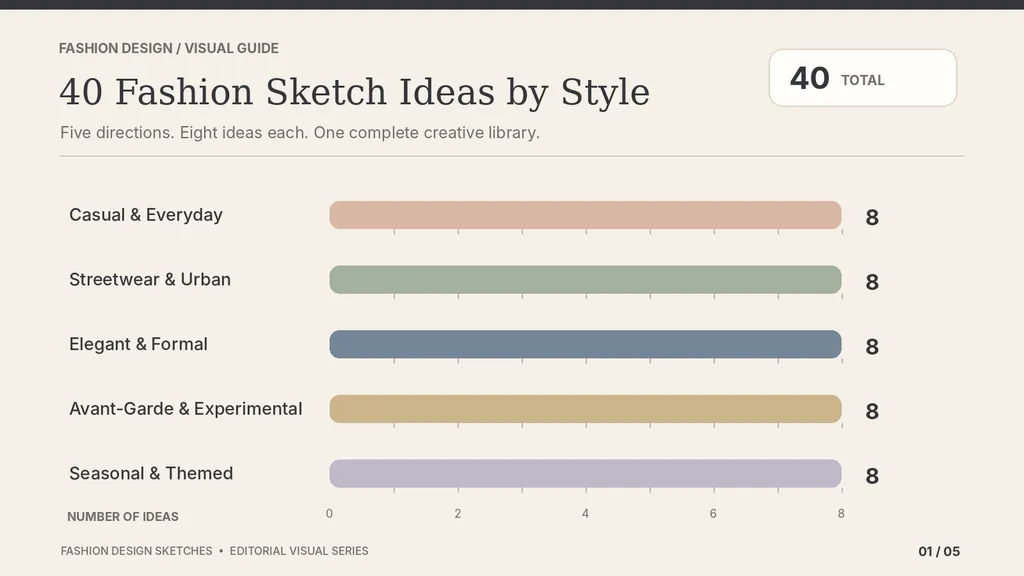
The following 40 fashion sketching ideas include what to draw, which details to emphasize, and how to make each design visually distinctive.
Casual and Everyday Fashion Sketch Ideas
Casual fashion is ideal for beginners because familiar garments make it easier to understand fit, fabric, and proportions.
# | Fashion Sketch Idea | Details to Draw |
|---|---|---|
1 | Oversized Graphic T-Shirt | Dropped shoulders, loose sleeves, oversized graphic placement |
2 | Cropped Hoodie | Short hem, ribbed waistband, hood volume, drawstrings |
3 | Minimalist Linen Outfit | Relaxed shirt, straight-leg trousers, soft natural folds |
4 | Layered Tank Top and Cardigan | Overlapping necklines, contrasting lengths, knit texture |
5 | Denim Jacket and Pleated Skirt | Structured collar, seam lines, evenly spaced pleats |
6 | Oversized Sweater Outfit | Low shoulder line, thick cuffs, soft knit folds |
7 | Athleisure Two-Piece Set | Fitted panels, curved seams, stretch-fabric contours |
8 | Summer Sundress | Adjustable straps, gathered waist, flowing skirt |
Sketching tip: Try drawing the same T-shirt in fitted, regular, and oversized silhouettes. Compare the shoulder lines, sleeve volumes, and overall proportions.
Streetwear and Urban Fashion Sketch Ideas
Streetwear sketches emphasize exaggerated shapes, layered garments, graphic details, and functional accessories.
# | Fashion Sketch Idea | Details to Draw |
|---|---|---|
9 | Oversized Streetwear Hoodie | Dropped shoulders, large hood, small chest logo and bold back graphic |
10 | Baggy Cargo Pants | Wide legs, large utility pockets, reinforced stitching |
11 | Layered Urban Outfit | Long inner shirt, cropped outer jacket, contrasting proportions |
12 | Cropped Bomber Jacket | Rounded sleeves, ribbed cuffs, structured waistband |
13 | Utility Vest | Multiple compartments, straps, adjustable closures |
14 | Patchwork Denim Jacket | Contrasting denim panels, visible seams, irregular shapes |
15 | Futuristic Techwear Outfit | Adjustable straps, structured panels, waterproof-looking materials |
16 | Graphic Sweatshirt Set | Oversized print, coordinated colors, relaxed proportions |
Sketching tip: Use stronger outlines around structured garments and softer lines for loose layers. This makes the difference between stiff and flexible fabrics easier to understand.
Elegant and Formal Fashion Sketch Ideas
Formalwear designs are useful for practicing draping, fabric movement, symmetry, and elegant proportions.
# | Fashion Sketch Idea | Details to Draw |
|---|---|---|
17 | Structured Evening Gown | Fitted bodice, dramatic skirt, defined waist |
18 | Off-Shoulder Satin Dress | Curved neckline, reflective highlights, fluid folds |
19 | Tailored Double-Breasted Suit | Lapels, overlapping front panels, button placement |
20 | Pleated Midi Dress | Controlled pleats, waistband, balanced skirt volume |
21 | Asymmetric Cocktail Dress | Uneven hemline, diagonal neckline, intentional draping |
22 | Minimalist Monochrome Outfit | Clean silhouette, subtle seams, fabric contrast |
23 | Draped Silk Blouse | Soft folds, flowing sleeves, gentle highlights |
24 | Sculptural Long Coat | Exaggerated shoulders, structured collar, long vertical seams |
Sketching tip: When drawing satin or silk, place highlights alongside fabric folds rather than adding random white streaks. The direction of the highlights should follow the garment's shape.
Avant-Garde and Experimental Fashion Sketch Ideas
Avant-garde fashion encourages designers to explore unconventional silhouettes and visual structures.
# | Fashion Sketch Idea | Details to Draw |
|---|---|---|
25 | Sculptural Shoulder Dress | Exaggerated shoulder shapes, rigid contours |
26 | Asymmetric Layered Garment | Uneven panels, overlapping fabrics, offset openings |
27 | Oversized Cocoon Silhouette | Rounded volume, narrow openings, exaggerated proportions |
28 | Origami-Inspired Dress | Sharp folds, geometric panels, angular fabric structures |
29 | Deconstructed Denim Outfit | Exposed seams, unfinished edges, reconstructed panels |
30 | Transparent Layered Outerwear | Translucent surfaces, overlapping silhouettes |
31 | Geometric Panel Outfit | Angular construction, contrasting fabric sections |
32 | Modular Fashion Design | Removable sleeves, detachable pockets, adjustable panels |
Sketching tip: Before refining an experimental design, consider how the garment could be supported. A dramatic shoulder might require interfacing, internal structure, or a stiffer fabric.
Seasonal and Themed Fashion Sketch Ideas
Seasonal themes help you connect garments with practical requirements such as insulation, breathability, movement, and weather resistance.
# | Fashion Sketch Idea | Details to Draw |
|---|---|---|
33 | Spring Trench Coat | Belt, storm flap, lightweight layered silhouette |
34 | Summer Linen Set | Relaxed proportions, breathable shapes, natural wrinkles |
35 | Autumn Knitwear Outfit | Layered sweater, scarf, textured fabrics |
36 | Winter Wool Coat | Thick collar, structured shoulders, heavy fabric folds |
37 | Futuristic Metallic Outfit | Reflective panels, sharp silhouettes, metallic highlights |
38 | Vintage-Inspired Dress | Retro neckline, defined waist, period-inspired skirt |
39 | Botanical Resort Outfit | Flowing fabrics, botanical prints, relaxed draping |
40 | Sustainable Patchwork Fashion | Reused textile panels, visible stitching, mixed textures |
Creative exercise: Choose one idea and develop three variations: a commercial everyday version, an editorial runway version, and an experimental version. This helps build a recognizable design language without repeating the same garment.
How to Draw Fashion Design Sketches Step by Step
The most effective fashion sketching workflow moves from quick concept → croquis → silhouette → fabric details → refined illustration → technical drawing.
The goal is not to make every early sketch beautiful. It is to gradually make your design clearer.
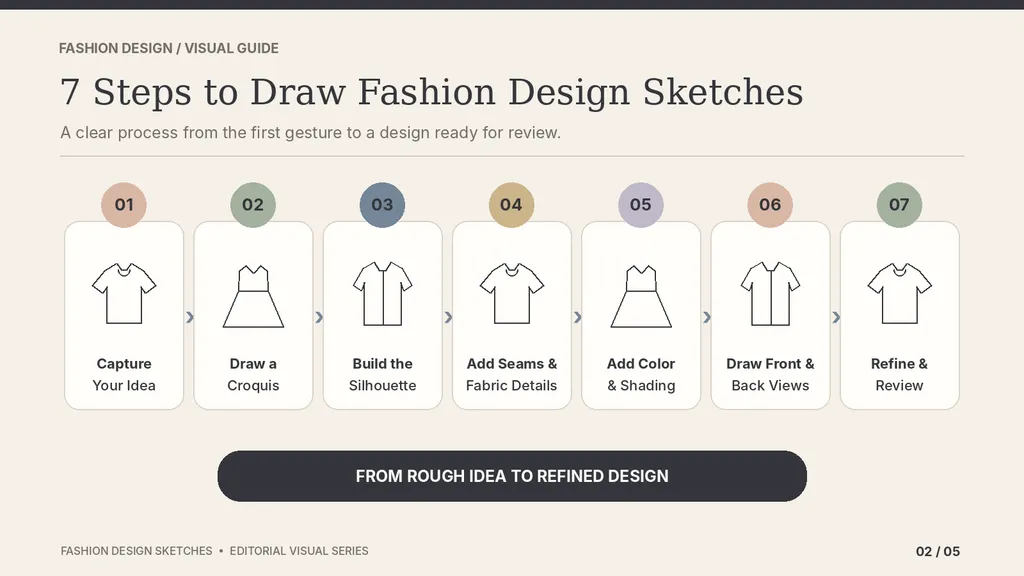
Step 1: Capture Your Clothing Idea with a Quick Sketch
Start with a loose drawing of the garment you imagine.
Focus on the overall shape rather than drawing a detailed human figure. Your first sketch may contain only a neckline, shoulder shape, waistline, and garment length.
For example, if you imagine a futuristic oversized jacket, quickly draw its wide shoulders, cropped waist, and oversized sleeves.
Avoid spending time on stitching, shadows, or decorative details.
The purpose of a rough sketch is to preserve the idea before you forget it.
Once you have several rough concepts, select the strongest direction to develop.
Step 2: Draw or Use a Fashion Croquis
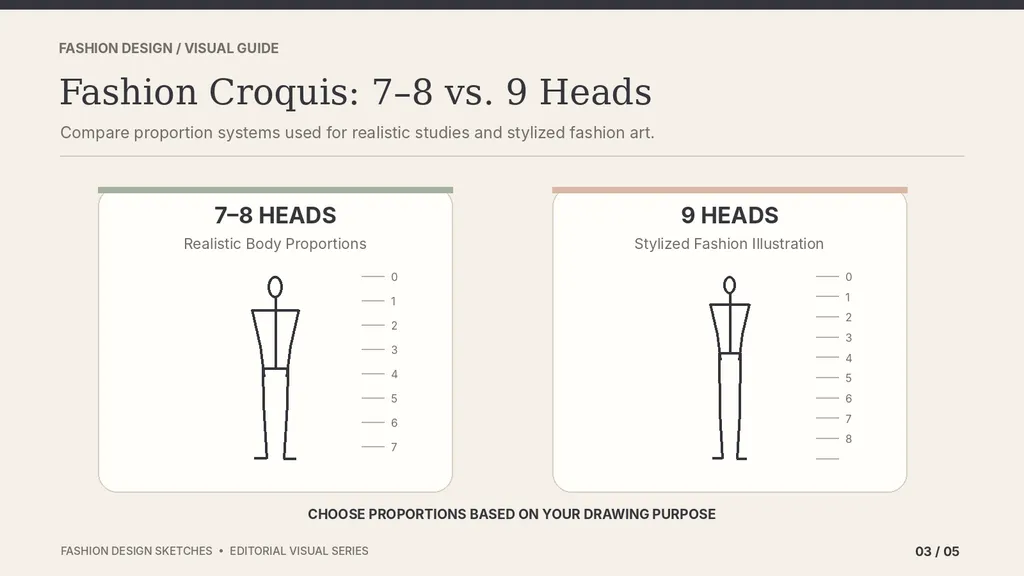
A fashion croquis is a simplified body template that serves as the foundation for clothing illustrations.
Traditional fashion illustrations sometimes use elongated nine-head figures, while realistic body proportions are closer to seven to eight heads tall, with natural individual variation.
To use a croquis:
- Draw a vertical balance line.
- Mark the head, shoulders, waist, hips, knees, and ankles.
- Establish a natural or stylized pose.
- Sketch the garment around the body.
- Adjust the clothing to match the figure's posture.
Beginners can use printable croquis templates to avoid repeatedly drawing anatomy.
For technical development, prioritize realistic body proportions rather than dramatic fashion-illustration poses.
Step 3: Build the Clothing Silhouette
Draw the outer contour of your clothing before adding internal details.
Pay attention to:
- Shoulder width and placement
- Waistline and hip proportions
- Garment length
- Sleeve shape and volume
- Fit and ease
- Overall balance
For example, an oversized bomber jacket should extend beyond the body's natural shoulder line, while a fitted blazer should follow the shoulders and waist more closely.
Try viewing your sketch as a solid black silhouette. If the clothing shape is still recognizable, the design has a clear visual identity.
Step 4: Add Seams, Folds, and Fabric Details
Once the silhouette is established, add the garment's defining features.
These might include pockets, collars, zippers, buttons, decorative panels, pleats, or embroidery.
Then consider how the fabric behaves.
Fabric | How It Behaves | How to Sketch It |
|---|---|---|
Silk | Soft, fluid, reflective | Long flowing folds and smooth highlights |
Denim | Firm and moderately stiff | Defined creases, seam details, structured shapes |
Wool | Thick and relatively heavy | Broad folds, soft shadows, visible volume |
Chiffon | Lightweight and transparent | Fine lines, layered transparency, gentle draping |
Leather | Structured with reflective surfaces | Clear edges, controlled folds, sharp highlights |
Knitwear | Stretchable and textured | Soft contours, ribbing, stitch patterns |
Satin | Smooth with directional sheen | Strong light-dark contrast along folds |
Don't draw fabric folds randomly. Identify where the material is stretched, compressed, supported, or hanging under gravity.
For example, a loose sleeve may produce folds near the elbow, while a gathered skirt creates repeated folds descending from the waistband.
Step 5: Add Colors, Textures, and Shading
Use color to communicate the garment's materials and visual personality.
Start with a primary color palette, then add contrasting fabrics, accents, and shadows.
For stronger volume:
- Place shadows beneath overlapping fabric layers.
- Use highlights on exposed or reflective surfaces.
- Vary line thickness between the outer contour and internal details.
- Match the shading technique to the fabric type.
A satin dress should look different from a wool coat even when both use the same color.
Step 6: Draw Front and Back Views
A polished front-facing illustration communicates the look of your design, but it rarely communicates enough information for production.
Create a separate technical drawing with front and back views.
Show:
- Seams and panel divisions
- Collar and neckline construction
- Sleeve shapes
- Pockets and closures
- Hem finishes
- Back openings and fastenings
Add side views when the design includes unusual volume, structural details, or asymmetry.
Technical flats are commonly drawn without a human figure so the garment's proportions and construction are easier to evaluate.
Step 7: Refine and Review the Complete Design
Compare your refined sketch with the original concept.
Ask whether the design still communicates the initial creative idea while addressing real garment requirements.
At this stage, you can create alternative colorways, refine proportions, or adjust construction details.
If you use AI-assisted visual references, compare the generated concept with your hand-drawn or technical design. AI can suggest interesting shapes, but it may also invent seams, closures, or fabric structures that would not function in reality.
From Fashion Sketch to Real Garment: What Makes a Design Wearable?
A beautiful fashion illustration does not automatically represent a garment that can be produced.
A wearable design must account for fabric behavior, pattern construction, closures, fit, movement, and how the front and back of the garment connect.
This is one of the most important distinctions between fashion illustration and actual clothing design.
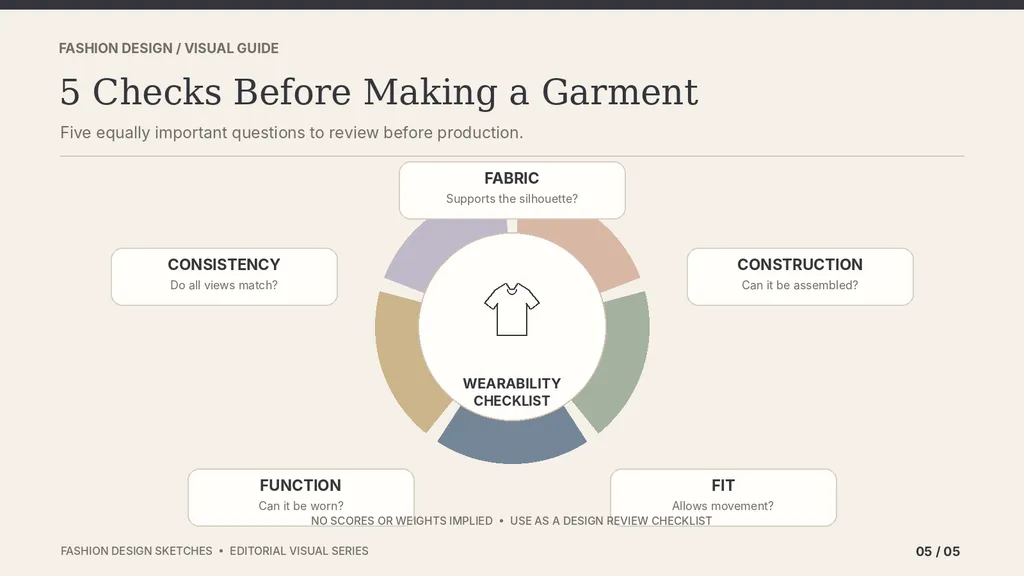
A Practical Example: Developing an Oversized Jacket
Consider a hypothetical oversized bomber jacket with sculptural sleeves.
Design Stage | What You Create | What You Need to Check |
|---|---|---|
Initial concept | Rough jacket sketch | Is the silhouette recognizable? |
Refined illustration | Detailed garment on a croquis | Do the proportions look balanced? |
Fabric research | Nylon, denim, or structured cotton references | Can the material hold the intended shape? |
Technical flat | Front and back views | Are seams, panels, and closures consistent? |
Pattern development | Pattern pieces and measurements | Can the garment be cut and assembled? |
Prototype | First physical sample | Does it fit, move, and retain the design's intended shape? |
Final garment | Revised wearable piece | Does the result match the creative and functional goals? |
For example, a jacket with dramatic balloon sleeves needs more than a curved outline. You must determine how the sleeves connect to the armholes, how much fabric creates the volume, and whether the cuffs can control the final shape.
If the material is too soft, the sleeves may collapse. If it is too stiff, they may restrict movement.
These decisions affect both the final garment and how you should illustrate it.
Five Questions to Ask Before Making a Garment
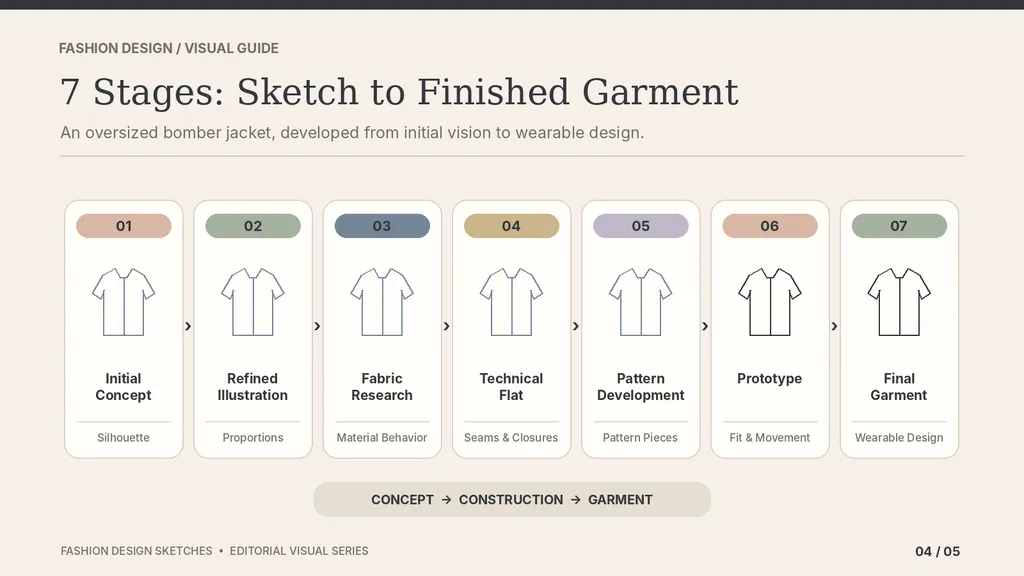
Before transferring a fashion sketch into production, ask:
- Fabric: Will the chosen material support the desired silhouette and movement?
- Construction: Can the panels, seams, and garment pieces be assembled realistically?
- Fit: Does the design provide enough space for the body to move?
- Function: Can the wearer put the garment on, fasten it, and use it comfortably?
- Consistency: Do the front, back, and side views describe the same design?
These questions are especially useful for asymmetric dresses, sculptural garments, experimental streetwear, and oversized fashion.
Fashion Sketch vs. Technical Flat vs. Finished Garment
A strong design presentation can show the same garment in three forms.
Fashion illustration: Communicates the visual concept, mood, silhouette, and styling.
Technical flat: Shows construction information, seam locations, closures, and garment proportions.
Finished garment: Demonstrates how the design behaves with real fabric, gravity, body movement, and manufacturing constraints.
Presenting all three creates a more complete explanation of your design process than showing a polished illustration alone.
How to Create and Improve Fashion Design Sketches with AI
AI image tools can support fashion designers during concept development, particularly when exploring silhouettes, materials, compositions, and visual styles.
However, AI is most useful when treated as a creative exploration tool rather than an automatic replacement for garment design skills.
Use Virse to Explore Multiple Fashion Concepts
Virse provides an AI creative workspace where designers can organize references, generate images, compare creative directions, and refine visual concepts on an infinite canvas.
A practical fashion design workflow looks like this:
- Upload your rough fashion sketch or collect reference images on the canvas.
- Describe the garment concept using details such as silhouette, fabric, color, and fashion style.
- Generate visual variations to compare possible interpretations.
- Refine a selected direction by adjusting specific visual elements or experimenting with another model.
- Use the strongest reference to develop your own detailed fashion illustration or technical drawing.
For example, you could upload a rough jacket sketch and explore alternatives featuring structured cotton, metallic fabric, or oversized sculptural sleeves.
Using Virse's multi-model workspace, you can compare how different image models interpret the same design brief without separating your references into unrelated projects.
AI Fashion Design Sketch Prompts You Can Try
The quality of an AI fashion concept often depends on how precisely you describe the garment.
Instead of using a broad prompt such as "beautiful fashion sketch," specify the silhouette, fabric, pose, design features, and illustration style.
Design Goal | Example AI Prompt |
|---|---|
Beginner fashion sketch | "A clean pencil fashion design sketch of a casual women's outfit, relaxed shirt and wide-leg trousers, standing fashion croquis, accurate garment proportions, white background, visible garment construction details." |
Streetwear concept | "Professional fashion illustration of an oversized streetwear hoodie with dropped shoulders, wide cargo trousers, layered silhouette, bold black-and-red palette, detailed folds, front three-quarter view, white sketchbook background." |
Evening gown | "Elegant fashion design illustration of a floor-length satin evening gown, asymmetric neckline, structured bodice, flowing draped skirt, realistic satin highlights, refined pencil and watercolor rendering." |
Avant-garde fashion | "Experimental runway fashion concept featuring a sculptural shoulder silhouette, asymmetric geometric panels, structured textile, dramatic garment volume, editorial fashion sketch style." |
Technical reference | "Clean black-and-white fashion technical flat of an oversized bomber jacket, separate front and back views, symmetrical layout, clear seam lines, pockets, zipper, ribbed cuffs, no human figure, plain white background." |
AI-generated technical views may contain inconsistent or invented construction details. Use them as starting references and redraw the final flats accurately.
How to Refine an AI Fashion Sketch Without Losing the Concept
When a generated design is close to your idea, avoid changing the entire concept unnecessarily.
Use a targeted edit to adjust one feature at a time.
For example:
Original concept: An oversized bomber jacket with sculptural sleeves and a cropped waist.
Refinement prompt:
"Keep the original bomber jacket silhouette, color palette, and overall proportions. Change only the sleeves to a more structured balloon shape with visible seam construction and ribbed cuffs. Preserve the remaining design details."
Virse's canvas supports image-based references and localized editing, helping designers iterate on promising concepts while keeping earlier directions available.
After refining the visual, return to the construction checklist and confirm whether the suggested changes are practical.
How to Make Fashion Design Sketches Look More Professional
Improving a fashion sketch does not always require additional decoration. Often, the biggest improvement comes from correcting proportions, volume, and fabric behavior.
Fix Flat-Looking Garments with Better Volume and Shading
If a garment appears flat, identify its three-dimensional shape before adding more detail.
For instance, a sleeve is a cylindrical form, not a flat rectangle. Its fabric should wrap around the arm and create shadows near folds or overlapping sections.
Use darker lines where fabric overlaps and softer lines where surfaces curve.
Study real clothing photographs to understand how folds form around shoulders, elbows, waists, and knees.
Improve Croquis Proportions and Clothing Fit
Avoid drawing clothing directly against the body without considering material thickness or ease.
An oversized jacket should extend beyond the body, while a fitted dress should follow the figure more closely.
Practice sketching the same garment over different poses and body shapes.
This helps you distinguish between the body's anatomy and the clothing's structure.
Develop an Original Fashion Illustration Style
Originality often comes from combining references with your own design decisions rather than inventing something entirely unfamiliar.
Experiment with:
- Different silhouette proportions
- Unusual material combinations
- Distinctive seam placement
- Personal color palettes
- Cultural or historical design influences
- Functional details adapted to a new context
Keep a sketchbook of recurring visual ideas. Over time, you may discover patterns in your preferred silhouettes, textures, and garment structures.
Best Tools for Fashion Design Sketches
The right tool depends on whether you are capturing ideas, creating illustrations, developing technical drawings, or exploring AI-generated concepts.
Tool | Best For | Strength | Main Limitation |
|---|---|---|---|
Pencil and paper | Quick concept sketches | Immediate, flexible, inexpensive | Manual revisions and organization |
Procreate | Digital fashion illustration | Natural drawing and brush-based rendering | Requires compatible Apple hardware |
Adobe Photoshop | Refining scanned sketches | Image editing, color, and texture control | Less suitable for precise vector flats |
Adobe Illustrator | Technical fashion drawings | Clean vector lines and scalable artwork | Requires practice with vector tools |
Virse | AI fashion concept exploration | Multi-model generation, visual comparison, and iterative editing | Does not replace technical patternmaking |
A practical workflow can combine multiple tools.
For example, begin with a pencil sketch, explore styling references in Virse's AI Canvas, refine the selected illustration in Procreate, and prepare accurate technical flats in Illustrator.
You do not need every tool to become a capable fashion designer. Start with the one that best supports your immediate task.
How to Turn Fashion Design Sketches into a Portfolio
A strong fashion portfolio should show how you think, not just how well you draw.
Fashion schools, creative teams, and potential collaborators often need to understand your design process, visual research, technical decisions, and ability to develop ideas.
Show the Full Design Development Process
Organize each project around a clear sequence:
- Concept and inspiration
- Mood board and visual research
- Initial rough sketches
- Silhouette and color variations
- Fabric research and material decisions
- Refined fashion illustrations
- Technical flats and construction details
- Prototype or finished garment photographs, when available
You can also place an early sketch beside the final garment to demonstrate how the design changed during development.
Present Sketches with Clear Layouts
Keep your portfolio pages organized and visually consistent.
Use clear project titles, consistent typography, neutral backgrounds, and concise explanations of the design decisions.
Avoid filling every page with unrelated sketches. A smaller selection of well-developed projects often communicates more than a large collection of disconnected drawings.
For fashion school applications, always follow the institution's specific portfolio guidelines.
Explain What Changed Between Sketch and Garment
If you have a finished sample, identify the changes required during construction.
For example, an original sketch might feature dramatic sleeves, while the prototype requires an adjusted sleeve shape to improve movement.
Explaining this decision demonstrates technical understanding and creative problem-solving.
If your portfolio includes AI-generated visual references, distinguish those images from original hand drawings, technical sketches, and physically produced garments.
This makes your design process more transparent.
Common Fashion Design Sketching Mistakes
Mistake | Why It Happens | Practical Fix |
|---|---|---|
Incorrect body proportions | Limited figure-drawing practice | Use croquis and gesture studies |
Flat-looking garments | Missing volume, highlights, and shadows | Study real fabric folds and three-dimensional forms |
Unrealistic clothing construction | Focusing only on aesthetics | Examine seams, pattern pieces, and garment assembly |
Repetitive silhouettes | Relying on familiar shapes | Explore fitted, oversized, asymmetric, and layered variations |
Too much detail too early | Trying to make the first sketch perfect | Start with loose silhouettes and refine gradually |
Missing back views | Designing only the visible front | Add technical flats showing both sides |
Weak portfolio presentation | Including only final illustrations | Show concept research, iterations, and technical development |
Overreliance on AI images | Confusing visual generation with garment engineering | Validate fit, fabric behavior, and construction manually |
The most useful improvement is to separate ideation, illustration, and technical development into distinct stages.
A rough sketch should capture an idea. A refined illustration should communicate its visual identity. A technical drawing should explain its structure.
Conclusion
Fashion design sketches help transform clothing ideas into designs that can be explored, refined, and eventually produced. Start with quick concepts, practice croquis and silhouettes, learn how fabrics behave, and develop accurate front and back views before moving toward garment construction. Whether you draw by hand, work digitally, or use Virse to explore AI-assisted fashion concepts, the most effective approach combines creative experimentation with practical design knowledge.
Frequently Asked Questions
Do you need to know how to draw to become a fashion designer?
You do not need advanced illustration skills to begin fashion design. However, you should develop a reliable way to communicate silhouettes, proportions, and garment details. Croquis templates, reference images, and digital tools can help beginners while they practice drawing, fabric studies, and garment construction.
What is the difference between fashion sketching and fashion illustration?
Fashion sketching describes the process of visually developing clothing ideas, from rough drawings to detailed garment designs. Fashion illustration emphasizes artistic presentation, including stylized figures, poses, colors, and textures. Technical sketches are more precise and focus on the garment's construction and design details.
What is a croquis in fashion design?
A croquis is a basic human figure template used as a foundation for fashion drawings. It helps designers sketch clothing quickly without redrawing the body each time. Croquis figures can use stylized or realistic proportions depending on whether the purpose is fashion illustration or technical development.
How can beginners make fashion sketches look more realistic?
Start by improving body proportions and garment silhouettes. Then study real clothing to understand fabric folds, shadows, material thickness, and movement. Use consistent lighting and add construction details such as seams and closures. Practicing one fabric type at a time can make the learning process more manageable.
What software is best for fashion design sketches?
Procreate is well suited to freehand fashion illustration, Photoshop helps refine scanned drawings, and Illustrator is useful for precise technical flats. Pencil and paper remain effective for quick ideas. AI visual workspaces such as Virse can help explore different concepts and visual directions before detailed development.
Can AI turn a rough fashion sketch into a finished design?
AI can help transform rough sketches into more developed visual concepts and generate variations of silhouettes, colors, and materials. However, the resulting images do not automatically provide accurate measurements, sewing patterns, or manufacturing specifications. Designers must still validate the garment's structure and construction.
Do fashion design sketches need front and back views?
Not every rough concept needs multiple views. However, developed garment designs usually benefit from front and back technical flats, especially when seams, closures, or construction details differ between sides. Side views can also help communicate unusual garment volume or complex silhouettes.
How do you turn a fashion sketch into a real garment?
Begin by refining the sketch and choosing suitable fabric. Create technical drawings, establish measurements, develop sewing patterns, and construct a prototype. Test the fit, movement, and fabric behavior, then revise the pattern and construction details before producing the final garment.
Mais do blogue da Virse
Inspiração
40 Hoodie Design Ideas for Streetwear, Brands, and Custom Apparel
8 de novembro de 2026 by Yifan Zhao
Inspiração

40 T-Shirt Design Ideas: Creative Styles & Examples for 2026
8 de novembro de 2026 by Yifan Zhao
Inspiração
30 Design Portfolio Examples That Inspire and What Makes Them Work
8 de novembro de 2026 by Yifan Zhao