
What Does a Graphic Designer Do? Real Tasks, Revisions, Tools & Workflow
 Yifan Zhao10분 읽기 ·
A graphic designer turns ideas, information, and business goals into clear visual communication. They research audiences, develop concepts, organize typography and imagery, create layouts and brand assets, manage feedback, and prepare finished work for print or digital use.
The challenge is that the final visual hides a much larger workflow. A logo, menu, campaign asset, or social graphic can involve multiple concepts, changing content, stakeholder feedback, revisions, and production work. As AI speeds up execution, designers increasingly need to focus on creative direction, consistency, and scaling ideas into complete visual systems.
Virse is built for this kind of workflow. Its canvas-based AI workspace helps design teams organize references, generate assets, and collaborate with AI while keeping designers in control. Paid plans include unlimited use of 40+ models such as Nano Banana 2 and GPT Image 2, plus unlimited seats. New users receive free credits that can cover up to 10 Nano Banana 2 images or one Seedance 2.0 video, while Seedance 2.5, Seedance 2.0, and MiniMax H3 are also available on Virse.
What Does a Graphic Designer Do in a Real Design Project?
A graphic designer usually moves through five connected stages: understand the problem, explore directions, develop the design, refine it through feedback, and prepare the final output. The time spent inside design software is only one part of that process.
Graphic Designers Turn a Brief Into a Visual Direction
The first job is understanding what the design actually needs to accomplish.
Designers clarify the target audience, core message, brand requirements, content, format, production constraints, deadline, and approval process before detailed execution begins.
In our review of practitioner-reported logo workflows, one project began with roughly one hour of discussion and sketching before three initial logo directions were developed. This is not an industry-wide benchmark. It illustrates an important point: meaningful design work begins before a polished graphic exists.
From a professional design perspective, this stage prevents one of the most expensive creative mistakes: executing the wrong idea efficiently.
Graphic Designers Explore Concepts Before Refining One
Once the brief is clear, designers may collect references, build moodboards, sketch layouts, test typography, compare imagery, explore colors, and develop alternative visual directions.
A branding project might compare three identity concepts. A campaign might test several relationships between product imagery, headlines, typography, and calls to action.
The designer's value is therefore not simply generating options. It is judging which option communicates the right message and can survive real production requirements.
Graphic Designers Turn Approved Ideas Into Visual Systems
A professional design rarely ends with one image.
A brand direction may expand into typography, colors, image treatments, templates, presentations, ads, and social content. A campaign key visual might later need to work across dozens of formats.
This changes the challenge from making one attractive graphic to building a repeatable visual system. The twentieth asset should still feel connected to the first.
What Does a Graphic Designer Do Day to Day?
A graphic designer's daily work normally combines creative development, communication, revisions, production, and organization.
A typical day may include reviewing a brief, researching references, designing layouts, editing images, attending a feedback meeting, refining an approved direction, adapting assets into multiple sizes, checking copy, organizing files, and preparing deliverables.
Communication Is Part of Graphic Design Work
Designers rarely work alone. They collaborate with clients, marketers, copywriters, product teams, creative directors, printers, developers, and other stakeholders.
They may need to explain why one layout works better, request missing content, consolidate conflicting feedback, or confirm production specifications.
As designers become more senior, this balance often shifts further toward creative direction, presentations, reviews, team coordination, and quality control. The role becomes less about personally pushing every pixel and more about ensuring the overall visual system works.
What Types of Work Does a Graphic Designer Create?
Graphic designers work across many formats because the profession is defined by visual communication rather than a single deliverable.
Design Area | Typical Graphic Design Work |
|---|---|
Branding | Logos, identity systems, typography, guidelines |
Marketing | Ads, campaigns, email assets |
Social Media | Posts, Stories, templates |
Brochures, menus, posters, reports | |
Packaging | Labels, boxes, product graphics |
Editorial | Books, manuals, publications |
Digital | Web graphics, banners, landing assets |
Presentations | Pitch decks and sales decks |
Motion | Animated graphics and campaign assets |
A designer may specialize in one category or work across several. The common responsibility remains the same: organize visual information so an audience can understand, recognize, and respond to it effectively.
How Long Does a Graphic Designer Take to Complete a Project?
There is no universal project duration. Graphic design time depends on scope, content readiness, concept development, number of deliverables, feedback quality, and revision rounds.
Our review of real practitioner workflows shows why judging a project only by the size of its final output can be misleading.
Logo and Branding Projects Can Take One to Two Weeks
In one workflow we reviewed, early logo development included about one hour of discussion and sketching followed by three concept directions.
Another practitioner-reported workflow estimated approximately one to two weeks for a first branding or logo round.
That does not mean a designer spends two weeks continuously drawing one symbol. The schedule can include research, concept exploration, evaluation, presentation, feedback, and refinement.
The real work is not simply drawing a logo quickly. It is deciding what the logo should communicate and which direction deserves further investment.
A Simple Menu Can Hide Eight to Ten Hours of Work
One project in our research involved a two-sided tri-fold menu with an internal allowance of only two hours.
The designer completed the task in roughly three hours, while experienced practitioners reviewing the scope considered approximately eight to ten hours more realistic for a complete process.
The work can include content hierarchy, typography, imagery, pricing checks, folds, proofreading, print specifications, and final production files.
The final object looks small. The workflow is not.
Social and Email Design Becomes a Scaling Problem
Repeatable digital assets can become faster once a visual system already exists.
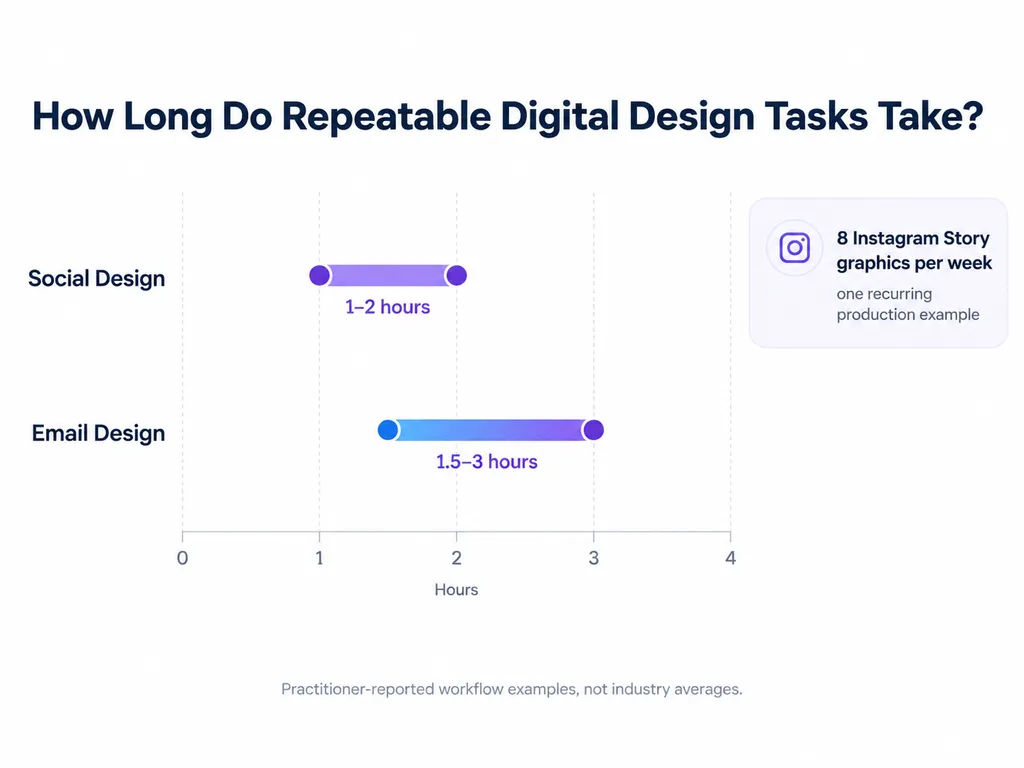
One workflow in our research estimated roughly 1–2 hours for a social design and 1.5–3 hours for an email design. Another recurring production example involved eight Instagram Story graphics per week with one revision round included.
At this stage, the challenge changes from creating one good asset to maintaining the same identity and quality across continuous production.
Why Are Revisions a Major Graphic Designer Responsibility?
Revisions are not an exception in professional graphic design. They are part of the workflow.
A project can change because stakeholders disagree, copy arrives late, requirements shift, legal feedback appears, or an approved direction is reopened.
Our review of practitioner-reported cases found projects exceeding 10 revision rounds, while one invitation project reached 24 proof versions before approval.
These are individual project examples, not industry averages. They show how feedback can dramatically expand the workload behind an apparently simple deliverable.
Graphic Designers Need to Control Revision Scope
Revision management is a professional design skill.
One manual-design case in our research was originally estimated at 30 hours, but extensive alternatives and changes eventually resulted in fees around three times the original estimate. That workflow also used a 20-minute minimum billing increment for additional revisions.
Another recurring social-design arrangement included one revision round, with additional revisions billed at $35 per hour.
These figures are not universal pricing recommendations. The practical lesson is more important: designers need clear expectations around concepts, revision rounds, approvers, final content, and additional scope.
Late Content Changes Can Create Disproportionate Work
A small text change can affect far more than one sentence.
One editorial-layout project in our research received more than 65 content changes after layout had already begun.
In a multi-page document, those changes can alter line breaks, pagination, headings, image positions, tables, and page balance. This is why getting content reasonably stable before detailed layout is one of the simplest ways to reduce unnecessary production work.
What Skills and Tools Does a Graphic Designer Need?
A graphic designer needs visual judgment, communication skills, production knowledge, and fluency with the right creative tools.
Software matters, but understanding why a visual decision works matters more.
Graphic Designers Need Typography, Hierarchy, and Composition Skills
Typography affects readability and tone. Designers control scale, weight, spacing, line length, alignment, and relationships between information levels.
Hierarchy determines what viewers notice first. Composition determines how visual elements relate to one another. Brand thinking ensures that separate assets still feel like one recognizable system.
These fundamentals remain valuable even when software changes because every new tool still produces work that needs to be evaluated.
Ai, Ps, Id, and Figma Serve Different Graphic Design Workflows
Current U.S. job-posting data from O*NET shows how broad software expectations have become. Adobe Illustrator appears in 62% of relevant postings, Photoshop in 61%, InDesign in 49%, After Effects in 16%, and Figma in 11%.
Ai is especially useful for vector and identity work. Ps supports raster imagery and compositing. Id is built for complex multi-page layouts. Figma becomes more relevant when graphic design overlaps with collaborative digital product workflows.
A strong designer does not use every tool for every project. The important skill is choosing the right tool for the production problem.
How Is AI Changing What Graphic Designers Do?
AI is accelerating visual exploration, image generation, variations, editing, resizing, and repetitive production. That makes producing options easier, but it makes selection and direction more important.
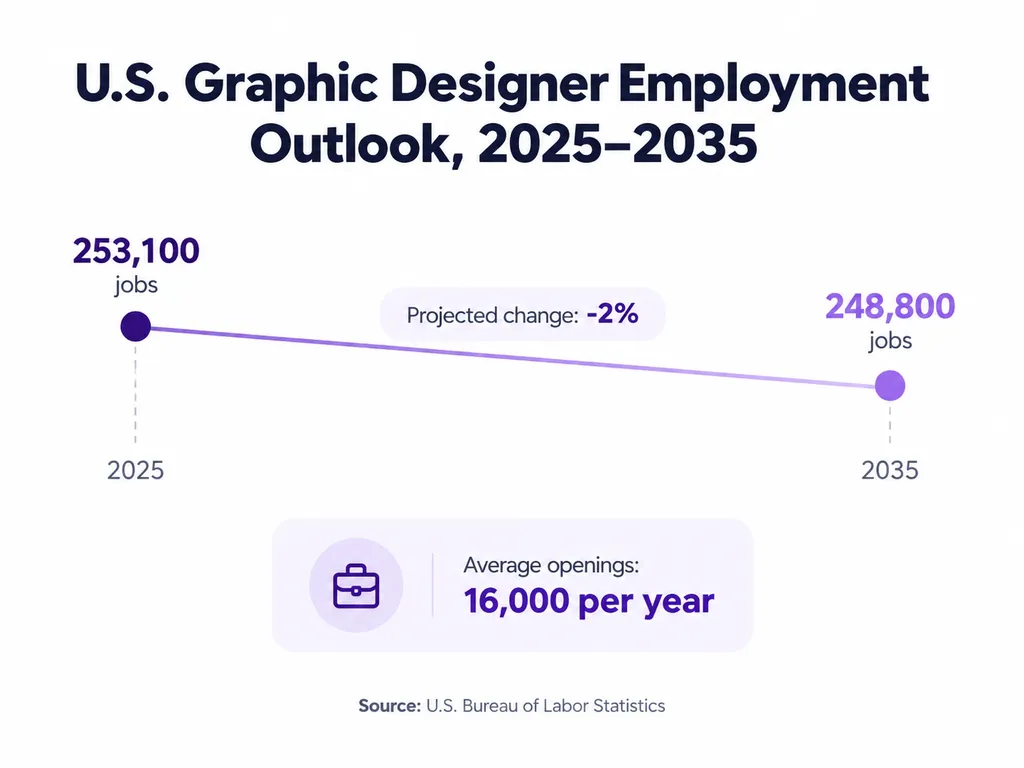
The U.S. Bureau of Labor Statistics projects graphic designer employment to decline 2% from 2025 to 2035, while still projecting about 16,000 openings per year on average. BLS also identifies automated design tools, including AI, as a factor that may make designers more productive while reducing some labor demand.
From an AI design workflow perspective, the key change is where designers create value.
AI can generate ten visual directions quickly, but someone still needs to determine which direction fits the brief, whether the composition works, whether the output matches the brand, what needs correction, and how that direction can scale across a campaign.
The role is therefore expanding from manual asset creation toward creative direction, curation, consistency management, system design, and AI-assisted production.
FAQ
What does a graphic designer actually do every day?
A graphic designer typically moves between research, concept development, layouts, typography, image editing, meetings, feedback, revisions, asset adaptation, file organization, and production preparation. The exact balance depends on the role. Brand designers may spend more time developing systems, while marketing designers often handle a higher volume of campaign assets.
How long should a graphic designer take to design a logo?
There is no fixed standard. In our review of practitioner workflows, one process began with roughly one hour of discussion and sketching followed by three concepts, while another estimated one to two weeks for a first branding or logo round. Research, number of directions, feedback, and revisions usually matter more than drawing speed.
Should a graphic designer learn Ps, Ai, Id, or Figma?
Most designers benefit from learning several tools because each solves a different problem. Ps supports raster images, Ai handles vector graphics, Id is strong for multi-page layouts, and Figma supports collaborative digital workflows. Current U.S. job-posting data shows Ai, Ps, and Id remain especially common requirements.
How should a graphic designer handle endless revisions?
Define the number of concepts, included revision rounds, decision-makers, final-content responsibilities, and additional-scope terms before detailed production begins. Our review found individual projects exceeding 10 revision rounds and one reaching 24 proof versions, showing that feedback management is a core professional design skill rather than an administrative detail.
Conclusion: What Does a Graphic Designer Really Do?
A graphic designer turns communication problems into visual systems that people can understand, recognize, and use. The work includes research, concept development, typography, layout, image creation, collaboration, revisions, production, and increasingly AI-assisted workflows. The tools will continue to change, but the core responsibility remains consistent: understand the goal, make informed visual decisions, maintain consistency, and turn a creative direction into work that performs reliably in the real world.
Virse 블로그의 다른 글
워크플로
How to Learn Graphic Design in 2026: A Step-by-Step Roadmap From Fundamentals to Portfolio
2026년 9월 23일 by Yifan Zhao
워크플로
What Is Graphic Design? Definition, Real Examples, Process & Tools
2026년 9월 23일 by Yifan Zhao
워크플로
MiniMax H3 Guide: Character Consistency, VRAM, LoRA & Real Workflows
2026년 9월 23일 by Yifan Zhao