Wan 3.0 Reddit Reviews: Great Visuals, Too Many Retries?
 Yifan Zhao11 menit baca ·
Wan 3.0 Reddit reviews show mixed results: detailed visuals and promising montage continuity come with reports of unwanted cuts, reference errors, and uneven camera movement. Whether Wan 3.0 is worth paying for depends on how reliably it completes your intended shot—and how much you spend reaching an acceptable result.
A polished demo cannot answer that question. An unexpected cut can ruin a product demonstration, while character drift can make a sequence unusable. Our review of published cases and user questions examines those tradeoffs, including one measured Standard-versus-Prime comparison, to help you judge the fit before committing.
Explore your creative options with Virse: sign up to receive credits, then choose a paid plan with unlimited use across a wide selection of models and unlimited team seats. Give your team more room to explore visual directions and find the models that suit the work you want to create.
Wan 3.0 Reddit Reviews: Main Strengths and Weaknesses
The clearest pattern is a gap between attractive output and dependable shot execution. Positive examples highlight detail and visual progression; difficult experiences concern continuity, reference interpretation, and the effort required to obtain a usable result.
Our research combines public generation reports, published examples, and user questions. It is a qualitative synthesis, not an independent generation benchmark or a representative satisfaction survey.
Area | Encouraging evidence | Main limitation |
|---|---|---|
Visual detail | Rich textures and background activity in comparison footage | Polished imagery can miss a naturalistic brief |
Physical action | Reported improvements over Wan 2.7 in selected movements | Convincing actions can coexist with unwanted cuts |
Montage continuity | A recurring hiker remained broadly coherent across landscapes | Some character drift remained |
Reference control | Product images and page information informed an advertising tutorial | Other cases describe references appearing sequentially |
Prime speed | Earlier observed completion in one matched test | Higher charge; no established quality advantage |
These findings support testing by task, rather than treating every positive or negative example as a verdict on the entire model.
Wan 3.0 Video Quality: Detail, Realism, and Action
Detailed scenes can still miss the intended style
The published marina comparison illustrates why reactions differ. Positive assessments emphasized ground textures, water, clothing, and background characters. Critical assessments focused on a polished appearance that conflicted with the requested casual nighttime phone footage.
Visual fidelity describes the rendered detail; brief fidelity describes whether the result matches the intended look and action.
A richly textured fantasy scene may benefit from visual polish. A handheld social clip may require ordinary framing, imperfect lighting, and less controlled camera behavior.
The comparison’s alternative-model label also remains unresolved: its title identifies Seedance 2.5, while an automated notice on the page contradicts that version’s availability. The footage is useful for examining aesthetic preferences, but cannot establish a verified model ranking.
Better action does not guarantee a usable sequence
The public test titled “Wan 3.0 vs Wan 2.7 I2V” reportedly used the same first frame, prompt, seed, and 720p resolution. It discussed five- and 30-second clips.
The tester favored aspects of Wan 3.0’s collisions, rotations, and subject stability, while also reporting unwanted cuts. That combination matters: improvements in individual movements do not establish better execution of an entire scene.
Assess action quality and continuity separately. For a demonstration, first confirm that the complete action remains visible. Then evaluate textures, lighting, and cinematic appeal.
Wan 3.0 Case Studies: Promising Creative Uses
Travel montage: coherent progression with character drift
The published example “Tried pushing Wan 3.0 through a bunch of very different landscapes” followed the same hiker through changing environments.
Its creator reported stronger overall continuity, transitions, and cinematography than expected, while acknowledging local character drift. The prompt combined a recurring subject, timestamped shots, camera direction, and weather or lighting progression.
This is a useful case for travel concepts and mood films where transitions are intentional. It does not establish a measured success-rate improvement from timestamped prompting.
The transferable principle is to describe what remains consistent and what changes. Inspect the face, clothing, accessories, and silhouette at each transition; a coherent atmosphere can conceal identity changes.
Character dialogue: an encouraging Prime example
The case titled “Wan 3.0 Prime closest I have found to Sora 2” focused on characters talking to one another.
Its creator considered Prime’s conversational realism closer to the desired result than several alternatives they had tried, while still preferring Sora 2. No matched prompts, attempt counts, or scoring method accompanied the assessment.
The example supports trying dialogue scenes without establishing a category-leading result. Evaluate speaker identity, turn-taking, facial reactions, and audio continuity independently. A plausible exchange does not prove consistent behavior throughout a longer scene.
Product advertising: a workflow example, without verified business results
A Reference-to-Video tutorial using documents and web pages demonstrated a jewelry advertisement built around a product-page link and product images. The target was a 15-second advertisement.
The example shows how product information and visual assets can inform a creative brief. It supplies no verified sales, conversion, production-time, or repeatability results.
For ecommerce work, acceptance should require recognizable geometry, materials, color, and branding throughout the video. An attractive advertisement that changes the product still needs correction.
Wan 3.0 Problems: Cuts, Motion, References, and Audio
Continuous 30-second shots need separate testing
The Venice case “Wan single take 30s” describes an attempt at a 30-second continuous scene that produced unwanted transitions around action changes, particularly with references.
Another participant described the output jumping toward reference images after a 14-second reference video. These are specific failure reports, not a measured overall failure rate.
Video duration does not establish continuous-shot reliability.
Prompt ambiguity also deserves attention. The marina example requests handheld footage while supplying a shot list with changing framings. That cannot cleanly isolate model behavior from interpretation of the brief.
Choose one structure: a continuous take with one camera path and uninterrupted action, or a montage with explicitly permitted transitions. This is a diagnostic approach, not a guaranteed fix.
Camera movement and spatial logic require playback review
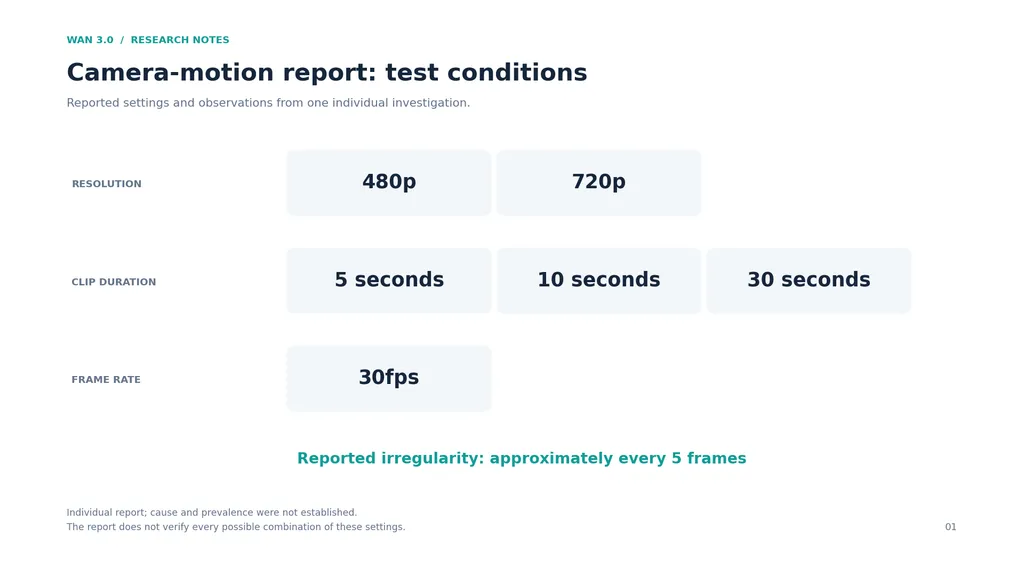
The case “Wan 3.0 camera motion stuttering / judder” describes uneven motion across 480p and 720p, five-, 10-, and 30-second outputs, and more than one access route.
The investigator reported irregular movement approximately every five frames in 30fps footage. Those details identify a testable symptom, but neither its cause nor prevalence was established.
A separate prompt-limitation case described scenery moving in the wrong direction outside a train and pursuer–target roles switching during a chase. These failures concern spatial relationships as much as appearance.
Watch normal playback first, then inspect the failure frame by frame. Simplify complex scenes to one movement or relationship before adding more action.
Reference errors differ from unusable completed videos
The Venice case “WAN 3.0 Reference Error” contains two distinct outcomes:
- Rejected requests displaying an invalid-parameters message and refund notice.
- Completed videos presenting character references sequentially.
One participant estimated the sequential-reference behavior occurred in approximately one out of every three or four videos, sometimes resolving on an unchanged retry. That remains an individual estimate.
Check the selected mode’s input requirements, clarify each reference’s purpose, and reduce the request to one reference and one action.
Record refunded errors separately from charged outputs that fail the brief. Combining them would distort both reliability and cost calculations.
Audio quality needs its own acceptance criteria
Feedback on a published launch demonstration included concerns about speech disappearing near the end and voices sounding detached from the scene.
These are viewing reactions, not independently reproduced generation tests. They cannot establish how often audio problems occur.
For dialogue or narrated scenes, check speech completion, speaker identity, synchronization, and the balance between voices and ambient sound. A visually acceptable clip can still require replacement audio. The positive Prime dialogue example supports testing the task while leaving voice quality as a separate decision.
Wan 3.0 Prime Review: Speed and Total Cost
What the matched Standard-versus-Prime test measured
The provider-community test “Wan 3.0 vs Video Prime: Same Prompt, Same Settings—What Does Prime Actually Save?” used the same prompt and seed, five-second duration, 480p resolution, 16:9 framing, and enabled audio.
Both jobs were submitted together.
Reported measurement | Standard | Prime |
|---|---|---|
First observed completion | 141.1 seconds | 86.7 seconds |
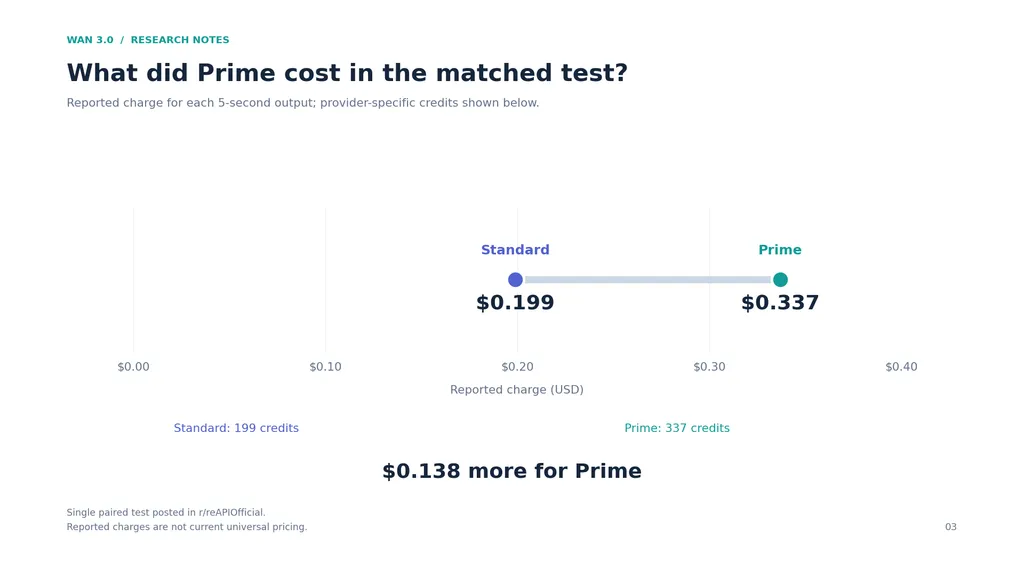
Provider credits | 199 | 337 |
Reported charge | $0.199 | $0.337 |
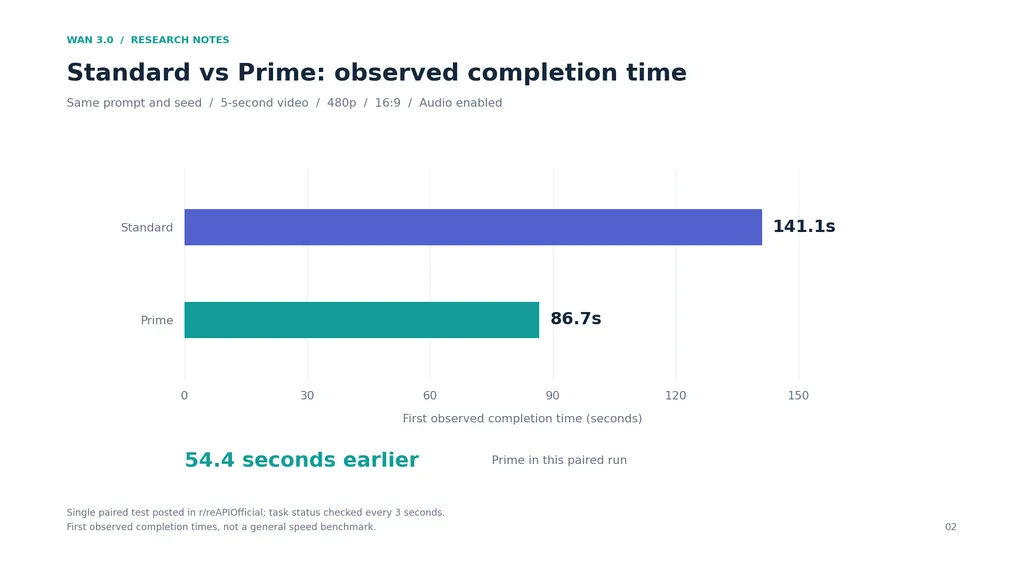
Prime was observed complete 54.4 seconds earlier, costing $0.138 more. Task status was checked every three seconds.
This was one paired test in r/reAPIOfficial, not a typical-speed benchmark or current price list. It does not demonstrate superior Prime image quality.
Earlier completion may matter during a live review. For unattended drafts, waiting time may have less practical value.
Retries and availability change the production budget
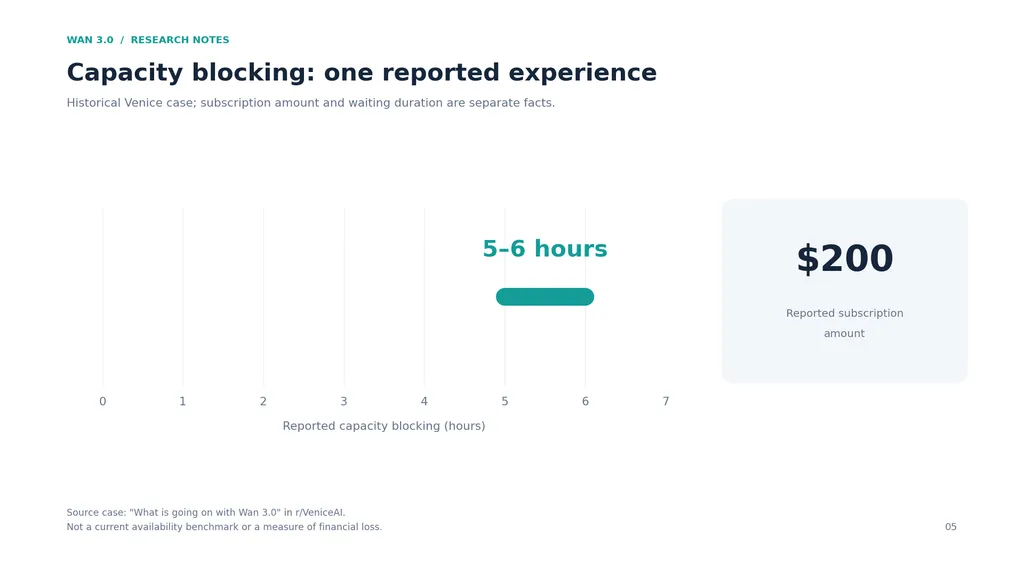
The Venice capacity case “What is going on with Wan 3.0” includes a reported $200 subscription alongside five to six hours of capacity-related blocking.
Another experience describes spending more than “1k tokens” on unsatisfactory results. The unit is unclear and cannot reliably be converted into dollars.
These are platform-specific experiences, not evidence of current universal behavior.
Cost per accepted clip equals total generation spend divided by accepted clips. Include charged retries, and track waiting and repair work separately. If none qualify, report the spend and zero accepted results.
The planning case “Local Wan 2.2 or Wan 3.0 API?” illustrates the scaling question. Its creator considered at least 10 minutes of animation assembled from five-second segments. It was a purchasing decision, not a completed production with a verified budget.
Is Wan 3.0 Worth Paying For Your Creative Workflow?
Wan 3.0 is worth a limited trial for detailed visual concepts and montage-based projects where planned transitions are acceptable. The collected evidence provides less confidence for uninterrupted demonstrations, exact product identity, and complex actions that must work consistently.
Your priority | Recommended decision |
|---|---|
Detailed concepts and planned montages | Run a limited trial against your brief |
Continuous camera movement | Test the entire required action |
Exact product or character identity | Inspect consistency throughout every clip |
Time-sensitive generation | Measure provider waiting and availability |
Offline control and privacy | Verify deployment options before committing |
Our review of user questions points to a consistent need: enough control to finish a specific shot without open-ended retries.
Use this evaluation sequence:
- Define acceptance criteria. Specify action, identity, style, camera behavior, and whether cuts are allowed.
- Record the setup. Retain provider, model identifier, mode, inputs, resolution, duration, and audio settings.
- Test the hardest requirement first. Prioritize continuity, product accuracy, or dialogue behavior.
- Keep unsuccessful outcomes. Record rejected requests and charged retries.
- Change one variable at a time. Separate prompt revisions from mode or provider changes.
- Compare accepted output and total effort. Include spend, waiting, and repair.
This produces evidence relevant to your workflow instead of relying on someone else’s best example.
Conclusion
Wan 3.0’s documented strengths make it worth exploring for detailed concepts, structured montages, and selected character scenes. Its difficult cases involve continuous movement, reference interpretation, and repeatable execution of complex actions. The most useful verdict is task-specific: choose it when it preserves the subject, completes the required action, and produces acceptable clips at a manageable total cost.
FAQ
Is Wan 3.0 worth paying for?
It can be worth a limited test when its documented strengths match your project. Start with the hardest requirement and track accepted clips, paid retries, waiting, and repair effort. The collected cases do not justify committing a large production budget based on showcase footage alone.
How can I generate a continuous 30-second Wan 3.0 video?
Use an unambiguous continuous-shot brief with one location, a clear camera path, and uninterrupted action. Avoid mixing it with a multi-shot editing plan. Reported attempts still encountered cuts, especially with references, so treat these instructions as a test approach rather than a guaranteed solution.
Why does Wan 3.0 reject references or show them sequentially?
The reviewed material includes request-validation errors and completed videos using references as separate segments. Their causes were not established. Check the selected mode’s input rules, clarify each reference’s role, and simplify the request. Keep refunded errors separate from charged outputs that fail your brief.
Is Wan 3.0 Prime better than Standard?
One matched test recorded earlier observed completion and a higher charge for Prime. It did not demonstrate better visual quality or instruction following. Evaluate speed and quality separately, using your provider’s actual conditions and your own acceptance criteria before deciding whether the premium is worthwhile.
Can I run Wan 3.0 locally?
We could not verify an official Wan 3.0 local release as of October 20, 2026. Our check of the official Wan-Video GitHub organization GitHub found public Wan 2.1 and 2.2 repositories, but no Wan 3.0 repository. Do not assume earlier local workflows apply; verify weights, licensing, and deployment instructions before buying hardware.