Nano Banana 2.1 vs FLUX 3: Image Editing Tested Over 40 Rounds
Vincent13 menit baca ·
FLUX 3 preserves image details better than Nano Banana 2.1 across published 40-round editing tests, showing significantly less editing drift. However, Nano Banana 2.1 completes more requested edits and delivers faster results in a separate evaluation. The better model depends on whether you prioritize image consistency or editing speed and instruction accuracy.
The biggest problem with AI image editing is unwanted changes during revisions. Product labels shift, character faces change, and approved backgrounds lose consistency. Repeated edits can make these problems worse, increasing manual corrections, production time, and costs.
Virse helps designers maintain control over complex AI image editing workflows. Its infinite canvas connects reference images, creative assets, and multiple AI agents in one workspace. With shared project context and memory for brand guidelines, teams can manage revisions, compare results, and maintain creative consistency.
Nano Banana 2.1 vs FLUX 3: Which AI Image Model Is Better?
FLUX 3 is a stronger candidate for repeated editing and preserving approved image details, while Nano Banana 2.1 performs competitively in product photography and instruction-focused edits.
Our review of published evaluations identifies five critical criteria: visual quality, prompt adherence, editing drift, character consistency, and production cost.
Design task | Research finding | Test first |
Photorealistic scenes | Better dawn lighting in one test | FLUX 3 |
New product photography | Better composition compliance | Nano Banana 2.1 |
Existing product editing | More accurate packaging preservation | FLUX 3 |
Repeated image editing | Lower non-target editing drift | FLUX 3 |
Edit instruction completion | Fewer missed changes in one evaluation | Nano Banana 2.1 |
Character consistency | Mixed evidence | Both |
Poster text rendering | Tie in one spelling test | Both |
Production cost | Depends on accepted outputs | Compare both |
What Did the Five Same-Prompt Tests Reveal?
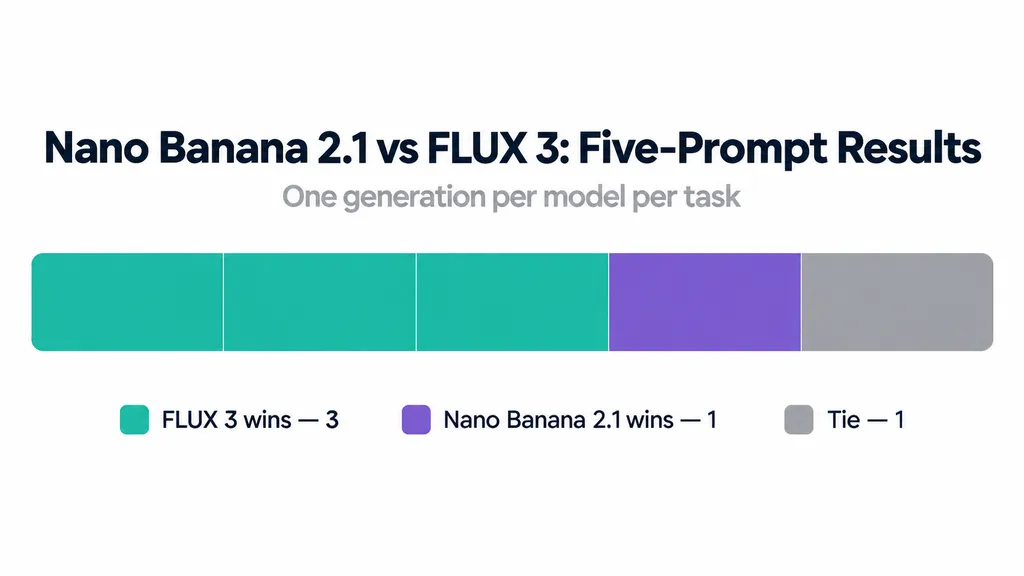
Fuser's October 6, 2026 comparison tested both models across five creative tasks using identical prompts and reference inputs, with approximately 2K output settings.
FLUX 3 was preferred for photorealistic scenes, existing-product editing, and reference-character likeness. Nano Banana 2.1 won the product photography task, while both reproduced the requested poster text correctly.
The result was three FLUX 3 wins, one Nano Banana 2.1 win, and one tie.
However, each task involved only one usable generation per model. These findings reveal possible task-specific strengths, not statistically reliable overall win rates.
Nano Banana 2.1 vs FLUX 3 Image Quality: Photorealism and Product Photography
Image quality involves more than realistic textures. Professional visual assets must also satisfy lighting, composition, product placement, and creative direction.
Case Study: Photorealistic Fisherman at Dawn
One comparison requested an elderly fisherman repairing an orange fishing net on a wooden dock at dawn.
The brief specified harbor mist, sharply focused hands, warm morning light, and a softly blurred background resembling a 50mm photograph.
FLUX 3 reproduced the requested dawn atmosphere and depth of field more closely. Nano Banana 2.1 generated a believable image, but its lighting appeared cooler and the background remained relatively sharp.
Design insight: Photorealism and prompt adherence are separate quality measures. An attractive image can still fail the intended art direction.
Case Study: Ceramic Coffee Dripper Product Photography
The product photography test requested a sage-green ceramic coffee dripper on a pale oak board, illuminated from the left with a right-facing shadow and empty space for advertising copy.
Nano Banana 2.1 reproduced the board, lighting direction, and negative space more accurately.
FLUX 3 generated a realistic product but placed it on a darker tabletop with less distinct directional lighting.
For e-commerce designers, accurate composition can be more valuable than additional visual detail because the final asset must satisfy an approved advertising layout.
FLUX 3 vs Nano Banana 2.1 Image Editing: Which Preserves Product Details?
FLUX 3 preserved existing product details more accurately in the reviewed single-image editing comparison. This matters because editing an approved product photograph is fundamentally different from generating a new image.
Case Study: LUMA 02 Serum Bottle Background Replacement
The comparison started with an amber serum bottle labeled LUMA 02, featuring a smooth black dropper cap.
Both models were instructed to place the bottle on a moss-covered river stone with morning sunlight and a blurred stream, while preserving the original packaging.
FLUX 3 maintained the bottle shape, label, glass, and smooth cap more accurately.
Nano Banana 2.1 preserved the general product identity but introduced unintended ribbing to the cap collar.
Although subtle, this change can misrepresent the physical product in commercial advertising.
How Should Designers Evaluate Product Fidelity?
A professional product editing review should separate three requirements:
- Geometry preservation: Shape, proportions, packaging structure, and materials.
- Brand preservation: Logos, labels, typography, and approved product colors.
- Edit completion: Whether the requested background or lighting modification succeeded.
The original product photograph should remain the approval reference throughout the editing process.
A successful edit changes what the designer requests without redesigning what was already approved.
FLUX 3 vs Nano Banana 2.1 Editing Drift: What Happens After 40 Edits?
Editing drift is the unintended alteration of image regions that should remain unchanged during successive revisions. It can affect background textures, colors, object positions, lighting, and character identity.
Three published experiments provide useful evidence about this problem, although their methods and metrics differ. These findings help explain the editing trade-offs between FLUX 3 and Nano Banana 2.1.
Case Study 1: Forty Editing Rounds Across Three Scenes
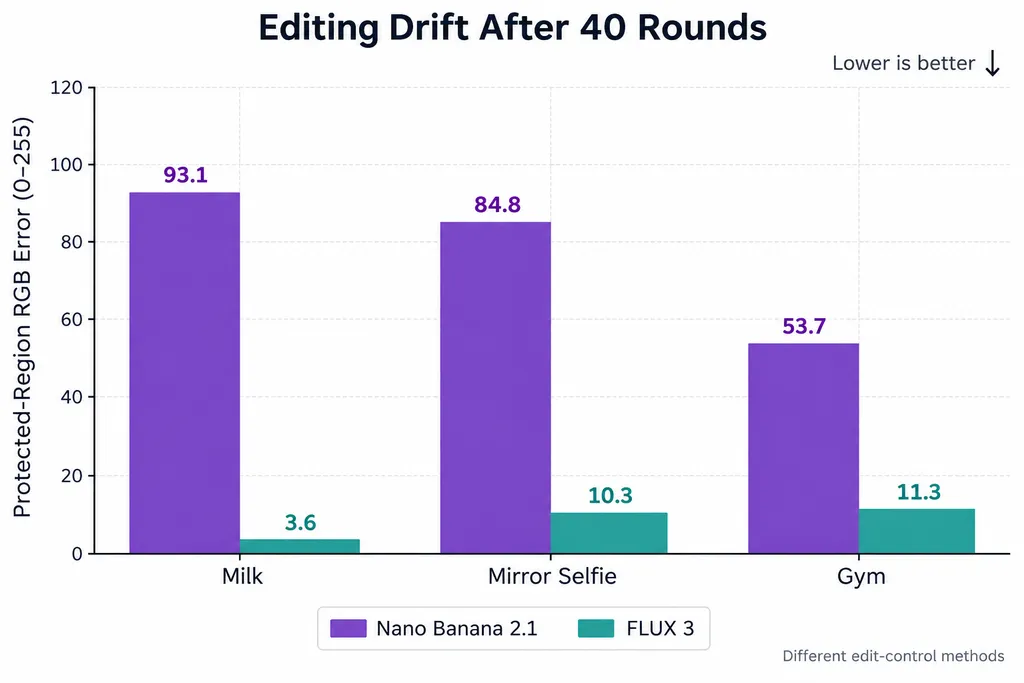
An October 2026 experiment tested 40 recursive edits on three images: a milk scene, a mirror selfie, and a gym.
Each output became the input for the next edit. The evaluation measured mean absolute RGB error in protected image regions after 40 rounds, using a 0–255 scale.
Lower values indicate less change in protected regions.
Scene | Nano Banana 2.1 | FLUX 3 |
Milk | 93.1 | 3.6 |
Mirror selfie | 84.8 | 10.3 |
Gym | 53.7 | 11.3 |
FLUX 3 demonstrated substantially lower drift in all three scenes.
However, FLUX 3 used coordinate-based bounding boxes and preservation anchors, while Nano Banana 2.1 received natural-language instructions through a different interface.
The experiment therefore evaluated two editing workflows rather than model performance under identical controls.
FLUX 3 also reportedly missed two requested modifications in the gym sequence.
Key finding: preserving the original image and successfully completing an edit are separate capabilities.
Case Study 2: The 480-Edit Benchmark
Morphed's October 7, 2026 evaluation compared four image editors across three photographs: a kitchen scene, a café scene, and a still-life arrangement.
Each image underwent 40 consecutive edits per model, producing 480 editing operations across 12 editing chains.
Mean background drift after 40 edits was:
Model | Mean RGB drift |
Ideogram 4.5 | 0.95 |
FLUX 3 | 5.64 |
GPT Image 2.5 Sunburst | 48.44 |
Nano Banana 2.1 | 100.48 |
FLUX 3 maintained substantially lower background drift than Nano Banana 2.1.
However, instruction completion revealed a different trade-off.
Nano Banana 2.1 had no clearly identified missed instructions across its 120 edits. FLUX 3 missed or weakly applied approximately five to seven modifications.
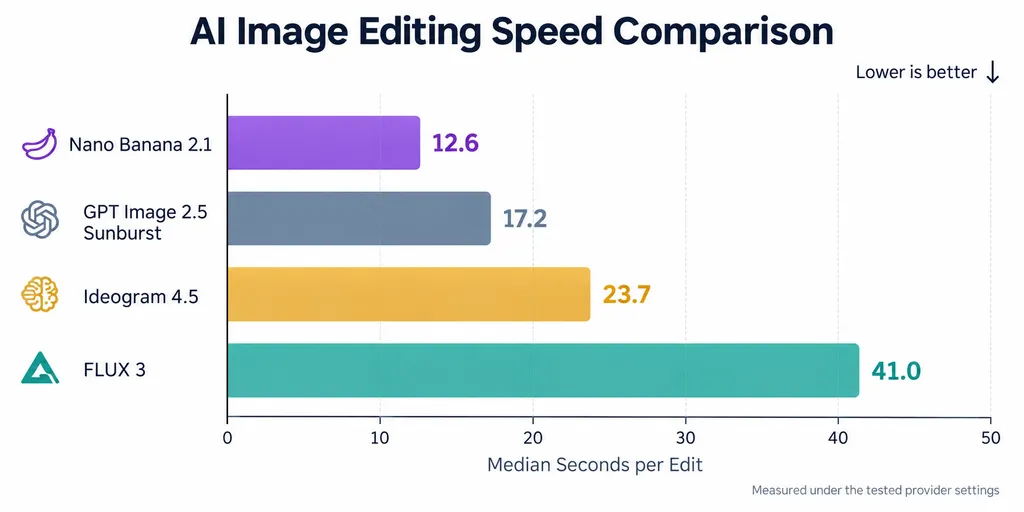
Median editing times also differed:
Model | Median time per edit |
Nano Banana 2.1 | 12.6 seconds |
GPT Image 2.5 Sunburst | 17.2 seconds |
Ideogram 4.5 | 23.7 seconds |
FLUX 3 | 41.0 seconds |
FLUX 3 encountered 14 timeout or server-error events, all resolved after retries.
These measurements reflect the provider settings and workload used in the experiment. Each editing chain was run once, so the results are not universal guarantees of model performance.
FLUX 3 preserved more background detail, while Nano Banana 2.1 completed more requested changes and generated results faster under the tested conditions.
Case Study 3: Thirty Café Changes Across Six Generations
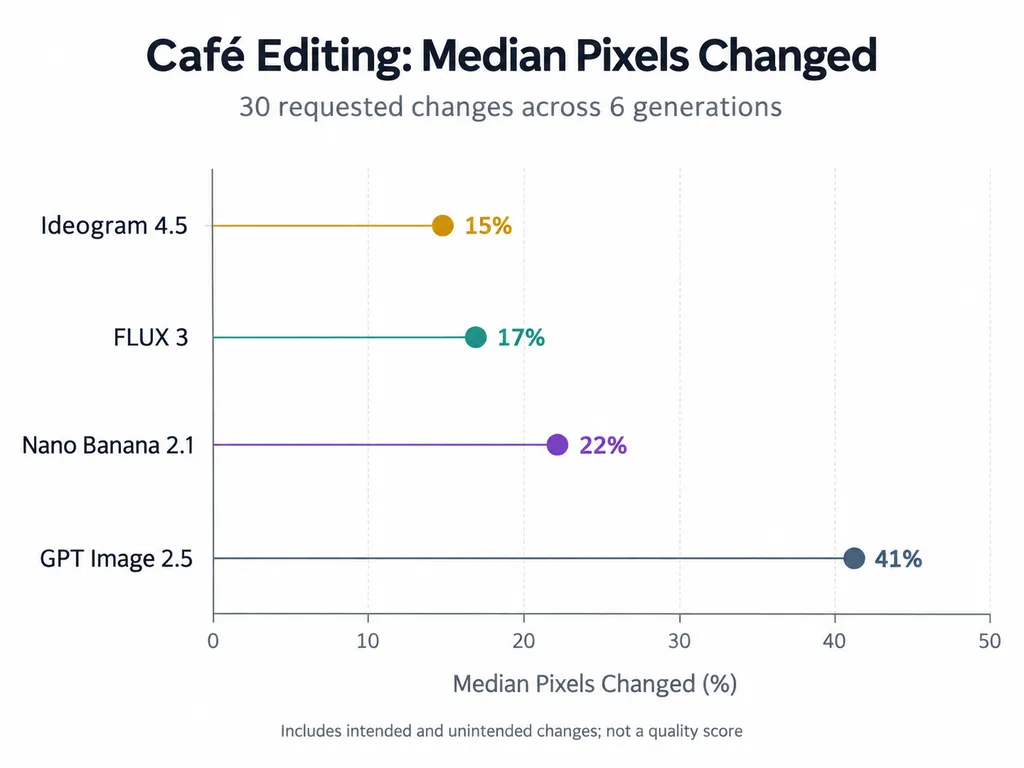
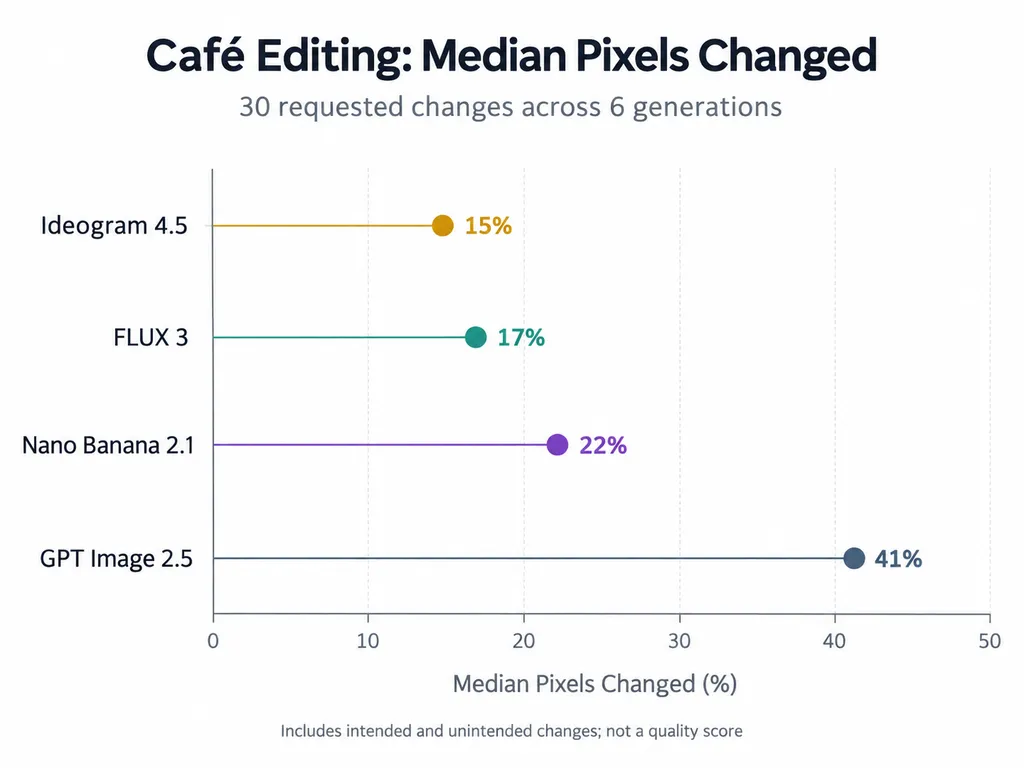
Another documented experiment started with an empty café and introduced 30 requested modifications grouped into six sequential generations.
Changes included adding furniture, installing an espresso machine, updating wall finishes, introducing signage, and transforming the scene into a rainy nighttime environment.
The median percentage of pixels changed during smaller editing steps was:
Model | Median changed pixels |
Ideogram 4.5 | 15% |
FLUX 3 | 17% |
Nano Banana 2.1 | 22% |
GPT Image 2.5 | 41% |
FLUX 3 changed fewer pixels than Nano Banana 2.1 in this particular workflow.
Some Nano Banana outputs also developed a warm or magenta color shift, potentially affecting the accuracy of approved interior finishes.
However, changed-pixel percentage includes intended modifications. It measures image change, not editing success.
This metric also differs from the accumulated RGB-error measurements in the 40-round experiments and should not be combined with them.
How Can Designers Reduce Editing Drift?
The most practical approach is version branching instead of continuous editing chains.
Rather than repeatedly modifying the latest result, create new revisions from an approved source whenever possible.
Separate major composition changes from smaller refinements, retain original color references, and review protected details after each significant edit.
This reduces the risk of accumulating unwanted changes regardless of the model.
Nano Banana 2.1 vs FLUX 3 Character Consistency: Which Maintains Identity?
Character consistency means preserving recognizable facial features and identity across different poses, environments, clothing, and lighting conditions.
The existing evidence for Nano Banana 2.1 does not establish a universal winner.
Case Study: The Rainy Bicycle Scene
One reference-based comparison used a portrait of a woman with curly copper-red hair, freckles, and round tortoiseshell glasses.
The task placed the same woman on a bicycle in a neon-lit rainy street.
FLUX 3 reproduced the hairstyle, freckles, glasses, and facial likeness more closely.
Nano Banana 2.1 created a believable scene, but some distinctive facial characteristics became less pronounced.
This single-scene result favored FLUX 3.
However, Google documents improved multi-turn character consistency for Nano Banana 2.1, including support for reference-based image generation.
Single-image likeness and consistency across an entire campaign are different evaluation tasks.
How Should Designers Test Character Consistency?
A meaningful evaluation should use the same approved character across at least five scenes, with multiple generations per scene.
Assess facial identity, distinctive features, pose accuracy, lighting, and visual style independently.
For brand mascots, storyboards, and recurring advertising characters, consistency across the complete series matters more than one convincing portrait.
FLUX 3 vs Nano Banana 2.1 Text Rendering and 4K Image Quality
Both models reproduced the requested wording in a same-prompt concert poster comparison, including the headline, event details, and website address.
FLUX 3 generated flat poster artwork, while Nano Banana 2.1 produced a more contextual presentation resembling a printed poster.
The test ended in a tie for spelling accuracy.
What Makes AI Text Rendering Production-Ready?
Professional typography requires more than correct spelling.
Designers must also evaluate visual hierarchy, spacing, alignment, readability, and layout accuracy.
A useful text-rendering test should include short headlines, URLs, numbers, and smaller multi-line text.
For production layouts, correct wording and usable typography should be evaluated separately.
Does 4K Resolution Guarantee Better Detail?
Google's official Nano Banana 2.1 documentation lists 1K, 2K, and 4K output resolutions and support for up to 14 reference images.
FLUX 3 also supports high-resolution output through compatible providers, although exact dimensions and editing controls depend on the endpoint.
Higher resolution does not automatically guarantee greater detail accuracy.
Product labels, skin textures, small typography, and material finishes still require inspection at the intended delivery size.
Nano Banana 2.1 vs FLUX 3 Pricing: Which Costs Less?
The cheapest model per generation is not necessarily the cheapest model per approved image.
Pricing varies across platforms, output resolutions, providers, and editing workflows.
Platform Pricing Comparison
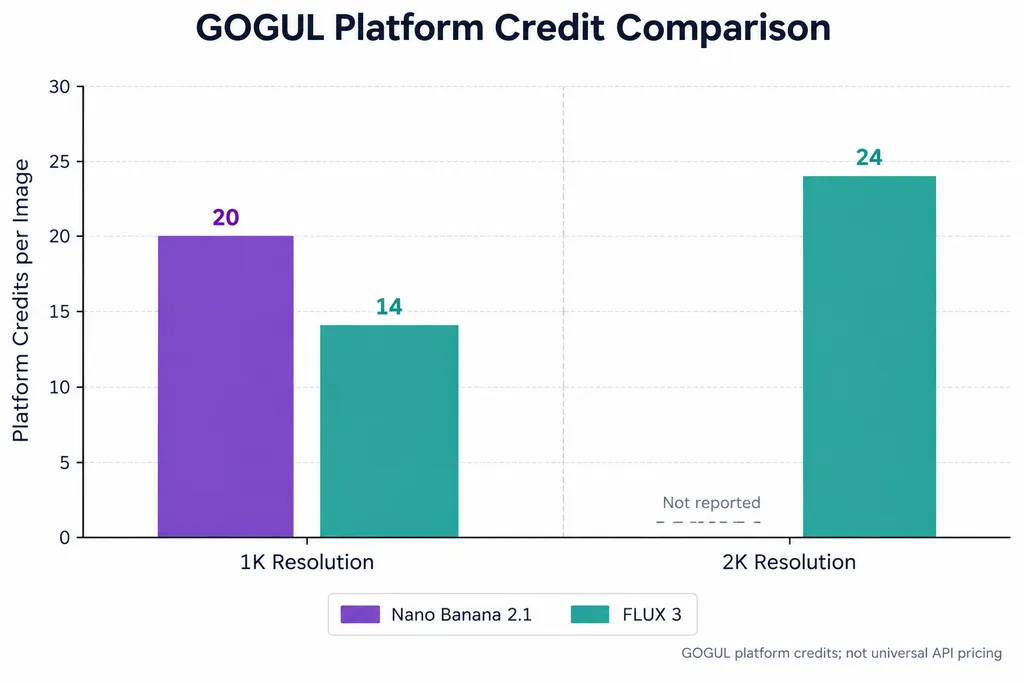
GOGUL's October 2026 comparison listed these platform-specific credit prices:
Model and resolution | Credits |
Nano Banana 2.1, 1K | 20 |
FLUX 3, 1K | 14 |
FLUX 3, 2K | 24 |
These are GOGUL credits, not universal API prices.
Fuser reported that FLUX 3 at 2K costs approximately twice as many internal credits as Nano Banana 2.1 at the same resolution.
Different credit systems cannot be compared directly without knowing their monetary value.
Why Cost per Accepted Image Matters
For commercial production, a more useful measure is:
Cost per accepted image = (Total generation costs + Manual correction costs) ÷ Accepted images
Total generation costs include initial attempts and retries.
A model with lower generation prices may become more expensive if its outputs repeatedly fail product, brand, or composition requirements.
Processing time also matters. In Morphed's evaluation, Nano Banana 2.1 completed individual edits faster than FLUX 3 under the tested conditions.
For production teams, compare actual provider charges, retry frequency, correction time, and accepted-output rates before choosing a model.
How to Choose Nano Banana 2.1 or FLUX 3 for Professional Design Workflows
The best model depends on the deliverable, the visual details that must remain fixed, and the number of revisions required.
For E-Commerce Product Photography
Nano Banana 2.1 is worth testing first for new compositions requiring precise lighting, subject placement, and advertising copy space.
FLUX 3 deserves priority when editing existing product imagery with strict packaging requirements.
Evaluate labels, product geometry, materials, and composition against approved references before delivery, especially when working to preserve design accuracy.
For Interior Design and Architecture
Interior design workflows often involve repeated changes to furniture, lighting, wall finishes, and spatial arrangements.
The café experiments demonstrate how background and color differences can accumulate, a common challenge with AI image editing drift.
Maintain an approved base image and create alternative revisions from that reference instead of continuously editing the latest output.
For Brand Characters and Campaigns
Test the same character across multiple environments, camera angles, and poses.
Keep identity references separate from editable elements such as clothing, lighting, and backgrounds.
Evaluate the complete series rather than selecting a model based on one successful portrait.
For Collaborative AI Design Workflows
Professional AI design workflows require more than individual image outputs.
Teams need to maintain creative references, compare alternatives, coordinate tasks, and preserve brand requirements across revisions.
A shared canvas helps organize these relationships and makes the creative process easier to review.
Virse supports this collaborative approach through an infinite canvas, multiple AI agents, shared project context, and long-term memory for design preferences. Designers can coordinate different creative tasks while retaining responsibility for direction, evaluation, and final approval.
The broader principle is to use AI for repetitive execution while keeping human judgment central to the creative process.
FAQ
Is FLUX 3 better than Nano Banana 2.1 for editing?
FLUX 3 is generally the stronger candidate for preservation-sensitive repeated edits, based on published editing drift experiments. Nano Banana 2.1 completed more requested modifications in one 120-edit evaluation. The better choice depends on whether the task prioritizes protecting existing details or reliably executing individual instructions.
Why does Nano Banana 2.1 change backgrounds or develop a magenta tint?
Repeated editing can introduce unintended changes to background textures, composition, and color balance. Some documented Nano Banana 2.1 editing sequences developed warm or magenta shifts, although the technical cause remains unverified. Keeping an approved original, checking colors, and branching revisions can help limit accumulated changes.
Which model is better for character consistency and 4K images?
FLUX 3 preserved facial likeness more closely in one reference-based comparison, but broader multi-scene evidence remains inconclusive. Nano Banana 2.1 supports 4K output and multiple reference images. Both models should be evaluated using consistent references and actual output details, rather than judging character identity or image quality from one sample.
Which is cheaper for product photography and repeated edits?
Pricing varies by provider, resolution, and credit system. FLUX 3 may cost less per generation on some platforms, while Nano Banana 2.1 demonstrated faster editing in one published benchmark. Cost per accepted image, including retries and manual corrections, is the more useful measure for commercial production.
Conclusion: Nano Banana 2.1 or FLUX 3?
Nano Banana 2.1 is a strong choice for detailed image generation, product photography, and individual editing instructions, while FLUX 3 demonstrates stronger preservation of existing details across repeated revisions. The published 40-round editing experiments consistently show lower background drift with FLUX 3, but also reveal trade-offs involving instruction completion and processing speed. Character consistency, text accuracy, and production cost remain dependent on the task and provider. For professional designers, the best approach is to evaluate both models against approved references and choose a workflow that maintains visual consistency, minimizes unnecessary rework, and keeps creative decisions under human control.