Nano Banana 2.1 Reddit Reviews: Is It Actually Better?
 Yifan Zhao11 menit baca ·
Nano Banana 2.1 Reddit reviews show a promising but uneven upgrade: realistic images and recognizable character features receive praise, while ignored prompts and unwanted changes remain recurring concerns. Our review of public discussions found no consistent verdict that it outperforms Nano Banana 2 across every task. Its value depends on whether you need an attractive first image, precise instruction following, or reliable revisions.
For designers, these differences affect delivery. A convincing portrait can still miss the requested pose. A polished product image can still alter packaging. An impressive showcase offers limited guidance if reproducing its quality requires repeated attempts.
Our research separates documented examples, reported experiences, and practical workflow recommendations. The central question is whether Nano Banana 2.1 can produce an image that satisfies your brief—and preserve what you approve when the brief changes.
What Do Nano Banana 2.1 Reddit Reviews Reveal?
The strongest finding is that image quality and creative control receive different assessments. Positive examples demonstrate appealing results, while negative discussions focus on requirements that the model allegedly overlooks or changes.
Evaluation area | Findings from the reviewed discussions | What remains uncertain |
|---|---|---|
Photorealism | Portrait showcases attract praise and scrutiny | Repeatability across ordinary attempts |
Character likeness | One comparison credits 2.1 with recognizable features | Consistency across poses and scenes |
Instruction following | Positive and negative experiences appear in the same launch discussion | Overall failure rate |
Prompt format | Detailed JSON prompts generate interest and disagreement | Whether format independently improves results |
Platform differences | Some contributors prefer Gemini app results to Flow | Whether settings or platform explain the difference |
Repeated editing | Preservation is a concern in the supplied research | Independently verified reliability across editing chains |
The distinction matters because each task has different acceptance criteria. Concept exploration allows more interpretation. A product label, approved character, or carefully arranged composition leaves less room for changes.
These discussions identify problems worth testing; they do not provide a representative satisfaction survey. Upvotes, enthusiastic titles, and forceful complaints cannot establish how frequently a result occurs.
Nano Banana 2.1 Image Quality: What Do the Case Studies Show?
Case Study: Realistic Character Features Versus Visual Appeal
An October 7 comparison in r/nanobanana used realistic interpretations of Handsome Squidward. The author considered Nano Banana 2.1 an improvement over 2.0 and credited it with capturing the character’s specific features, while still preferring another model’s overall appearance.
This is a useful example because it separates recognizability from aesthetic preference.
For a character-led campaign, an attractive face is insufficient if the distinctive proportions disappear. For an exploratory moodboard, atmosphere and composition may matter more.
The case supports a narrow conclusion: Nano Banana 2.1 preserved recognizable features effectively in that example. It does not establish a general character-consistency advantage or show how the character survives subsequent edits.
A practical evaluation should therefore ask:
- Are the defining facial proportions recognizable?
- Does the character remain identifiable in a different pose?
- Are distinctive accessories preserved?
- Does a requested change alter unrelated features?
Case Study: A Detailed Portrait Prompt Sparks a Format Debate
The “Nano Banana 2.1 goes crazy” showcase in r/GeminiAI included a lengthy JSON prompt describing the subject, framing, lighting, and photographic qualities.
The discussion included praise for realism alongside criticism of lighting and individual details. It also raised a more useful question: did the result benefit from the information in the prompt, its JSON structure, or the selection of a successful output?
The thread does not isolate those variables. It also does not establish the number of rejected generations, time to approval, or repeatable success rate.
For designers, the transferable lesson is to extract the visual brief:
Prompt component | What it controls |
|---|---|
Subject description | Identity, appearance, clothing |
Composition | Framing, viewpoint, subject placement |
Lighting | Direction, softness, atmosphere |
Material detail | Skin, fabric, surface appearance |
Exclusions | Unwanted objects or stylistic effects |
A detailed showcase is a source of prompting ideas, not evidence of predictable production performance.
Nano Banana 2.1 Prompt Following: Why Are Reviews So Divided?
Conflicting Experiences Appear Within the Same Discussion
The launch discussion in r/singularity contains opposing assessments: one contributor described regression, another reported substantially better results, and another described improvement in the Gemini app with extended thinking enabled.
A participant also requested concrete examples supporting the complaints.
Our research supports the existence of disagreement, but not a single explanation for it. Different tasks, references, settings, and expectations could contribute; the discussion does not establish their individual effects.
For an actionable comparison, save the complete brief and identify the exact failure. “The model ignored me” becomes more informative when expressed as:
- The requested pose was absent.
- The clothing changed unexpectedly.
- Required text was omitted.
- An approved background was replaced.
These categories are recommended review criteria, rather than measured frequencies from the threads.
A Beautiful Output Can Still Be an Incorrect Output
For commercial work, assess three dimensions separately:
Dimension | Acceptance question | Example |
|---|---|---|
Visual quality | Does the image look convincing? | Materials and lighting appear coherent |
Instruction completion | Did it perform the requested task? | The subject adopts the specified pose |
Detail preservation | Did protected content remain intact? | The original label remains unchanged |
Consider a product image that needs a new background. If the model also redesigns the packaging, visual improvement does not make the result acceptable.
The relevant standard is successful completion of the brief. This explains why a model can receive enthusiastic reactions from image explorers and frustrated reactions from people working within fixed constraints.
Nano Banana 2.1 JSON Prompts: Do They Actually Improve Results?
What the Portrait Case Can—and Cannot—Establish
The portrait discussion contains competing claims about JSON and natural-language prompting. It does not provide a controlled, repeated comparison showing that JSON independently improves Nano Banana 2.1 image quality.
Our review found no basis for treating JSON as a required quality setting.
Structured fields can still be useful. A team can maintain a consistent template for subject, composition, lighting, and exclusions, then inspect which fields change between versions.
That is a workflow advantage. It should be evaluated separately from image quality.
A Practical Prompt Comparison
For a fair test, express the same requirements in both formats. Keep the references, platform, and available output settings consistent.
An illustrative natural-language brief could read:
Create a natural indoor portrait with soft window light from the left. Preserve visible skin texture and a relaxed expression. Use a neutral background. Avoid beauty-filter smoothing and additional accessories.
This is a suggested test prompt, not a prompt validated by the reviewed examples.
Compare the results against the same checklist. If one prompt includes more information, the test cannot isolate format. If only the best output is retained, it cannot establish reliability.
Choose a format that makes the brief easier to maintain, then judge the generated images independently.
Nano Banana 2.1 in Gemini vs Flow: Can the Platform Explain Different Reviews?
What the Available Experiences Suggest
The portrait discussion includes a report of better perceived quality in the Gemini app than in Flow. The launch discussion also includes a positive account associated with extended thinking.
These observations justify further comparison, but they do not prove that Gemini inherently generates better images or that extended thinking fixes instruction failures.
Platform claims become difficult to assess when the model label, settings, references, or conversation history differ.
How to Make a Useful Platform Comparison
Record the conditions before drawing conclusions:
Variable | What to document |
|---|---|
Model | Exact model label displayed |
Platform | Gemini app, Flow, or another interface |
Inputs | Prompt and original reference files |
Settings | Available thinking and output options |
Context | Fresh request or continuing conversation |
Selection | All outputs and reasons for rejection |
For example, comparing a fresh generation in one interface with a heavily revised conversation in another introduces an additional variable.
Treat a platform preference as a finding about the tested setup until repeated comparisons support a broader conclusion.
Nano Banana 2.1 Editing Consistency: What Can We Learn From the Reported Tests?
The 30-Edit Café Comparison
The supplied research describes a platform-community comparison involving 30 consecutive edits to a café scene. Each model reportedly started with the same image and continued from its previous output.
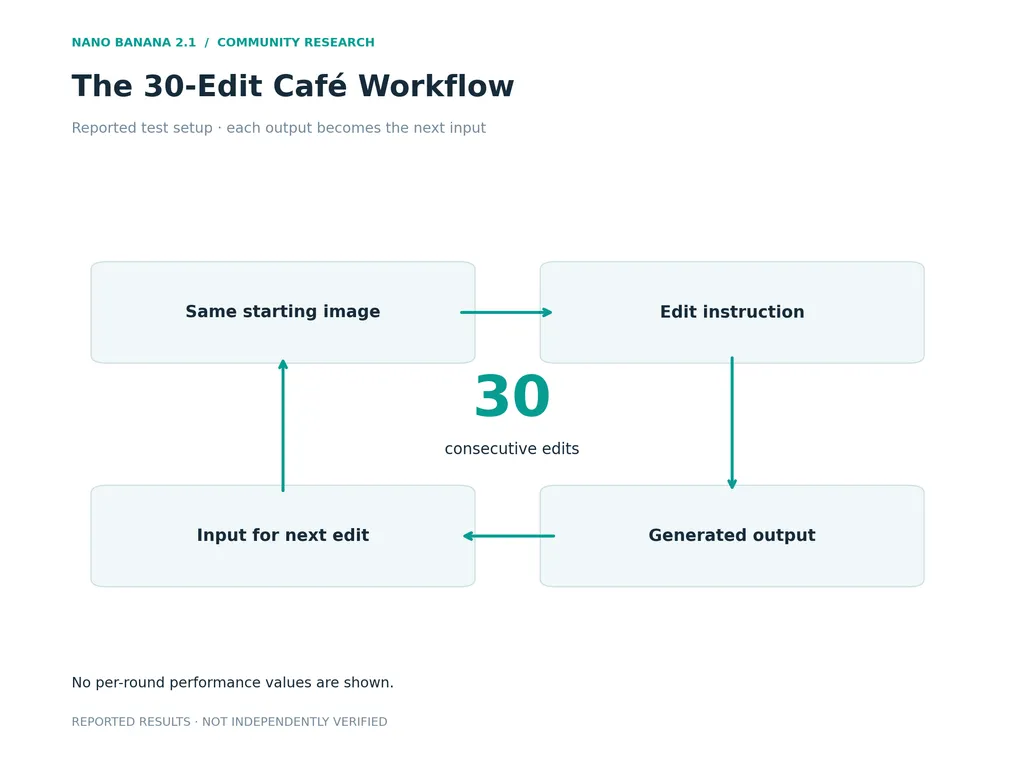
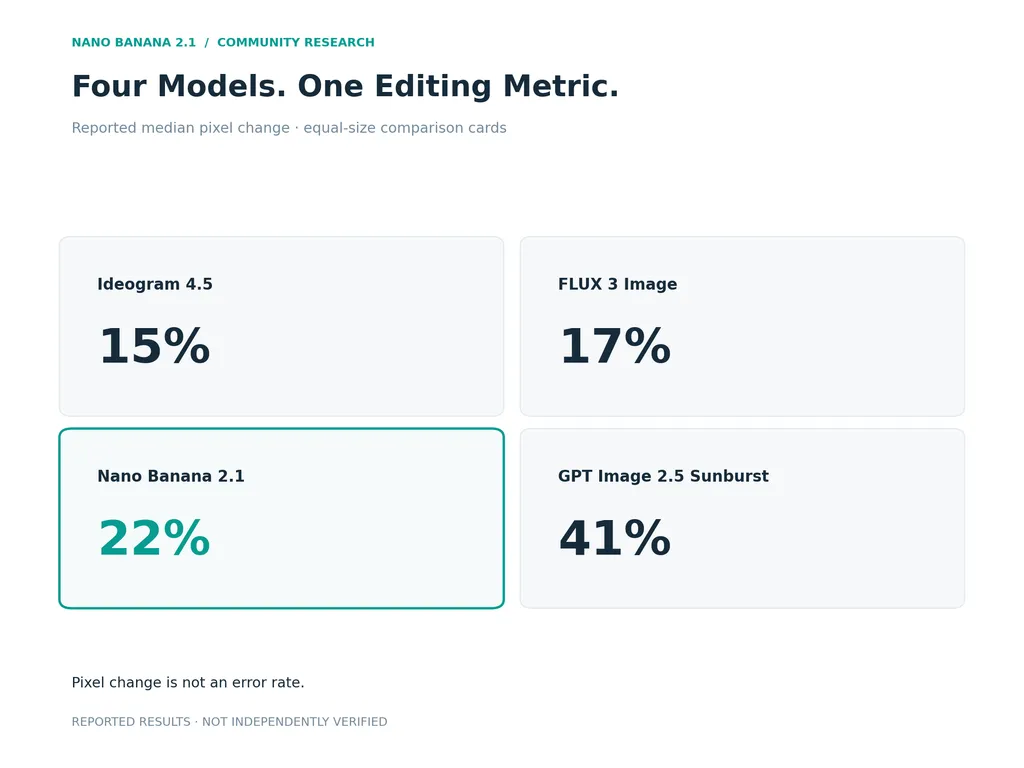
The reported median pixel-change proportions for small edits were:
Model | Reported median pixel change |
|---|---|
Ideogram 4.5 | 15% |
FLUX 3 Image | 17% |
Nano Banana 2.1 | 22% |
GPT Image 2.5 Sunburst | 41% |
These figures remain unverified in this review because the original test page could not be retrieved. They should not be treated as an independently confirmed benchmark or used to establish an overall ranking.
Even if reproduced, pixel change requires interpretation. A larger changed area may reflect unwanted redraws, necessary lighting adjustments, or successful completion of a broader instruction. Pixel change is not an error rate.
The useful research question is whether changes occurred outside the intended region—and whether they damaged approved content.
The Reported Character Duplication Case
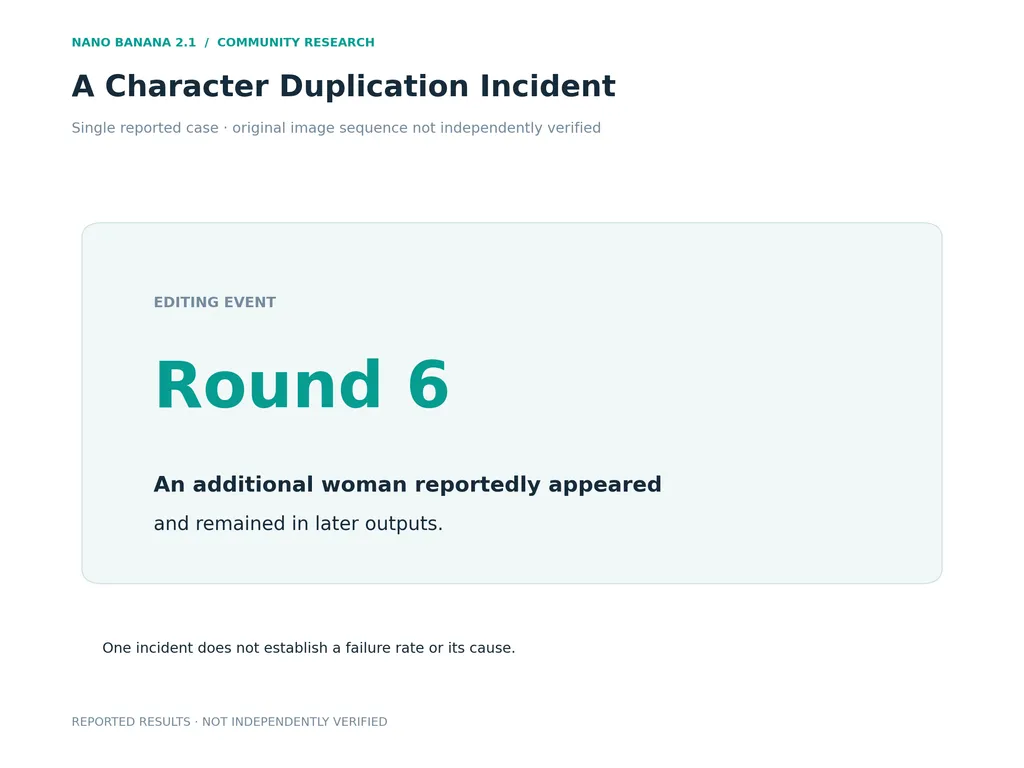
The supplied material also describes an editing-chain report in which an additional woman appeared at round six and remained in subsequent outputs.
The original image sequence could not be checked here, so this remains an unverified reported case. It cannot establish the frequency or cause of character duplication.
It does, however, illustrate an important acceptance criterion: check object and character counts after every consequential edit.
If an unintended addition enters the next reference image, later instructions may preserve it. Returning to the last approved version is therefore a sensible workflow safeguard, although the reviewed material does not measure its effectiveness.
How to Evaluate Your Own Editing Chain
Use a fixed starting image and distinguish:
- Requested changes: what should be different.
- Protected details: what must remain identical.
- New errors: what appeared unexpectedly.
- Recovery effort: what it takes to restore an acceptable result.
For product photography, inspect packaging and geometry. For character work, inspect identity and clothing. For interiors, inspect layout and perspective.
Nano Banana 2.1 Review: How Should Designers Decide Whether to Switch?
Evaluate the model against the work you actually need to deliver. The reviewed examples are more useful for building a test plan than making a universal buying decision.
Workflow | Priority | Useful test |
|---|---|---|
Portrait concepts | Appearance and visual direction | Compare ordinary attempts |
Character imagery | Recognizable identity | Change pose while preserving features |
Product photography | Packaging and geometry | Request a background-only change |
Marketing graphics | Exact content and arrangement | Check wording and required elements |
Repeated revisions | Preservation and recoverability | Track changes against approved versions |
Keep rejected outputs in the evaluation. Record generation expenses, review time, and manual correction effort.
Effort per approved asset is more useful than the attractiveness of the best sample. This is a recommended production measure; the reviewed discussions do not provide enough data to calculate it.
Conclusion: What Is the Verdict on Nano Banana 2.1 Reddit Reviews?
Nano Banana 2.1 shows promising image quality, but the reviewed feedback does not establish consistently better creative control. Character and portrait examples provide reasons to try it, while conflicting accounts of prompt adherence justify testing it against explicit requirements. Repeated-editing figures in the supplied research remain provisional and should not decide the comparison alone. For designers, the strongest evaluation combines visual quality, instruction completion, preservation of approved details, and effort per accepted asset.
FAQ
Is Nano Banana 2.1 better than Nano Banana 2?
It performs better in some reported examples, including one realistic-character comparison, but the reviewed discussions contain conflicting experiences. There is no representative success rate establishing a universal improvement. Test both against equivalent briefs, and assess image appearance separately from instruction completion and preservation.
Why does Nano Banana 2.1 ignore parts of my prompt?
Our review of user questions found recurring concerns about instruction following, but no single verified cause. Save the complete prompt and identify the missing requirement. A narrower request can help investigate the failure. Repeated tests are needed before attributing the problem to a particular setting or platform.
Do JSON prompts work better for Nano Banana 2.1?
The reviewed material does not establish a consistent quality advantage. JSON can help organize reusable fields, while natural language can make manual revisions easier. Compare equivalent information under the same conditions. Otherwise, improvements may come from added detail rather than formatting.
Does Nano Banana 2.1 preserve characters during repeated edits?
The reviewed evidence is insufficient to establish reliable performance across editing chains. One positive character example demonstrates recognizable features in a particular output. It does not prove identity preservation over subsequent changes. Evaluate likeness, clothing, character count, and composition after each important revision.
Is Nano Banana 2.1 better in Gemini or Flow?
Some reviewed comments prefer Gemini app results, but they do not establish a controlled platform advantage. Our review of user questions suggests that settings, model identification, and reproducibility deserve attention. Compare the same inputs, record the available options, and retain rejected outputs before deciding which setup works better.