Kling 4.0 vs Seedance 2.5: Quality, Motion & Real Tests
Vincent13 menit baca ·
Kling 4.0 is a stronger starting choice for sharp cinematic visuals and high-impact action, while Seedance 2.5 is particularly promising for natural acting, realistic dialogue, and character-driven storytelling. Our review of published side-by-side comparisons found no clear overall winner. Kling stood out for dramatic movement and visual detail, while Seedance received more favorable assessments for human expressions, handheld footage, and scene continuity.
The real challenge is producing footage you can actually use. Both models can miss important actions, add unwanted dialogue, change a character's appearance, or distort product details. These mistakes become expensive when every failed generation consumes credits, making Seedance 2.5 pricing and retry costs important considerations. The better model isn't necessarily the one that looks more impressive—it's the one that delivers usable footage with fewer costly retries.
That's where Virse can make your creative workflow easier. Bring visual references, generated assets, and creative decisions together through a connected AI design workflow on one shared AI canvas instead of juggling separate tools. Paid plans offer unlimited use across a broad selection of included AI models and unlimited team seats, giving creative teams more freedom to explore and refine visual directions. Sign up to receive starter credits and experience a more connected creative workflow.
Kling 4.0 vs Seedance 2.5: Which Is Better Overall?
Choose Kling 4.0 when cinematic impact and dramatic physical action matter most. Start with Seedance 2.5 when natural character performances, dialogue, and scene continuity are the priority.
Our review of user questions and published comparisons suggests that performance depends more on individual scene requirements than on a universal quality ranking.
Kling 4.0 vs Seedance 2.5 Feature Comparison
Feature | Kling 4.0 | Seedance 2.5 |
Visual sharpness | Crisp details and strong contrast | Natural-looking images in some tests |
Human realism | Cinematic, sometimes stylized | Favorable reports for expressions |
Action scenes | Strong dramatic movements | Promising dynamic staging |
Prompt adherence | Occasional missed actions or extra dialogue | Competitive, but errors remain |
Character consistency | Reference-dependent | Favorable multi-shot observations |
Dialogue | Mixed results | Stronger acting in several examples |
Handheld footage | Polished cinematic appearance | More natural documentary feel |
Product advertising | Strong visual potential | Strong visual potential |
Cost efficiency | No verified advantage | No verified advantage |
These observations reflect published comparisons, not measured model-wide success rates.
Video Duration, References, and Generation Controls
Both models support longer AI video workflows, but their control systems emphasize different creative requirements.
Kling 4.0 offers native generation from 3 to 30 seconds, with support for up to 10 keyframes in applicable workflows. Its controls are useful when creators need to guide important visual moments, character actions, or camera transitions.
Seedance 2.5 reference workflows support multimodal references and generation workflows reaching 30 seconds, with capabilities designed around maintaining context across characters, environments, and audiovisual elements.
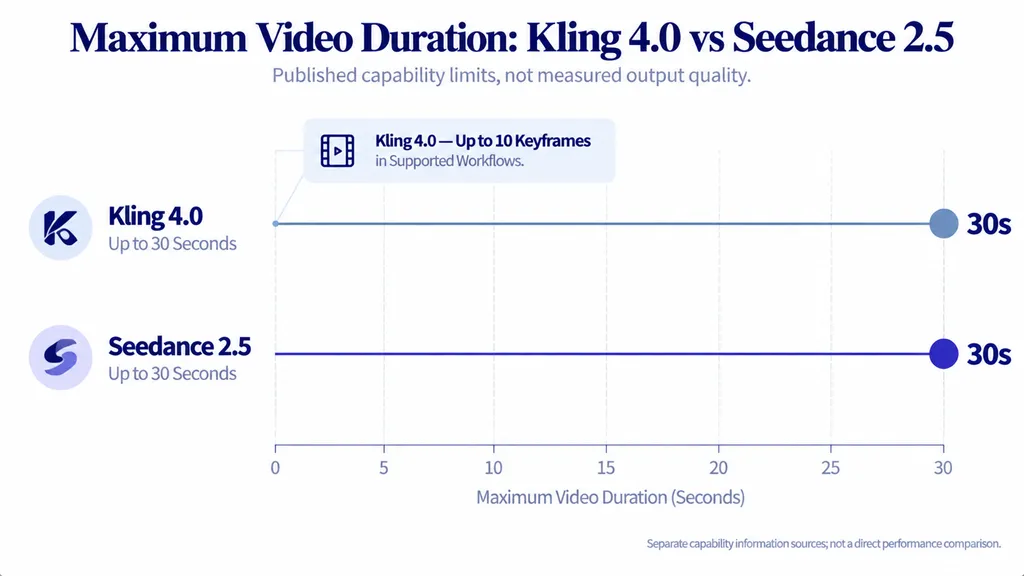
The practical difference is how creators direct a scene.
Kling's keyframe controls are useful for defining specific visual moments. Seedance's multimodal reference workflow is attractive for character-driven scenes involving multiple connected elements.
Available settings can vary by platform, model version, and generation mode. Kling 4.0 Flash should not automatically be treated as identical to the full Kling 4.0 model; compare its capabilities with the Kling 4.0 vs. 3.0 overview when choosing a version.
Real Case: 32 Seconds Across 8 Planned Shots
One of the most informative comparisons in our research involved a Halloween-themed office comedy.
The creator used identical prompts, character references, location sheets, and generation settings.
Both models were evaluated at 720p, 16:9, with audio enabled.
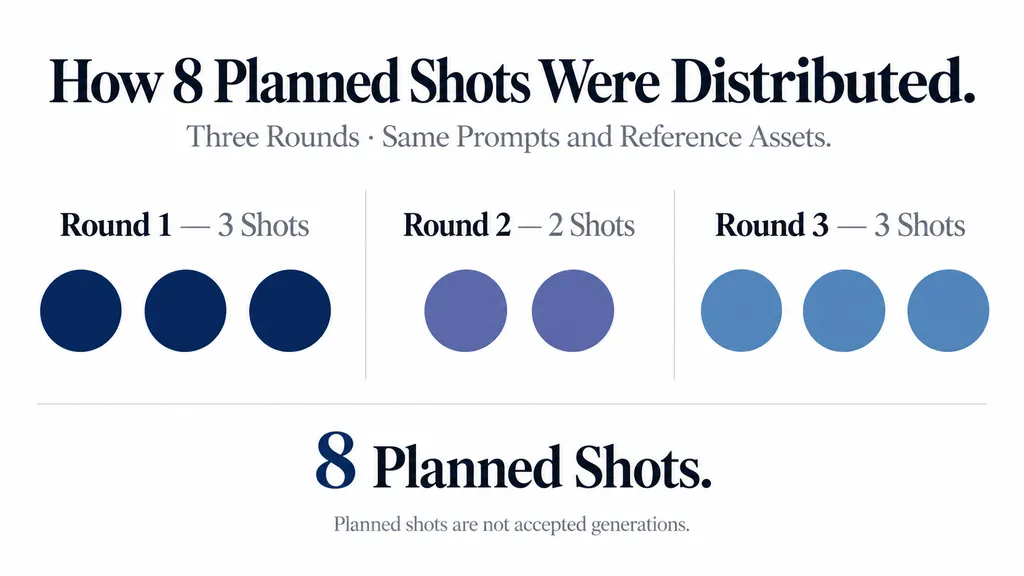
Round | Duration | Planned Shots | Main Challenge |
1 | 10 seconds | 3 | Character introduction |
2 | 10 seconds | 2 | Physical action and reactions |
3 | 12 seconds | 3 | Dialogue and continuity |
Total | 32 seconds | 8 | Multi-shot storytelling |
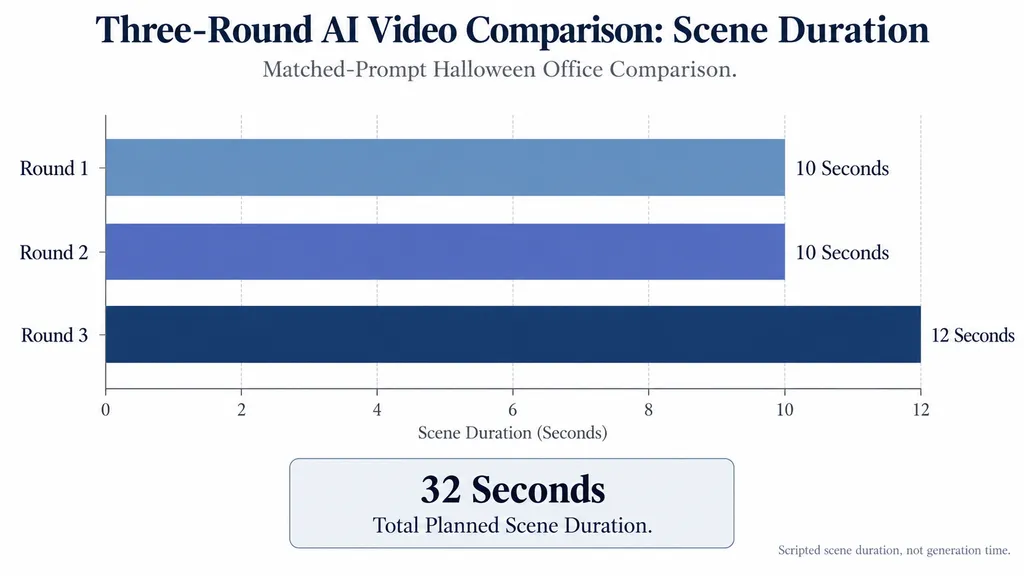
The 32 seconds represent scripted scene durations, not rendering time. The eight shots are planned shots, not accepted generations.
The independently reported results showed complementary strengths.
Kling delivered stronger visual impact during certain physical actions. Seedance produced more convincing character reactions and handheld-style footage.
Neither model was preferred in every round.
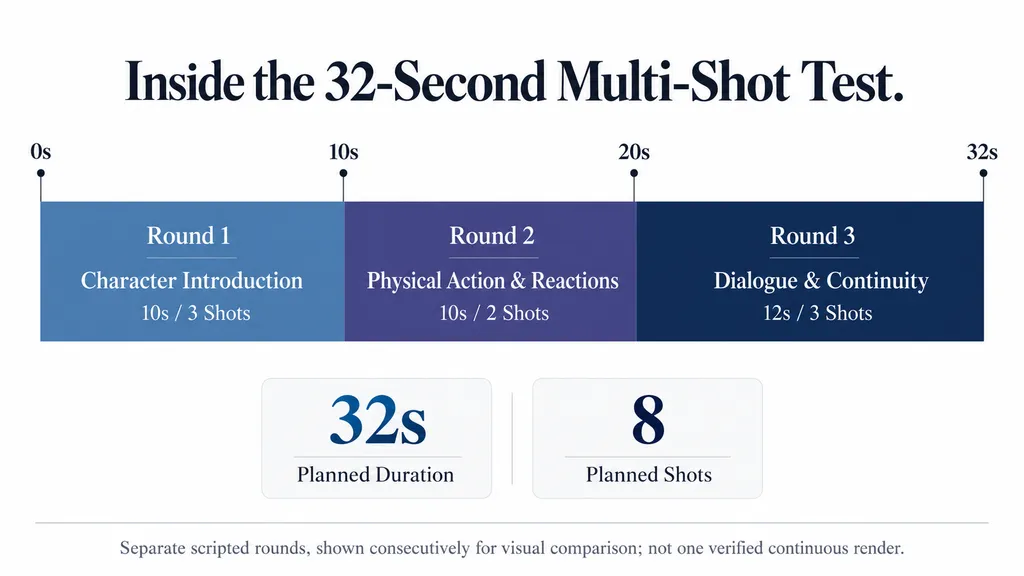
The key lesson is that a model can win an action shot and lose the next dialogue scene within the same project.
Our analysis is based on the published comparison and its described conditions, not an original controlled benchmark conducted by our team.
Which Model Produces Better Video Quality and Realism?
Seedance 2.5 received more favorable human-realism assessments in several reviewed comparisons, while Kling 4.0 was praised for sharp-looking textures, stronger contrast, and cinematic presentation.
However, visual fidelity and believable realism are different qualities.
Faces, Expressions, and Natural Acting
A realistic character needs more than detailed facial features.
Eye movement, facial expressions, posture, and reactions must match the surrounding action.
In the Halloween office comparison, Seedance was preferred for natural-looking character behavior, particularly during conversations and group reactions.
Kling generated polished visuals, but stronger cinematic presentation did not always translate into more believable acting.
This distinction matters for interviews, character-driven films, lifestyle advertisements, and documentary-style footage.
For example, an employee reacting to unexpected news should display a believable emotional response rather than simply maintain a detailed face.
For storytelling, natural reactions can matter more than image sharpness.
Lighting, Color, and Handheld Camera Movement
Kling received favorable assessments for dramatic contrast, crisp textures, and polished visual presentation.
Seedance was preferred in some comparisons for softer lighting and handheld-camera movement resembling everyday recording.
However, the findings were not unanimous.
One dialogue-focused comparison favored Kling's lighting while preferring Seedance's conversational performance.
This suggests that lighting, acting realism, and camera authenticity should be evaluated independently.
For a luxury fashion commercial, Kling's cinematic aesthetic may better fit the creative direction.
For a casual smartphone-style testimonial, Seedance may provide a more suitable starting point.
The best-looking video is the one that matches the intended visual style—not necessarily the one with the strongest contrast.
Kling 4.0 vs Seedance 2.5: Which Handles Motion and Physics Better?
Neither model has demonstrated consistent superiority across every physical action. Kling performed well in certain dramatic movements, while Seedance received favorable assessments for action staging and natural transitions.
Real Motion Tests: Fighting, Jumping, and Physical Contact
Our research included a forest-fighting comparison involving movement around a tree, throwing actions, and jumping.
The assessments were mixed.
Some preferred Kling's animation and visual impact. Others considered Seedance's physical staging more convincing.
Another example involved wrestling-style choreography, including a diving movement and interaction with a referee.
Kling received favorable feedback for specific large physical actions.
These examples show why motion quality should be evaluated by task.
Motion Type | What Determines Success |
Running | Foot placement and balance |
Jumping | Takeoff, trajectory, and landing |
Fighting | Physical contact and reactions |
Throwing | Momentum and object movement |
Camera tracking | Smoothness and framing |
Complex sequences | Correct action order |
A convincing jump can still fail if the landing is physically incorrect.
A fight scene may contain impressive movement but omit an essential action.
For action-heavy projects, evaluate the complete sequence rather than individual impressive frames.
Prompt Adherence: When Beautiful Footage Becomes Unusable
Another reviewed comparison revealed an important dialogue issue.
Kling generated an additional spoken response that the prompt did not request.
Although the footage contained convincing visual elements, the unexpected dialogue changed the intended interaction.
This illustrates the difference between understanding a scene and following an exact script.
Consider this production brief:
Scene: A detective enters a dark office.
Action: He picks up a folder, examines it, and places it back on the desk.
Camera: Static medium shot.
Audio: Quiet room ambience.
Restrictions: No dialogue, additional characters, or camera cuts.
The output fails if the detective speaks, skips an action, or changes the camera angle.
Seedance can also produce instruction errors. The available evidence does not establish which model has a lower overall prompt-failure rate.
For improved control, separate prompts into scene description, character, ordered actions, camera, audio, and restrictions, following a structured Seedance 2.5 prompt guide where relevant.
Complex choreography may benefit from smaller, individually directed shots.
Which Model Maintains Better Character and Scene Consistency?
Seedance 2.5 showed promising continuity in some reviewed multi-shot comparisons, but neither model guarantees stable character identities or environments across generations.
Reference preparation remains essential for longer projects.
Face Drift, Clothing Changes, and Character References
Character drift becomes especially noticeable when generated clips are edited together.
Common problems include changing facial proportions, hairstyles, accessories, and clothing details.
In the Halloween office case, the creator prepared turnaround sheets for recurring characters and used consistent location references.
An additional close-up facial portrait was recommended to strengthen identity guidance.
Reference Asset | Main Purpose |
Facial portrait | Preserve identity |
Side-profile image | Maintain facial structure |
Full-body reference | Preserve clothing and proportions |
Character turnaround | Support different viewpoints |
Location sheet | Maintain environmental consistency |
A practical approach is to prepare these assets before generation and reuse them across related scenes.
References cannot eliminate drift, but they provide a clearer visual target than text descriptions alone.
Background Continuity Across Cuts
Character consistency is only part of the challenge.
Another reviewed comparison highlighted background vehicles behaving differently between connected shots.
Cars that appeared to be moving in one scene could become stationary in the next.
These inconsistencies may seem minor when reviewing clips separately but become obvious during editing.
For multi-shot production, inspect character identity, clothing, object positions, background movement, lighting direction, and location layout.
A consistent character cannot rescue a scene if the surrounding environment changes unexpectedly.
This matters particularly for episodic stories and recurring branded characters.
Which Is Better for Dialogue, Storytelling, and Product Videos?
Seedance 2.5 is a promising starting choice for natural dialogue and character-driven storytelling. Kling 4.0 remains competitive for dramatic commercial visuals.
Both require additional quality checks when audio accuracy or product details determine whether footage is usable.
Dialogue, Lip Sync, and Unwanted Audio
Several reviewed examples favored Seedance's conversational acting and character reactions.
However, audio control remains imperfect.
Our research identified cases involving unexpected dialogue and unwanted background music.
Audio Requirement | Possible Error |
Dialogue accuracy | Extra or missing words |
Speaker identity | Incorrect character speaking |
Lip sync | Mouth movement mismatches speech |
Background audio | Unwanted music or sounds |
Emotional delivery | Voice does not match the scene |
A video can look realistic and still fail because the spoken lines differ from the script.
For dialogue-heavy projects, evaluate the soundtrack independently before accepting a shot.
These examples do not establish statistically reliable audio-error rates for either model.
Product Advertising: The Beverage-Can Case
A commercial-production comparison evaluated several AI video models, including Kling 4.0 and Seedance 2.5, using a beverage-can advertisement.
The evaluation examined:
- Condensation on metal surfaces.
- Realistic reflections.
- Finger interaction with the pull tab.
- Packaging and label stability.
- Plausible movement during opening.
These details determine whether a generated advertisement is commercially acceptable.
Imagine a beautifully lit beverage commercial where a finger passes through the pull tab.
The shot may look impressive but cannot be approved.
Another generation might execute the opening action correctly while changing the product label.
For product advertising, brand consistency and object accuracy can matter more than cinematic polish.
The available comparison did not establish a reliable overall winner.
Short Films: The 30-Second Story Case
Another case involved a creator using a real dog photograph and character references to develop a 30-second story.
The goal was to expand it into a film lasting approximately 3–5 minutes.
The short sample reportedly delivered promising storytelling and audio, but production expense remained a concern.
The completed longer film and final costs were not documented.
This illustrates a practical limitation of AI filmmaking.
Every additional scene creates more opportunities for character drift, incorrect actions, audio errors, and repeated generations.
For longer stories, shot-based production with consistent references is generally more manageable than relying on one complicated generation request; the Seedance 2.5 workflow guide offers a related workflow perspective.
Kling 4.0 vs Seedance 2.5: Which Costs Less per Usable Video?
Neither model has a verified advantage in cost per usable video. Official pricing provides a useful starting point, but generation settings, subscription terms, and failed attempts make direct cost comparisons difficult.
Official Pricing: What Can We Actually Compare?
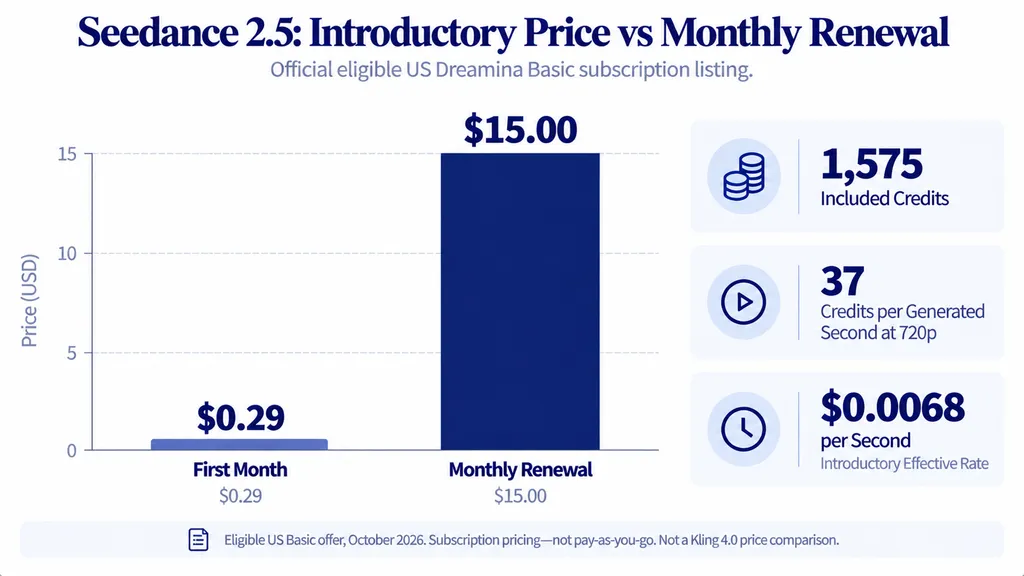
As of October 25, 2026, Dreamina lists a US introductory Basic offer for eligible subscribers at $0.29 for the first month, with 1,575 shared credits.
At the listed 720p settings, Seedance 2.5 consumes 37 credits per generated second.
This produces an introductory effective rate of approximately $0.0068 per generated second. The regular US monthly renewal price is listed as $15.
Dreamina
Seedance 2.5 Pricing Metric | Official Dreamina Listing |
Eligible US introductory month | $0.29 |
Included credits | 1,575 |
720p generation | 37 credits/second |
Effective introductory cost | Approximately $0.0068/second |
US monthly renewal | $15/month |
Important: The $0.0068 figure is an effective introductory subscription calculation, not a permanent API price or a pay-as-you-go rate.
It cannot be directly compared with a regular-priced Kling subscription.
Kling 3.0 pricing provides a useful reference for understanding earlier Kling pricing, although it is not a verified Kling 4.0 rate. Kling publishes separate membership and API pricing information. However, a verified, like-for-like Kling 4.0 per-second price for the same generation conditions was not established in the material reviewed for this comparison.
We therefore cannot responsibly declare either model cheaper.
Why Cost per Usable Shot Matters
The more useful production metric is:
Cost per Usable Shot = Total Generation Spend ÷ Accepted Shots
A lower generation price does not guarantee lower production costs.
A model may require additional attempts because of incorrect actions, inconsistent characters, unwanted dialogue, or distorted product details.
For meaningful comparisons, record:
- Total paid generation attempts.
- Accepted shots.
- Credits consumed.
- Total monetary expense.
- Reasons for rejecting footage.
The final cost should be calculated only after determining which outputs meet the production requirements.
Which Model Should You Choose for Your Project?
Our research supports the following starting recommendations.
Project Type | Recommended Starting Model | Main Reason |
Cinematic action | Kling 4.0 | Dramatic motion and visual impact |
Natural conversation | Seedance 2.5 | Favorable acting observations |
Handheld social videos | Seedance 2.5 | Natural camera aesthetics |
Stylized fashion ads | Kling 4.0 | Cinematic presentation |
Character-driven stories | Seedance 2.5 | Promising continuity and acting |
Product commercials | Test both | Product accuracy remains uncertain |
Complex choreography | Test both | Motion results vary |
Long-form production | Test both | Retry economics require measurement |
The most economical model is the one that reaches your required quality with the lowest total production cost—not necessarily the lowest advertised generation price.
FAQ
Is Kling 4.0 Better Than Seedance 2.5 for Realistic Videos?
Not consistently. Kling 4.0 received favorable assessments for cinematic detail and dramatic visuals, while Seedance 2.5 performed well in natural character expressions, dialogue, and handheld-style footage. Seedance is worth trying first for realistic human performances, while Kling may better suit polished commercial scenes.
Which Has Better Motion and Lip Sync?
Kling 4.0 performed well in certain high-impact physical actions. Seedance 2.5 received stronger feedback for natural acting and conversational scenes in some comparisons. Neither demonstrated reliable superiority in overall physics or lip-sync accuracy. Complex motion and dialogue should be evaluated separately.
How Can I Reduce Character Drift in AI Videos?
Prepare consistent facial portraits, full-body references, character turnaround sheets, and location images. Reuse these references across related scenes and inspect identity, clothing, accessories, and background objects before editing. This approach may improve consistency, but neither model guarantees identical results across generations.
Which Is Cheaper After Retries?
Neither model has a verified advantage in cost per usable video. Seedance 2.5 has a published introductory Dreamina pricing calculation, but that is not directly comparable with an unverified Kling 4.0 production rate. Track every paid generation and divide total spending by accepted shots to compare real costs.
Conclusion
Kling 4.0 is a compelling starting choice for cinematic visuals, high-impact action, and stylized commercial footage, while Seedance 2.5 is particularly promising for realistic acting, dialogue, and character-driven storytelling. Our review of real-world comparisons shows that neither model consistently wins across motion, prompt adherence, continuity, and commercial usability. For professional creators, the best approach is to match the model to each scene, maintain consistent visual references, and evaluate the true cost of usable footage rather than relying on impressive demonstrations alone.