Cheapest Seedance 2.5 in 2026: Which Platform Actually Costs Less?
Vincent9 menit baca ·
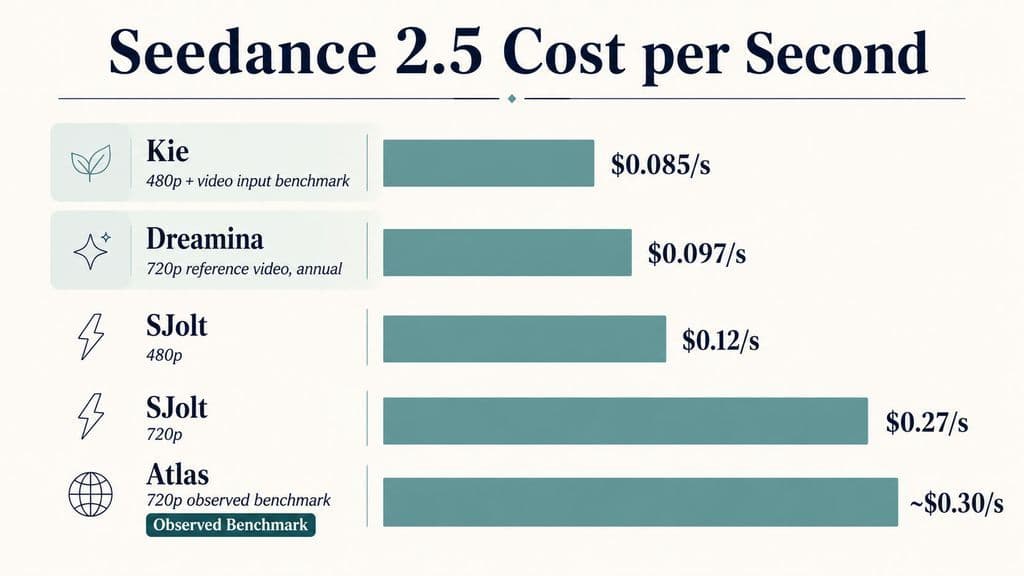
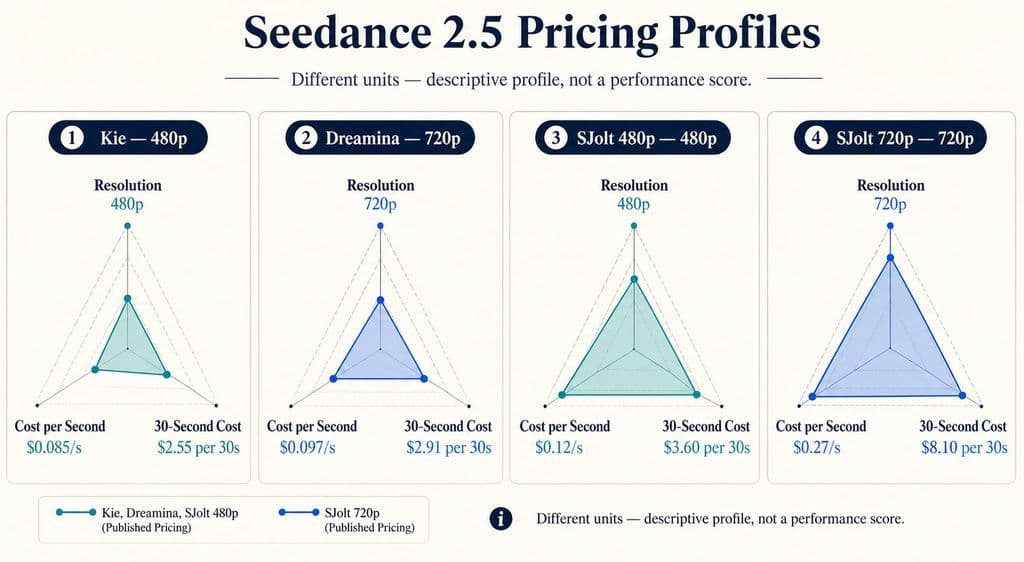
The cheapest Seedance 2.5 option in 2026 depends on how you generate. Kie has the lowest observed rate in our research at about $0.085/s for 480p with video input, while Dreamina reaches $0.097/s for 720p reference-video generation on its Advanced annual plan. That works out to about $2.55 vs $2.91 for a 30-second generation, under different settings.
But the lowest price per second is not always the lowest real cost. Resolution, reference inputs, failed jobs, rerolls, moderation, billing terms and queue delays can all increase what you actually spend. The better metric is cost per usable clip, not just cost per generated second.
For professional workflows, compare providers under the same resolution, reference mode and billing conditions, then factor in retries and turnaround time. Virse helps teams manage reference-heavy Seedance workflows on an infinite canvas, keeping project context, references and revisions organized so fewer generations are wasted.
Seedance 2.5, Seedance 2.0 and MiniMax H3 are now available on Virse, so teams can explore and compare multiple leading video models in the same creative workflow.
Seedance 2.5 Pricing Comparison: Which Option Is Cheapest?
A reliable Seedance 2.5 comparison must separate resolution, reference type and billing model. Mixing a 480p PAYG API with a 720p annual subscription creates a ranking that looks precise but is not useful.
Option | Pricing Condition | Approx. $/s | 30s Cost |
Kie | 480p + video input, research benchmark | $0.09 | $2.55 |
Dreamina | 720p + reference video, annual | $0.10 | $2.91 |
SJolt | 480p API | $0.12 | $3.60 |
SJolt | 720p API | $0.27 | $8.10 |
Atlas | 720p, observed benchmark | ~$0.30 | ~$9.00 |
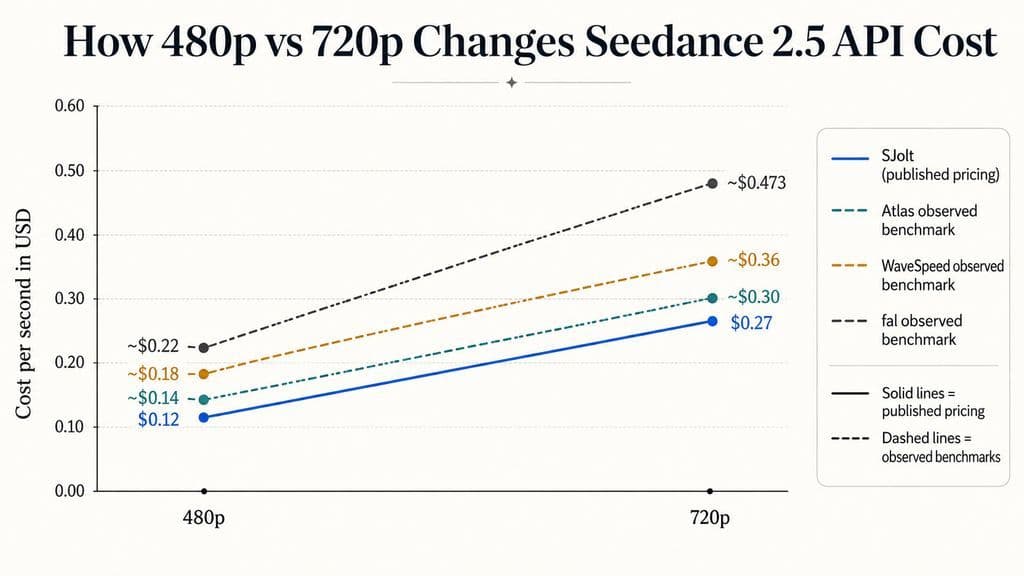
SJolt currently publishes $0.12/s at 480p and $0.27/s at 720p , while Dreamina explicitly describes its $0.097/s figure as an annual-plan equivalent for 720p with a reference video, not a universal PAYG rate. Atlas figures in this article are therefore kept as observed benchmark data rather than presented as a permanent current rate.
Cheapest Seedance 2.5 at 480p: Kie Has the Lowest Observed Rate
Our research found Kie at approximately $0.085/s for 480p with video input, making it the lowest observed numerical rate in the dataset. At that rate, a 30-second generation is about $2.55.
From a product-design perspective, this matters because early iterations rarely need final-production fidelity. Teams can use lower-cost output to evaluate camera movement, pacing, framing and concept direction, then generate only approved ideas at higher settings.
Kie also supports 480p, 720p and 1080p output plus image, video and audio references , making it suitable for workflows where references are part of the creative brief rather than an afterthought.
Cheapest Seedance 2.5 at 720p: Dreamina Leads the Annual Comparison
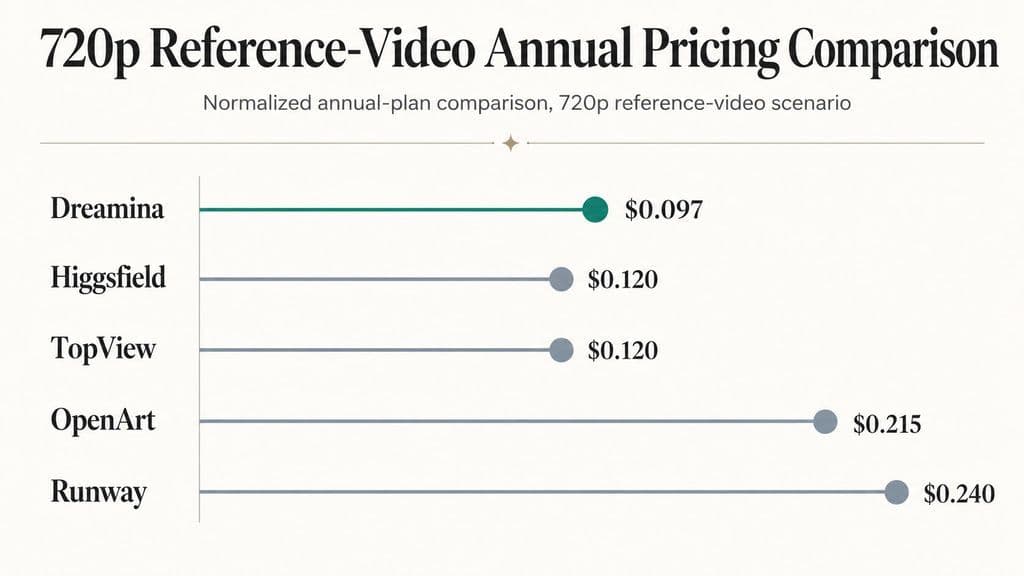
For 720p with a reference video, Dreamina's Advanced annual comparison is $0.097/s or $2.91 for 30 seconds. In the same normalized comparison, Higgsfield and TopView were listed at $0.120/s, OpenArt at $0.215/s and Runway at $0.240/s.
That puts Dreamina roughly 19% below the $0.120 comparison rate, but the annual commitment matters. A creator who uses the included value consistently can benefit from the lower normalized cost; an occasional user may save more with PAYG even when its nominal rate is higher.
Why Is There No Single Cheapest Seedance 2.5 Platform?
Seedance 2.5 pricing changes with the task. ByteDance describes the model as a 30-second storytelling system with multimodal reference control and editing capabilities, so a simple text generation and a reference-heavy production request should not automatically be treated as equivalent.
Resolution, References and Billing Change the Real Price
Before comparing providers, normalize:
- Model and endpoint
- 480p, 720p or higher resolution
- Output duration
- Text, image or video references
- Audio requirements
- PAYG versus annual billing
- Failure and retry policy
- Queue and concurrency behavior
Dreamina follows the same principle in its own comparison methodology, matching 720p, reference-video mode and annual billing before comparing plans.
This is why “Kie is cheaper than Dreamina” is incomplete. Kie's $0.085 benchmark and Dreamina's $0.097 rate describe different generation conditions.
How Much Does a 30-Second Seedance 2.5 Video Cost?
Because Seedance 2.5 supports output up to 30 seconds, the 30-second equivalent is often easier for creative teams to budget than credits.
Seedance 2.5 30-Second Cost Examples
At the rates above:
- Kie 480p + video-input benchmark: about $2.55
- Dreamina 720p annual reference-video rate: $2.91
- SJolt 480p: $3.60
- SJolt 720p: $8.10
- Atlas observed 720p benchmark: about $9.00
The numbers reveal why settings matter. A team producing 100 attempts at $2.91 spends $291 in generation value, while 100 attempts at $8.10 represent $810. But the cheaper workflow only wins if the outputs are usable and the purchasing conditions fit the team's production volume.
Cheapest Seedance 2.5 API: Kie vs Atlas vs SJolt vs WaveSpeed vs fal
For developers, agencies and creative automation teams, PAYG APIs trade the lowest subscription-equivalent rate for flexibility and automation.
Kie and SJolt Are Strong Price-First API Options
Kie combines low observed pricing with multimodal references and up-to-30-second generation. Its current interface supports multiple image, video and audio reference inputs as well as synchronized audio generation.
SJolt provides a particularly transparent current rate card: $0.12/s at 480p and $0.27/s at 720p, with output durations from four to 30 seconds. It also exposes text-to-video, image-to-video, reference-to-video, extension and editing routes.
In professional workflows, these API features matter because generation can move from manual Playground submission to asynchronous batch processing, allowing creative systems to queue concepts and return results to review pipelines automatically.
Atlas, WaveSpeed and fal Should Be Compared as Live Benchmarks
Our earlier same-setting research placed Atlas around $0.14/s at 480p and $0.30/s at 720p, WaveSpeed around $0.18/s and $0.36/s, and fal around $0.22/s and $0.473/s under the tested configurations.
These are useful market benchmarks, not permanent rate cards. API pricing can change quickly, so the safest purchasing method is to run the same resolution, duration, reference configuration and prompt through shortlisted providers immediately before scaling.
Are Seedance 2.5 Unlimited Plans Actually Unlimited?
Unlimited should be evaluated by throughput, not by the word itself. Dreamina's pricing methodology explicitly warns that speed, concurrency, queues, fair-use rules and model access can change the real value of an unlimited plan.
Artlist Cases Show Why Unlimited Throughput Needs Validation
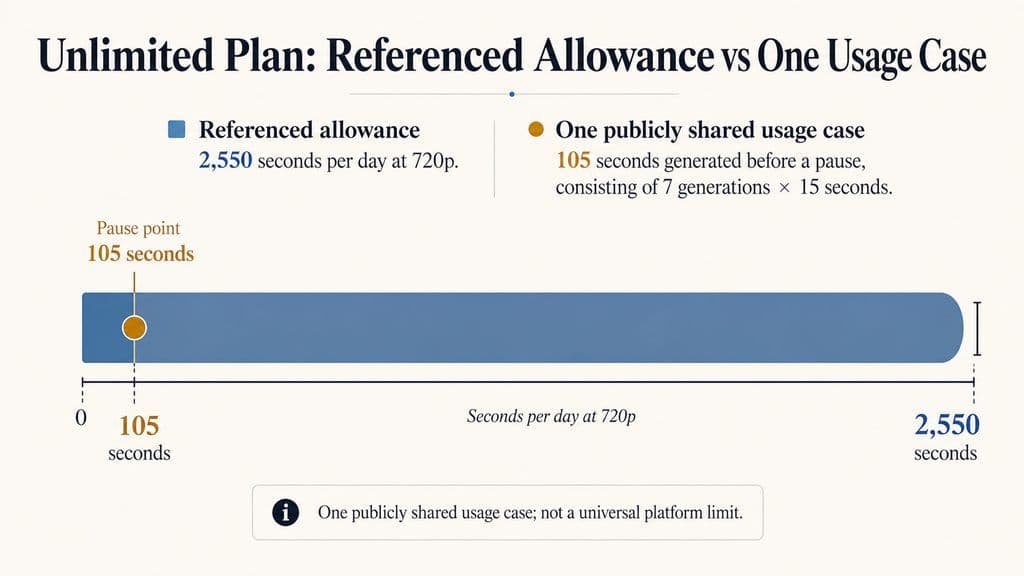
Our review of publicly shared usage cases found an Artlist annual-plan example priced at $499, alongside a referenced allowance of roughly 2,550 seconds per day at 720p. Another case recorded seven 15-second generations, or 105 seconds, before a pause.
These cases do not establish a universal Artlist limit. They show why creative teams should test actual daily throughput, throttling and recovery time before converting an unlimited subscription into a theoretical per-second price.
TopView Pricing Should Be Treated Carefully Until 2.5 Availability Is Clear
Dreamina's normalized comparison supplied a $0.120/s TopView figure, but TopView's own current pricing page lists Seedance 2.5 as coming soon.
For that reason, I would not treat $0.120/s as a confirmed currently purchasable TopView 2.5 rate until its own plan page is updated. This is exactly the kind of discrepancy that makes live verification essential in fast-changing AI-video pricing.
Why Cost per Usable Clip Matters More Than Price per Second
Cost per usable clip = total generation spend divided by approved outputs.
This is the article's most important decision framework because creative production rarely ends after one generation.
Retries Can Multiply the Real Seedance 2.5 Cost
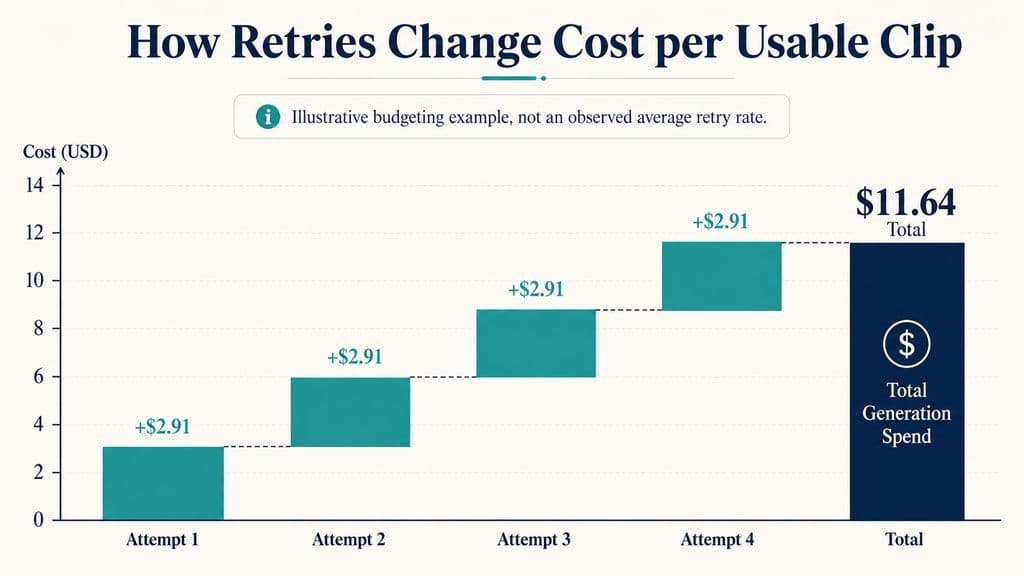
If a $2.91 Dreamina generation requires four attempts before one result is approved, the generation spend for that usable clip becomes $11.64. This is a budgeting example, not an observed average retry rate.
Design teams often reject technically successful outputs because product geometry changes, movement feels wrong, character consistency drifts or camera direction misses the brief. A provider with a slightly higher headline price may therefore be cheaper when it reaches approval in fewer attempts
Failed Jobs, Moderation and Credits Are Part of Effective Cost
Our research also surfaced recurring questions around failed generations, human references, moderation, queues and credit-rule changes. A historical Dreamina Seedance 2.0 case, for example, reported a 15-second generation moving from 210 to 675 credits. That is not current Seedance 2.5 pricing, but it illustrates why credit economics should be recalculated whenever plan rules change.
For a professional trial, track attempts, successful jobs, approved outputs, total spend and turnaround time. That produces a much more useful buying signal than credits alone.
Best Seedance 2.5 Platform by Use Case
Use Case | Best Fit |
Lowest observed 480p rate | Kie |
720p annual reference-video value | Dreamina |
Transparent current PAYG pricing | SJolt |
API benchmark comparison | Kie, Atlas, WaveSpeed, fal |
High-volume subscription | Dreamina, if annual usage is high |
Fast creative iteration | PAYG API with predictable turnaround |
Best Seedance 2.5 for Designers and Creative Teams
A practical design workflow is to separate exploration from production. Use lower-cost settings to test motion, composition and visual direction, then move only approved concepts into higher-quality generation.
This mirrors established design practice: sketches and prototypes are inexpensive because their purpose is decision-making, not final delivery.
Best Seedance 2.5 for Developers and Automation
For developers, compare price, references, failure handling, async processing, latency and integration complexity together. A slightly cheaper API can create higher operational cost if it requires manual intervention or forces a fragmented production workflow.
Conclusion
There is no universal cheapest Seedance 2.5 platform. Kie has the lowest observed rate in our research at about $0.085/s for 480p with video input, while Dreamina offers the strongest verified 720p reference-video annual comparison at $0.097/s. SJolt provides transparent PAYG pricing at $0.12/s for 480p and $0.27/s for 720p, while Atlas, WaveSpeed and fal remain useful benchmark alternatives whose live rates should be rechecked before scaling. For professional creative work, normalize settings first and then measure retries, failures, moderation and turnaround: the provider with the lowest cost per usable clip is the one that is actually cheapest.
FAQ
What is the cheapest Seedance 2.5 platform?
Kie has the lowest observed rate in our research at about $0.085/s for 480p with video input. Dreamina is cheaper for a different standardized scenario: $0.097/s for 720p reference-video generation on its Advanced annual plan. The two rates should not be compared without their conditions.
How much does a 30-second Seedance 2.5 video cost?
Using the rates reviewed here, Kie's lowest 480p benchmark is about $2.55 for 30 seconds, Dreamina's 720p annual reference-video rate is $2.91, and SJolt is $3.60 at 480p or $8.10 at 720p. Retries and other workflow costs can increase the final amount.
Is Dreamina cheaper than Kie for Seedance 2.5?
Dreamina is cheaper in the normalized 720p annual reference-video scenario, while Kie has the lower observed 480p video-input rate. Dreamina's $0.097/s and Kie's $0.085/s describe different configurations, so there is no valid universal winner without first matching resolution, references and billing.
What is the cheapest Seedance 2.5 API?
Kie has the lowest observed API figure in our research under its 480p video-input condition. For a currently transparent published rate card, SJolt lists $0.12/s at 480p and $0.27/s at 720p. Developers should also compare references, retries, latency and automation support before choosing purely on price.