
Qwen Image 3.0 Review: Better Text, But Is It Really Better Than Qwen Image 2?
Vincent11 min de lecture ·
Qwen Image 3.0 is better than Qwen Image 2 for text-heavy, structured design—but not for every task. Its clearest strengths are small-text rendering, complex layouts, long-prompt adherence, and reference fidelity, making it especially useful forposters, infographics, UI concepts, comics, and controlled editing.
But stronger capabilities do not always mean a better workflow. Slower generations, factual errors, retries, and unwanted visual changes can still increase production time. The real question is whether Qwen Image 3.0 can reduce corrections and deliver usable assets more efficiently.
Virse helps turn AI generation into a scalable design workflow. On its infinite canvas, teams can organize references, connect assets and tasks, run multiple Agents with shared context, and retain brand rules, aesthetic preferences, and project knowledge across production.
What Is Qwen Image 3.0 and What Makes It Different?
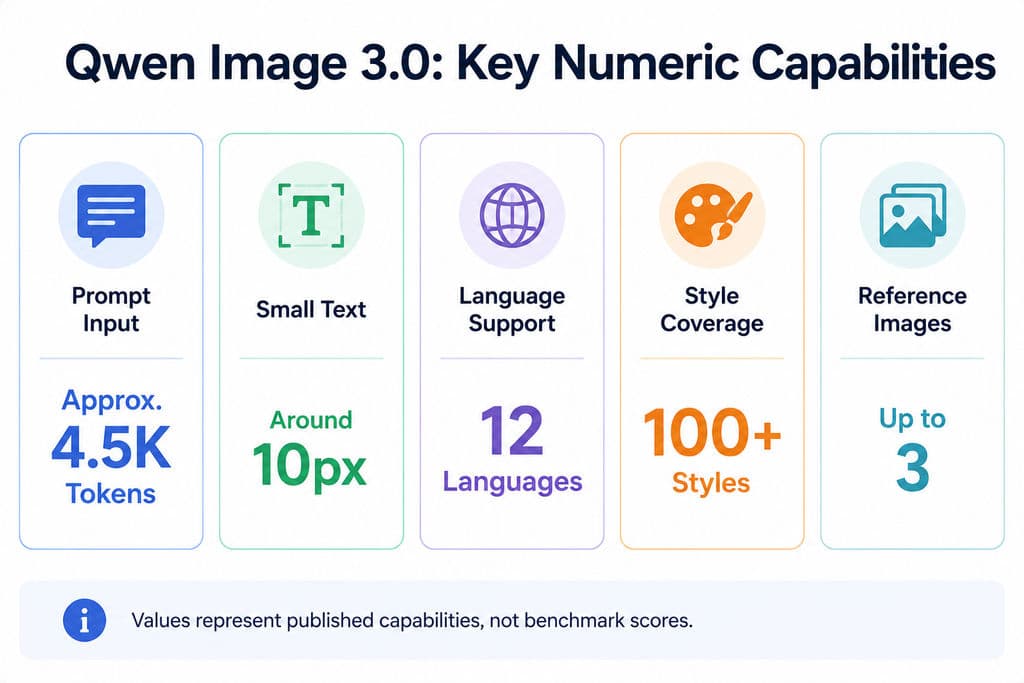
Qwen Image 3.0 is better understood as a structured visual-generation model than simply another image-quality upgrade. Its official capabilities include approximately 4.5K-token inputs, text around 10px, support for 12 languages, more than 100 styles, and stronger complex-layout generation.
These capabilities matter because professional design briefs rarely contain a single instruction.
Why 4.5K-Token Prompts Matter for Professional Design
A commercial visual may require a fixed product position, multiple text regions, hierarchy, lighting direction, brand colors, reference constraints, camera framing, and elements that must remain unchanged.
The value of a 4.5K-token context window is therefore not longer prompts for their own sake. It gives designers more room to encode creative intent, relationships, and constraints before generation instead of repairing missing instructions afterward.
This makes Qwen particularly relevant for:
- posters and advertising layouts
- editorial and newspaper-style compositions
- educational visuals
- packaging concepts
- UI mockups
- Information-heavy graphics
What the Current Evidence Still Does Not Prove
The specifications are strong, but our research found that Qwen Image 3.0 still lacks a complete model-specific public benchmark package covering areas such as multilingual text accuracy, reference drift, average latency, P95 latency, retry rates, and cost per usable output.
Qwen has published broader image-evaluation frameworks, so the issue is not that image benchmarks do not exist. The gap is the lack of a sufficiently complete, independently reproducible Qwen Image 3.0-specific production benchmark.
That distinction is important when moving from product claims to real design decisions.
How Good Is Qwen Image 3.0 Text Rendering?
Text rendering is the clearest evidence-backed reason to test Qwen Image 3.0.
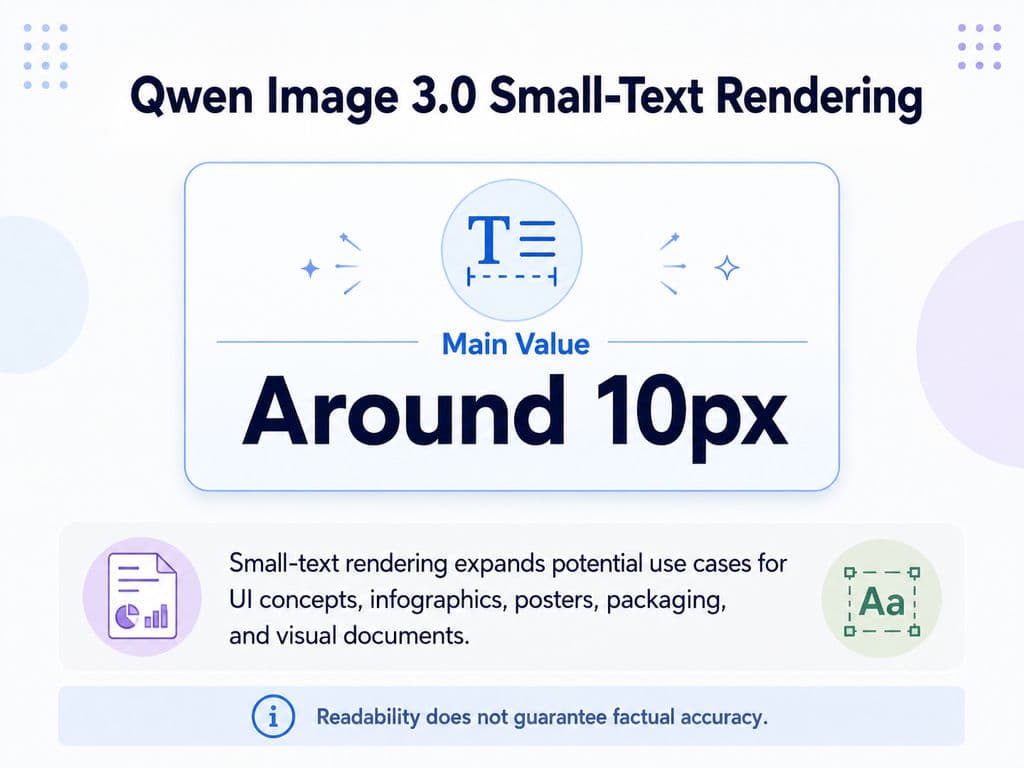
Official materials highlight text around 10px, and our review of available cases found independent examples reporting readable text at approximately that scale.
Why 10px Text Matters More Than It Sounds
Small typography is one of the fastest ways to expose weaknesses in image-generation models.
A model may generate an attractive poster but fail when asked to create:
- UI labels
- product specifications
- chart annotations
- subtitles
- comic dialogue
- small promotional copy
Qwen Image 3.0 extends the range of visuals that can potentially be generated as complete compositions instead of image backgrounds that still need all text rebuilt manually.
That is especially valuable for UI concepts, posters, infographics, packaging, educational graphics, and visual documents.
Case Study: Readable Text Can Still Contain Wrong Information
One important finding from our research is that visual correctness and factual correctness must be evaluated separately.
In one multilingual evaluation, Korean text contained an error. Another test involving a Poland GDP visualization showed problems with the data or timeline.
The design could look convincing while the information itself remained unreliable.
For production use, the workflow should therefore be:
- Check whether the text is visually readable.
- Verify every number, date, label, translation, timeline, and chart.
- Correct factual content before publication.
This is particularly important for infographics, financial graphics, educational materials, and client-facing reports.
How Well Does Qwen Image 3.0 Handle Reference Images and Editing?
Reference fidelity is another area where Qwen Image 3.0 shows meaningful promise.
Our review of cross-model editing cases found that Qwen often preserved the original sketch, scene structure, composition, and prompt intention more closely than models that interpreted the source more creatively.
The official Qwen Image 3.0 Pro API also supports one to three reference images, which makes multi-reference workflows relevant for product scenes, advertising concepts, and controlled visual variations.
Case Study: Preserving a Comic Panel During Style Transfer
A useful case involved an existing comic-style panel where the goal was to change the visual treatment without redesigning the underlying scene.
Qwen tended to preserve the original relationships more closely while applying the requested style.
This matters because a common AI-editing failure is collateral change: the designer asks to modify color, lighting, or style, but the model also changes the pose, face, camera, background, or object placement.
In professional editing workflows, it is useful to separate instructions into:
Preserve: identity, pose, camera angle, composition, key objects, text position.
Change: material, palette, lighting, texture, style, or explicitly requested details.
Reference Fidelity Is Not the Same as Better Aesthetics
The same comparison pattern also showed that GPT Image 2 could produce stronger stylistic reinterpretation in some cases.
That creates a useful distinction:
Choose Qwen when preserving the source matters. Choose a more interpretive model when creative transformation matters more.
For production editing, fidelity may save more time than visual novelty.
Is Qwen Image 3.0 Better Than Qwen Image 2?
Qwen Image 3.0 appears to be a capability shift rather than a universal quality upgrade.
The clearest improvement signals are concentrated in text, complex layout, long-prompt adherence, and controlled reference editing.
Where Qwen Image 3.0 Adds Real Workflow Value
If the model can correctly place a headline, retain the product position, follow several composition constraints, and preserve a reference, it can eliminate multiple manual correction steps.
That makes the upgrade particularly meaningful for structured commercial design.
Case Study: General Image Quality Did Not Always Improve
Our review also found cases where ordinary prompts produced results considered no better, and sometimes less satisfying, than Qwen Image 2.
There were also isolated examples of unusual facial or skin coloration.
That means teams working mainly on portraiture, illustration, or open-ended image exploration should not assume every workflow must migrate to 3.0.
Qwen Image 3.0 Speed Can Affect Production Economics
Another repeated observation was that Qwen Image 3.0 could take noticeably longer to generate than Qwen Image 2.
There is not yet enough standardized data to responsibly claim an exact percentage slowdown.
For professional teams, however, the key metric is not raw latency alone. It is time per accepted image, including failed generations, retries, and manual corrections.
Qwen Image 3.0 vs GPT Image 2 vs NB: Which Is Better for Design?
There is no evidence-supported universal winner. The better model depends on the design objective.
Design Need | Strongest Current Signal |
Small text | Qwen Image 3.0 |
Complex layouts | Qwen Image 3.0 |
Reference fidelity | Qwen Image 3.0 |
Strong stylistic reinterpretation | GPT Image 2 |
General aesthetics | Mixed |
Structured commercial visuals | Qwen Image 3.0 |
Open-ended exploration | Compare models |
When Qwen Image 3.0 Is the Better Choice
Qwen becomes more compelling as the brief contains more text, more layout constraints, more reference material, and more elements that must remain unchanged.
That describes many real marketing, product, UI, poster, packaging, and campaign-production workflows.
When GPT Image 2 or NB May Be Better
If the objective is visual exploration rather than controlled execution, GPT Image 2 may offer stronger stylistic reinterpretation in some cases.
NB remains competitive in general generation and editing, but our research provides less evidence that it consistently beats Qwen in text-heavy structured visuals.
The practical lesson is simple: select the model according to the failure mode you need to eliminate, not according to a universal leaderboard.
How Much Does Qwen Image 3.0 Cost?
Our research did not identify a published universal official USD-per-image rate for Qwen Image 3.0 Pro.
However, Qwen Image 3.0 Pro is now an official Alibaba Cloud Model Studio model ID, currently listed as a limited-preview model rather than merely a third-party product name.
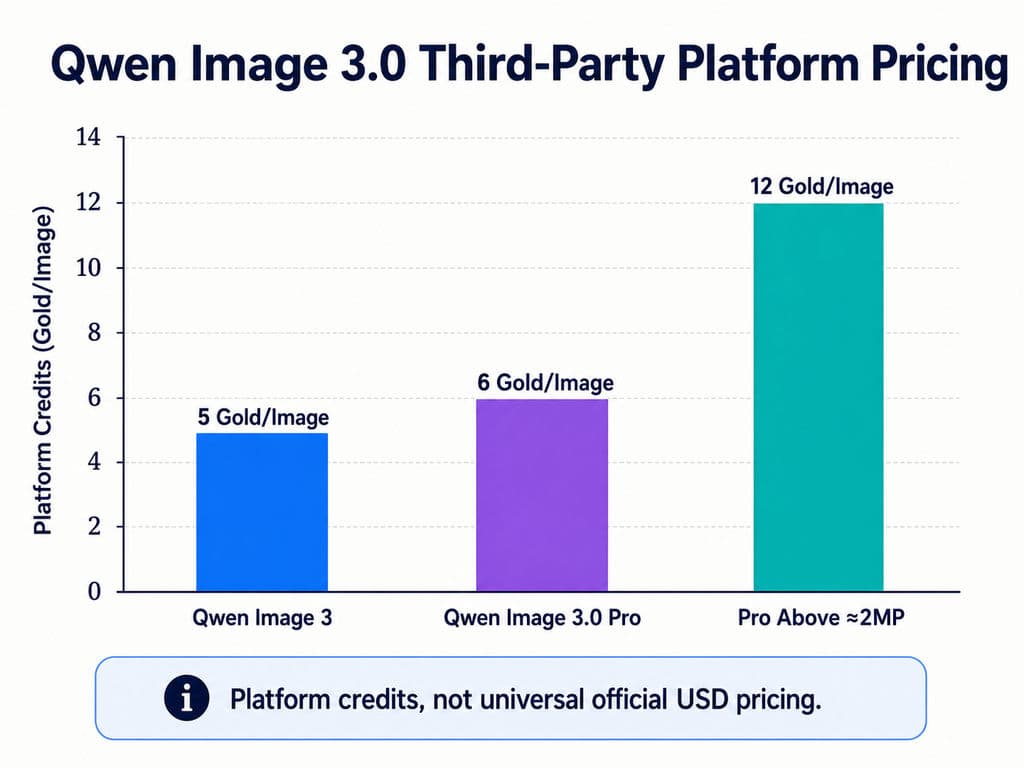
One third-party platform has published the following usage pricing:
Option | Platform Price |
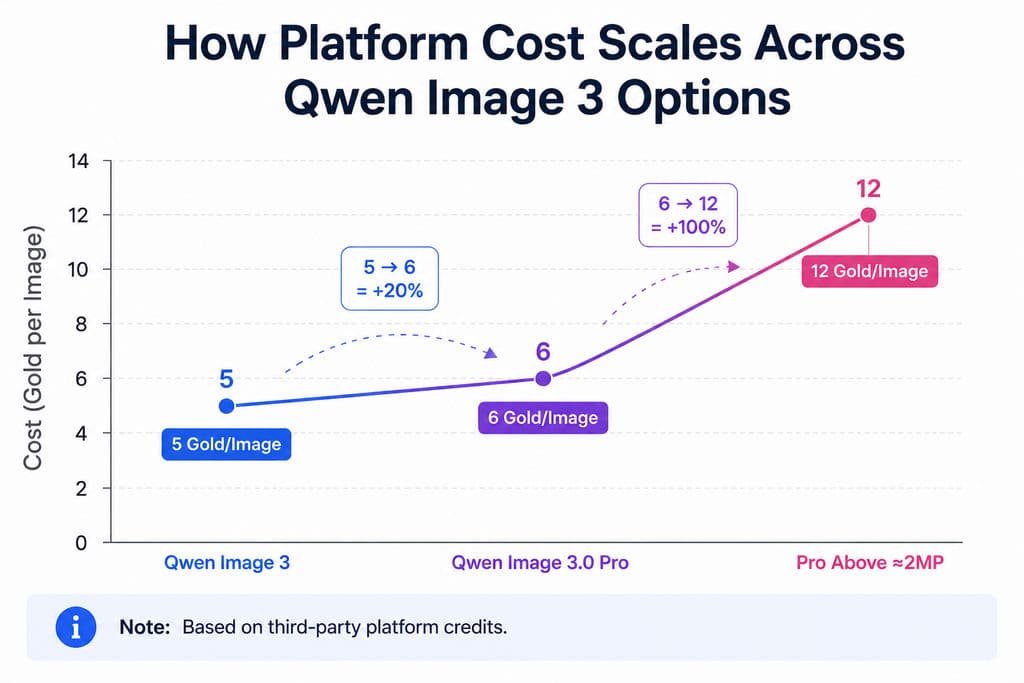
Qwen Image 3 | 5 gold/image |
Qwen Image 3.0 Pro | 6 gold/image |
Pro above about 2MP | 12 gold/image |
These are platform credits, not Alibaba Cloud's official universal USD pricing.
Why Cost per Usable Image Matters More Than Price per Call
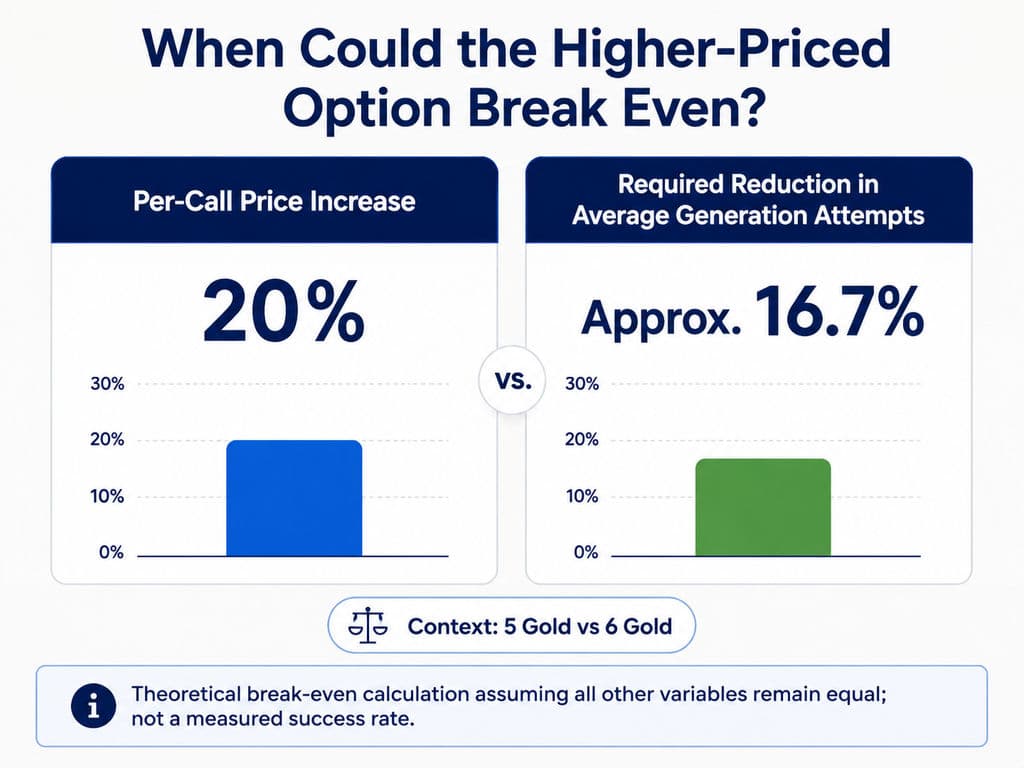
The increase from 5 to 6 gold is 20%. Moving from 6 to 12 gold doubles the platform cost.
But the more useful production metric is:
Cost per usable image = total generation spend divided by accepted outputs.
Under the 5-versus-6-gold example, the higher-priced option would theoretically need to reduce the average number of generation attempts by about 16.7% to offset the additional per-call cost, assuming all other variables remain equal.
For professional evaluation, our preferred framework tracks:
- text accuracy
- reference drift
- retry rate
- time per accepted image
- factual accuracy
A cheaper generation is not cheaper if it creates more correction work.
Is Qwen Image 3.0 Open Source and Suitable for ComfyUI?
For local AI workflows, closed weights remain one of the largest limitations.
The official Qwen Image 3.0 Pro offering is currently a hosted limited-preview model, which is very different from having downloadable weights for unrestricted local workflows.
Why Closed Weights Matter to Creative Teams
Local access affects:
- offline generation
- privacy-sensitive assets
- ComfyUI workflows
- quantization
- LoRA development
- custom inference infrastructure
- model experimentation
For teams that depend on those capabilities, local control may outweigh improvements in text or layout.
Why Qwen Image 2512 Is Still Relevant
Our research found that parts of the local ecosystem continue optimizing Qwen Image 2512.
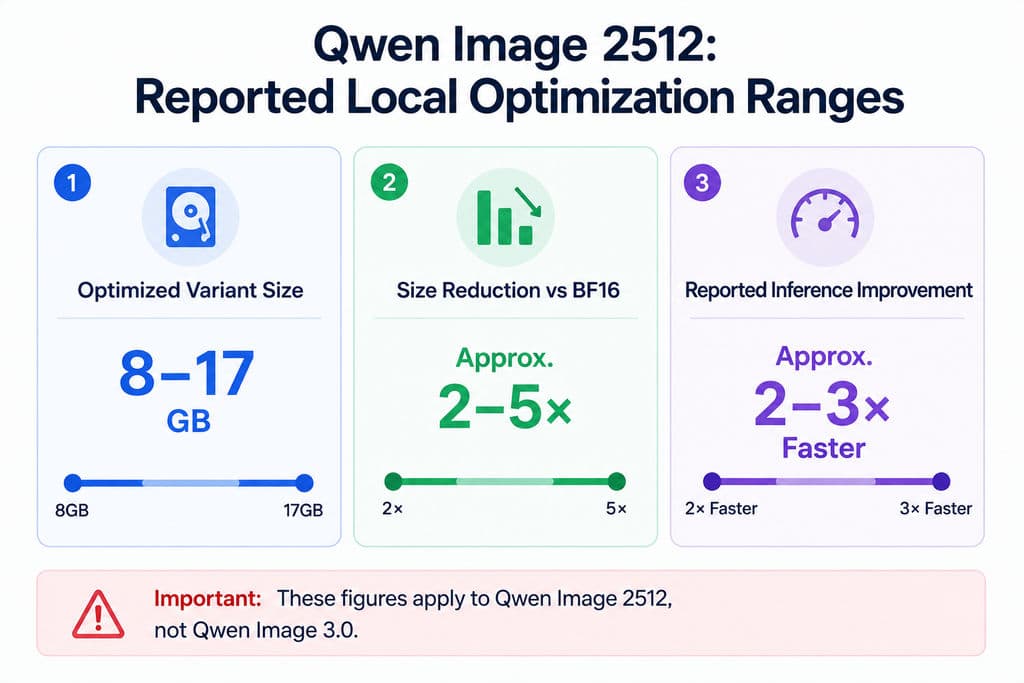
Available community optimization examples include 8–17GB variants, approximately 2–5× size reduction compared with BF16 in specific implementations, and optimization paths reporting around 2–3× faster inference.
These figures apply to Qwen Image 2512, not Qwen Image 3.0.
For local production, an older open ecosystem can therefore remain more practical than a more capable hosted model.
What Are the Best Qwen Image 3.0 Use Cases for Professional Designers?
The strongest Qwen Image 3.0 use cases share one characteristic: the design contains structure that must survive generation.
Infographics, Posters, and UI Concepts
These tasks combine typography, hierarchy, layout, and detailed instructions.
A practical workflow is to:
- finalize the copy
- define visual regions and hierarchy
- generate the composition
- inspect small text
- verify factual information
- finish the asset in a traditional design tool
The value is not replacing Figma or Photoshop. It is reducing how much of the layout needs to be rebuilt manually.
Comics and Reference-Based Editing
When a composition, character, or scene is already approved, controlled editing can be more valuable than creative regeneration.
Qwen's reference-preservation behavior is therefore relevant for comic panels, advertising adaptations, character scenes, product variations, and style-transfer workflows.
High-Volume Creative Production
For campaigns producing dozens or hundreds of variations, consistency becomes more important than one impressive image.
The best KPI is therefore time per usable asset, not generation speed alone.
A model that follows composition and reference requirements more reliably can outperform a faster model if it reduces retries, layout repair, and manual editing.
Qwen Image 3.0 FAQ
How much does Qwen Image 3 cost?
There is currently no verified universal official USD-per-image price in our research. One third-party platform lists Qwen Image 3 at 5 gold/image, Qwen Image 3.0 Pro at 6 gold/image, and certain Pro outputs above roughly 2MP at 12 gold/image. These are platform-specific credits.
Is Qwen Image 3 better than GPT Image 2 or NB?
It depends on the task. Qwen shows stronger evidence for small text, complex layouts, detailed instructions, and reference fidelity. GPT Image 2 can be stronger for creative reinterpretation, while NB remains competitive for general generation and editing. Professional teams should compare usable-output rates rather than choose a universal winner.
Can Qwen Image 3 reliably generate text and infographics?
Qwen Image 3.0 can generate unusually small and complex text, with official capabilities and reviewed cases around 10px. However, readable typography does not guarantee correct information. Numbers, dates, labels, translations, timelines, and chart data still require human verification before publication.
Is Qwen Image 3 available for ComfyUI?
Qwen Image 3.0 Pro is currently offered as a hosted limited-preview model, while closed weights restrict the local ComfyUI, quantization, LoRA, and custom inference workflows available with open-weight alternatives. This is one reason Qwen Image 2512 remains relevant for teams prioritizing local control.
Conclusion: Is Qwen Image 3.0 Worth Using?
Qwen Image 3.0 is worth testing when your design workflow depends on text, complex layout, long instructions, or reference fidelity, because these are the areas where its practical differentiation is strongest.
Its roughly 10px text capability, 4.5K-token input, structured-composition focus, multi-reference support, and encouraging reference-preservation results point toward a shift from generating attractive images to generating more controllable visual documents.
At the same time, mixed aesthetic results, slower-generation reports, factual-accuracy risks, closed weights, and limited independent production benchmarks mean it should not be treated as an automatic replacement for Qwen Image 2, GPT Image 2, NB, or local alternatives.
For professional design teams, the most useful benchmark is ultimately which model delivers the lowest cost, shortest time, and fewest corrections per usable design.
Plus d’articles du blog Virse
Produit
What Is Product Design in 2026? What Product Designers Actually Do
21 septembre 2026 by Vincent
Produit
GPT Image 2.5 Pricing: Flare vs Sunburst & the Real Cost per Image
14 septembre 2026 by Vincent
Produit
GPT Image 2.5 Review: Does It Finally Fix AI Image Editing Drift?
14 septembre 2026 by Vincent