
How to Preserve Design Accuracy in AI Mockups Without Endless Cleanup
 Yifan Zhao9 min de lecture ·

Preserving design accuracy in AI mockups means reducing how much the AI is allowed to invent. The most reliable approach is to give it reference screens, approved components, design tokens, spacing rules, and interaction constraints before generation, then compare the result against the original design.
The problem is that an AI mockup can look convincing while quietly changing hierarchy, spacing, component behavior, responsive logic, or interaction states. Those small differences often create substantial cleanup later. Our review of public AI design workflows shows that accuracy improves when AI works inside defined design constraints rather than repeatedly guessing from prompts.
Virse is designed around this more controlled creative workflow. References, assets, and AI tasks can stay together on an infinite canvas while Agents work from connected materials instead of isolated prompts. Paid plans include unlimited usage across 40+ models, including Nano Banana 2 and GPT Image 2, with unlimited seats. New users receive credits that can cover up to 10 Nano Banana 2 images or one Seedance 2.0 video, while Seedance 2.5, Seedance 2.0, and MiniMax H3 are also available in Virse.
What Does Design Accuracy in AI Mockups Actually Mean?
Design accuracy is the degree to which an AI-generated mockup preserves the visual appearance, system structure, and interaction behavior intended by the original design.
I use three dimensions to evaluate it:
Accuracy Layer | What Must Be Preserved | Typical AI Failure |
|---|---|---|
Visual fidelity | Spacing, color, typography, proportions, hierarchy | Generic styling or inconsistent spacing |
Structural fidelity | Components, variants, tokens, layout rules | Custom layers replacing real components |
Behavioral fidelity | States, navigation, responsive behavior | Correct-looking screens with incorrect logic |
This distinction matters because pixel similarity is not the same as design accuracy. In the workflow cases we reviewed, some generated interfaces looked close to their references but failed to use the actual design-system components. Other files required extensive Auto Layout reconstruction before they became maintainable.
A useful test is simple: an accurate mockup should remain accurate when it is edited, resized, reused, or moved into another product state.
Why Do AI Mockups Lose Design Accuracy?
Most accuracy problems begin when the model lacks structured design context.
If AI knows that a page needs a primary button but does not know the real component, size variant, spacing, radius, typography, or states, it must reconstruct those decisions itself. Repeating that process across forms, cards, navigation, tables, and layouts creates design drift.
Our review of user questions found that one of the most persistent concerns was not “How do I write a better prompt?” but “How do I make AI use the design system I already have?”
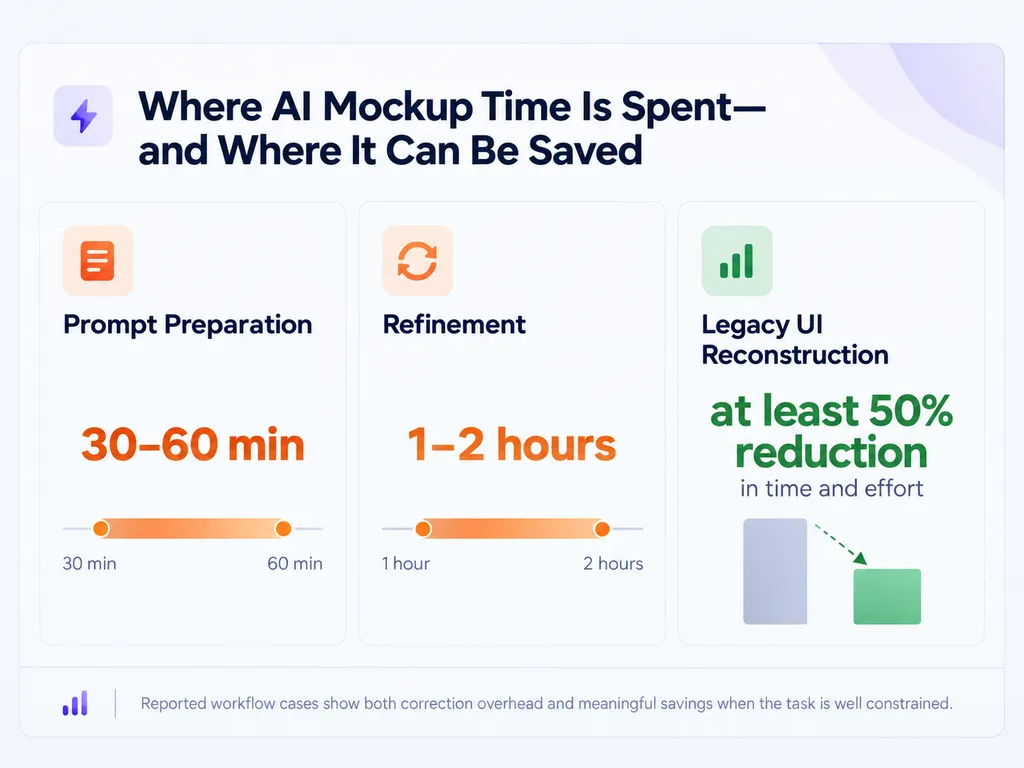
Repeated conversational refinement introduces another problem: regression. Fixing padding can shift alignment elsewhere; correcting one component can alter another breakpoint. Some practitioners in the reviewed workflows estimated 30–60 minutes preparing prompts plus another 1–2 hours refining results for visual tasks that could sometimes be sketched much faster manually. These are individual workflow reports rather than universal benchmarks, but they expose a real cost: generation speed does not equal production speed.
How Do Design Systems and References Preserve AI Mockup Accuracy?
The strongest way to preserve AI mockup accuracy is to convert existing design decisions into constraints the model can reuse.
AI should receive the approved components, variants, semantic tokens, typography, spacing scale, grids, breakpoints, and key states before it generates production-oriented UI. If a decision already exists in the design system, the AI should select it rather than recreate it.
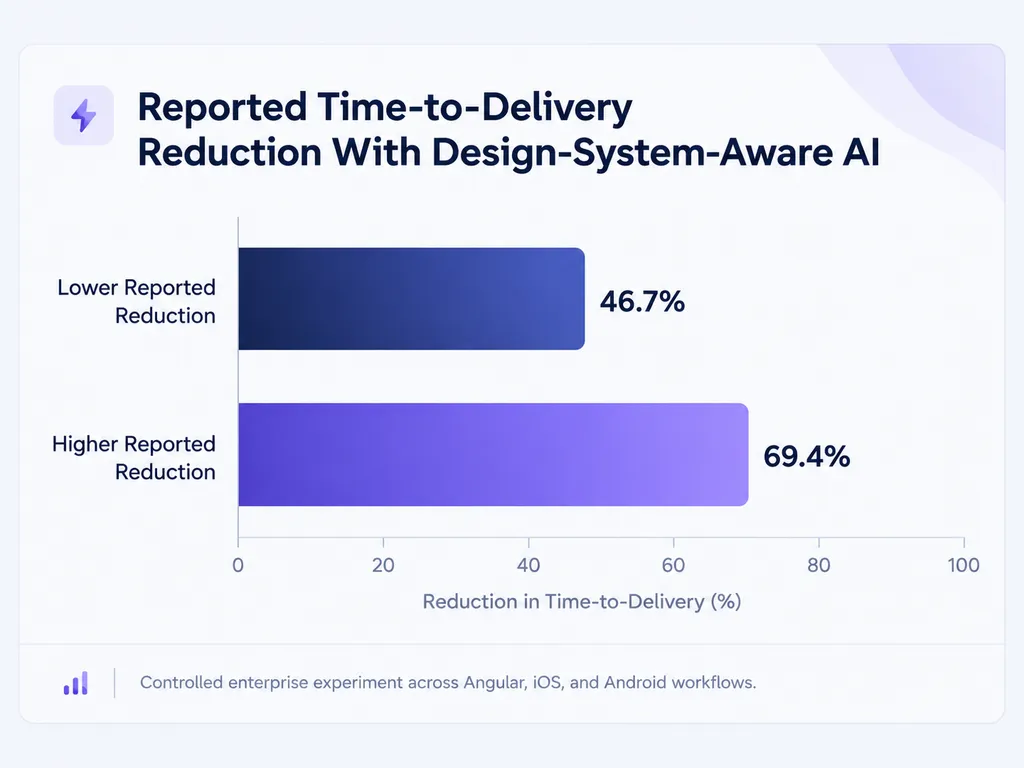
There is growing empirical support for this approach. A 2026 controlled enterprise experiment comparing manual development, design-system-only development, and design-system-aware AI development reported 46.7% to 69.4% lower time-to-delivery with AI assistance, alongside higher task completeness and lower performance variability. The study evaluated Angular, iOS, and Android workflows, so it should not be treated as a universal benchmark, but it provides useful evidence that AI performs better when grounded in an established design system.
References also need more than a screenshot. A stronger input combines reference screen + real components + design rules + interaction requirements + content constraints. The screenshot establishes appearance; structured context explains how that appearance should be reproduced.
For production work, separate decisions into two groups. Fixed decisions include brand colors, typography, components, spacing, navigation, responsive behavior, and accessibility rules. Flexible decisions can include composition, imagery, information grouping, and early visual exploration. The closer the mockup gets to production, the smaller the flexible category should become.
What Is the Best Workflow for Pixel-Accurate AI Mockups?
A repeatable process is more reliable than trying to write one perfect prompt.
- Define one source of truth. Choose the approved Figma screen, production interface, or design-system reference.
- Lock the design primitives. Supply components, tokens, type styles, spacing, grids, breakpoints, and important states.
- Define what AI cannot change. Protect component selection, brand rules, hierarchy, and interaction logic.
- Generate a bounded section first. Validate one form, navigation pattern, card group, or state before generating a complete flow.
- Review the three fidelity layers separately. Check visual appearance, system structure, and behavior instead of treating them as one approval.
- Render and compare. Replace vague instructions such as “make it closer” with visible differences between the approved reference and the output.
- Run human QA. Test responsive behavior, accessibility, content extremes, empty states, errors, and product-specific interactions.
The principle behind the workflow is straightforward: put accuracy into the system before generation instead of trying to repair it afterward.
What Do Real AI Mockup Workflow Cases Reveal About Accuracy?
Complex AI Prototyping Took Days While a Manual Figma Build Took Hours
One public workflow we reviewed involved a product designer creating a prototype with detailed interaction logic, including an airline-style seat-selection experience. Several AI prototyping approaches were explored for a couple of days, while the required result was eventually rebuilt in conventional Figma in a few hours. Another report described a similar days-versus-hours pattern.
The difficult part was not generating screens. It was preserving states, spatial rules, navigation, and product-specific behavior.
The lesson: complex interaction accuracy must be modeled explicitly. A visually impressive first screen does not prove that the flow is accurate.
AI Reduced Legacy UI Reconstruction Effort by at Least 50%
A stronger result appeared when AI was used to reconstruct an existing legacy interface before redesign work began. Because the target and system context already existed, the task had much less ambiguity.
One reviewed case reported at least a 50% reduction in time and effort compared with rebuilding the interface manually.
The lesson: AI tends to perform better on reconstruction, migration, adaptation, and controlled variation because there is a clear result to compare against.
A 4px Fix Worked Immediately, While Another Workflow Spent 90% of Cleanup on Auto Layout
The difference between constrained and unconstrained work becomes especially clear in two smaller examples.
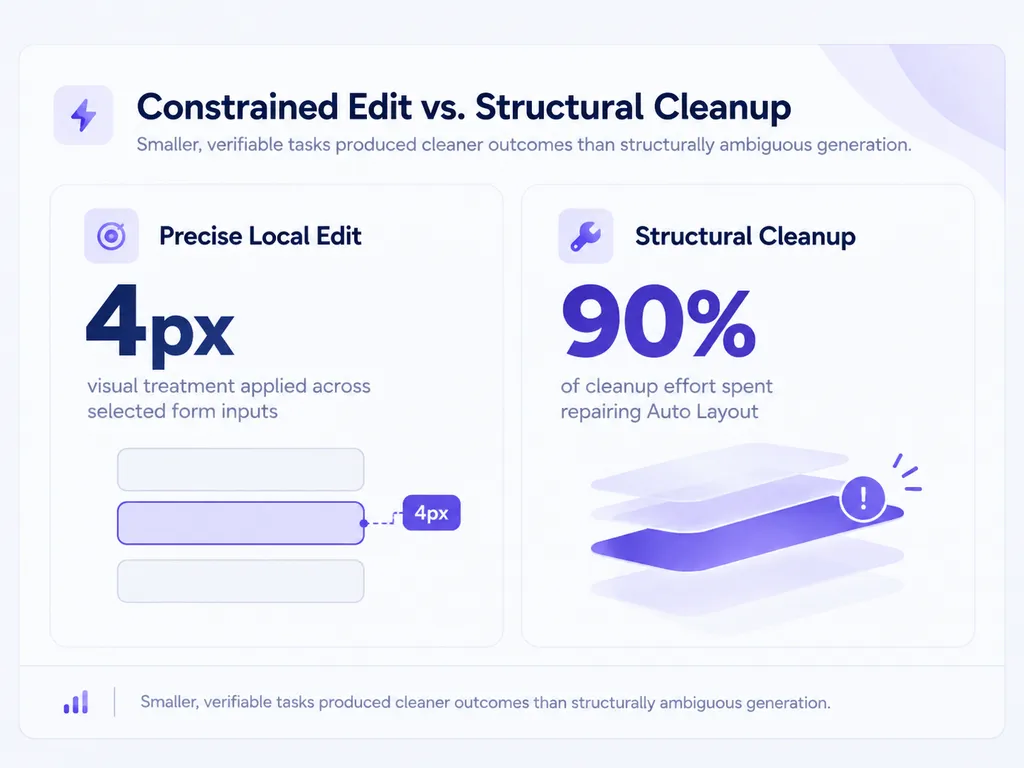
In one case, AI was asked to apply the same missing 4px visual treatment across selected form inputs and completed the bounded change correctly. In another Figma workflow, a practitioner reported spending roughly 90% of cleanup effort repairing Auto Layout after AI generation.
These figures are individual workflow reports, not industry averages. Their value is diagnostic: AI accuracy rises when the target is specific, constrained, and easy to verify.
How Do Visual Regression and QA Improve AI Mockup Accuracy?
Once an AI mockup can be rendered, visual fidelity becomes a verification problem rather than a prompting problem.
The useful loop is approved reference → generated implementation → rendered comparison → targeted correction → validation.
Research on mockup-to-code generation supports this direction. The 2026 DesignCoder study evaluated 300 high-fidelity mockups and combined hierarchy-aware generation with vision-guided self-correction. Compared with its strongest baseline on the Figma dataset, it reported a 37.6% reduction in visual error and a 30.2% improvement in structural similarity.
That result reinforces an important distinction: visual comparison and structural validation should happen together.
For practical QA, measure four things:
Metric | What It Answers |
|---|---|
Visual fidelity | Does the render match the approved reference? |
System compliance | Are the correct components, variants, and tokens used? |
Correction cost | How much manual rework remains? |
Regression rate | Do later edits damage previously approved UI? |
A useful productivity model is therefore generation + correction + structural cleanup + validation. The best AI mockup is not necessarily the fastest first draft; it is the one that reaches an approved and reusable state with the least total rework.
Conclusion: How to Preserve Design Accuracy in AI Mockups
Preserving design accuracy in AI mockups is fundamentally a context, constraint, and verification problem. Give AI real components, tokens, references, layout rules, and interaction requirements; separate fixed decisions from flexible ones; generate in bounded stages; evaluate visual, structural, and behavioral fidelity independently; and compare rendered results against an approved baseline. Both published research and the workflow cases we reviewed point in the same direction: AI becomes more reliable when the intended result is explicit, reusable, and testable rather than left for the model to infer.
FAQ About Design Accuracy in AI Mockups
How do I make AI follow my Figma design system?
Give AI structured access to your real components, variants, tokens, typography, spacing, and layout rules instead of describing the system only through prompts. The objective is to make AI reuse existing decisions rather than generate visually similar substitutes. This directly reduces component and styling drift.
Can AI reproduce a screenshot pixel-perfectly?
AI can reproduce many visible characteristics of a screenshot, but a screenshot does not fully describe components, responsive behavior, tokens, states, or interaction logic. For higher accuracy, combine the visual reference with structured design context and validate the rendered output against an approved baseline.
Why does AI fix one UI issue and break another?
The requested edit may not have clear scope boundaries, so the model can reinterpret surrounding layout, styling, or component behavior. Smaller edits, locked design primitives, explicit states, and visual comparison after each change make regressions easier to prevent.
Should Figma components or code components be the source of truth?
Use whichever system actually controls the production experience, then connect the other environment to it as closely as possible. The main risk is not choosing Figma or code; it is maintaining two disconnected sources of truth that gradually drift apart.
Plus d’articles du blog Virse
Flux de travail

How to Create AI T-Shirt Mockups That Actually Match Your Product
17 septembre 2026 by Yifan Zhao
Flux de travail

How to Create Clothing Mockups That Look Real: 5 Practical Methods
17 septembre 2026 by Yifan Zhao
Flux de travail
How to Keep Characters Consistent in GPT Image 2.5
16 septembre 2026 by Yifan Zhao