How to Start a Clothing Brand in 2026: Step-by-Step
Vincent12 min read ·
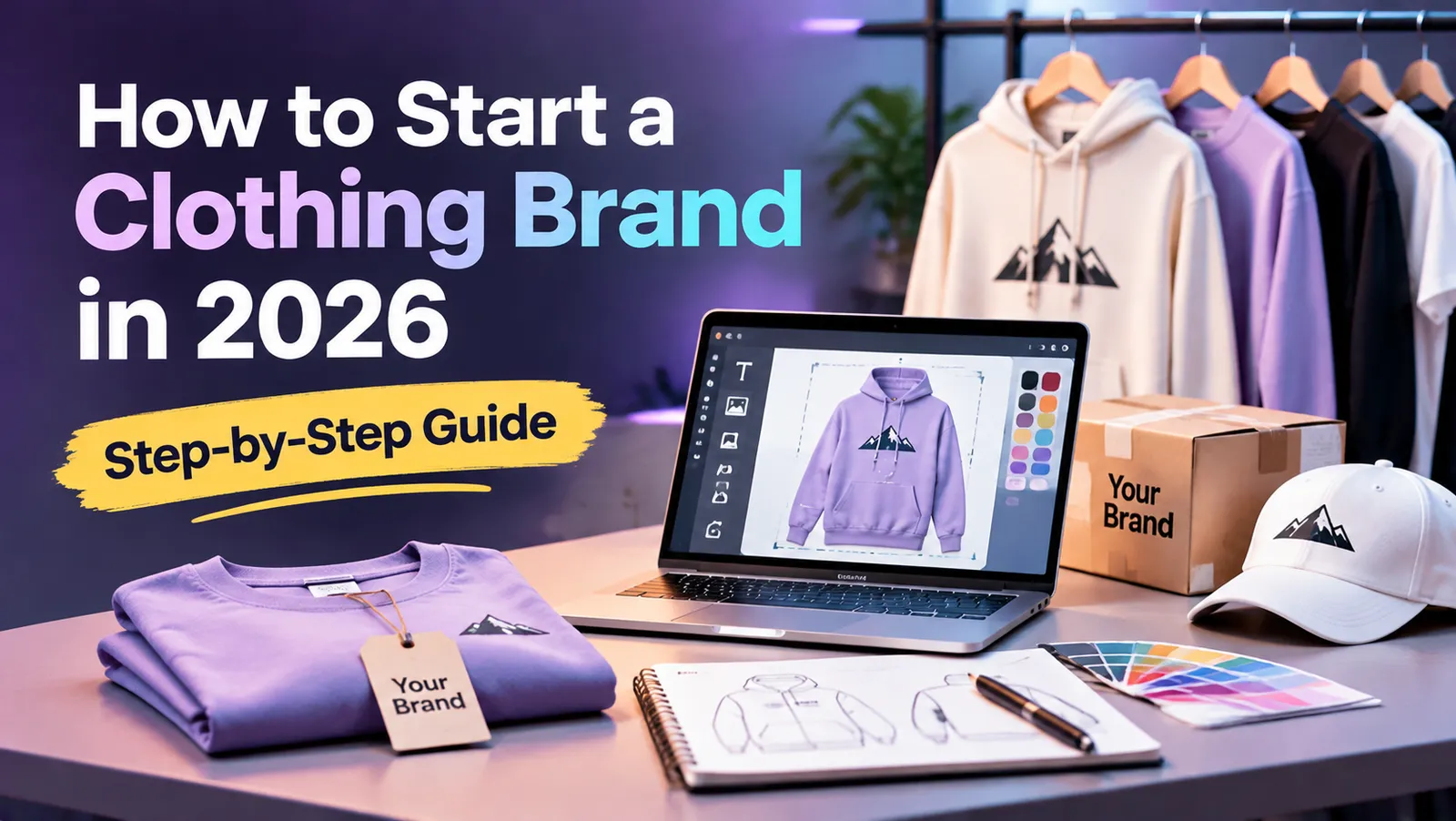
To start a clothing brand in 2026, choose a specific niche, identify your target customers, develop your first fashion products, select a production model, find reliable suppliers, test samples, and launch through an online store or marketplace. Start with a focused collection, calculate your production costs, and validate customer demand before investing in large quantities of inventory.
The challenge isn't simply designing attractive clothes. New founders must also deal with high minimum order quantities (MOQs), unreliable manufacturers, inconsistent product quality, pricing decisions, and the risk of unsold inventory. Spending money on branding and production before understanding your customers can make an otherwise promising business difficult to sustain.
This is where Virse can help you develop your creative direction. Its AI-powered creative canvas brings multiple AI models into one workspace, allowing you to generate, explore, and refine clothing graphics, visual concepts, and brand assets. Whether you're developing a streetwear identity, experimenting with apparel designs, or creating product visuals, Virse helps you explore different creative directions and turn early ideas into compelling visual concepts, without relying entirely on manual design work.
How to Choose a Clothing Brand Niche and Validate Demand
A clothing brand needs a recognizable identity and a specific audience. Rather than trying to sell everything to everyone, identify a market where your designs, product quality, and brand positioning can stand out.
Choose a Clothing Niche and Target Customer
Potential clothing niches include:
- Streetwear: Oversized T-shirts, graphic hoodies, and statement designs.
- Athleisure: Comfortable clothing for workouts and everyday activities.
- Minimalist fashion: Neutral colors, simple silhouettes, and timeless basics.
- Vintage fashion: Retro graphics and nostalgic styles.
- Sustainable fashion: Clothing emphasizing responsible materials and production.
Research competing brands, customer reviews, and social media conversations. Look for recurring complaints about sizing, fabric quality, pricing, or product availability.
Turn your findings into a simple customer profile covering age range, lifestyle, preferred styles, shopping habits, and spending expectations.
For example, a streetwear brand targeting creative professionals might focus on oversized silhouettes, distinctive typography, and limited graphic collections rather than competing directly with mass-market basics.
Build a Clothing Brand Identity Beyond Your Logo
Your brand identity should connect your name, visual direction, product designs, and customer experience.
Define:
- Brand name and positioning: What does your brand represent?
- Logo and typography: What visual elements make it recognizable?
- Color palette: Which colors will appear consistently across products and marketing?
- Photography style: How will you present your clothing?
- Brand story: Why should customers care about your brand?
For example, a minimalist clothing brand might use neutral colors, understated typography, and clean product photography, while a streetwear brand might use bold graphics and more experimental visual elements.
AI design tools can help explore different directions before committing to final designs. The important thing is to establish a recognizable visual system rather than producing unrelated graphics for individual products.
How to Choose a Clothing Production Model and Calculate Startup Costs
Your production model affects upfront investment, product customization, inventory exposure, and potential profit margins. There are several ways to manufacture clothing, and the right choice depends on your product requirements and available budget.
Compare POD, Blank Apparel, Private Label, and Cut-and-Sew
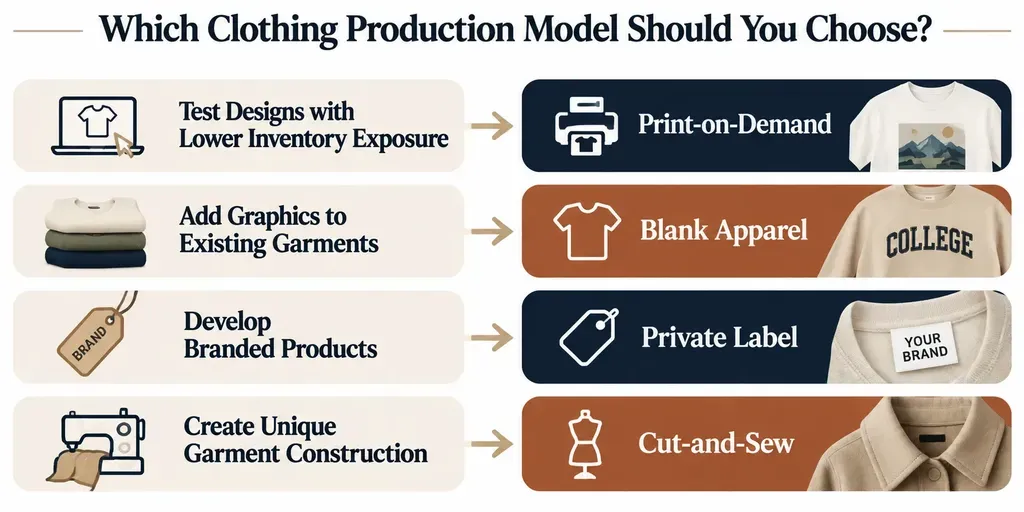
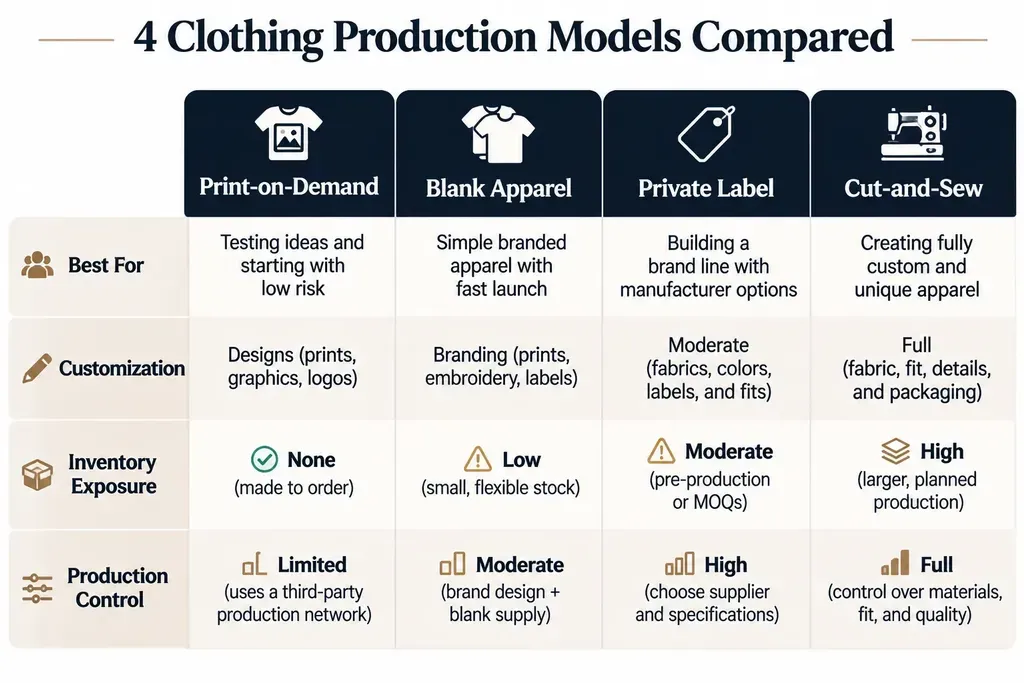
Print-on-demand (POD) produces and fulfills products after customers place orders. It is useful for testing designs without purchasing large inventories in advance.
Blank apparel involves purchasing ready-made garments and adding your own graphics, prints, or embroidery. It offers a practical middle ground for brands that want more control over presentation without developing garments from scratch.
Private label manufacturing allows you to sell products manufactured by a supplier under your own brand, often with selected customization options.
Cut-and-sew manufacturing involves developing garments from specified fabrics, patterns, measurements, and construction requirements. It provides greater product control but usually requires more development work and production coordination.
Production Model | Best For | Main Trade-Off |
POD | Testing designs | Limited customization |
Blank apparel | Custom graphics and branding | Existing garment construction |
Private label | Branded products | Supplier-dependent options |
Cut-and-sew | Unique garments | Higher development complexity |
Calculate Clothing Brand Startup Costs
Don't set your budget using a generic startup-cost estimate. Build it from the actual expenses involved in your first collection.
Include:
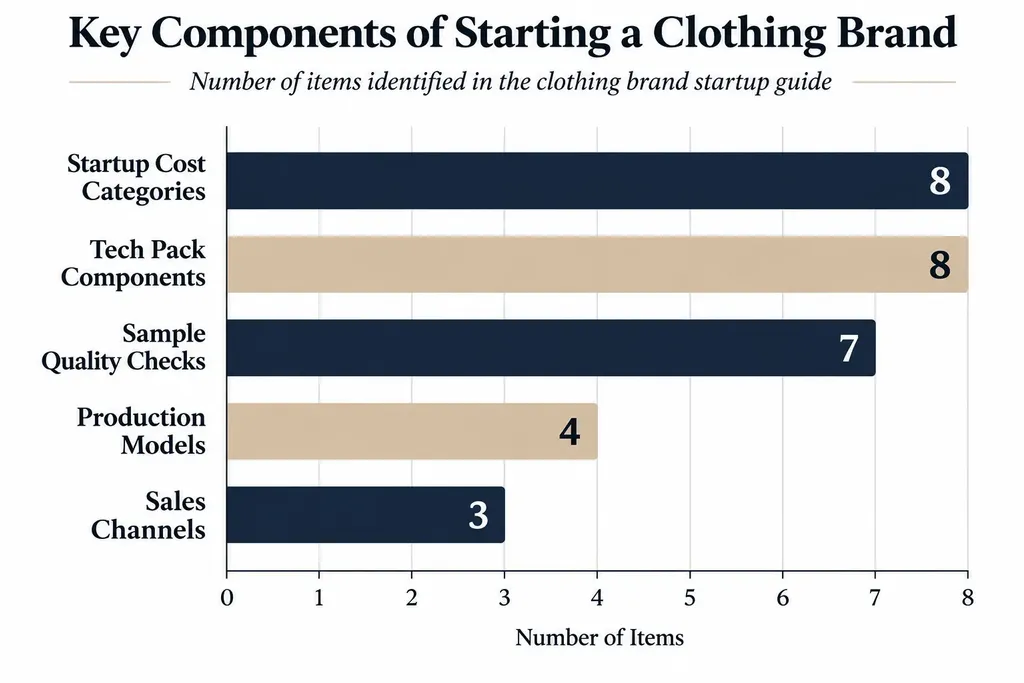
- Design and product development: Artwork, patterns, and design revisions.
- Sampling: Prototype garments and sample modifications.
- Manufacturing: Fabric, labor, printing, and embroidery.
- Labels and packaging: Tags, branding materials, and packaging.
- Shipping and fulfillment: Freight, duties, warehousing, and delivery.
- Website and payment processing: Store setup, subscriptions, and transaction fees.
- Photography and marketing: Product images, advertising, and creator collaborations.
- Operating reserves: Returns, replacements, and unexpected expenses.
For each product, calculate its total landed cost, including manufacturing, shipping, packaging, and applicable import expenses.
Then compare the selling price against product costs, payment fees, discounts, returns, and marketing expenses.
A useful calculation is:
Contribution per unit = Selling price − Variable costs per unit
Break-even quantity = Fixed launch costs ÷ Contribution per unit
For example, if your contribution per unit is positive, the break-even calculation helps estimate how many units you need to sell to recover fixed launch expenses. Use your actual supplier quotations and operating costs rather than assumed industry averages.
How to Design Your First Clothing Collection and Create a Tech Pack
Your first collection should communicate your brand clearly without creating unnecessary production complexity.
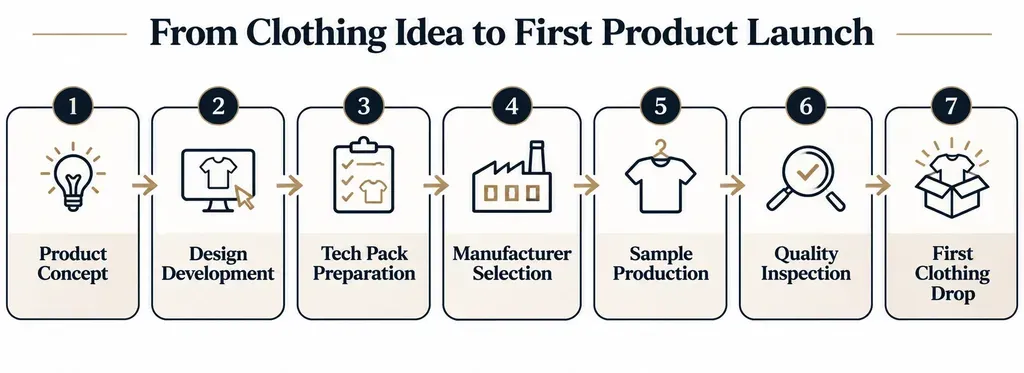
Start With a Focused Product Range
Consider a streetwear collection featuring:
- An oversized graphic T-shirt.
- A heavyweight hoodie.
- Custom sweatpants.
- An embroidered cap.
Choose products that share a consistent aesthetic and appeal to the same audience.
A focused collection makes it easier to coordinate samples, compare supplier quotations, photograph products, and manage inventory.
The objective is not to launch as many products as possible. It is to identify a small group of products that communicate your brand's identity and can be produced consistently.
Create a Clothing Tech Pack
A clothing Tech Pack communicates the technical requirements manufacturers need to reproduce your designs.
Important components include:
- Technical sketches: Front, back, and detail views.
- Fabric specifications: Composition, weight, and material details.
- Measurement chart: Garment dimensions and size grading.
- Color references: Approved garment and artwork colors.
- Artwork placement: Print and embroidery positions.
- Construction details: Stitching, seams, and finishing.
- Branding: Labels, tags, and trims.
- Packaging: Folding and packaging requirements.
A digital clothing mockup is useful for visualizing a design, but it doesn't replace production specifications. Missing measurements or unclear fabric requirements can lead to incorrect samples and unnecessary revisions.
A mockup communicates what a garment should look like; a Tech Pack explains how it should be made.
Before contacting manufacturers, make sure your product specifications are clear enough for suppliers to evaluate the design and provide comparable quotations.
How to Find Clothing Manufacturers With Low MOQs
Finding the right manufacturer requires more than searching for the lowest quotation. You need a supplier whose capabilities, production requirements, and communication style match your business.
Where to Find Clothing Manufacturers
Start with these sourcing channels:
- Alibaba: Explore international suppliers and apparel manufacturers.
- Local garment factories: Consider closer production and more direct communication.
- Apparel manufacturing directories: Find suppliers specializing in particular garment categories.
- Fashion trade shows: Review products and develop supplier relationships.
- Industry referrals: Identify manufacturers through established business contacts.
Check whether a supplier operates its own factory or acts as an intermediary. Ask to see examples of comparable products and clarify which production processes are handled internally or subcontracted.
What to Ask Manufacturers About MOQ and Pricing
Before contacting suppliers, prepare your product specifications and ask:
- What is your MOQ per design, color, and size?
- Do you accept small-batch production?
- What are the sample and revision fees?
- Which fabrics and customization techniques are available?
- What are the estimated production lead times?
- How do you inspect bulk production quality?
- What are your payment and shipping terms?
Request quotations using identical specifications so you can compare suppliers fairly.
Evaluate the complete offer, including sampling, customization, production, packaging, shipping, and quality control.
A low unit price is not necessarily the cheapest overall option if the supplier requires expensive revisions or cannot consistently meet your specifications.
How to Test Clothing Samples and Plan Your First Drop
Before committing to production, confirm that your physical products match your design and quality requirements.
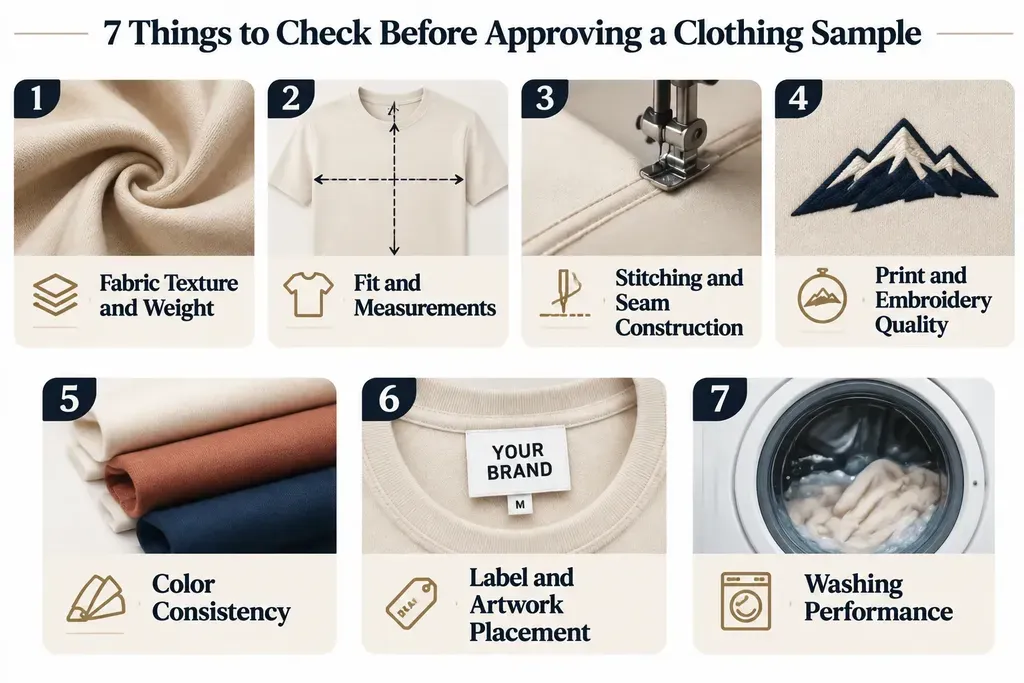
Use a Clothing Sample Quality Checklist
Inspect every sample for:
- Fabric texture, composition, and weight.
- Fit and garment measurements.
- Stitching and seam construction.
- Print and embroidery quality.
- Color consistency.
- Label and artwork placement.
- Washing performance.
Pay particular attention to print durability. A graphic that looks excellent when new may fade, crack, or peel after washing.
Document defects with photographs and specific revision instructions. Approve the final sample before using it as the reference for bulk production.
A useful practice is to maintain a sample evaluation sheet recording the approved measurements, fabric details, construction requirements, and outstanding corrections. This gives you a consistent reference when reviewing production samples and finished garments.
Validate Demand Before Ordering Inventory
Your first clothing drop should test whether customers are willing to purchase your products.
Consider these approaches:
- Product previews: Share actual samples and collect feedback.
- Waitlists: Let interested customers register for launch notifications.
- Preorders: Test purchase demand with clear delivery expectations.
- Small-batch production: Limit initial inventory exposure while learning from real sales.
Don't mistake likes, comments, or social media views for confirmed demand.
Track which products sell, which sizes customers choose, and what feedback they provide. Use these signals to decide what to restock, improve, or discontinue.
Your first collection should generate useful business information as well as sales.
How to Launch a Clothing Brand Online and Choose Sales Channels
Your sales channel determines how customers discover, evaluate, and purchase your products.
Choose the Right Clothing Sales Channel
Direct-to-consumer (DTC): Sell through your own website. You have more control over branding, customer experience, and product presentation, but must generate your own traffic.
Marketplaces: Sell through established shopping platforms. They can provide access to existing shoppers, but competition, fees, and platform requirements affect profitability.
Wholesale: Sell products to boutiques and retailers. This can expand distribution but requires reliable production, consistent pricing, and the ability to fulfill larger orders.
Sales Channel | Main Advantage | Main Challenge |
DTC website | Brand and customer experience control | Must generate traffic |
Marketplace | Access to existing shoppers | Competition and platform fees |
Wholesale | Retail distribution opportunities | Production and pricing requirements |
You can combine channels as your business develops, but start with the approach that best matches your audience and resources.
Create Product Pages That Build Customer Confidence
Online shoppers cannot touch fabric or try on garments before ordering. Your product pages should reduce uncertainty with:
- Front, back, and close-up product photographs.
- On-model images showing fit and proportions.
- Fabric composition and weight.
- Size charts and measurement instructions.
- Care information.
- Shipping and return policies.
- Videos showing garment details.
Also establish clear customer service, payment, and fulfillment processes.
Before accepting orders, check applicable business registration, trademark, tax, textile-labeling, and import requirements in the markets where you operate. These requirements vary by jurisdiction.
How to Market a Clothing Brand and Improve Online Sales
A good product doesn't automatically generate customers. Build a repeatable marketing process that connects brand discovery, product interest, and completed purchases.
Build an Audience Before Launch
Start publishing content while developing your collection.
Useful content includes:
- Behind-the-scenes design development.
- Fabric and sample comparisons.
- Outfit styling ideas.
- Product previews.
- Brand storytelling.
- Production and packaging content.
Instagram and TikTok are useful visual channels for presenting clothing, while email marketing can help you communicate launch announcements and new collections to interested subscribers.
Creator collaborations can also introduce your products to audiences that already match your target market.
Build interest before launch rather than waiting until your products are available to start marketing.
Why Does a Clothing Store Get Traffic but No Sales?
Traffic without purchases can indicate problems with product presentation, pricing, customer trust, or checkout.
Review the purchasing journey:
- Product discovery: Are the right customers reaching your store?
- Product engagement: Are visitors exploring product details?
- Add to cart: Are images, pricing, and product information convincing?
- Checkout: Are shipping costs or payment options creating friction?
- Purchase: Are customers completing their orders?
If visitors aren't adding products to their carts, improve product photography, sizing information, and perceived value.
If customers abandon checkout, examine shipping fees, payment methods, and unexpected costs.
Use actual store analytics to identify the problem before increasing advertising expenditure.
More website traffic does not automatically mean more sales. Improving the shopping experience is equally important.
Common Mistakes to Avoid When Starting a Clothing Brand
Avoid these mistakes when building your first collection:
- Ordering too much inventory: Validate demand before increasing production.
- Choosing manufacturers based only on price: Evaluate samples and production capabilities.
- Skipping physical testing: Check garment construction and print durability.
- Ignoring Tech Packs: Give suppliers clear specifications.
- Launching too many products: Keep your initial collection manageable.
- Neglecting pricing: Include fulfillment, fees, returns, and marketing in your calculations.
- Relying entirely on viral marketing: Develop consistent customer acquisition channels.
- Ignoring conversion problems: More website traffic doesn't automatically mean more sales.
FAQs
How much money do you need to start a clothing brand?
There is no universal startup budget. Costs depend on the production model, samples, inventory, shipping, packaging, website, and marketing. POD can reduce upfront inventory commitments, while custom manufacturing generally involves more development and production expenses. Obtain actual supplier quotations and calculate your costs before deciding how much capital to invest.
Can you start a clothing brand with no experience?
Yes. Start by researching a specific niche, developing a focused product concept, and ordering samples. POD and blank apparel can help beginners test designs without developing custom garments immediately. Learn basic product specifications, supplier evaluation, pricing, and inventory management before expanding production.
Is POD better than bulk manufacturing for beginners?
POD reduces upfront inventory exposure and simplifies fulfillment, making it useful for testing designs. Bulk manufacturing provides greater control over materials, fit, and customization but requires more production coordination and inventory investment. Compare actual samples, MOQs, unit costs, and fulfillment requirements before choosing.
How do you find clothing manufacturers with low MOQs?
Prepare a Tech Pack, identify factories specializing in your garment category, and request quotations at different quantities. Ask about sample fees, customization, production timelines, and quality inspections. Compare physical samples and written terms before placing an order.
Conclusion
Starting a clothing brand in 2026 requires a combination of creative direction, product development, manufacturing, financial planning, and marketing. Define a clear audience, develop a recognizable identity, choose a production model that fits your budget, and test product quality before committing to inventory. Most importantly, use actual customer demand and sales data to guide your next collection. A sustainable clothing brand is built through consistent product quality, thoughtful decisions, and continuous improvement.