Tech Pack: What It Is and How to Make One
 Yifan Zhao8 menit baca ·
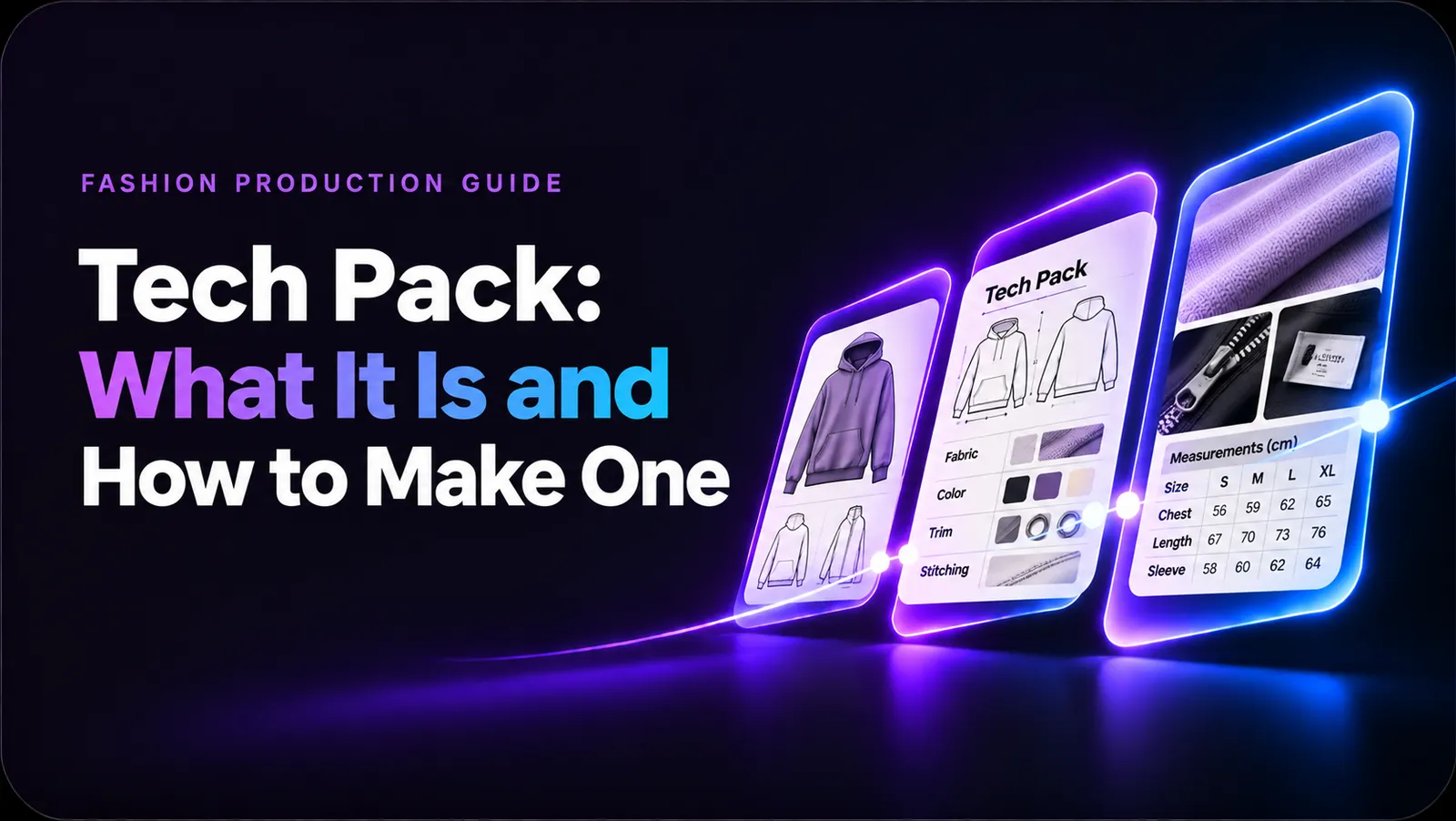
A tech pack is a production document that tells a clothing manufacturer exactly how to make a garment. It combines technical drawings, measurements, fabric specifications, construction instructions, trims, artwork, tolerances, and packaging details in one organized file.
A tech pack turns a visual concept into measurable production instructions. Without one, terms such as “oversized,” “boxy,” or “heavyweight” can be interpreted differently by the factory, causing inaccurate samples, inconsistent bulk orders, and expensive rework.
This guide explains what a tech pack includes, how it differs from a sewing pattern, how to make one step by step, and how to decide whether to create it yourself or work with a technical designer.
What Is a Tech Pack?
A tech pack, short for technical package, is a specification document used to communicate a garment’s production requirements.
It acts as a shared reference for the brand, pattern maker, sample room, and factory. A complete tech pack may include:
- Technical flats
- Points of measurement (POM)
- Size specifications
- Grading instructions
- Bill of materials (BOM)
- Fabric composition and weight
- Color and Pantone references
- Sewing and construction details
- Print and embroidery placement
- Labels and packaging instructions
- Tolerances and revision notes
For example, “oversized hoodie” describes a design direction, but it does not tell a factory the chest width, body length, shoulder drop, sleeve length, hood height, cuff opening, or acceptable measurement tolerance.
The purpose of a tech pack is to remove guesswork from production.
Tech Pack vs. Sewing Pattern: What Is the Difference?
A tech pack explains how a garment should be produced, while a sewing pattern provides the shapes used to cut the fabric.
Document | Main Purpose | Typical Contents |
|---|---|---|
Tech pack | Communicate production requirements | Measurements, materials, construction, trims, artwork |
Sewing pattern | Create fabric pieces for cutting and assembly | Pattern shapes, seam allowances, notches, grain lines |
Design sketch | Show the intended appearance | Silhouette, styling, color, visual details |
Mood board | Establish creative direction | References, textures, colors, visual inspiration |
A tech pack does not automatically include a production-ready pattern. In many workflows, the pattern maker uses the tech pack, design references, and fit requirements to create or adjust the pattern.
What Should a Clothing Tech Pack Include?
1. Cover Page and Style Information
Begin with:
- Brand name
- Style name and style number
- Product category
- Collection or season
- Version number
- Revision date
- Sample stage
- Contact information
Version control helps prevent a factory from using an outdated measurement chart or artwork file.
2. Technical Flats
Technical flats are clean two-dimensional drawings showing the garment from the front and back.
Add enlarged detail views for:
- Necklines
- Cuffs
- Pockets
- Hoods
- Closures
- Panels
- Seams
- Hem finishes
A fashion illustration shows how the garment looks. A technical flat should show how it is constructed.
3. Measurement Specification and POM
The measurement chart defines the finished garment dimensions. Common points of measurement include:
- Chest width
- Body length
- Shoulder width
- Sleeve length
- Bottom opening
- Neck width
- Hood height
- Cuff opening
Define how each measurement is taken. Also include a tolerance for every measurement so the factory knows what deviation is acceptable.
4. Size Grading
If the garment is sold in multiple sizes, specify how measurements change from one size to the next.
Measurement | XS | S | M | L | XL |
|---|---|---|---|---|---|
Chest width | Spec | Spec | Spec | Spec | Spec |
Body length | Spec | Spec | Spec | Spec | Spec |
Sleeve length | Spec | Spec | Spec | Spec | Spec |
Different garment types require different grading logic. Do not assume every measurement should increase equally.
5. Bill of Materials
The BOM lists every material and component used in the garment:
- Main fabric
- Contrast fabric
- Lining
- Thread
- Zippers
- Buttons
- Snaps
- Elastic
- Drawcords
- Labels
- Interfacing
- Packaging materials
Specifications should be precise. “Size 5 zipper” may be incomplete because the factory may also need the material, length, color, finish, and puller style.
6. Fabric and Color Details
Record:
- Fiber composition
- Fabric construction
- Weight or GSM
- Stretch percentage
- Finish
- Shrinkage requirements
- Color reference
- Pantone code, when applicable
Describe special washes, coatings, brushed surfaces, or pre-shrunk treatments separately.
7. Construction and Sewing Instructions
Explain:
- Seam type
- Seam allowance
- Stitch type
- Stitch density
- Thread color
- Topstitch placement
- Seam reinforcement
- Hem construction
- Binding
- Overlock or coverstitch requirements
Small omissions can create large production inconsistencies. An unclear neckline instruction, for example, may lead to different construction methods within the same order.
8. Artwork, Print, and Embroidery
Include:
- Final artwork files
- Placement measurements
- Print method
- Print size
- Ink or thread colors
- Embroidery density
- Appliqué details
- Minimum distance from seams
Specify whether placement is measured from the neckline, center front, side seam, pocket, or another fixed reference point.
9. Labels, Packaging, and Carton Information
Add instructions for:
- Main labels
- Size labels
- Care labels
- Hangtags
- Polybags
- Stickers
- Folding method
- Carton quantities
- Carton markings
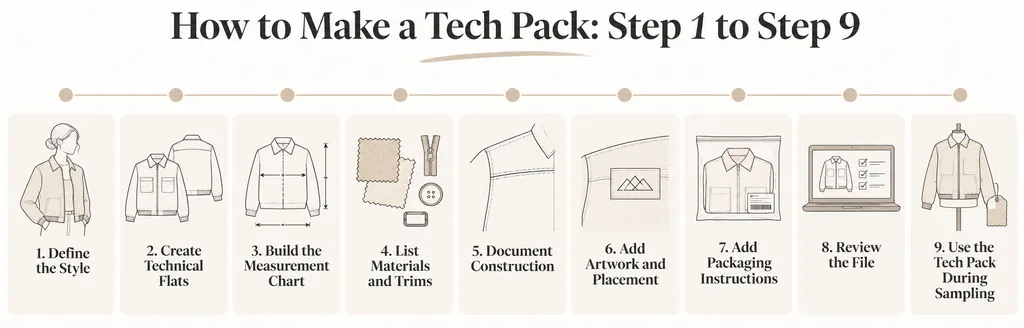
How to Make a Tech Pack Step by Step
Step 1: Define the Style
Record the product name, intended fit, target customer, size range, colorways, and product category. Replace vague descriptions with measurable requirements.
Step 2: Create Technical Flats
Draw the front and back views, then add close-ups for construction details. Use numbered callouts that match the written instructions.
Step 3: Build the Measurement Chart
Choose the relevant points of measurement and define the measurement method, base size, grading, tolerances, and unit.
Step 4: List Materials and Trims
Create a BOM identifying every material and component. Add color codes, dimensions, supplier references, and approved alternatives when applicable.
Step 5: Document Construction
Describe seams, stitches, hems, reinforcement, closures, pockets, collars, cuffs, and other structural details. Use diagrams when words are not enough.
Step 6: Add Artwork and Placement
Attach final print or embroidery files. Specify size, color, production method, placement, and clearance from seams.
Step 7: Add Packaging Instructions
Explain how the garment should be folded, labeled, packed, and shipped.
Step 8: Review the File
Ask a technical designer or factory whether the instructions are complete, measurable, and producible.
Step 9: Use the Tech Pack During Sampling
A tech pack does not replace a sample. Compare the sample against the document, record deviations, and update the file after each approved revision.
Can You Make a Tech Pack Yourself?
You can create a basic tech pack yourself if the garment is simple and you understand measurements, materials, and construction.
Common tools include:
- Illustrator or Inkscape for technical flats
- Excel or Google Sheets for measurement charts and BOMs
- Figma for layout and collaboration
- Specialized garment software for technical development and grading
A template organizes information, but it cannot decide the correct measurements, sewing method, or material specifications for you.
DIY work becomes riskier when the garment includes complex construction, stretch fabrics, tailoring, multiple panels, specialized washes, or complicated grading. These products usually benefit from a garment technician or technical designer.
You can use Virse to explore silhouettes, colorways, print directions, and visual references before converting the concept into a technical document.
Should You Hire a Freelancer or Technical Designer?
Fiverr and Upwork can be useful for simple styles or early-stage concept development. Before hiring someone, check:
- Garment construction knowledge
- Portfolio quality
- Experience with similar products
- Measurement and grading coverage
- Revision policy
- Factory communication skills
- Editable final file formats
A low-priced file may still require professional correction if it lacks accurate construction details or production-ready measurements.
For complex garments, a specialist garment technician is generally safer than a general graphic designer.
How Much Does a Tech Pack Cost?
The cost depends on:
- Garment complexity
- Number of colorways
- Size range
- Artwork requirements
- Grading requirements
- Number of revisions
- Whether pattern development is included
A simple T-shirt may need a straightforward specification. A jacket, tracksuit, lined dress, or technical outerwear product usually requires more specialist input.
The key question is whether the document reduces sampling errors, supplier confusion, and bulk-production risk.
How Do You Check Whether a Tech Pack Is Production Ready?
Before sending it to a factory, check that:
- Every style has a unique name and version number.
- Front, back, and detail flats are included.
- Important measurements have defined POMs.
- Sizes, grading, and tolerances are documented.
- Every fabric and trim appears in the BOM.
- Zippers, buttons, labels, and cords have complete specifications.
- Construction instructions explain seams, hems, and reinforcement.
- Artwork includes size, placement, and production method.
- Packaging requirements are clear.
- The factory can identify the current files.
- The document has been checked against the first sample.
FAQs
Is a tech pack the same as a clothing pattern?
No. A tech pack communicates production requirements, while a pattern provides the shapes used to cut fabric. Both may be needed to manufacture a finished product.
Can a factory create my tech pack?
Some factories offer technical design services, but the brand should review and approve the specifications. Otherwise, the factory may choose materials, measurements, or construction methods that do not match the design intent.
Do I need a tech pack for every clothing item?
You should create a separate style document for each distinct garment. Shared components can be referenced, but each garment still needs its own measurements, construction details, and artwork placements.
Can AI generate a complete tech pack from an image?
AI can help create initial sketches, organize information, and suggest specification fields. It cannot reliably determine every hidden construction detail, exact measurement, tolerance, or production constraint from a single image. Human technical review is still necessary.
Does a tech pack replace a sample?
No. A tech pack communicates target specifications, while sampling verifies how those specifications work in an actual garment. The approved sample and latest tech pack should agree before bulk production.
What software is best for making a tech pack?
There is no single required tool. Illustrator is useful for technical flats, Excel works well for measurement tables, and Figma can organize collaborative documents. The quality of the specifications matters more than the software used.
Conclusion
A strong tech pack gives a factory measurable instructions instead of assumptions. When measurements, materials, construction, artwork, packaging, and revisions are documented clearly, the first sample becomes easier to evaluate and bulk production becomes more consistent.