What Is MiniMax H3 Max? Fal's Faster H3 Explained
Vincent10 min read ·
MiniMax H3 Max is fal’s post-trained and inference-optimized version of the open-weight MiniMax H3 video model. fal reports that it can generate a five-second video in under three seconds and deliver roughly 35× the throughput of MiniMax’s official H3 endpoint. Crucially, this is a full-system result involving post-training and a custom inference stack, not proof that an H3 Max checkpoint will run 35× faster on every GPU.
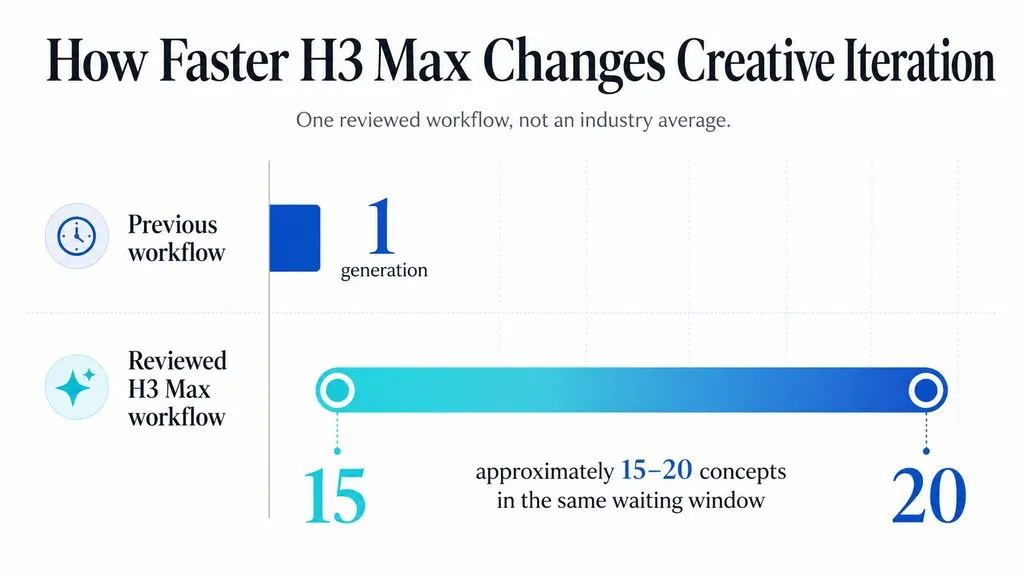
The bigger change is workflow. In one reviewed case, faster generation turned a previous one-render waiting window into roughly 15–20 concept variations. The bottleneck shifts from waiting to comparing ideas, maintaining consistency, and choosing which concept deserves a final render.
This is where Virse becomes useful. Virse combines AI agents with an infinite canvas, allowing designers to organize references, connect assets, run multiple agents in parallel, and work from shared project context and long-term memory. Instead of turning H3 Max’s speed into dozens of disconnected outputs, Virse helps teams turn rapid generation into a structured workflow for exploring, comparing, and refining the strongest creative direction. MiniMax H3, Seedance 2.5 and Seedance 2.0 are now available on Virse, so teams can explore and compare multiple leading video models in the same creative workflow

What Is H3 Max and Who Made It?
H3 Max starts with MiniMax H3, but it is more accurate to describe it as fal’s H3 derivative than as a separate MiniMax foundation-model release.
How fal Changed MiniMax H3
Fal says it started with the open-weight H3 model and performed additional post-training with new data, focusing on prompt adherence and visual quality. The model was developed alongside fal’s inference optimization work rather than being treated as a finished checkpoint that was optimized later.
The clearest definition is therefore:
H3 Max = post-trained MiniMax H3 + fal’s optimized inference system.
Is H3 Max Just a Turbo LoRA?
The available evidence does not support that description.
The wider H3 ecosystem already uses accelerators such as reduced steps, alternative attention implementations, precision changes, and Turbo-style methods. H3 Max is broader because fal combines model-level training with runtime and serving optimization.
Why Is H3 Max So Fast?
H3 Max speed is best understood as model-system co-optimization, not one acceleration trick.
Post-Training and Inference Were Developed Together
fal states that model research and inference engineering were connected throughout development. The goal was not simply minimum latency, but higher throughput while preserving the quality improvements from post-training.
This distinction matters because making a video model faster by reducing precision or sampling work can also reduce output quality. fal says optimizations were retained only when they continued to satisfy its internal preference evaluations.
Why Infrastructure Matters
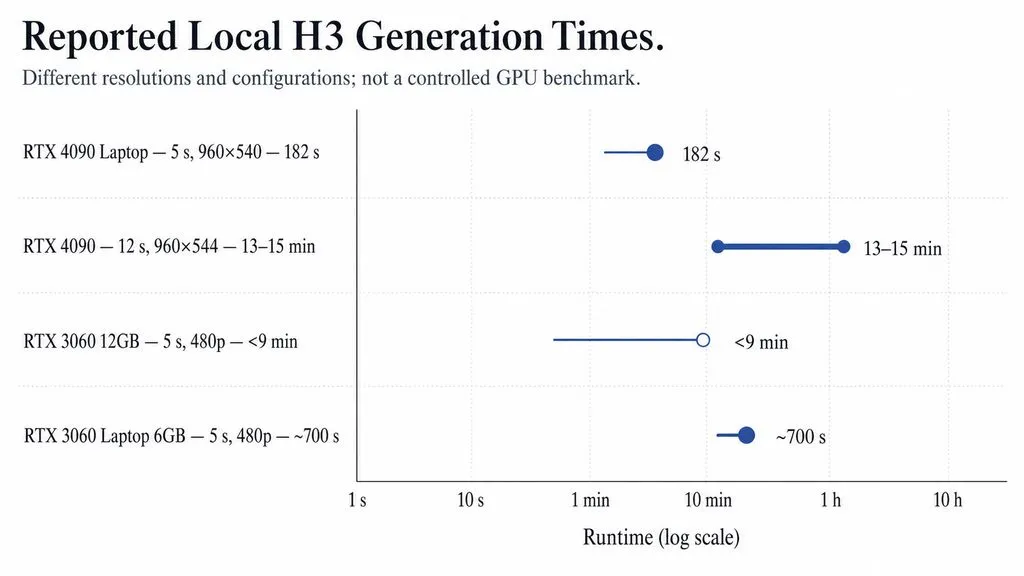
Local H3 results show how strongly system configuration affects performance.
Our review found examples including:
- 5 seconds at 960×540 in 182 seconds on a 4090 Laptop
- 12 seconds at 960×544 in 13–15 minutes on an RTX 4090
- 5 seconds at 480p in under 9 minutes on a 12GB RTX 3060
- 5 seconds at 480p in about 700 seconds on a 6GB 3060 Laptop
These tests used different H3 workflows and should not be treated as a controlled GPU benchmark. Their value is showing why endpoint speed and checkpoint speed are not interchangeable concepts.
What Does H3 Max “35× Faster” Actually Mean?
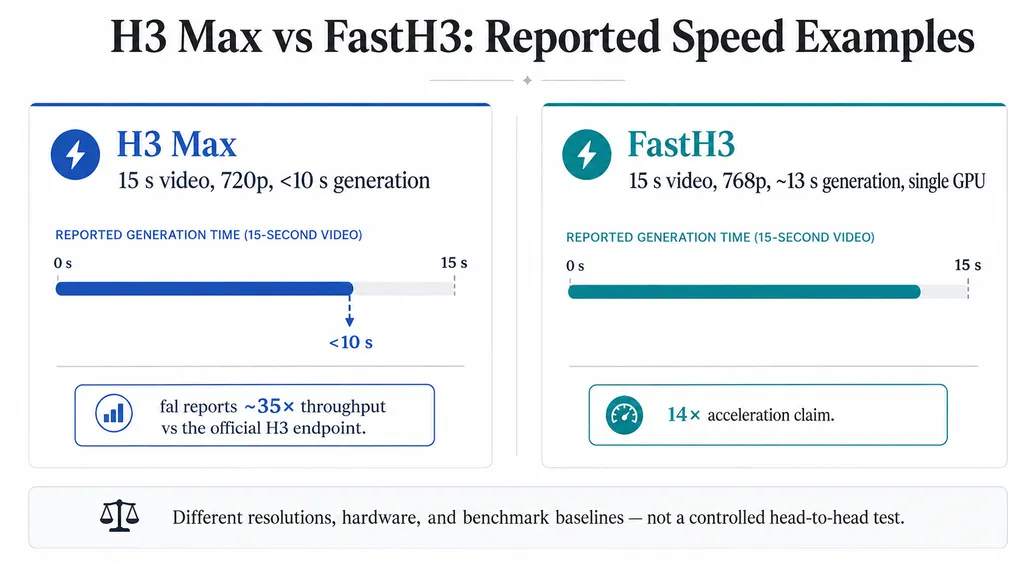
fal reports roughly 35× the throughput of the official MiniMax H3 endpoint while generating a five-second video in approximately three seconds.
35× Does Not Mean 35× Faster on an RTX 4090
Throughput measures how much work a system can process over time. It is not identical to the latency every individual request will experience.
More importantly, the comparison includes the post-trained model and fal’s inference stack. The current evidence does not show H3 and H3 Max running side by side on the same 4090 with H3 Max completing every job 35× faster.
For local users, the correct takeaway is: fal has demonstrated a dramatically faster H3-based production system, not a universal 35× consumer-GPU speedup.
Is H3 Max Really Faster Than Realtime?
Yes under some tested conditions, but not consistently across every reported workflow.
Five Seconds in Under Three Seconds
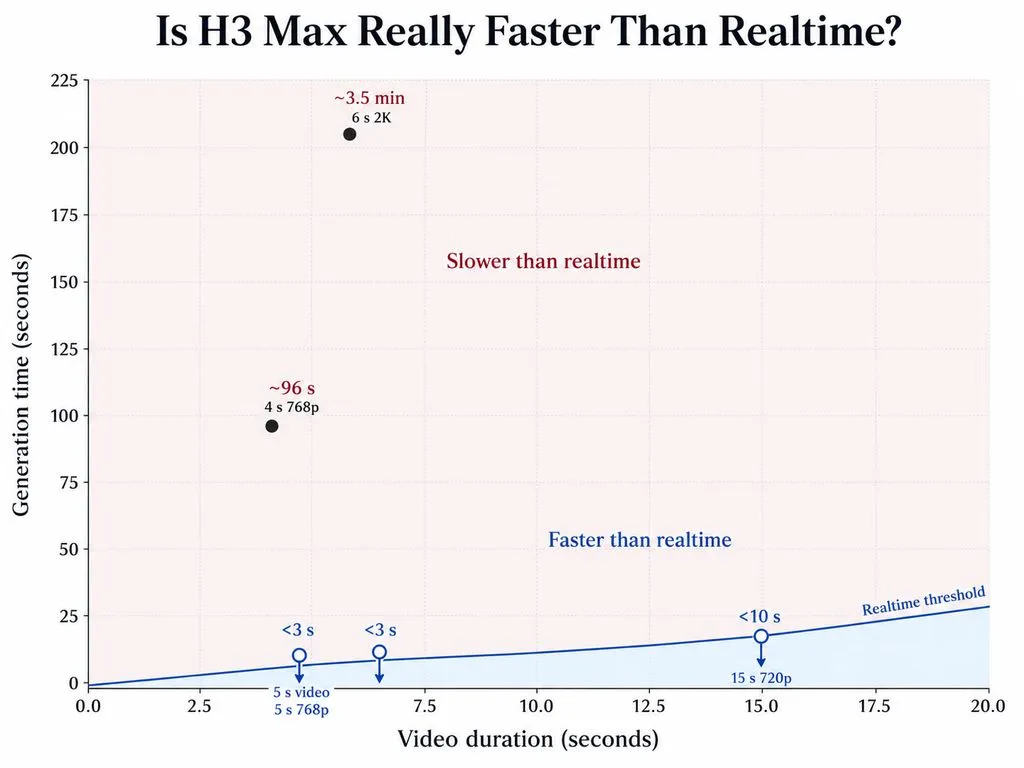
fal’s headline benchmark is a five-second video generated in under three seconds. A separate user test in our research reported a similar result for a five-second 768p clip.
Another case generated 15 seconds of 720p video in under 10 seconds in typical runs. That is a meaningful threshold because generation finishes before the viewer finishes watching the output.
Why Some H3 Max Generations Were Much Slower
Our review also found a contrasting API case:
Output | Reported Generation Time |
4-second 768p video | About 96 seconds |
6-second 2K video | About 3.5 minutes |
The research does not establish exactly what caused the slowdown, so it would be misleading to attribute it to queueing, hardware, or one specific API condition.
The practical conclusion is that faster-than-realtime is a demonstrated capability, not a universal latency guarantee.
What Are the H3 Max Specs and Capabilities?
Fal currently exposes H3 Max through text-to-video and image-to-video workflows. Its API documentation lists 480p and 768p native generation options, with 768p as the default, and supports aspect-ratio control for text-to-video. The image-to-video route can use a starting image and optionally an ending image for first-to-last-frame generation.
Fal also states that H3 Max preserves H3’s unified multimodal context and natively synchronized audio and video capabilities after post-training.
For creative teams, this makes H3 Max relevant not only to prompt-based generation but also to image animation, storyboard development, shot exploration, and controlled visual sequences.
How Does H3 Max Improve AI Video Workflows?
The most useful H3 Max metric may be iterations per minute, not seconds per clip.
From One Render to 15–20 Concept Variations
One workflow in our research reported enough speed to explore approximately 15–20 concepts within a previous one-generation waiting window.
That enables teams to test camera direction, action, composition, lighting, pacing, and alternative interpretations of the same brief before committing to a final render.
From a design perspective, this is closer to sketching than traditional rendering.
The Best H3 Max Draft-to-Final Workflow
A practical workflow is:
- Generate multiple H3 Max drafts
- Compare camera, motion, timing, and composition
- Reject weak directions quickly
- Select the strongest concept
- Use a higher-cost or slower model only when additional final-shot quality is needed
Across the production patterns we reviewed, Seedance and Kling were sometimes used for selected hero shots after creative direction had already been established with a faster model.
H3 Max Quality: Does Speed Reduce Video Quality?
The evidence is less consistent on quality than on speed.
Where H3 Max Performs Well
fal reports that H3 Max ranked strongly in its own human preference evaluations for overall quality, prompt understanding, and aesthetics.
Across the cases in our research, H3 Max also showed value for dynamic scenes, multi-cut instructions, prompt adherence, audio, and rapid visual exploration.
Where Quality Can Still Vary
Our review also found concerns around anatomy, natural human movement, and robotic-looking behavior in some outputs.
That suggests a practical distinction: H3 Max is particularly compelling when rapid visual decision-making matters, but anatomy-critical or highly nuanced hero shots may still benefit from model comparison before final production.
H3 Max vs H3: Which Should You Use?
Factor | H3 | H3 Max |
Model | Original H3 | fal post-trained H3 |
Main strength | Open model control | Fast hosted iteration |
Local workflow | Strong | Downloadable checkpoint not verified |
Speed | Often minutes locally | Seconds in optimized fal tests |
Best use | Local research and customization | Previz and rapid exploration |
Choose H3 when local control, custom optimization, or model experimentation matters most.
Choose H3 Max when the main bottleneck is waiting for generations and you want a hosted workflow optimized for iteration.
H3 Max vs FastH3: Hosted Speed or Open Control?
FastH3 addresses a similar problem from a more open deployment direction.
Its development team reported 15 seconds of 768p video in about 13 seconds on a single GPU, together with a claimed 14× acceleration. Another reported FastH3 configuration produced different timings, so these numbers should not be merged into one universal benchmark.
The better comparison is strategic:
H3 Max optimizes the hosted experience. FastH3 emphasizes accelerated open ownership.
Teams prioritizing immediate creative throughput may prefer H3 Max. Developers prioritizing local deployment, privacy, or control over the inference stack may prefer an open route such as FastH3.
Can H3 Max Run Locally on an RTX 4090?
At publication time, fal’s hosted H3 Max text-to-video and image-to-video endpoints are verifiable, but our review did not verify an official downloadable H3 Max checkpoint from fal.
Even if downloadable weights become available, a 4090 should not be expected to reproduce fal’s hosted benchmark automatically.
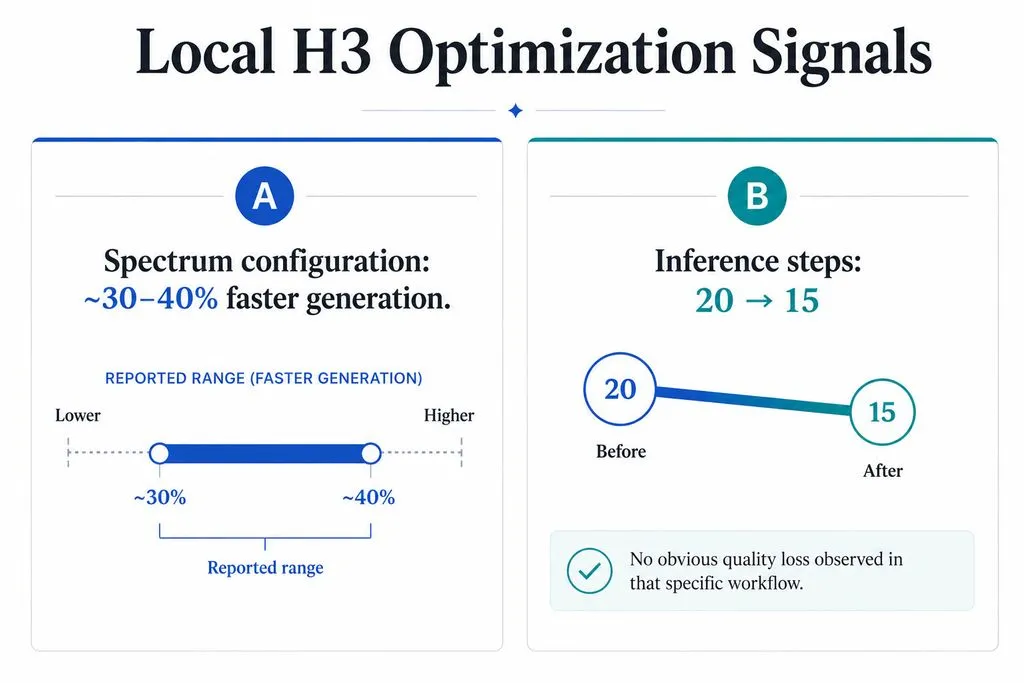
Local H3 speed can vary substantially with VRAM, system RAM, precision, offloading, attention backend, resolution, and step count. In our research, one Spectrum configuration reported approximately 30–40% faster generation, while another workflow reduced inference from 20 to 15 steps without an obvious quality loss in that specific test.
Can H3 Max Enable Real-Time AI Video?
H3 Max makes real-time generative video more plausible, but peak speed alone is not enough.
A continuous generative stream also needs predictable latency, consistent characters, stable environments, temporal coherence, and sustained throughput.
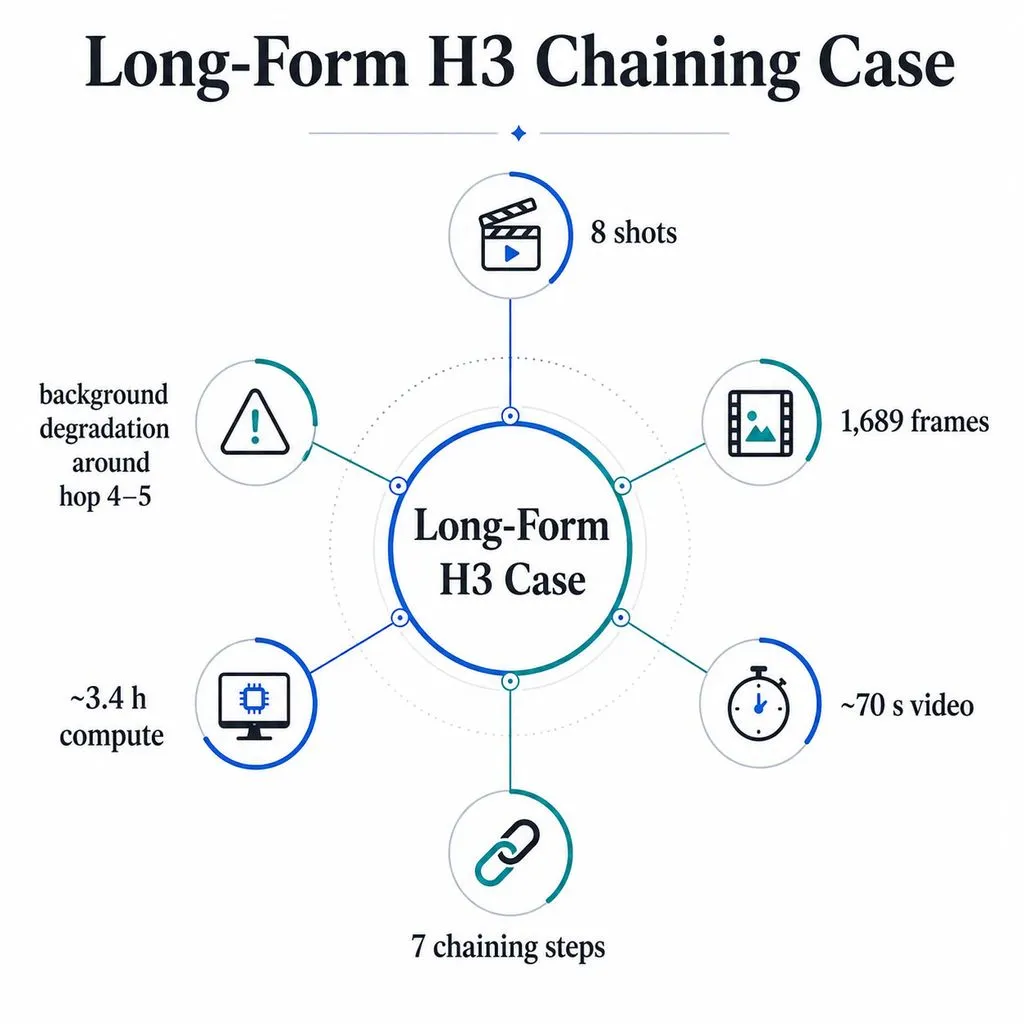
Our research into longer H3 workflows found one chained experiment producing 8 shots, 1,689 frames, about 70 seconds of video, and seven chaining steps over roughly 3.4 hours. Background degradation became more visible around the fourth or fifth hop.
This reveals the next bottleneck: once generation becomes fast, continuity becomes more important.
Who Should Use H3 Max?
H3 Max is most useful when creative iteration is the bottleneck.
Designers can explore visual directions, directors can test camera movement, advertising teams can produce multiple concepts, and storyboard or previz workflows can reject weak ideas before expensive final generation.
It is less clearly suited to teams that require fully local deployment, highly predictable real-time latency, deep checkpoint customization, or anatomy-critical output without additional comparison.
The strongest use case is therefore not replacing every video model with H3 Max. It is using H3 Max before the final creative decision, where speed produces the greatest workflow advantage.
FAQ
What is H3 Max?
H3 Max is fal’s post-trained H3 variant combined with an optimized inference system. fal reports a five-second video in under three seconds and roughly 35× the throughput of the official H3 endpoint. The speed claim applies to the optimized hosted system rather than proving a 35× checkpoint-only acceleration.
Is H3 Max really 35× faster?
fal reports about 35× higher throughput versus the official H3 endpoint. Our review also found faster-than-realtime results, but slower cases exist. The figure should therefore be understood as a system-level throughput comparison, not a guarantee that every H3 Max request or local GPU setup will run 35× faster.
Can H3 Max run on a 4090?
There is no verified H3 Max 4090 benchmark in our current research. fal’s fastest numbers rely on its optimized inference environment, so local weights alone would not reproduce those results automatically. Base H3 performance on 4090-class systems varies substantially depending on resolution, memory, offloading, and software configuration.
H3 Max vs FastH3: which is better?
Use H3 Max when fast hosted iteration is the priority. FastH3 is more relevant when open weights and local control matter. FastH3 developers reported about 13 seconds for a 15-second 768p clip in one test, but hardware and benchmark conditions differ, so direct speed comparisons require caution.
Conclusion
H3 Max matters because it shifts AI video from slow batch rendering toward interactive creative iteration. The sub-three-second five-second result and roughly 35× throughput claim are technically impressive, but the larger change is workflow: when teams can explore many visual directions before committing to one, generative video becomes a tool for creative decision-making rather than simply final rendering. H3 Max is already compelling for concept development, previz, camera testing, scene blocking, and rapid drafts, while local performance, latency consistency, anatomy-sensitive final shots, and long-form continuity still require careful evaluation. Its strongest role today is as a high-speed creative iteration layer that helps teams reach better final decisions faster.