Wan 3.0 vs Wan 3.0 Prime: Faster, but Worth the Cost?
Vincent10 min read ·
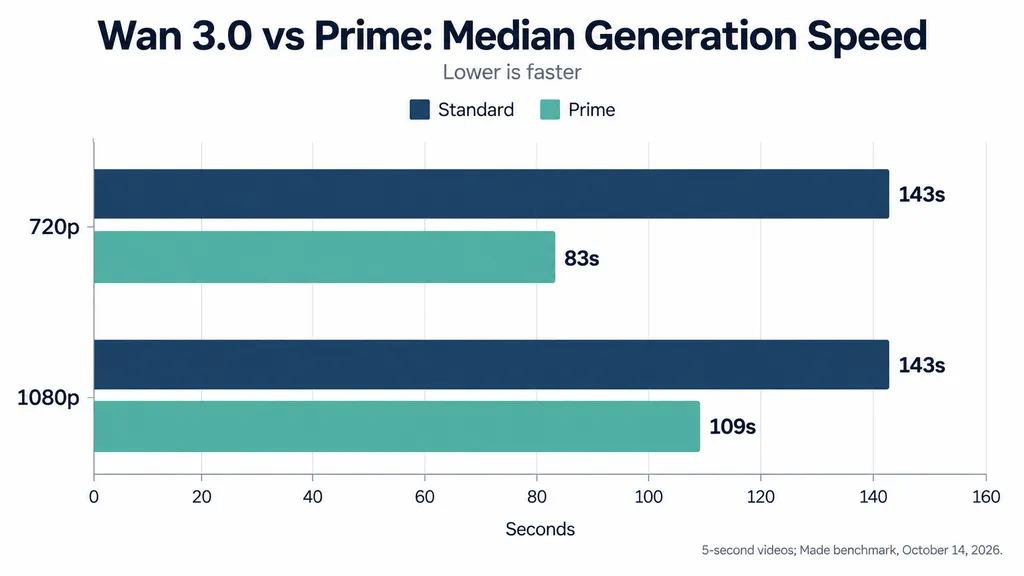
Wan 3.0 Prime is faster than standard Wan 3.0, but it costs more without a proven video-quality advantage. In an October 14, 2026 benchmark, Prime generated five-second 720p videos in a median 83 seconds versus 143 seconds for Standard, making it 1.72× faster. At 1080p, Prime was 1.31× faster. Standard remains the more economical starting point for budget-conscious creators.
But faster generation doesn't guarantee a faster finished video. Inaccurate motion, character inconsistency, unexpected scene changes, and repeated retries can erase Prime's time savings. The real question is whether faster output justifies the extra expense when Wan 3.0 prompt accuracy, reference reliability, and the cost of usable videos matter most.
Great AI video production requires more than choosing the fastest model. Virse brings 50+ creative AI models, visual references, and iterative workflows into one connected canvas. With video models including Seedance 2.5 and Kling 3.0, creators can explore visual directions, compare outputs, and preserve creative context without constantly switching tools. Start creating with Virse and make every iteration count.
Wan 3.0 vs Wan 3.0 Prime: What Are the Key Differences?
Wan 3.0 Prime is the accelerated variant of Wan 3.0, designed to reduce generation time rather than introduce a separate high-quality tier. Both versions share core text-to-video and image-to-video capabilities, while specific workflow availability depends on the provider.
Feature | Wan 3.0 Standard | Wan 3.0 Prime |
Main advantage | Lower cost | Faster generation |
720p median time | 143s | 83s |
1080p median time | 143s | 109s |
720p API rate example | $0.10/s | $0.15/s |
Resolutions | 480p–1080p | 480p–1080p |
Maximum listed duration | 30s | 30s |
Text-to-video | Supported | Supported |
Image-to-video | Supported | Supported |
Reference-to-video | Supported | Provider-dependent |
Native audio | Supported | Supported |
Proven quality advantage | Not established | Not established |
Speed: Made, October 14, 2026. API prices: WaveSpeedAI, September 5, 2026. Features and pricing vary by provider.
What Does Wan 3.0 Prime Actually Improve?
Prime's clearest advantage is reduced generation latency. WaveSpeedAI's September comparison describes equivalent parameters for supported Standard and Prime workflows, so creators can reuse compatible prompts and settings.
Consider a product advertisement showing a perfume bottle rotating under studio lighting. Both variants can generate the scene, but Prime may return the draft sooner.
That doesn't establish better product geometry, cleaner reflections, or more accurate movement.
Prime improves turnaround speed in documented tests, not guaranteed creative quality.
Wan 3.0 vs Prime Speed Test: How Much Faster Is Prime?
Made published a side-by-side benchmark on October 14, 2026, using five matched prompts per resolution.
Both variants received identical seeds, durations, aspect ratios, audio settings, and prompt-expansion configurations through fal endpoints. Requests were submitted simultaneously, with queue waits under six seconds.
Each prompt was tested once per variant and resolution. The results are useful comparisons, not guaranteed performance across every provider.
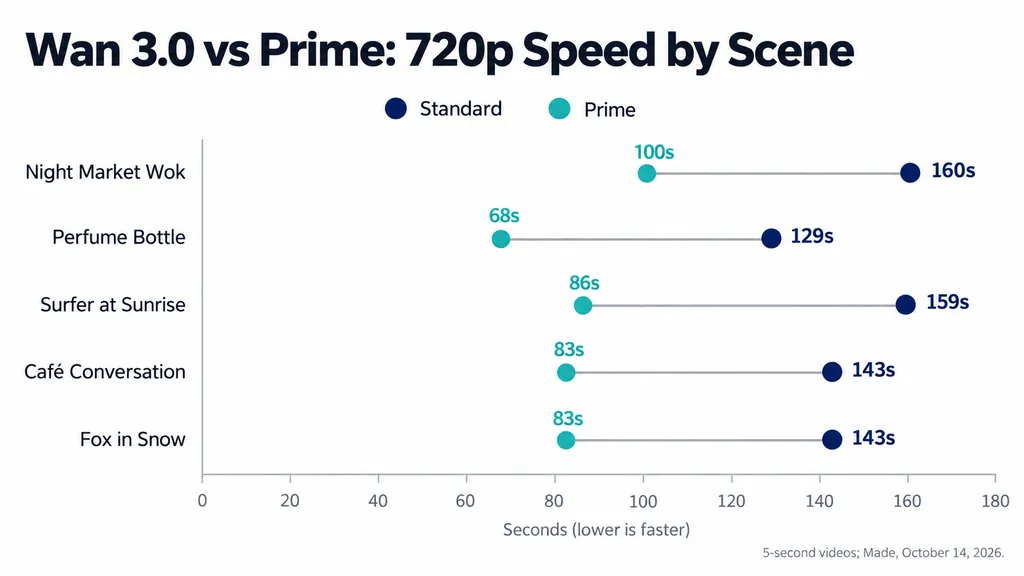
Wan 3.0 vs Prime: 720p Generation Speed
Test scene | Standard | Prime |
Night market wok | 160s | 100s |
Perfume bottle | 129s | 68s |
Surfer at sunrise | 159s | 86s |
Café conversation | 143s | 83s |
Fox in snow | 143s | 83s |
Median | 143s | 83s |
Prime reduced median waiting time by approximately 42%, saving 60 seconds per five-second video.
The perfume-bottle scene showed a 61-second advantage, while the night-market scene saved 60 seconds.
These prompts covered product visuals, human interaction, environmental motion, and moving cameras.
For five sequential concept generations, applying the reported medians gives an illustrative total of 715 seconds for Standard versus 415 seconds for Prime.
That represents five minutes of potential waiting-time savings, assuming similar conditions.
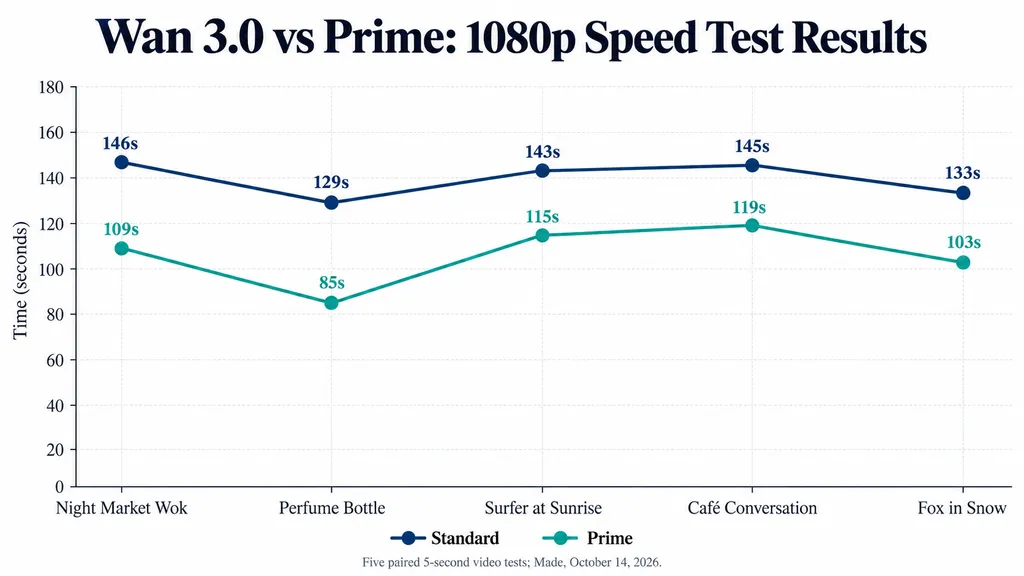
Wan 3.0 vs Prime: 1080p Generation Speed
Test scene | Standard | Prime |
Night market wok | 146s | 109s |
Perfume bottle | 129s | 85s |
Surfer at sunrise | 143s | 115s |
Café conversation | 145s | 119s |
Fox in snow | 133s | 103s |
Median | 143s | 109s |
At 1080p, Prime saved 34 seconds at the median, representing approximately 24% less waiting time.
The perfume-bottle scene improved by 44 seconds, while the café scene improved by 26 seconds.
The acceleration advantage narrowed at higher resolution and varied across prompts.
Claims that Prime is universally five to seven times faster are not supported by this benchmark.
Why Can Prime Still Take Longer Than Expected?
Our review of documented user experiences identified a Prime Reference case involving a 15-second request that reportedly approached 45 minutes before cancellation.
A subsequent attempt reportedly failed to follow the intended instructions.
This isolated experience does not establish typical Prime latency. It illustrates how service delays and unsuccessful generations can undermine faster processing.
For production planning, distinguish generation time from time to usable video, which includes waiting, review, corrections, and retries.
Wan 3.0 vs Prime Video Quality: Does Faster Mean Better?
There is insufficient controlled evidence to conclude that Prime consistently improves, matches, or reduces visual quality compared with Standard.
Made's five paired comparisons found no consistent visual winner. Matching seeds produced different takes, making exact frame-by-frame matching inappropriate.
The useful question is whether each output meets the creative brief.
Visual Realism and Character Consistency
Visual quality involves lighting, materials, anatomy, camera continuity, and subject identity.
In one documented character-reference case, four images of the same woman were supplied, but the resulting video reportedly changed her facial identity.
The report did not isolate Standard against Prime. It therefore cannot establish a comparative identity-preservation advantage.
For character-driven advertising, inspect facial features, clothing, proportions, and background details throughout the video.
A convincing opening frame does not guarantee a usable final sequence.
Prompt Following and Motion Accuracy
Our review also identified two instructive production scenarios.
One reported 30-second continuous-shot request introduced unwanted cuts when character actions changed. Another involved a 14-second video reference followed by an unexpected visual transition.
Neither case provides a controlled variant comparison, but both highlight weaknesses that generation speed cannot solve.
For example, an advertisement may require someone to lift a bottle, rotate it toward the camera, and place it on a table. Missing the final action can make an otherwise realistic clip unusable.
Evaluate prompt compliance, motion fidelity, and visual realism separately.
Wan 3.0 vs Prime Pricing: Is Faster Generation Worth the Cost?
Prime generally costs more, but its price premium varies by provider and billing system.
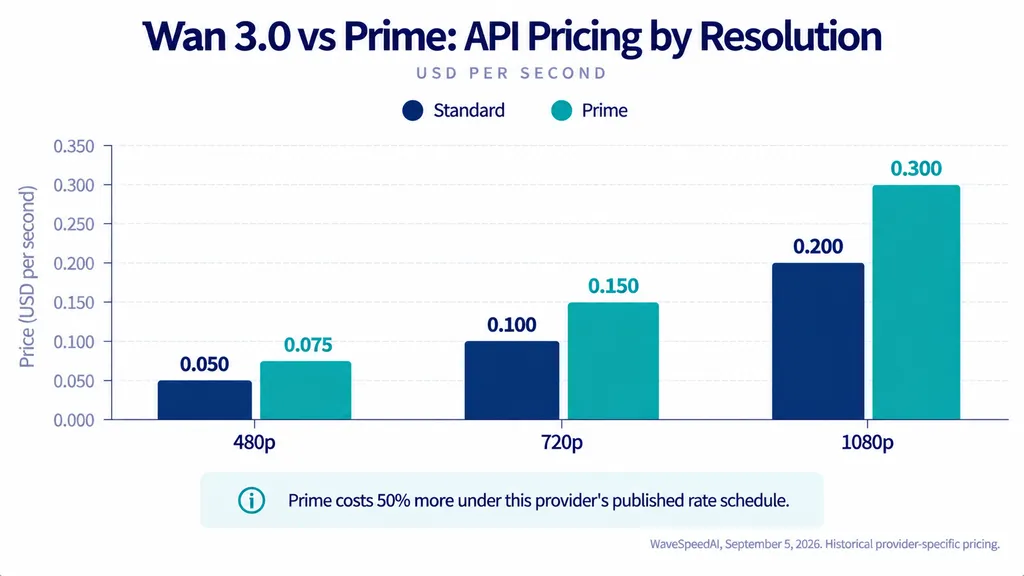
WaveSpeedAI's September 2026 schedule charged 50% more for Prime. Made's typical-generation example used 28 credits for Prime versus 20 for Standard, a 40% premium.
Another September provider snapshot showed different rates, confirming that pricing is not universal.
Wan 3.0 vs Prime API Pricing
Resolution | Standard / second | Prime / second |
480p | $0.05 | $0.08 |
720p | $0.10 | $0.15 |
1080p | $0.20 | $0.30 |
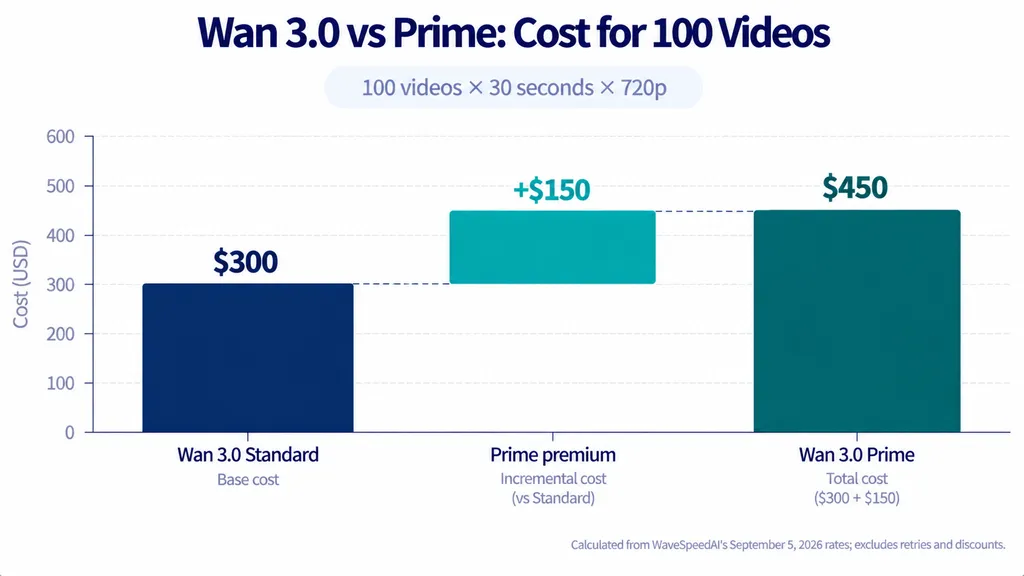
At these rates, a 30-second 720p generation costs $3.00 with Standard and $4.50 with Prime.
For 100 generations, the difference becomes $300 versus $450, excluding retries and discounts.
The additional expense buys faster processing under favorable conditions, not a guaranteed improvement in output acceptance.
Why Reference-to-Video Can Cost More
Reference-video inputs may add billable duration.
Under WaveSpeedAI's published reference-to-video billing example, generating five seconds of 720p output using five seconds of source video produces 10 billable seconds.
Model | Example cost |
Standard | $1.00 |
Prime | $1.50 |
Reference images and audio do not add duration-based charges under that historical schedule.
However, Prime Reference availability must be confirmed with the chosen provider. WaveSpeedAI's current public Wan Studio listing explicitly advertises Prime text-to-video and image-to-video, but not a Prime Reference endpoint.
Cost per Usable Video: The Real Economic Test
Cost per usable video = Total generation spending ÷ Number of accepted videos.
Our review identified an account involving more than 1,000 platform tokens reportedly consumed during unsuccessful Wan generations.
This was not a controlled Prime-specific test, and platform tokens cannot be converted into API dollars without the corresponding billing rules.
The underlying financial problem remains relevant: technically completed but rejected outputs can increase production costs.
At a 50% per-attempt premium, Prime would need an acceptance rate greater than 1.5 times Standard's to deliver a lower direct cost per accepted video, assuming equivalent billing conditions.
This is a break-even calculation, not an observed Prime acceptance-rate advantage.
Wan 3.0 Prime Reliability: What Do Real Production Cases Reveal?
Our review of documented production experiences identified delays, unexpected reference behavior, and costs associated with unsuccessful generations.
These individual accounts help identify risks but do not establish model-wide failure rates.
Case 1: Unexpected Generation Delays
The reported Prime Reference request that approached 45 minutes demonstrates why isolated speed benchmarks cannot guarantee delivery times.
A separate account described a $200 monthly subscription alongside approximately five to six hours of service-capacity difficulties.
The evidence does not establish that Prime itself caused either problem.
Provider infrastructure, queue delays, and model execution should be evaluated separately.
Case 2: Reference Images Producing Unexpected Montages
Another documented reference workflow reportedly produced montage-like results rather than the requested coherent scene.
This can disrupt character-driven videos when multiple reference images compete to define identity, composition, and action.
A practical troubleshooting method is to give each reference a clear role, simplify motion instructions, and remove contradictory scene requirements.
These are diagnostic recommendations, not guaranteed fixes.
Case 3: Failed Generations and Lost Credits
Other reported incidents involved rejected requests and provider errors affecting several Wan variants.
Because the incidents were not isolated to Prime, they cannot establish a higher Prime failure rate.
However, they reinforce the importance of tracking unsuccessful attempts.
Record whether a generation failed technically, completed with unacceptable content, received a refund, or required another paid attempt.
The number of accepted outputs matters more than the number of completed requests.
Wan 3.0 vs Wan 3.0 Prime: Which Should You Choose?
Choose Prime when faster feedback has measurable value. Choose Standard when minimizing generation costs matters more than immediate turnaround.
Production scenario | Better starting choice |
Rapid concept exploration | Prime |
Budget experimentation | Standard |
Bulk social videos | Standard |
Deadline-driven content | Prime |
Character-consistent videos | Test both |
Complex reference motion | Test supported workflows |
Commercial delivery | Compare accepted outputs |
When Prime Makes Sense
Prime is valuable when someone must review an output before making the next creative decision.
A marketing designer exploring product angles, lighting, and camera movement may benefit from shorter iteration cycles.
The 720p benchmark provides the strongest evidence for that advantage.
However, a faster first draft is valuable only when subsequent outputs meet the requirements.
When Standard Makes Sense
Standard is generally preferable for asynchronous rendering and high-volume production.
For example, an ecommerce team generating numerous product variations may prioritize predictable costs over immediate feedback.
A practical approach is to develop concepts with Standard and reserve Prime for deadline-sensitive generations.
How to Run a Fair Comparison
A production-focused comparison should use matching prompts, reference assets, resolutions, durations, and providers whenever possible.
Record five measurements for each variant:
- Generation time
- Prompt compliance
- Visual and character consistency
- Retry count
- Total cost per accepted video
Use a predefined acceptance standard before reviewing the outputs.
Made's published paired videos and downloadable run records provide useful third-party reference material. However, they do not replace original testing for a specific commercial workflow.
The winner is the variant that produces an acceptable result with the best combination of time, quality, and cost.
FAQ
Is Wan 3.0 Prime faster than Wan 3.0?
Yes. In Made's October 14, 2026 benchmark, Prime was approximately 1.72× faster at 720p and 1.31× faster at 1080p for five-second videos. Actual performance depends on the provider, resolution, workload, and service conditions.
Does Wan 3.0 Prime have better quality?
No consistent visual-quality advantage has been demonstrated. The available paired comparison found no universal winner. Individual reports of identity changes, inaccurate motion, and reference problems do not establish comparative failure rates.
Is Wan 3.0 Prime worth the extra cost?
Prime is worth considering when faster feedback or deadline-sensitive production justifies its premium. Standard is generally more economical for budget-conscious experimentation and asynchronous batches. Compare retry costs, accepted-output rates, and total completion time before choosing.
What is the difference between Prime, Pro, I2V, and R2V?
Prime identifies the accelerated Wan variant. I2V means image-to-video, while R2V means reference-to-video. Pro may refer to a separate offering or provider-specific tier and should not automatically be treated as equivalent to Prime. Confirm workflow support and pricing on the selected platform.
Conclusion
Wan 3.0 Prime is the stronger starting choice for speed-sensitive video generation, while Standard offers better direct cost efficiency. The October 2026 benchmark demonstrates a meaningful Prime speed advantage, particularly at 720p, but current evidence does not establish superior visual quality, prompt accuracy, or reference consistency. Documented production cases involving long waits, unwanted motion, identity changes, and unsuccessful generations show why generation latency alone cannot determine the better option. For creators and commercial teams, the most reliable decision comes from comparing time to usable video, cost per accepted output, and prompt success rate under equivalent conditions. Prime earns its premium when faster iteration creates measurable workflow value; otherwise, Standard remains the more economical choice.