Lifestyle Product Photography: 20 Creative Ideas, Examples, and Tips
 Yifan Zhao21 min read ·
Lifestyle product photography places products in realistic environments to show how people use them in everyday life. Instead of displaying an item against a plain white background, it uses carefully styled settings, natural lighting, props, and contextual details to create images that communicate both product features and brand personality.
For ecommerce businesses, independent creators, and marketing teams, effective lifestyle photography can make products more relatable and help customers imagine owning them. However, achieving professional results requires more than attractive backgrounds. Lighting, composition, product positioning, color accuracy, and visual consistency all influence the final image.
This guide explores 20 lifestyle product photography ideas across different industries, with practical instructions for choosing props, camera angles, and lighting setups. It also covers affordable DIY techniques and AI-powered workflows for creating additional marketing visuals without building a new photography set for every campaign.
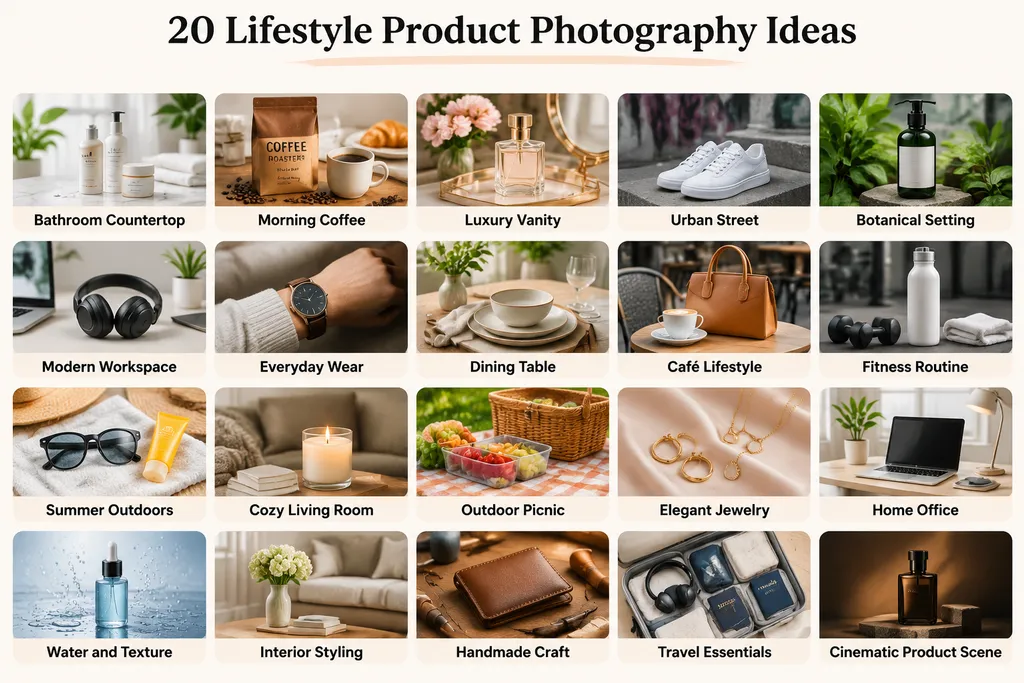
20 Lifestyle Product Photography Ideas for Different Products
The best lifestyle product photography connects an item with a recognizable environment or activity. The following ideas cover beauty, fashion, technology, food, home decor, and other popular product categories.
Bathroom Countertop Photography
<Insert image: Skincare bottles arranged on a marble bathroom countertop with soft morning light>
<AsyncImage query="premium skincare product photography bathroom marble countertop white towels natural window light" aspectRatio="16:9"/>
Bathroom scenes are particularly effective for skincare, cosmetics, soaps, and personal care products because they immediately communicate cleanliness and daily routines.
How to create the shot:
- Props: Marble trays, folded white towels, ceramic soap dishes, and small plants.
- Composition: Position the main product in the foreground and use bathroom accessories to create depth.
- Camera angle: Shoot at a 45-degree angle for a natural countertop perspective.
- Lighting: Use soft window light from the side to reveal packaging details without creating harsh shadows.
Creative variation: Add subtle water droplets to the packaging or countertop to communicate freshness, especially for facial cleansers and moisturizing products.
Morning Coffee Photography
<Insert image: Coffee packaging and ceramic cup on a wooden breakfast table>
<AsyncImage query="coffee bag product lifestyle photography ceramic cup breakfast table warm morning sunlight" aspectRatio="16:9"/>
Morning coffee photography creates an inviting atmosphere that works well for coffee brands, reusable cups, kitchen accessories, and food packaging.
How to create the shot:
- Props: Ceramic cups, coffee beans, pastries, wooden trays, and linen napkins.
- Composition: Place the coffee packaging beside a prepared cup to communicate the product's intended use.
- Camera angle: Use a 45-degree angle to capture both the packaging and tabletop details.
- Lighting: Use warm morning window light from one side.
Creative variation: Capture coffee being poured into a cup. The movement adds visual storytelling and makes the product feel more connected to an everyday routine.
Luxury Vanity Photography
<Insert image: Perfume bottle on an elegant vanity with silk fabric and flowers>
<AsyncImage query="luxury perfume bottle vanity product photography elegant mirror silk flowers soft lighting" aspectRatio="16:9"/>
Luxury vanity scenes are ideal for perfume, jewelry, cosmetics, and premium beauty products. Reflective surfaces and carefully selected materials help communicate elegance and exclusivity.
How to create the shot:
- Props: Glass trays, silk fabric, mirrors, flowers, and decorative containers.
- Composition: Keep the perfume bottle as the central subject with supporting props arranged around it.
- Camera angle: Shoot slightly below the bottle's centerline to emphasize its silhouette.
- Lighting: Use diffused side lighting and controlled highlights.
Creative variation: Place the product near a mirror to introduce reflections and visual depth without overcrowding the frame.
Urban Street Photography
<Insert image: Sneakers photographed against a textured urban concrete wall>
<AsyncImage query="sneaker lifestyle product photography urban concrete street architecture editorial" aspectRatio="16:9"/>
Urban environments work particularly well for sneakers, backpacks, streetwear, headphones, and accessories targeting younger audiences.
How to create the shot:
- Props: Concrete surfaces, benches, skateboards, bicycles, and streetwear accessories.
- Composition: Use architectural lines to guide attention toward the product.
- Camera angle: Try a low-angle shot to emphasize footwear and product proportions.
- Lighting: Use directional daylight to create stronger textures and shadows.
Creative variation: Photograph the product in an actual usage situation, such as sneakers beside a skateboard or headphones worn during a city walk.
Botanical Product Photography
<Insert image: Natural skincare packaging surrounded by green leaves and stone textures>
<AsyncImage query="botanical skincare product photography green leaves natural stone soft sunlight" aspectRatio="16:9"/>
Botanical photography is suitable for organic skincare, wellness products, sustainable packaging, and handmade cosmetics.
How to create the shot:
- Props: Fresh leaves, flowers, natural stone, wooden surfaces, and botanical ingredients.
- Composition: Use greenery around the edges of the frame while leaving the product clearly visible.
- Camera angle: Try a straight-on shot for packaging or a top-down flat lay for ingredient-based products.
- Lighting: Use soft natural light to preserve subtle green tones and material details.
Creative variation: Use ingredients associated with the product, such as aloe leaves for skincare or botanical extracts for natural cosmetics.
Modern Workspace Photography
<Insert image: Wireless headphones and notebook arranged on a minimalist desk>
<AsyncImage query="modern workspace product photography wireless headphones notebook minimalist desk" aspectRatio="16:9"/>
Workspace photography provides context for technology products, office accessories, productivity tools, and stationery.
How to create the shot:
- Props: Laptops, notebooks, desk lamps, coffee cups, and keyboards.
- Composition: Arrange the product within a functional workspace rather than displaying it separately.
- Camera angle: Use a three-quarter angle to show both the product and surrounding environment.
- Lighting: Combine window light with subtle fill lighting to avoid dark areas.
Creative variation: Show a person interacting with the product to communicate its functionality and intended audience.
Everyday Wear Photography
<Insert image: Luxury wristwatch worn on a person's wrist in a natural lifestyle setting>
<AsyncImage query="luxury wristwatch lifestyle photography wrist natural light casual fashion editorial" aspectRatio="16:9"/>
Showing a product being worn helps customers understand its scale, fit, and appearance in everyday situations.
This approach is effective for watches, bracelets, sunglasses, handbags, and fashion accessories.
How to create the shot:
- Props: Clothing, leather accessories, furniture, and everyday objects.
- Composition: Keep the product visible while including enough surrounding context to establish the lifestyle.
- Camera angle: Use close-up framing to emphasize product details.
- Lighting: Use soft directional light to preserve skin tones and reduce unwanted reflections.
Creative variation: Photograph the same accessory in different everyday environments to communicate its versatility.
Dining Table Photography
<Insert image: Ceramic dinnerware arranged on a styled dining table>
<AsyncImage query="ceramic dinnerware lifestyle product photography styled dining table linen natural light" aspectRatio="16:9"/>
Dining table photography works for ceramics, glassware, cutlery, kitchen accessories, and food brands.
How to create the shot:
- Props: Plates, glasses, linen napkins, cutlery, and fresh food.
- Composition: Arrange products as part of a complete dining setting.
- Camera angle: Use a top-down perspective for tableware layouts or a 45-degree angle for dimensional scenes.
- Lighting: Use diffused side lighting to reveal ceramic textures and food details.
Creative variation: Photograph a partially served meal to make the environment feel lived-in rather than artificially staged.
Café Lifestyle Photography
<Insert image: Designer handbag beside a coffee cup in a stylish café>
<AsyncImage query="designer handbag cafe lifestyle product photography coffee table editorial" aspectRatio="16:9"/>
Café environments communicate casual sophistication and everyday usability. They work especially well for handbags, sunglasses, notebooks, portable electronics, and fashion accessories.
How to create the shot:
- Props: Coffee cups, menus, wooden tables, magazines, and chairs.
- Composition: Place the product in the foreground and use the café environment as contextual background.
- Camera angle: Use a slightly elevated three-quarter view.
- Lighting: Position the product near a window and allow the background to remain softly illuminated.
Creative variation: Capture a person reaching for the product or using it naturally to introduce a human element.
Fitness Routine Photography
<Insert image: Reusable water bottle and fitness accessories inside a gym>
<AsyncImage query="fitness product photography reusable water bottle gym towel exercise accessories" aspectRatio="16:9"/>
Fitness scenes are useful for sportswear, reusable water bottles, gym bags, workout accessories, and wellness products.
How to create the shot:
- Props: Exercise mats, towels, dumbbells, gym bags, and sports equipment.
- Composition: Arrange products in a realistic workout environment.
- Camera angle: Use a low or three-quarter angle for a more dynamic composition.
- Lighting: Use directional lighting to emphasize textures and product contours.
Creative variation: Photograph the product during an actual workout rather than relying exclusively on static arrangements.
Summer Outdoor Photography
<Insert image: Sunglasses and sunscreen arranged on a beach towel under sunlight>
<AsyncImage query="summer beach lifestyle product photography sunglasses sunscreen beach towel sand" aspectRatio="16:9"/>
Summer scenes are ideal for sunglasses, sunscreen, swimwear, travel accessories, and seasonal products.
How to create the shot:
- Props: Beach towels, sunglasses cases, sand, water, and summer clothing.
- Composition: Use diagonal arrangements to create movement and avoid overly rigid layouts.
- Camera angle: Try a top-down flat lay for accessories or a low angle for outdoor scenes.
- Lighting: Shoot during softer morning or late-afternoon daylight.
Creative variation: Introduce water reflections or wet surfaces to create a stronger summer atmosphere.
Cozy Living Room Photography
<Insert image: Scented candle on a wooden coffee table in a cozy living room>
<AsyncImage query="scented candle home lifestyle product photography cozy living room warm neutral interior" aspectRatio="16:9"/>
A cozy living room provides a natural environment for candles, home fragrances, blankets, decorative accessories, and wellness products.
How to create the shot:
- Props: Books, cushions, blankets, wooden furniture, and decorative trays.
- Composition: Place the product within a comfortable interior arrangement.
- Camera angle: Shoot at seated eye level to create an inviting perspective.
- Lighting: Use warm ambient lighting combined with soft directional fill.
Creative variation: Capture the product during use, such as a lit candle beside a book and a comfortable chair.
Outdoor Picnic Photography
<Insert image: Food packaging and reusable containers arranged on a picnic blanket>
<AsyncImage query="outdoor picnic food packaging lifestyle product photography basket blanket natural sunlight" aspectRatio="16:9"/>
Outdoor picnic scenes work well for food packaging, beverages, reusable containers, and portable kitchen accessories.
How to create the shot:
- Props: Picnic baskets, blankets, fruit, sandwiches, and reusable plates.
- Composition: Arrange the products as part of a complete picnic setup.
- Camera angle: Use a top-down perspective for packaging and food layouts.
- Lighting: Use soft natural daylight to preserve food colors.
Creative variation: Include partially opened packaging and prepared food to show the product in use.
Elegant Jewelry Photography
<Insert image: Gold jewelry arranged on silk fabric with soft directional lighting>
<AsyncImage query="gold jewelry lifestyle product photography silk fabric elegant soft directional light" aspectRatio="16:9"/>
Jewelry photography requires careful attention to reflections, material details, and highlights. Silk, satin, velvet, and stone surfaces provide elegant backgrounds without distracting from the product.
How to create the shot:
- Props: Silk fabric, velvet trays, jewelry boxes, and natural stone.
- Composition: Use negative space to emphasize individual pieces.
- Camera angle: Shoot close to the jewelry's level to reveal its shape and details.
- Lighting: Use a large diffused light source and white reflectors to control metallic reflections.
Creative variation: Include a hand or wrist to communicate scale and demonstrate how the jewelry looks when worn.
Home Office Photography
<Insert image: Laptop and desk accessories arranged in a bright home office>
<AsyncImage query="home office lifestyle product photography laptop desk accessories natural daylight" aspectRatio="16:9"/>
Home office scenes are useful for laptops, ergonomic accessories, stationery, desk organizers, and productivity tools.
How to create the shot:
- Props: Desk lamps, notebooks, chairs, plants, and coffee cups.
- Composition: Build a functional workspace with the product as the main subject.
- Camera angle: Use a three-quarter view to show the desk and product simultaneously.
- Lighting: Use natural window light with subtle fill lighting.
Creative variation: Show a person working with the product to create a more relatable environment.
Water and Texture Photography
<Insert image: Skincare serum bottle with water droplets and reflective surfaces>
<AsyncImage query="premium skincare serum bottle water droplets reflective surface macro product photography" aspectRatio="16:9"/>
Water, condensation, and reflective surfaces can introduce freshness and texture to skincare, beverage, and personal care photography.
How to create the shot:
- Props: Clear acrylic surfaces, water droplets, glass sheets, and transparent containers.
- Composition: Position water details around the product without obscuring its label.
- Camera angle: Use close-up framing to emphasize material and surface details.
- Lighting: Use controlled side or backlighting to make water droplets visible.
Creative variation: Create a subtle water splash around the product for an energetic advertising composition.
Interior Styling Photography
<Insert image: Decorative furniture accessory styled in a contemporary living room>
<AsyncImage query="interior decor lifestyle product photography minimalist contemporary living room furniture accessory" aspectRatio="16:9"/>
Interior styling is effective for furniture, lamps, cushions, home decor, and decorative accessories.
How to create the shot:
- Props: Sofas, tables, books, rugs, plants, and decorative objects.
- Composition: Use the surrounding furniture to establish visual hierarchy and scale.
- Camera angle: Shoot from a natural standing or seated perspective.
- Lighting: Use window light to reveal the materials and textures of the interior.
Creative variation: Create different interior aesthetics, such as Scandinavian minimalism, contemporary luxury, or rustic farmhouse styling.
Handmade Craft Photography
<Insert image: Handmade leather wallet photographed on a craft workshop table>
<AsyncImage query="handmade leather wallet craft workshop lifestyle product photography tools wooden workbench" aspectRatio="16:9"/>
Handmade products benefit from photography that communicates craftsmanship and authenticity.
This style works for leather goods, ceramics, handmade jewelry, textiles, and artisanal accessories.
How to create the shot:
- Props: Craft tools, raw materials, wooden workbenches, and packaging.
- Composition: Show the finished product alongside a few relevant production materials.
- Camera angle: Use a three-quarter view to capture both the product and workspace.
- Lighting: Use soft side lighting to reveal handmade textures.
Creative variation: Include hands working on the product to communicate the creative process.
Travel Essentials Photography
<Insert image: Travel accessories arranged beside an open suitcase>
<AsyncImage query="travel essentials lifestyle product photography open suitcase passport headphones travel accessories" aspectRatio="16:9"/>
Travel-inspired scenes work for luggage, organizers, wallets, portable electronics, headphones, and travel accessories.
How to create the shot:
- Props: Suitcases, travel documents, clothing, maps, and packing organizers.
- Composition: Arrange the products around a packing or departure scenario.
- Camera angle: Use a top-down perspective for packing layouts.
- Lighting: Use bright, soft lighting to create an open and inviting atmosphere.
Creative variation: Create a hotel-room or airport-lounge setting to communicate the product's usefulness throughout a journey.
Cinematic Product Photography
<Insert image: Premium product photographed with dramatic directional lighting and atmospheric shadows>
<AsyncImage query="cinematic premium product advertising photography dramatic directional lighting dark atmospheric background" aspectRatio="16:9"/>
Cinematic product photography is useful for premium advertising campaigns, technology products, fragrances, and luxury accessories.
How to create the shot:
- Props: Reflective surfaces, textured backgrounds, acrylic blocks, and atmospheric elements.
- Composition: Use negative space and controlled visual contrast to emphasize the product.
- Camera angle: Experiment with low angles and close-up perspectives.
- Lighting: Use directional key lighting and controlled fill to create dramatic shadows.
Creative variation: Introduce colored light or atmospheric haze to establish a distinctive campaign identity while keeping the product recognizable.
How to Make Lifestyle Product Photos Look Professional
A professional-looking product photograph depends on the relationship between lighting, composition, styling, and product accuracy. Expensive equipment can help, but a carefully planned setup is often more important.
Develop a Visual Concept Before Shooting
Start by identifying the message the photograph needs to communicate.
Ask yourself:
- Who is the intended customer?
- What product feature should attract attention?
- What environment naturally fits the product?
- What emotion or lifestyle should the image communicate?
- Where will the photograph appear?
Create a moodboard with reference images, background materials, colors, and lighting directions before arranging the set.
Use Soft and Directional Lighting
Soft directional lighting is a reliable starting point for most lifestyle product photography.
A window with a sheer curtain can diffuse sunlight and create gradual shadows. Position a white reflector opposite the window to fill darker areas.
For more control, use a diffused LED light or studio strobe.
Different product materials require different lighting approaches:
Product Material | Lighting Approach | What It Reveals |
|---|---|---|
Matte packaging | Soft side lighting | Surface texture |
Glass | Controlled side or backlighting | Transparency and shape |
Metal | Large diffused light sources | Controlled highlights |
Fabric | Directional soft lighting | Texture and folds |
Glossy plastic | Diffused lighting | Surface details without harsh glare |
Create Visual Separation Between Product and Background
The product should remain recognizable even when the background contains multiple objects or textures.
Use complementary colors, differences in brightness, and controlled depth of field to separate the subject from its environment.
For example, a dark skincare bottle may stand out against a light stone surface, while a white product may need a slightly darker background to preserve its edges.
Control Reflections on Glossy Surfaces
Glass, metal, polished plastic, and reflective packaging can be difficult to photograph because they reflect their surroundings.
Instead of pointing a light directly at the product, use larger diffused light sources and adjust their positions to create controlled reflections.
Black and white cards can also help shape reflections and define product edges.
Maintain Accurate Product Colors and Details
Lifestyle photography should make products attractive without misrepresenting them.
Use consistent white balance, avoid excessive color grading, and check important details such as packaging colors, logos, labels, and product proportions.
This is particularly important for ecommerce because customers expect product images to represent the actual item.
How to Create Lifestyle Product Photography on a Budget
You do not need a professional studio to start creating lifestyle product images. A smartphone, natural light, inexpensive backgrounds, and household objects can provide a practical DIY setup.
Photography Equipment | Affordable Alternative | Main Purpose |
|---|---|---|
Professional camera | Smartphone | Capture product images |
Studio backdrop | Poster board or fabric | Create backgrounds |
Softbox | Window with sheer curtain | Diffuse natural light |
Reflector | White foam board | Fill shadows |
Product props | Household accessories | Build lifestyle scenes |
Tripod | Stable phone stand | Maintain consistent framing |
A simple DIY workflow:
- Choose a bright area near a window.
- Place a neutral background behind the product.
- Position a white reflector opposite the main light source.
- Arrange a few props that support the product's intended use.
- Clean the product and check its visible details.
- Capture several compositions and compare their visual balance.
- Adjust exposure, contrast, and white balance during editing.
The key is to establish a repeatable photography setup rather than purchasing equipment before understanding what your product actually needs.
Traditional vs. AI Lifestyle Product Photography
Traditional photography and AI-assisted image generation solve different problems. The best approach depends on product accuracy requirements, creative flexibility, production resources, and the number of visual variations needed.
Factor | Traditional Photography | AI-Assisted Photography |
|---|---|---|
Scene creation | Requires a physical location or studio setup | Can generate alternative environments digitally |
Equipment | Camera, lighting, and photography accessories | Product reference image and AI image tool |
Creative flexibility | Limited by available locations and props | Allows exploration of different visual directions |
Product accuracy | Directly captures the physical product | Requires checking generated details |
Consistency | Depends on controlled shooting conditions | Depends on reference images and editing workflow |
Best applications | Product catalogs and accurate commercial photography | Concept exploration and additional marketing visuals |
A hybrid workflow is often the most practical choice.
Start with a real photograph of the product to establish its appearance, then use AI to explore additional backgrounds, compositions, and campaign concepts.
This approach preserves a reliable product reference while reducing the need to physically recreate every lifestyle scene.
How to Create Lifestyle Product Photos With AI
AI product photography allows creators to experiment with different environments and visual directions using an existing product image as a starting point.
Instead of organizing a new physical photoshoot for every campaign, you can upload a product reference, describe the intended scene, and generate alternative compositions.
With Virse AI Product Photography Generator, creators can explore AI-assisted product image generation and develop different visual concepts.
Upload a Clear Product Reference
Start with a high-quality photograph of the actual product.
Choose an image with:
- Clearly visible product edges
- Accurate packaging colors
- Readable labels and logos
- Minimal obstruction
- Consistent lighting
A clean reference image gives the generation workflow a stronger visual starting point.
Choose a Lifestyle Environment
Select a setting that matches the product and intended audience.
For example:
Product | Suggested AI Environment |
|---|---|
Skincare | Minimalist marble bathroom |
Coffee | Warm morning breakfast table |
Sneakers | Modern urban street |
Jewelry | Elegant silk vanity |
Headphones | Minimalist home office |
Candles | Cozy living room |
Travel accessories | Luxury hotel room |
The environment should reinforce the product's positioning rather than simply make the image look decorative.
Write a Detailed Photography Prompt
A useful prompt should describe the product, environment, lighting, composition, and visual style.
For example:
"Place this skincare bottle on a minimalist marble bathroom countertop. Add soft morning window light, subtle natural shadows, folded white towels, and a small green plant. Use a premium commercial product photography aesthetic with realistic material textures and balanced composition. Preserve the original bottle shape, label, logo, and packaging colors."
For more consistent results, separate your instructions into two parts:
- Scene instructions: Background, props, lighting, camera angle, and atmosphere.
- Product preservation instructions: Original proportions, label, logo, colors, and material appearance.
Generate and Refine the Image
Review the generated image carefully instead of accepting the first result.
Pay attention to:
- Product shape and proportions
- Label and logo accuracy
- Background integration
- Shadow direction
- Material textures
- Unnatural reflections
If the product has changed, refine the image or use a more suitable reference rather than publishing an inaccurate result.
Create Marketing Variations
Once the product is visually consistent, explore additional environments for different marketing purposes.
For example, a skincare brand could create a bathroom scene for its product page, a botanical scene for social media, and a luxury vanity scene for an advertising campaign.
The objective is to develop a coherent visual collection while adapting the setting to each marketing channel.
Common Lifestyle Product Photography Mistakes to Avoid
Even attractive products can look unprofessional when the photography setup is poorly planned.
Common Mistake | Why It Happens | How to Fix It |
|---|---|---|
Too many props | Decorative objects compete with the product | Remove unnecessary elements |
Harsh lighting | Direct light creates strong shadows | Use diffusion or reflectors |
Similar product and background colors | Insufficient visual contrast | Choose a complementary background |
Uncontrolled reflections | Glossy surfaces reflect nearby objects | Adjust light positions and use diffusion |
Inaccurate product colors | Incorrect white balance or editing | Use consistent color settings |
Unrealistic AI edits | Generated details differ from the original | Check labels, logos, and proportions |
Inconsistent visual styles | Different images use unrelated aesthetics | Establish a consistent visual direction |
One particularly important mistake is prioritizing aesthetics over product accuracy. A beautiful image is not necessarily a useful commercial image if it changes the product's actual appearance.
Final Thoughts
Lifestyle product photography is about showing customers how products fit into their everyday lives. The most effective images combine relevant environments, thoughtful styling, controlled lighting, and clear product presentation.
You can start with a smartphone, natural window light, and simple household props. As your creative requirements grow, combine traditional photography with AI-assisted scene generation to explore additional backgrounds, compositions, and campaign concepts.
For ecommerce businesses and independent creators, the goal is not simply to produce attractive pictures. It is to create recognizable, believable product visuals that communicate product value and help customers imagine using the item themselves.
Frequently Asked Questions
What is lifestyle product photography?
Lifestyle product photography is a style of commercial photography that presents products in realistic environments or everyday situations. Instead of showing an item against a plain background, it demonstrates how people might use or interact with it. Common examples include skincare products in bathrooms, coffee products on breakfast tables, and electronics in home offices.
What is the difference between product photography and lifestyle product photography?
Traditional product photography focuses on showing the product clearly, often against a plain background. Lifestyle product photography places the product in a contextual environment to communicate its use, atmosphere, and brand personality. Ecommerce businesses often combine both approaches to provide product information and create emotional connections.
Can I take professional lifestyle product photos with an iPhone?
Yes. A modern iPhone can capture effective lifestyle product images when you use sufficient lighting, stable framing, and appropriate composition. Position your product near a window, use a simple background, and add a white reflector to soften shadows. Clean the camera lens and avoid excessive digital zoom.
What lighting is best for lifestyle product photography?
Soft, directional lighting is a reliable starting point. Natural window light works well for many products because it creates gradual shadows and natural-looking illumination. For more controlled results, use diffused LED lights or studio strobes. The ideal setup depends on the product material, desired atmosphere, and shooting environment.
How do I choose the right background for product photography?
Choose backgrounds based on product color, material, and brand identity. Neutral stone and marble work well for skincare, velvet complements jewelry, and wood creates a warm setting for food and home products. Make sure the background provides sufficient contrast so the product remains the main visual focus.
How can I create lifestyle product photos without an expensive studio?
Start with a smartphone, natural window light, poster boards, white foam boards, and household props. A simple table near a window can become a functional photography setup. Focus on clean compositions, controlled lighting, and consistent backgrounds before investing in professional equipment.
Can AI turn ordinary product photos into lifestyle images?
Yes. AI image tools can use an existing product photograph as a reference to generate new environments, backgrounds, and marketing compositions. However, generated results should be checked carefully because logos, packaging labels, product proportions, and colors may change during image generation.
Is lifestyle product photography better than white background photography?
Neither is universally better. White background photography is useful for clear product presentation and ecommerce catalogs, while lifestyle photography helps communicate product usage and brand identity. Combining both formats gives customers a clearer understanding of the product and how it fits into their lives