
How to Turn a Design Into a Real Product: What to Do After the Prototype
Vincent10 min read ·
Turning a design into a real product means moving from a working prototype to something that can be manufactured reliably and profitably at scale. After the prototype, the key steps are DFM, production-ready CAD, supplier validation, production testing, tooling, pilot production, QC, and mass production.
The challenge is that a working prototype is not a production-ready product. Materials, tolerances, assembly, tooling, compliance, unit economics, and production consistency may still be unresolved. Once you commit to molds, certification, inventory, or large production runs, mistakes become far more expensive. The goal is to remove major risks before each costly manufacturing decision
Virse helps design teams keep concepts, references, visual assets, and design decisions connected as ideas move toward production. With a shared canvas, multiple AI Agents, and long-term project memory, teams can preserve design intent, brand standards, and visual consistency throughout the process.
How Do You Turn a Design Into a Real Product Step by Step?
A practical design-to-product process follows 12 stages:
- Validate the problem and demand.
- Research competing products.
- Define requirements, price, and volume.
- Create or refine CAD.
- Build the right prototype.
- Test with real users.
- Iterate the design.
- Complete DFM and production engineering.
- Prepare manufacturing documentation.
- Verify manufacturers and production-intent samples.
- Approve tooling and pilot production.
- Establish QC, packaging, logistics, and MP.
The important idea is not simply following steps. Each stage should remove a specific risk before the project becomes more expensive.
A useful risk sequence is:
Problem → Demand → Function → User Experience → Engineering → Manufacturing → Economics → Compliance → Tooling → Production → Commercial Scale
Changing a sketch is cheap. Changing a production mold is not. Product development becomes safer when decisions become harder to reverse only after the underlying assumptions have been tested.
How Do You Validate a Product Before Manufacturing?
Manufacturing should not be the first major investment. First determine whether the product deserves to be manufactured.
Test Real User Behavior Before Tooling
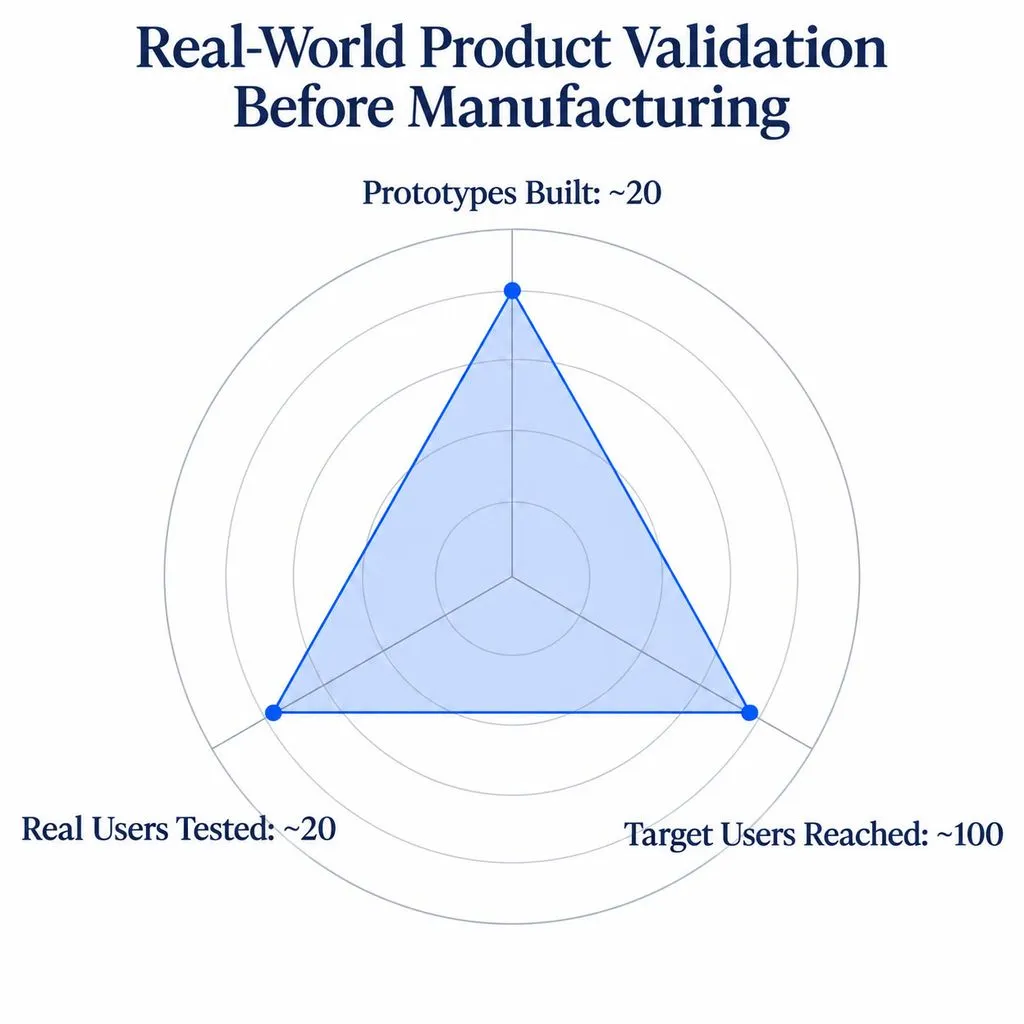
In one founder case reviewed in our research, a physical product went through around 20 prototypes, outreach to roughly 100 target users, and testing with about 20 real users before a larger production commitment was made.
The exact numbers are less important than the sequence.
Real users interacted with the product while changes were still relatively inexpensive. That allowed usability problems, feature assumptions, and product value to be tested before tooling.
In practice, stronger validation signals include:
- Repeated product use
- Specific problem-driven feedback
- Requests to purchase
- Willingness to pay
- Acceptance of realistic trade-offs
Compliments are weak evidence. Behavior is stronger evidence.
Research Competing Products Before Finalizing the Design
Competitor research should answer three questions: What alternatives already exist? What price range do customers already accept? What important problem remains unresolved?
This prevents teams from engineering features customers can already buy elsewhere or setting a target cost that cannot support the expected market price.
From a product design perspective, competitor research is not about copying features. It is about identifying gaps in usability, performance, workflow, materials, positioning, or price before expensive engineering begins.
How Do You Make CAD Ready for Manufacturing?
CAD is an important milestone, but CAD alone does not make a product production-ready.
Manufacturing-Ready CAD Must Reflect the Production Process
Depending on the manufacturing method, a supplier may need:
- Materials
- Critical dimensions
- Tolerances
- Surface requirements
- Assembly clearances
- Fasteners
- Draft
- Wall thickness
- Shrinkage allowances
- Undercut analysis
- Mold direction
- Manufacturing drawings
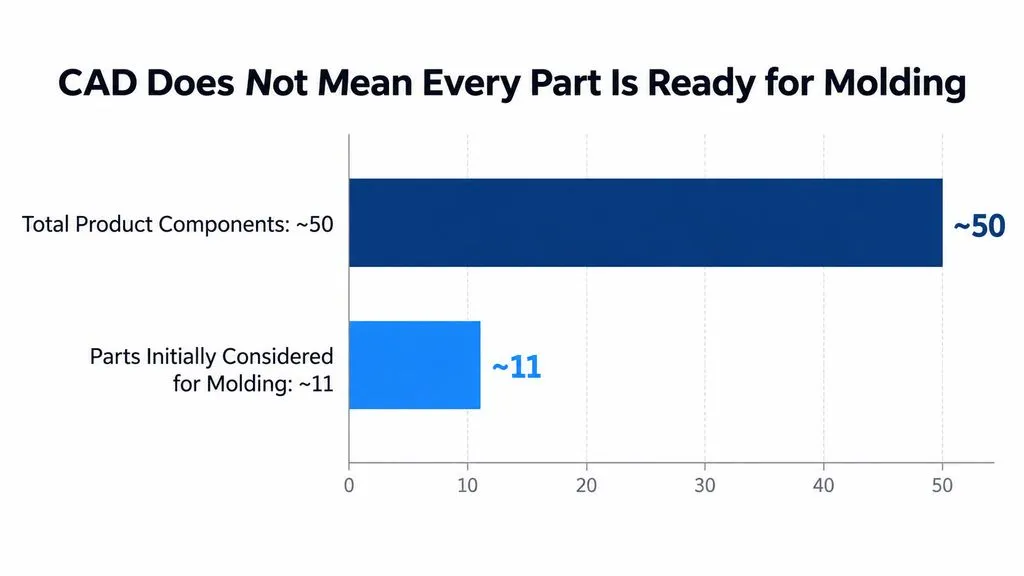
One case in our research involved a product with roughly 50 components, including about 11 parts initially considered for molding. The CAD already existed, but significant manufacturing decisions still remained.
The useful distinction is:
CAD defines what the product is. DFM defines how it can be made reliably.
Industrialize in Stages When Possible
The same multi-part case illustrates another useful strategy: not every component needs to enter high-volume manufacturing at once.
Strength-critical parts can sometimes move to molding first while lower-volume or frequently changing components remain 3D printed.
Staged industrialization reduces tooling exposure while preserving design flexibility.
Why Is DFM Critical From Prototype to Production?
DFM is the process of adapting a design so its intended manufacturing process can produce it reliably, repeatedly, and at an acceptable cost.
This is often the real bridge between prototype and production.
DFM Finds Problems a Prototype Can Hide
For injection-molded products, DFM may involve:
- Draft
- Wall thickness
- Undercuts
- Shrinkage
- Parting strategy
- Mold direction
- Tolerances
- Material behavior
- Part count
- Assembly sequence
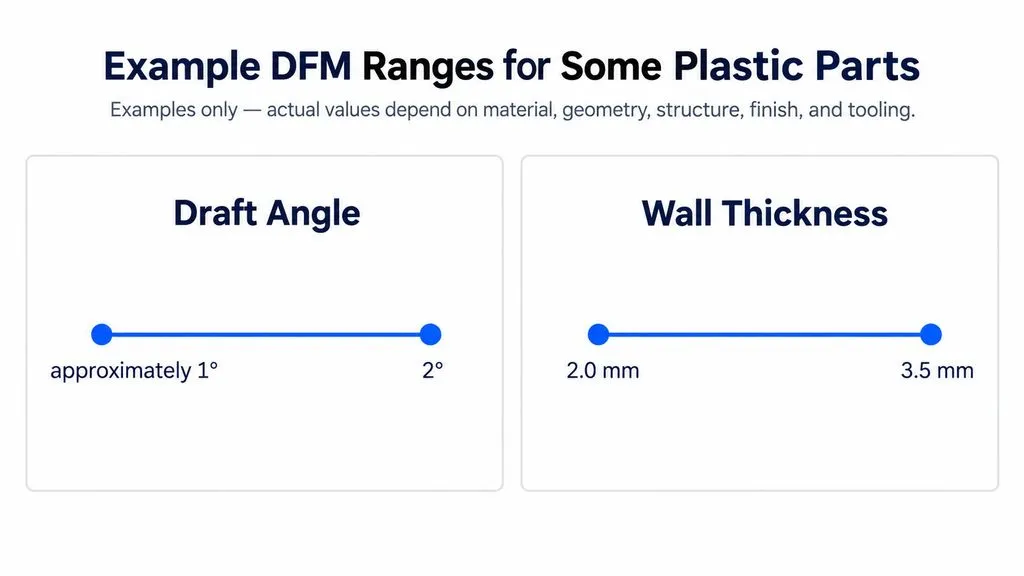
Professional guidance in our research uses values such as approximately 1–2° of draft and 2.0–3.5 mm wall thickness as examples for some plastic parts. These are not universal specifications. Correct values depend on material, geometry, structure, finish, and tooling strategy.
Another manufacturing case involved a relatively small component but still required substantial CAD refinement and a mold costing tens of thousands of dollars.
Small physical size does not automatically mean simple manufacturing.
What Prototype Do You Need Before Production?
“Prototype” is not one stage. Different prototypes remove different risks.
Move From Functional to Production-Intent Prototypes
- A proof of concept asks whether the idea can work.
- A looks-like prototype tests appearance.
- A works-like prototype tests functionality.
- An engineering prototype evaluates robustness.
- A production-intent prototype gets closer to final materials and processes.
- A pilot unit tests whether production can repeat the result consistently.
One hardware project in our research already included a custom PCB, ESP32-C3, LiPo battery, smartphone app, and 3D-printed enclosure. The product worked, but enclosure manufacturing, production electronics, assembly, packaging, compliance, and scalable production still remained unresolved.
That example captures the key point:
Working hardware is not automatically market-ready hardware.
Test Production-Like Materials Before Tooling
One multi-part product in our research was considering more than $20,000 in tooling while using processes such as ABS molding, overmolding, and ultrasonic welding.
A prototype can validate geometry and basic function without reproducing every property of final production materials.
As tooling becomes more expensive, production-intent testing becomes more valuable because late design changes become more costly.
When Should You Switch From 3D Printing to IM?
There is no universal quantity at which 3D printing should become IM.
The decision depends on volume, design stability, material requirements, tooling cost, production speed, and target unit economics.
Compare Flexibility With Unit Economics
3D printing is useful when quantities are low or the design is still changing.
IM becomes more relevant when:
- Geometry is stable
- Demand is clearer
- Final molded materials are required
- Production volume is increasing
- Lower unit cost can justify tooling
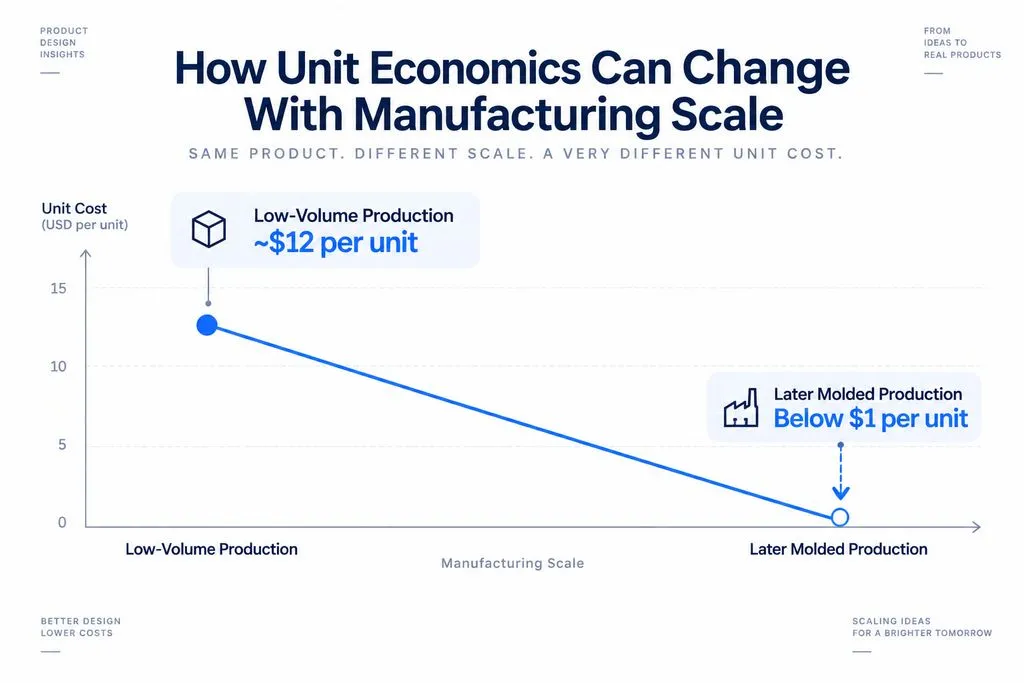
One founder-led case in our research moved from low-volume production costing roughly $12 per unit toward molding, where later landed costs reportedly fell below $1 per unit.
That does not mean every product will achieve similar economics. It demonstrates why prototype economics and MP economics can be dramatically different.
How Do You Choose a Manufacturer Before Tooling?
The cheapest quote is not automatically the lowest-risk option.
Look for Engineering Capability, Not Just Price
A useful manufacturer should be able to explain:
- How the product will be made
- Which DFM issues must change
- Whether similar products have been produced
- Which processes are performed internally
- Who creates samples
- How tooling is controlled
- How QC will work
In one product case, a supplier distinguished itself by identifying issues involving draft and material thickness rather than simply returning a price.
A manufacturer that identifies problems before tooling may create more value than one offering the lowest quotation.
Control Outsourced Development With Clear Gates
Our research also includes projects where outsourced development ran significantly over budget or expensive tooling failed to produce a sellable result.
The practical lesson is to define:
Milestones, deliverables, test criteria, acceptance criteria, budget gates, and stop conditions.
Do not rely on a supplier saying that something is possible. Require evidence that each development stage has actually met its objective.
What Happens After Tooling Before MP?
Tooling should not lead directly to a large production order.
The next goal is to prove the manufacturing system.
Use Pilot Production to Test Repeatability
A safer progression is:
Tooling → Initial Samples → Corrections → Pilot Production → QC Review → MP
A single perfect sample cannot show whether the hundredth unit will also be correct.
Pilot production can reveal:
- Tolerance variation
- Assembly errors
- Cosmetic defects
- Component inconsistency
- Packaging problems
- Production bottlenecks
- Weak QC procedures
Prototype testing validates the product. Pilot production validates the process.
Review Compliance Before Design Freeze
For electronic and wireless products, requirements such as CE, RED, or FCC may affect electronics, antennas, enclosure design, components, documentation, and testing.
The important product-development lesson is to investigate compliance early enough that required engineering changes do not arrive after expensive tooling has frozen the design.
How Much Does It Cost to Turn a Design Into a Real Product?
There is no useful universal average.
Our research contains founder-led projects launched for only several thousand dollars, individual molds costing tens of thousands, and tooling failures reaching six figures.
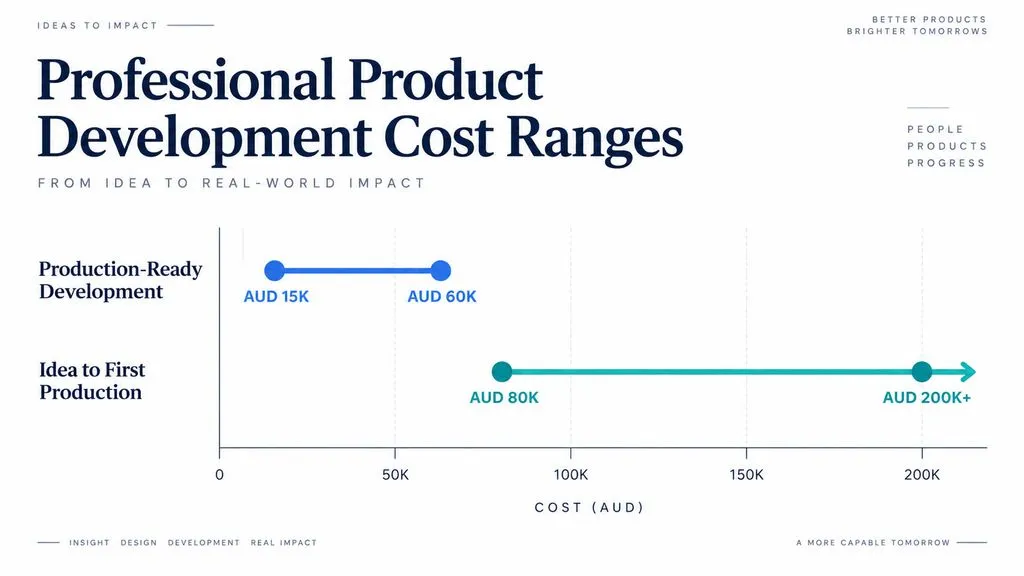
Professional product-development estimates in the research range from roughly AUD 15,000–60,000 for production-ready development to approximately AUD 80,000–200,000+ for a complete idea-to-first-production program, depending on complexity.
Simpler projects may take several months, while complex electronics, connected products, or products requiring certification can take considerably longer.
These figures should not be averaged because they represent fundamentally different products and development models.
The better budgeting question is:
What uncertainty must be removed before approving the next major expense?
Why Manufacturing Is Not the End of Product Development
Producing a successful batch does not automatically create a successful product business.
One product case in our research eventually reached more than 150 retail stores, but small initial store orders created replenishment challenges. Larger retail opportunities introduced a different problem: significantly more inventory had to be available to support distribution.
This reveals an often-overlooked stage of productization.
A real product must eventually connect manufacturing with:
Packaging → Inventory → Logistics → Margin → Replenishment → Distribution → Customer Feedback
The first production run is not the finish line. It creates new evidence for the next design and business decisions.
FAQ
Is an STL Enough for Manufacturing?
Usually not. An STL mainly communicates geometry. Production may also require material specifications, critical dimensions, tolerances, finishes, assembly information, drawings, and DFM decisions. For IM parts, draft, wall thickness, shrinkage, undercuts, and mold direction may directly affect whether the design can be manufactured reliably.
What Should I Do After a Working Prototype?
Move from proving functionality to proving manufacturability. Test with real users, document failures, define target cost and volume, complete DFM, build production-intent samples, review compliance where relevant, and obtain supplier feedback before committing to tooling or MP.
When Should I Switch From 3D Printing to IM?
Consider IM when the product design is stable, expected demand can justify tooling, molded material properties matter, and lower unit cost at scale supports the business case. If demand or design remains uncertain, 3D printing, CNC, or staged industrialization can preserve flexibility.
How Do I Know a Product Is Ready for MP?
A product is closer to MP when major design changes have stopped, DFM is complete, production documentation is controlled, materials and tolerances are defined, suppliers have demonstrated capability, compliance risks have been reviewed, tooling samples pass testing, and pilot production demonstrates repeatable quality.
Conclusion
Turning a design into a real product is not a single handoff from designer to factory; it is a process of replacing assumptions with evidence. Validate demand before committing to inventory, separate a working prototype from production-ready engineering, use DFM to make the design repeatable, test production-like materials before expensive tooling, verify manufacturers before irreversible spending, and use pilot production to prove consistency before MP. The strongest product-development process does not reach manufacturing as quickly as possible—it reaches manufacturing only when the design, production system, economics, and market evidence are strong enough to justify scaling.
More from the Virse Blog
Workflow
What Is Human-Centered Design? HCD Process, Real Examples & Why Most Teams Get It Wrong
September 21, 2026 by Vincent
Workflow
What Is Design Thinking? 5 Stages, Real Examples & Why Most Teams Get It Wrong
September 21, 2026 by Vincent
Workflow
What Is Industrial Design? Beyond Sketching, CAD and Pretty Renders
September 21, 2026 by Vincent